Summary: COPQ eats 10–20% of sales in most firms. Yet up to 90% of those costs never appear in standard reports, per ASQ. This guide covers the PAF model — which sorts every quality cost into three categories: Prevention (stopping defects before they happen), Appraisal (inspecting and testing to catch them), and Failure (the price of defects that slip through, both internal and external) — how to measure COPQ, and the financial case for digital quality audits as the fastest path to reclaiming that spend.
Yet, most finance leaders think quality costs start and end with the QA budget. That number is real. Yet it’s only a small part of the story.
In reality, the bigger costs are hiding elsewhere. Mostly, they live in scrap bins, rework loops, recalls, and the hours spent on each customer complaint. In all, this is the Cost of Poor Quality (COPQ). For most CFOs, it remains hidden.
Importantly, this guide gives quality leaders the data and language to change that. Here, we cover the four COPQ cost types and how to measure them. Also, we show why digital audits convert quality spending into real returns.
Key statistics
- Quality-related costs reach 15–20% of sales in many firms — and up to 40% in some plants — per ASQ (updated July 2025)
- Up to 90% of quality costs are hidden from standard financial reports, per the 2025 Cost of Quality Insights Report
- COPQ in plants averages 15% of the sales dollar (range: 5–35%), per the Institute of Industrial and Systems Engineers (IISE)
- Digital audit programs have cut quality costs by 50% and dropped internal PPM by 73% in real cases, per an ASQ/BCG Quality 4.0 study
- The FDA issued 303 drug warning letters in FY 2025 — a 59% jump from FY 2024 — with quality system failures as the top cause, per Pharmaceutical Online
What Is Cost of Poor Quality (COPQ) and Why Does It Matter to Finance?
At its core, COPQ is the cost of products and processes that fail to meet quality standards. Put simply, it’s everything you spend — or lose — because something went wrong. For instance, it includes scrap, rework, warranty claims, recalls, and fines.
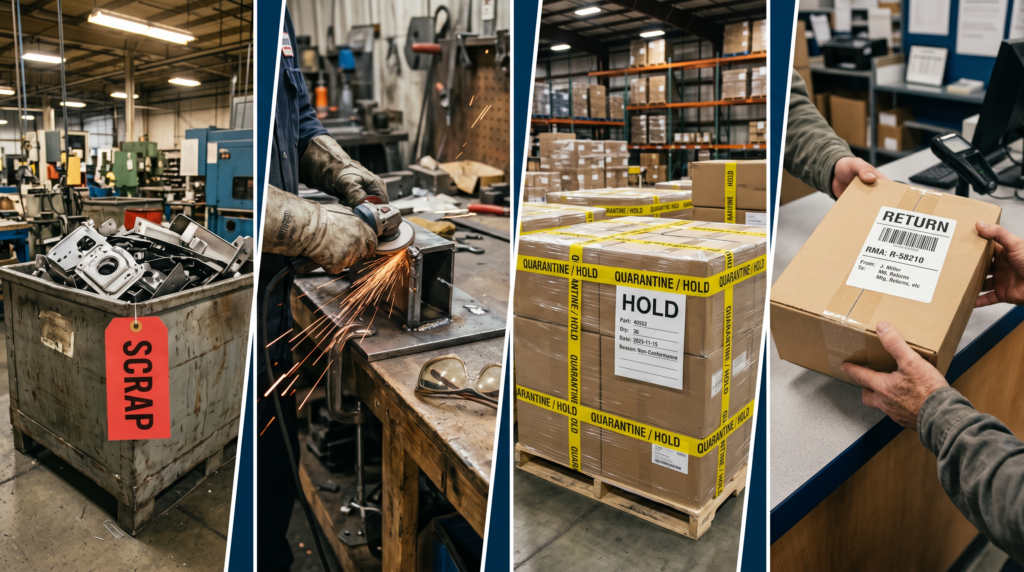
To start, COPQ sits inside the Cost of Quality (CoQ) framework. Here, CoQ uses the PAF model — Prevention, Appraisal, and Failure (split into internal and external) — to sort every quality cost into four groups. Two cover the cost of preventing and catching defects. The other two cover the price of defects that escape.
The four PAF types
- Prevention costs — Cost to stop defects before they happen. This includes audits, supplier checks, and staff training. Moreover, each dollar here is planned and managed.
- Appraisal costs — Spending to find defects before they reach customers. Inspection, testing, equipment checks, and incoming quality checks fall here. These costs detect problems. However, they don’t prevent them.
- Internal failure costs — The cost of defects found before shipping: scrap, rework, downtime, and yield loss. These consume labor, raw goods, and machine time. Yet they produce nothing saleable.
- External failure costs — The most costly group. These are defects that reach customers: warranty claims, returns, recalls, fines, and brand damage. External failure costs run 5–10 times higher than internal ones. In fact, fixes happen at full market value — often with legal penalties on top.
Essentially, prevention and appraisal are planned costs. In contrast, internal and external failure — the COPQ proper — signal a quality system not at its best. Per ASQ, most firms carry quality costs of 15–20% of sales. Some older plants reach 40% of total costs.
The 1-10-100 rule
In practice, the PAF model leads to the 1-10-100 rule. First, every $1 spent on prevention avoids $10 in appraisal costs and $100 in failure costs, per ASQ. As a result, shifting spend toward prevention is the best move in ops. Indeed, it’s not a cost ask. It’s a capital choice.
How Much Is Poor Quality Costing You?
Surprisingly, most firms can’t answer this question. Often, they’ve never measured it. Indeed, the Institute of Industrial and Systems Engineers (IISE) reports that COPQ in plants runs at 15% of the sales dollar. The range runs from 5% to 35%. Meanwhile, in service firms, it runs at 30%.
Moreover, the 2025 Cost of Quality Insights Report found 90% of quality costs are hidden. They show up instead in overtime, warranty reserves, and customer service staff. Finance sees the sign. Quality sees the cause. Yet neither team has the full picture.
The hidden factory
Put simply, the CFO uses one concept here: the “hidden factory.” If your plant runs at full speed with a 10% scrap rate, then 10% of all labor, energy, and machine time makes bad goods. Those goods earn no money. Yet fixing that scrap rate reclaims output you already paid for.
External failure: the recall effect
Meanwhile, external failure costs grow fast once product leaves your plant. A 2026 Lumafield report, citing a grocery industry study, puts the average direct cost of a food recall at about $10 million per event. However, 52% of firms that faced a major recall saw total impact above $10 million. Notably, business downtime alone makes up roughly 49% of total recall cost. Overall, the full impact typically runs 3–5 times the direct cost.
Furthermore, legal action adds to this. The FDA issued 303 drug warning letters in FY 2025 — a 59% increase from FY 2024. In fact, written procedures, lab controls, and complaint handling were the top findings. Notably, each letter is a precursor to far larger costs.
Meanwhile, the recall landscape is getting worse. The CPSC recorded 101 recall events in Q1 2025 alone — the highest quarter since 2011. That’s a 90.6% jump from Q4 2024. Therefore, firms that can’t document process compliance are exposed at the worst time.
Calculate Your COPQ and Build the ROI Case
Use our quality audit ROI template to estimate hidden quality costs and model the return from digital audits. Explore our free checklists →
How to Calculate COPQ at Your Firm
Fortunately, building a COPQ estimate doesn’t take six months. In fact, a working model takes a few weeks using data most firms already have. In the end, the goal isn’t precision — it’s trust. You need a number big enough to justify action.
For starters, the Certainty Software platform features include audit data capture, defect tracking, and CAPA workflows. Also, our post on quality audit software and digital audit programs covers rollout models that work well.
Step 1: Gather failure cost data
First, pull internal failure costs. Second, pull scrap and rework figures from your ERP or production records. After that, calculate the fully loaded cost: parts, labor, time, and re-checks. Finally, add external failure data: warranty claims from the last 12 months, return freight, and any recall costs.
Step 2: Estimate appraisal costs
Meanwhile, appraisal costs are often easier to find — they sit in labor budgets. Add up the hours your QA team spends on inspection, testing, and incoming checks. Then include time spent re-checking suppliers, re-inspecting returned product, and managing corrective action paperwork. Finally, equipment checks go here too.
Step 3: Benchmark against revenue
Next, divide total COPQ by annual sales. If you land between 5% and 15%, you’re in the range most mid-size firms report. If you can’t get a number at all, that is itself the finding. In fact, that means 90% of quality cost is hidden. So the case for better data makes itself.
Step 4: Model the return
After that, once you have a baseline, model a 20–30% reduction over 24 months. For example, a $200M firm at 12% COPQ has a $24M annual loss. Still, a 25% cut equals $6M recovered — with no revenue increase needed. That is the number to bring to a capital approval meeting.
Why Digital Audits Are the Action Layer for COPQ Reduction
Of course, knowing your COPQ is a first step. Reducing it needs a better audit process. Often, paper-based audits have key limits that block progress. However, digital audit platforms fix those limits directly.
Faster cycle times reduce internal failure cost
By contrast, paper audits generate findings in a notebook. Often, those findings then need data entry, email routing, and follow-up calls before anyone acts. In practice, digital audits close that cycle the same day — sometimes in real time. As a result, defects are caught sooner and less bad product piles up. That directly cuts internal failure cost.
Better root cause data drives prevention
Typically, a single finding gets a corrective action. However, a trend of similar findings points to a root cause. That’s where the real COPQ savings live. Sadly, paper audits can’t show those trends because findings never combine. Also, digital platforms turn findings into pattern data. Teams can then fix whole problem types. This is one reason structured audit programs like layered process audits are so effective at COPQ reduction — repeated, layered checks on the same high-risk items surface the patterns that one-off audits miss.
Trend data supports capital decisions
Notably, finance approves prevention spending when quality leaders show trend data. For instance, which process areas drive the most defects? Which suppliers cause the most rework? Moreover, trend data converts quality from a cost center into a data-driven business case.
Audit-ready evidence for customer and compliance reviews
Additionally, when a customer auditor or FDA inspector arrives, a digital audit trail speaks for itself. Here, timestamped findings and closed CAPAs with evidence are all there. As a result, prep time drops, findings are fewer, and the chance of a costly penalty falls.
A Quality 4.0 study by ASQ, Boston Consulting Group, EFNMS, and Aachen University found that digital audit programs achieved 50% cuts in quality costs, 73% lower internal PPM, and 53% fewer customer defects in real cases. Indeed, these results show what happens when audit data moves from paper to a connected tool.
An ROI Framework Quality Leaders Can Take to Finance
As a result, this framework turns COPQ data into a one-page model for a CFO review. Often, each step uses data most firms can pull in a few weeks.
- Establish the COPQ baseline. Express quality costs as a percentage of revenue and as a dollar figure. Cite the ASQ benchmark (10–20% of sales) to anchor against industry norms.
- Find the three biggest cost drivers. Break your COPQ into the four PAF groups. Isolate the two or three with the most cost savings. Rework, warranty spend, and recall risk are often the best starting points.
- Set a target reduction. A 20–30% COPQ cut over 24 months is a solid target. The ASQ/BCG Quality 4.0 study found 50% quality cost reductions in top rollouts. That anchors the high end of the range.
- Calculate net benefit. Subtract total platform costs (license, setup, training) from your projected COPQ savings. Most rollouts recover their cost within 12 months when rework and warranty costs are tracked.
- Include risk avoidance value. A chance-based recall risk number often doubles the apparent ROI. Average direct food recall costs run $10 million — and business disruption adds 49% more, per the Lumafield report. Even a small recall risk adds real cost.
Rollout Sequence: From COPQ Estimate to Managed Discipline
Overall, the goal isn’t a one-time study. Instead, it’s to build the systems that make COPQ a managed metric. Here is a practical sequence for teams ready to act.
Build the baseline and audit engine
- Month 1–2: Build the COPQ baseline. Work with finance to pull scrap, rework, warranty, and check cost data. Document your method. This step alone often reveals major gaps — and that gap becomes the opening argument for funding.
- Month 2–3: Digitize your audit program. Move from paper checklists to a platform that captures findings, links them to defects, and routes corrective actions fast. Start with your top-risk areas — the sites or product lines with the most rework, complaints, or risk.
- Month 3–6: Build the trend data. Run audits for at least one quarter before you act. Next, align defect groups across sites so the data stays clean.
Prove results and institutionalize
Once the baseline and digital audit engine are in place, the focus shifts to linking actions to financial outcomes and reporting COPQ as a standing executive metric.
- Month 6–12: Link findings to financial results. Track which action types cut rework rates. Note which fixes reduce external complaints. Record which supplier fixes improve incoming check rates. This links audit work to a dollar outcome — the link that makes the business case durable.
- Month 12+: Report COPQ as a management metric. Present COPQ trend data with revenue and margin in monthly ops reviews. When quality cost moves, leadership should see why. Finally, this moves quality from a compliance role to a managed metric with real financial ownership.
Ultimately, Certainty Software is built for this sequence. It also combines digital quality audit management, defect tracking, and CAPA workflows in one tool. Indeed, firms that move from paper to a connected quality platform don’t just cut COPQ. They make it visible — and visible costs get managed.
Key Takeaways:
- COPQ typically runs 10–20% of sales — and up to 40% in some plants. It’s one of the largest reachable cost pools in any firm, per ASQ.
- Up to 90% of quality costs are hidden from standard reports. Most firms are managing only the visible part of the real problem.
- The PAF model — Prevention, Appraisal, Internal Failure, External Failure — gives quality leaders a clear way to measure and cut quality costs.
- Product recalls are among the largest failure costs. The average direct food recall costs $10 million, with business disruption adding 49% more on top, per Lumafield’s 2026 report.
- Digital audit platforms reduce COPQ by closing finding-to-action cycles, trend data for root causes, and audit-ready evidence.
- A complete ROI case should cover cost savings (rework, warranty) and risk avoidance value (recall risk, legal risk). Together, these show the full picture.
You might also be interested in:
ISO 9001: an Overview of the Quality Management System Standard
Summary: ISO 9001 is the internationally recognized standard for quality management systems, certified by over one million organizations…

Targeting Total Quality: How a Total Quality Management Audit can Help
Summary: A Total Quality Management (TQM) audit evaluates manufacturing processes, supply chain frameworks, and customer experiences to…
What Is An ISO 9001 Audit And How To Be Prepared
Summary: An ISO 9001 audit systematically evaluates your quality management system against international standards, verifying QMS…
Frequently Asked Questions (FAQs)
What is the Cost of Poor Quality (COPQ)?
In short, COPQ is the financial cost of products or services that don’t meet quality standards. Specifically, it covers internal failure costs (scrap, rework, downtime) and external failure costs (warranty claims, recalls, returns). According to ASQ, COPQ runs 10–20% of sales in most firms and can reach 40% in older plants.
What is the PAF model in quality management?
Essentially, the PAF model sorts all quality costs into four groups: prevention, appraisal, internal failure, and external failure. Overall, it helps firms see where quality spend is going and where cutting failure costs returns the most value.
How do you calculate COPQ for a production firm?
First, pull loaded scrap and rework costs from production data. Then add external failure costs: warranty claims, returns, and recall costs. Then add appraisal costs (inspection labor, testing). Divide total costs by revenue. Benchmarks from IISE show these firms average about 15% of the sales dollar.
How do digital audits reduce COPQ?
Specifically, digital audits cut COPQ through faster finding-to-action cycles, trend data that finds root causes, and CAPA workflows that close defects with evidence. The ASQ/BCG Quality 4.0 study found digital audit programs achieved 50% reductions in quality costs and 73% lower internal PPM.
What is the financial impact of a product recall?
On average, the direct cost of a food recall is about $10 million per event, per a 2026 Lumafield report citing a Grocery Manufacturers study. Also, disruption adds roughly 49% more on top, and the total impact typically runs 3–5 times the direct cost.
How do I build an ROI case for quality software investment?
First, start with a COPQ baseline as a percentage of revenue. Then find the two or three largest cost drivers. Next, set a 20–30% reduction target over 24 months. Then calculate net savings after platform costs. Finally, add recall and legal risk avoidance value. Together, these steps frame quality as a capital choice.
Turn Quality Into a Measurable Profit Lever
Digital audits · Defect tracking · CAPA workflows · Trend data