A supplier compliance assessment program does more than screen new vendors — it creates a continuous, evidence-based record of whether your supply chain meets regulatory, quality, and ethical standards at every tier. Most programs fail not because of missing checklists but because findings never close with verified evidence. This guide explains how to build a scalable supplier compliance assessment program — from prequalification through closed-loop rectification — and why verified closure is the missing layer most portal-based programs never deliver. For the broader risk management context, see Certainty’s Supplier Risk Management guide.
Key Statistics
- 25% increase — CBP detained 25% more shipments under the UFLPA in 2024 than in 2023, averaging 428 detentions per month; about 48% of detained shipments were ultimately denied entry (Miller & Chevalier, UFLPA Enforcement 2024 Year in Review).
- Up to six months — supplier onboarding can take up to six months at many large companies under ideal conditions, involving multiple functions and creating substantial administrative cost (Institute for Supply Management).
- ~19,000 companies — are required to publish annual modern slavery and human trafficking statements under Section 54 of the UK Modern Slavery Act 2015, covering any commercial organisation with UK turnover of £36 million or more (Rights DD, UK Modern Slavery Act Guide); the EU’s Corporate Sustainability Due Diligence Directive (Directive 2024/1760) entered into force in July 2024 and will require supply-chain due diligence from about 6,000 large EU companies and 900 large non-EU companies by full application (European Commission).
- $10 million — average direct cost of a single food product recall (retrieval, disposal, notifications, labor), with 81% of affected companies rating the financial risk as big to catastrophic (GMA/FMI, as cited by Food Dive).
Most supplier compliance programs start with good intentions and a spreadsheet. In practice, a procurement lead builds a supplier questionnaire, legal adds a code of conduct acknowledgement. Quality adds an audit checklist. Within a year, the program is a collection of disconnected portals, emailed PDFs, and overdue action items nobody owns. In short, programs fail at scale because they treat assessment as a one-time gate rather than a continuous, evidence-based process.
Why supplier compliance programs fail at scale
Supplier compliance programs outgrow their original design before anyone notices. The warning signs are predictable: findings logged but never closed, the same nonconformances surfacing audit after audit, portal fatigue so severe that response rates collapse. Four structural failure modes explain why:
- Assessment as a gate, not a loop. Suppliers answer a questionnaire at onboarding and disappear into a “compliant” folder — no periodic reassessment, no trigger when risk changes.
- No evidence standard. The program collects answers but not proof. Without documented evidence attached to each response, it is an attestation library, not a compliance record.
- Finding closure without verification. Findings get assigned and marked “done,” but four of ten recur on the next audit because nobody verified the corrective actions actually worked — the verified closure gap applied to supplier programs.
- Tier 1 visibility, Tier 2 blindness. Most programs assess direct suppliers thoroughly and sub-tier suppliers not at all — exactly where the biggest forced labour, quality, and regulatory risks live, as the multi-tier supply chain visibility challenge makes clear.
As a result, the program looks solid on paper but cannot withstand a regulator, a customer audit, or a supply disruption. More questionnaires will not fix it — a different architecture will.
What a supplier compliance assessment actually is
A supplier compliance assessment is a structured, evidence-based evaluation of whether a supplier meets defined regulatory, quality, ethical, and operational standards. Unlike a supplier survey or a code of conduct agreement, it requires objective proof: documents, audit records, certifications, photographs, and corrective action evidence — not self-attestation.
Assessment, due diligence, and audit: key distinctions
Three related concepts are often conflated:
- Supplier prequalification — the entry gate: does this supplier meet minimum standards before we award business? Criteria include financial stability, regulatory certifications, insurance, and ethical sourcing attestations.
- Supplier due diligence — the ongoing obligation: continuous monitoring of supplier risk, especially in regulated sectors like food, pharma, and import/export.
- Supplier compliance audit — the periodic deep-dive: does evidence from the supplier’s operations match their stated compliance status?
A mature program integrates all three into a continuous management system with a recorded audit trail. The EU’s CSDDD (Directive 2024/1760), in force since July 2024, requires companies to account for human rights and environmental impacts across their entire value chain, including indirect suppliers. The UK Modern Slavery Act 2015 and Australia’s Modern Slavery Act 2018 similarly require annual supply-chain risk disclosure. None of these obligations is satisfied by a signed policy — each requires demonstrable assessment processes with records.
The five layers of a scalable supplier compliance assessment program
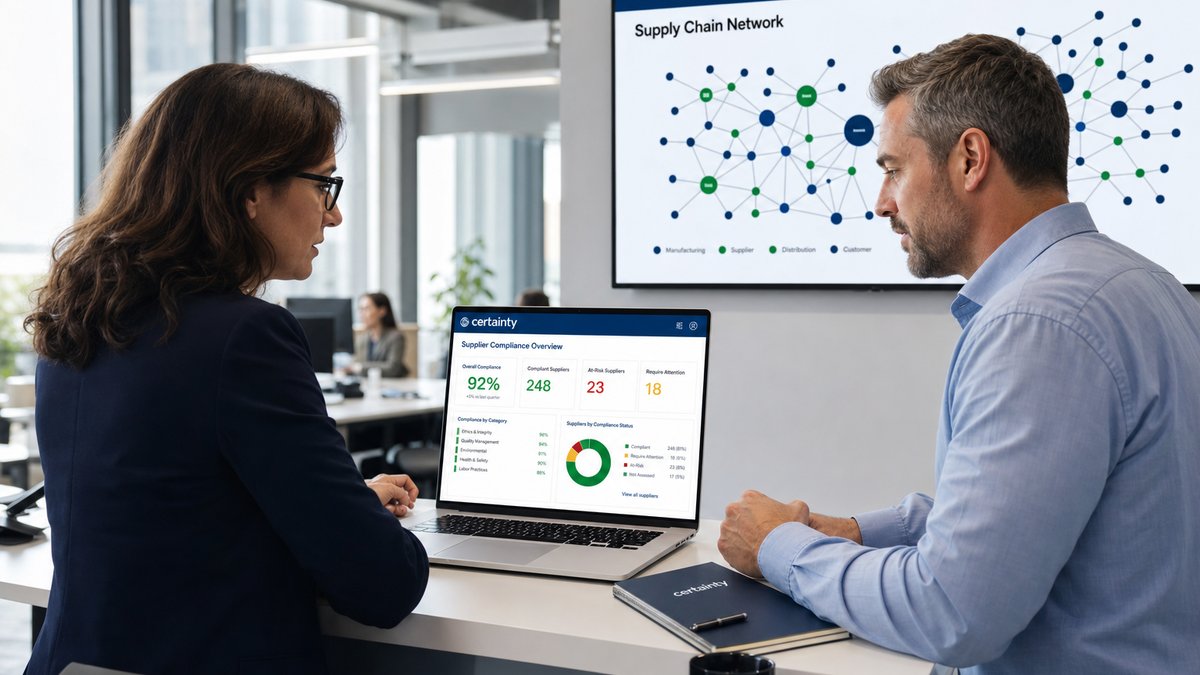
Scaling beyond a few dozen suppliers requires careful layering. Each layer feeds the next, replacing the one-time gate with a continuous loop.
Layer 1: Prequalification
Before awarding business, every prospective supplier must clear a minimum compliance threshold: valid certifications (ISO 9001, FSSC 22000, IATF 16949, or sector-appropriate equivalents), insurance certificates, and sign-off on your code of conduct and modern slavery statement. High-risk categories — those touching Xinjiang-origin materials or directly regulated products — should also require forced labour due diligence documentation aligned with UFLPA compliance requirements. This package becomes the evidence baseline against which every future assessment is measured.
Layer 2: Ongoing monitoring
Ongoing monitoring converts the assessment from a point-in-time snapshot into a continuous signal. It tracks certificate expiry dates, adverse media, sanctions list changes, and performance data; for regulated imports, it also covers CBP UFLPA Entity List updates. Its job is to triage: flag suppliers that need a targeted review, escalate to a periodic audit, or require immediate action. Without this layer, the program stays reactive.
Layer 3: Periodic assessments and audits
Periodic assessments are the structured, scheduled reviews of supplier compliance status: annual for Tier 1 critical suppliers, biennial for mid-risk suppliers, and event-triggered for sub-tier suppliers. The format varies — documentary review, remote assessment, or on-site audit with photographic evidence. Risk-calibrated frequency is what makes the program scale without collapsing under its own administrative weight.
Layer 4: Finding closure with verified evidence
This is where most programs break. Suppliers often submit brief notes claiming each issue was addressed, and the program marks findings closed. Without verified evidence that the corrective action actually worked, closure is an attestation, not a record — and the next audit finds the same issues.
Verified finding closure has three steps. First, the supplier submits objective evidence — an updated procedure, training record, inspection photograph, or re-test outcome. Second, an independent reviewer within the buying organisation confirms the evidence addresses the original finding. Third, for high-severity findings, a follow-up check at a defined interval confirms the issue has not recurred. This is the verified closure standard applied to the supply chain — the layer that separates defensible programs from paper-based ones.
Layer 5: Board-level and executive reporting
The fifth layer converts operational data into governance-level visibility. Under the UK Modern Slavery Act, the CSDDD, and ESG disclosure frameworks, senior leadership must demonstrate oversight of supply chain risk. That requires aggregating supplier compliance status, overdue findings, and risk-tiered health scores into a format executives can read and attest to. When leadership can see that 23% of Tier 1 suppliers have overdue corrective actions, procurement teams get the resources the program needs.
Tier 1, Tier 2, and Tier 3: how assessment depth changes with tier
Assessment depth should scale with tier and risk — not be applied uniformly across every supplier relationship. Understanding what each tier represents is foundational to calibrating the right approach:
A strict Tier 1 program that ignores Tier 2 is not a comprehensive compliance program. For industries subject to UFLPA, CSDDD, or UK Modern Slavery Act requirements, sub-tier visibility is a regulatory requirement.
Want to see a supplier compliance assessment program that scales beyond the spreadsheet?
Certainty’s supplier compliance workflows cover prequalification through verified finding closure, with a full audit trail that satisfies regulators, customers, and boards. Book a 30-minute demo to see it in action.
The portal problem: why suppliers hate compliance assessments (and what to do about it)
Ask any supplier compliance manager their biggest operational problem, and portal fatigue comes up within two minutes. Large suppliers complete questionnaires on six, eight, or twelve customer portals simultaneously, each with its own format and login, while compliance teams spend days copying answers between systems and chasing the same certificates in different file formats.
Why portal fatigue undermines data quality
Response rates fall, suppliers submit outdated documents, and higher-quality suppliers deprioritise the customers with the heaviest portals. The outcome is data that is voluminous but unreliable — reflecting administrative compliance with the portal, not actual compliance with the standard.
Four design principles that reduce friction without reducing rigour
- Risk-tiered questionnaires. Send a 12-question baseline to low-risk suppliers and a 45-question detailed assessment only to high-risk or critical suppliers. Do not send the same instrument to everyone — it wastes supplier time and dilutes your team’s ability to triage responses.
- Evidence persistence. If a supplier uploads an ISO 9001 certificate valid through 2027, do not ask them to re-upload it in six months. Store the document, track the expiry date, and send an automated alert before it lapses. Supplier time is not free.
- Mobile-accessible submission. Supplier contacts in manufacturing, logistics, and agriculture are frequently not desk-based. Assessment tools that require desktop browsers with complex file upload paths lose response rates. Mobile-accessible submission — photo evidence, digital signatures, structured answers — closes that gap.
- Clear expectations on closure timelines. Suppliers should know exactly what happens after they submit: what will be reviewed, by when, and how a finding gets escalated versus closed. Ambiguity breeds delay. Structured workflows with defined timelines remove that ambiguity.
Closed-loop rectification: why verified closure matters here too
Closed-loop rectification — requiring verified evidence before a finding is declared closed — most often applies to internal audit and quality management. Applied to supplier compliance programs, this same principle is the most effective defence against programs that lose credibility over time.
How the finding cycle breaks
Think about the typical cycle: an audit spots incomplete inspection records or materials of uncertain origin. Next, the supplier submits a corrective action plan and the buying organisation marks findings closed. Three months later, the same gaps appear. In short, accepting a plan as evidence of resolution is not verified closure. Verified closure requires the same chain that applies to internal audit:
- Goal evidence submitted. The supplier provides proof of implementation — updated procedures, training records, re-inspection outcomes, or corrected-condition photographs — not a written description of what they plan to do.
- Independent review by the buying organisation. A reviewer who did not issue the finding confirms the evidence addresses the original criteria.
- Effectiveness check at a defined interval. For critical or recurring findings, a follow-up review at 30, 60, or 90 days confirms the corrective action held.
Why building the loop into the workflow matters
When this loop is built into the workflow rather than left to individual judgment, audit recurrence falls and supplier relationships improve. A regulator or board asking “how do you know your suppliers are compliant?” gets a recorded evidence trail, not “we sent questionnaires.” Fewer re-audits and escalations mean the closed-loop model pays for itself in operational efficiency, not just risk reduction.
Frequently Asked Questions (FAQs)
What is a supplier compliance assessment?
A supplier compliance assessment is a structured, evidence-based evaluation of whether a supplier meets defined regulatory, quality, ethical, and operational standards. It requires objective proof — documents, certifications, audit records, or inspection photographs — not self-attestation. Assessments run at onboarding, then on a risk-tiered schedule, and in response to triggered events such as incidents or regulatory changes.
What is the difference between a supplier compliance assessment and a supplier audit?
A supplier compliance audit is one type of assessment — a checklist-driven inspection that creates findings. A supplier compliance assessment is the broader management process: prequalification, ongoing monitoring, periodic reviews, on-site audits, and finding closure through verified evidence.
How do you build a scalable supplier prequalification process?
Three design principles apply. First, risk-tier your supplier base before designing the questionnaire. Second, standardise the evidence requirements — a defined list of required documents rather than open-ended requests. Third, store evidence in a system that tracks expiry dates and triggers renewal requests automatically, keeping the prequalification record current without manual management.
What regulations require supplier compliance due diligence?
Several major frameworks now mandate formal supply chain due diligence. In the UK, Section 54 of the Modern Slavery Act 2015 requires about 19,000 companies to publish annual slavery statements. In the EU, the CSDDD (Directive 2024/1760, in force July 2024) will require companies to address human rights and environmental impacts across their value chains, with phased compliance from 2027. For US importers, the UFLPA creates a rebuttable presumption: goods from Xinjiang are presumed to involve forced labor, requiring documented due diligence for entry. Australia’s Modern Slavery Act 2018 (threshold lowered to AU$50 million in 2024) requires annual statements from in-scope entities.
How often should supplier compliance assessments be conducted?
Frequency should match risk, not administrative convenience. Tier 1 critical suppliers should be assessed annually; Tier 1 standard suppliers every 18–24 months; Tier 2 high-risk suppliers when triggered by Tier 1 findings or adverse events; and Tier 3 suppliers by intelligence monitoring. Any supplier subject to a forced labour or regulatory finding should receive a follow-up assessment within 90 days of corrective action closure.
What is closed-loop rectification in supplier compliance?
Closed-loop rectification means a finding is not declared closed until the supplier submits objective evidence and an independent reviewer confirms adequacy. For critical findings, a follow-up check confirms the issue has not recurred. Otherwise, findings get “closed” on paper while conditions remain unchanged.
How do you reduce supplier portal fatigue?
Four measures address it: send risk-tiered questionnaires rather than a universal long-form; store evidence documents so suppliers do not re-upload the same certificates; use mobile-accessible submission tools; and provide clear timelines so suppliers know what happens after they submit. Portal fatigue is a design problem — not a supplier motivation problem.
Key Takeaways
- Supplier compliance programs fail at scale because they treat assessment as a one-time gate — not a continuous, evidence-based process with verified finding closure.
- A scalable program has five layers: prequalification, ongoing monitoring, periodic assessments, verified finding closure, and board-level reporting. Each feeds the next.
- Assessment depth must scale with tier. Tier 1 needs full annual assessments. Tier 2 and Tier 3 require targeted, intelligence-driven reviews — and ignoring sub-tier suppliers is increasingly a regulatory exposure.
- Portal fatigue is a design problem. Risk-tiered questionnaires, persistent evidence storage, and mobile-accessible submission address it without reducing rigour.
- Closed-loop rectification — requiring objective evidence, independent review, and an effectiveness check — separates a defensible program from a paper trail of unverified attestations.
- Regulatory obligations are escalating. The UFLPA, UK Modern Slavery Act, EU CSDDD, and Australia’s Modern Slavery Act all require demonstrable supply chain due diligence processes — not signed policies.
Build a Supplier Compliance Program That Closes the Loop
Prequalification · Ongoing monitoring · Periodic audits · Verified finding closure · Board-level reporting
You might also be interested in:

Multi-Tier Supply Chain Visibility: How to Audit Beyond Tier 1
Summary: The companion piece to this guide — focused on audit coverage across tiers and how to extend visibility to sub-tier suppliers. The largest risks often hide…

UFLPA Compliance 2026: What Importers Need to Know About the CBP Dashboard
Summary: How CBP’s updated UFLPA dashboard works, what importers need to document. How supplier compliance evidence maps to the rebuttable presumption standard…

What Is Verified Closure in Audit and Inspection?
Summary: The definitive guide to verified closure — what it means, what evidence it requires, which standards mandate it. How CAPA-forward software makes it the default…