The federal OSHA heat rule (89 FR 70698) is stalled with no finalization date. Six state programs — California, Oregon, Washington, Nevada, Colorado, and Maryland — already enforce heat illness standards that exceed the proposed federal rule. This post maps every active state heat rule and what an audit-ready multi-state program must include. See also our ISO 45001 occupational health and safety guide.
Key Statistics
- 55 — U.S. workers who died from occupational heat exposure in 2023, a 77.4% increase from 31 deaths in 2012 (NSC Injury Facts / BLS Census of Fatal Occupational Injuries, 2023; increase figure from CPWR Data Bulletin, August 2025).
- ~34% — share of all U.S. occupational heat deaths that occurred in construction — an industry representing only 7% of the total workforce (CPWR Data Bulletin, August 2025).
- ~28,000 — estimated U.S. work injuries per year linked to hot weather, making official fatality counts a significant undercount (Milken Institute School of Public Health, George Washington University, October 2025).
- 6 state OSHA programs — California, Oregon, Washington, Nevada, Colorado, and Maryland — have enforceable heat illness prevention standards active in 2026, covering both indoor and outdoor workers under most of these programs.
For years, EHS leaders treated OSHA as the federal floor for workplace heat protection and waited for federal heat regulations to catch up. That framing no longer holds. Since 2022, four state programs have added enforceable heat standards, and as of mid-2026, six state OSHA programs have specific, citable heat rules — every one exceeding the proposed federal rule on at least one key dimension.
Why state heat rules now matter more than the federal rule for many employers
State heat rules matter more right now because the proposed federal rule does not yet exist as enforceable law. OSHA published its Notice of Proposed Rulemaking on August 30, 2024 (89 FR 70698), proposing triggers at 80°F and 90°F. However, the Trump administration’s January 2025 regulatory freeze halted the rulemaking, and the federal unified regulatory agenda lists no target date for final action.
In April 2026, OSHA renewed its National Emphasis Program through April 2031. The NEP is not a standard — it relies on General Duty Clause authority with no specific thresholds or rest-break schedules. For employers in the six states with active heat standards, those standards are enforceable today, with inspectors who can cite specific provisions directly. That is why the OSHA heat enforcement picture in 2026 is fundamentally a state story.
The state-by-state heat standard landscape in 2026
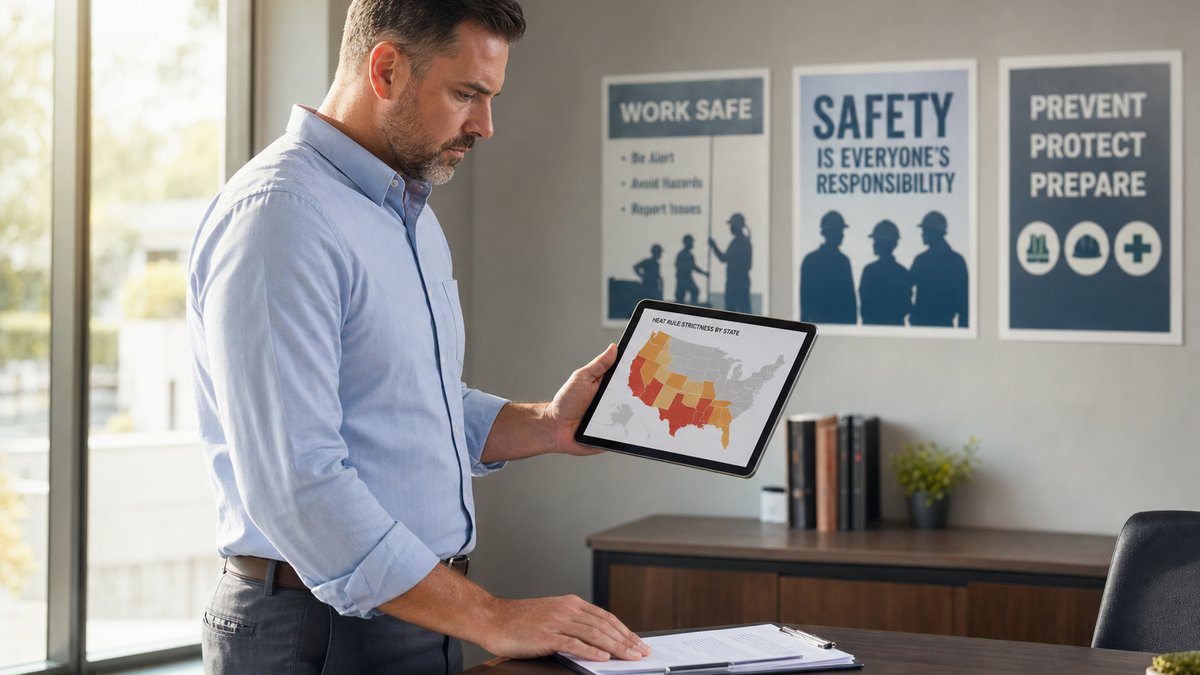
Six state OSHA programs have enforceable heat illness prevention standards in 2026. Here is what each requires.
California — Cal. Code Regs. tit. 8, §§ 3395 and 3396
California covers both indoor and outdoor workers. The outdoor standard — Title 8, § 3395 — requires shade above 80°F, mandatory 10-minute preventive cool-down rests every two hours at 95°F, written prevention plans, a 14-day acclimatization period, and one quart of water per employee per hour. In addition, the indoor standard, Title 8, § 3396, took effect July 23, 2024, applying at 82°F with a second tier at 87°F requiring engineering controls and documentation.
Oregon — OAR 437-002-0156 and OAR 437-004-1131
Oregon adopted two permanent rules effective June 15, 2022: OAR 437-002-0156 for general industry and OAR 437-004-1131 for agriculture. Both apply at 80°F, indoors or outdoors. At 90°F, employers must implement a written rest break schedule, with minimums that escalate sharply: 20 minutes every hour at 95°F, 30 every hour at 100°F, and 40 every hour at 105°F. Written acclimatization and emergency medical plans are also required.
Washington — WAC 296-62-095 through WAC 296-62-09560
Washington updated its outdoor heat exposure rules effective July 17, 2023. The revised WAC 296-62-095 dropped the primary action level from 89°F to 80°F and removed the seasonal limitation — requirements apply year-round. High-heat procedures kick in at 90°F (10-minute rest every two hours) and escalate at 100°F (15 minutes every hour). Acclimatization monitoring covers 14 days for new and returning workers.
Nevada — LCB File No. R131-24AP (NAC 618 series)
Nevada OSHA enforcement began April 29, 2025. Nevada’s approach is threshold-free: employers with 10 or more employees must complete a one-time written job hazard analysis (JHA) identifying job classifications where workers face heat exposure for more than 30 minutes per hour. Where the JHA identifies exposure, employers must implement written prevention plans, designate an emergency response person, provide water and cooling means, and train employees. Climate-controlled indoor environments are exempt unless climate control fails.
Colorado — 7 CCR 1103-15 (Agricultural Labor Conditions Rules)
Colorado’s heat standard applies only to agricultural employers under 7 CCR 1103-15, amended effective January 1, 2026. The activation threshold is 80°F; high-heat procedures apply at 95°F with mandatory 10-minute rests every two hours. Annual training must be completed by April 20 — a hard calendar deadline. For non-agricultural employers, Colorado has no enforceable heat standard.
Maryland — COMAR 09.12.32
Maryland’s Heat Stress Standards (COMAR 09.12.32) took effect September 30, 2024, covering all workplaces at 80°F or higher. Employers must have a written Heat Illness Prevention Plan ready before exposure occurs. Rest breaks are required at 90°F (10 minutes every two hours) and 100°F (15 minutes every hour). Acclimatization is four days. When a heat illness incident occurs, the standard requires retraining for all relevant employees and supervisors.
Where state rules exceed the proposed federal OSHA rule
The proposed federal rule (89 FR 70698) sets two triggers: 80°F and 90°F. State standards already go further on several dimensions.
Rest break frequency and duration
Oregon requires 30 minutes of cool-down rest per hour at 100°F and 40 minutes at 105°F. California’s 10-minute cool-down rest every two hours at 95°F kicks in below the federal high-heat trigger. On a 97°F day in California, Oregon, Washington, or Maryland, mandatory rest breaks are already enforceable.
Indoor coverage
California, Oregon, Nevada, and Maryland all explicitly cover indoor workplaces. California’s § 3396 (effective July 2024) was the first dedicated indoor heat standard in the country. All four enforce indoor coverage today with specific thresholds inspectors can cite directly — while the proposed federal rule has not reached final action.
Acclimatization monitoring period
California and Washington require 14 days of close supervisor observation for new or returning workers. Oregon mandates a written acclimatization plan. Maryland requires four days. Under California and Washington law, the first 14 days of a new hire’s tenure are a documented compliance window.
Written program and documentation requirements
Every active state standard requires a written heat illness prevention plan, but required content varies. California mandates it in English and the language understood by the majority of employees. Maryland requires a site-specific plan. Nevada requires a job hazard analysis before the plan is written. Oregon mandates procedures for shade, water, rest breaks, emergency response, and acclimatization.
The multi-state employer compliance problem
In practice, the compliance challenge is not that any one standard is unusually difficult. Rather, each state has built its own framework. Different triggers, different rest break schedules, different documentation requirements — and none maps cleanly onto the others.
In contrast, consider a contractor with crews in California, Oregon, and Washington. On a 90°F day, California requires high-heat procedures. Oregon requires a rest break schedule and active emergency medical plan; Washington requires 10-minute rests every two hours. However, a supervisor trained on California’s § 3395 is not automatically compliant with Oregon’s OAR 437-002-0156. Add Nevada — where a JHA drives compliance rather than numeric thresholds. And Maryland, where post-incident retraining demands a dynamic field response.
In any case, these six state standards remain in effect regardless of what happens with the federal rule. As a result, each site’s heat program must be built for the state that governs it. A templated enterprise plan is a starting point, not a finished one.
Managing heat compliance across multiple state standards?
Certainty helps multi-site safety teams build site-specific heat programs with the documentation trail that each state’s inspectors actually look for — inspection findings, corrective actions, training records, and monitoring evidence, all in one place. Book a 30-minute demo to see how it works with your own sites and checklists.
How to build a heat program that meets the strictest state standard
Build to the strictest applicable standard in each requirement category, using California’s § 3395 and Oregon’s OAR 437-002-0156 as primary templates.
Written heat illness prevention plan
Build a site-specific plan for every location in a covered state. Generic templates do not satisfy Maryland’s COMAR 09.12.32 or Nevada’s JHA requirement. Each plan must identify action thresholds, cool-down access, water provision procedures, rest break schedules at each temperature tier, and emergency response procedures with local EMS contact.
Acclimatization program
Set the monitoring period at 14 days for new and returning workers — California and Washington both require this. In addition, use Oregon’s written acclimatization structure as the baseline. Document the start date, assigned supervisor, and any symptoms for each worker during the monitoring window.
Rest break schedules
Use Oregon’s Table 2 simplified schedule as the enterprise baseline: 10 minutes every two hours at 90°F, 20 every hour at 95°F, 30 every hour at 100°F, and 40 every hour at 105°F — meeting or exceeding every other covered state. Make rest breaks paid and document their occurrence.
Training
Train all employees before heat exposure begins; Maryland requires annual retraining. Train supervisors separately on observation protocols, emergency response, and acclimatization monitoring — California, Washington, and Oregon all specify this as a distinct requirement. Deliver training in each employee’s language, document each session, and note Colorado’s April 20 annual deadline for agricultural employers.
Monitoring and emergency response
Assign a designated person at each site to monitor heat conditions and initiate emergency response. Nevada’s regulation formalizes this role with specific duties. Additionally, maintain an emergency response procedure with local EMS contact (required by Oregon, Nevada, and Maryland). In practice, treat Maryland’s post-incident retraining requirement as a baseline obligation at all sites.
What audit-ready evidence looks like when six agencies might inspect you
A citation requires only showing that a specific provision was not met. The burden falls on the employer to prove compliance. An audit-ready record at each site must contain the following elements.
- Written heat illness prevention plan — site-specific, dated, signed by site leadership, stored on-site and accessible to inspectors on demand. Include the applicable state rule citation on the plan itself.
- Temperature monitoring log — daily record of heat index or ambient temperature during the active heat season, or year-round where required (Washington). Include time, location, and monitoring method.
- Training records — timestamped, per-employee, per-supervisor records of heat illness prevention training. Include the curriculum used, the language of delivery, the trainer’s name, and whether the training was initial, seasonal, or post-incident (Maryland).
- Acclimatization log — per-worker records showing the start date of heat exposure, the supervising observer’s name, and any symptoms during the monitoring period. A 14-day window is the California and Washington standard.
- High-heat activation records — documented record for every day the high-heat threshold was reached, showing that high-heat procedures activated, who was on-site, which rest breaks occurred, and that those breaks were paid.
- Incident and near-miss records — any heat illness event documented with the date, worker involved, symptoms, response taken, and corrective actions. Maryland requires post-incident retraining tied to this record. This is also the evidence chain that an audit-ready corrective action process depends on.
The common failure mode: records exist in disconnected places — plan in a shared drive, training in an LMS, temperature log in a notebook. Programs fall apart when documentation is assembled under pressure. The evidence chain must be accessible and linked before the inspector arrives.
Frequently Asked Questions (FAQs)
What is a state heat illness standard?
A state heat illness standard is an enforceable occupational safety regulation adopted by a state OSHA program. Unlike the federal General Duty Clause, which addresses hazards without specific thresholds, a state standard specifies exact temperature trigger levels, required controls, written program requirements, and acclimatization protocols that inspectors can cite directly.
Which states have enforceable heat illness standards in 2026?
Six states have enforceable heat illness prevention standards in 2026: California (§§ 3395 and 3396), Oregon (OAR 437-002-0156 and OAR 437-004-1131), Washington (WAC 296-62-095), Nevada (LCB File No. R131-24AP, enforcement began April 29, 2025), Colorado (7 CCR 1103-15, agricultural only, effective January 1, 2026), and Maryland (COMAR 09.12.32, effective September 30, 2024).
What is the status of the federal OSHA heat rule in 2026?
The federal heat rule — 89 FR 70698, published August 30, 2024 — is stalled. The Trump administration’s January 2025 regulatory freeze halted the rulemaking. Public hearings concluded July 2025 and post-hearing comments closed October 30, 2025. No target finalization date appears in the federal unified regulatory agenda. OSHA renewed its National Emphasis Program through April 2031, but the NEP uses General Duty Clause authority, not a standard.
Does a state heat standard apply if you are a federal contractor?
State OSHA programs have jurisdiction over private employers — including federal contractors — in state-plan states. As a result, contractors must comply with the heat standard in the state where work is performed. However, federal agency workplaces on federal property fall under federal OSHA directly.
What triggers California’s high-heat procedures?
California’s outdoor standard (§ 3395) triggers high-heat procedures at 95°F — communication systems, monitoring for heat illness signs, water reminders, and mandatory 10-minute preventive cool-down rests every two hours. The indoor standard (§ 3396, effective July 23, 2024) triggers enhanced controls at 87°F.
How does Oregon’s rest break schedule compare to the proposed federal rule?
Oregon’s simplified schedule (Table 2 under OAR 437-002-0156) requires 10 minutes every two hours at 90°F, 20 every hour at 95°F, 30 every hour at 100°F, and 40 every hour at 105°F. The proposed federal rule sets no escalating scale above 90°F, making Oregon’s requirements substantially more protective at higher temperatures.
What must a written heat illness prevention plan include to meet multiple state standards?
A plan meeting the strictest requirements across all six states should include: the applicable state rule citation; cool water procedures (one quart per employee per hour under California and Oregon); shade or cool-down access; a temperature monitoring procedure; rest break schedules at each temperature level; a 14-day acclimatization program; training documentation; emergency response procedures with local EMS contact; and a post-incident retraining protocol (Maryland). The plan must also be in the languages workers at each site understand.
Key Takeaways
- The federal heat rule is stalled. OSHA’s proposed rule (89 FR 70698, August 2024) has no finalization date. State programs are the enforceable law in 2026 for the six states covered here.
- Six states have active heat standards: California (§§ 3395 + 3396), Oregon (OAR 437-002-0156 + OAR 437-004-1131), Washington (WAC 296-62-095, revised July 2023), Nevada (R131-24AP, enforcement April 2025), Colorado (7 CCR 1103-15, agricultural only, amended January 2026), and Maryland (COMAR 09.12.32, effective September 2024).
- State rules exceed the proposed federal rule on rest break duration (Oregon), indoor coverage (California, Oregon, Nevada, Maryland), acclimatization monitoring period length (California, Washington), and post-incident retraining requirements (Maryland).
- Multi-state employers cannot use a single generic plan. Each site in a covered state needs a site-specific written plan that cites the applicable state rule and meets that state’s specific documentation and program requirements.
- Audit-ready evidence is the real compliance test. Every active state standard requires a documentation trail — written plans, training records, acclimatization logs, temperature monitoring records, rest break documentation, and incident records — that must be accessible when an inspector arrives, not assembled afterward.
- Building to the strictest standard protects everywhere. Using Oregon’s rest break schedule, California’s 14-day acclimatization period, Maryland’s post-incident retraining requirement, and Nevada’s JHA framework as your enterprise baseline creates a program that meets or exceeds every active state standard in 2026.
Build a Heat Program That Passes Inspection in Any State
Site-specific plans · State-by-state documentation · Training records · Inspection-ready evidence
You might also be interested in:
OSHA Heat Enforcement 2026: What Employers Need to Know
The federal heat rule is stalled, but OSHA enforcement under the General Duty Clause and the renewed National Emphasis Program is very much active. What employers need to prepare for in 2026…
Confined Space Safety in 2026: OSHA Enforcement and Permit Programs
Permit-required confined space entries remain among the most frequently cited OSHA violations. What inspection-ready permit programs, entry documentation, and attendant procedures look like in 2026…

What Is Verified Closure in Audit and Inspection?
Verified closure is the point where a corrective action is implemented, independently verified as effective. Documented with evidence — not just marked “done.” Why most CAPA tools fall short and how to build a defensible audit trail…