Most workplace safety inspection programs break down not because of poor intent but because the tools behind them were never built for enterprise complexity. This guide explains the seven non-negotiable requirements that distinguish enterprise-grade workplace safety inspection software from generic apps, examines how 2026 OSHA enforcement is raising the bar, and gives EHS directors and plant safety leads the right questions to ask any vendor before they buy.
Key Statistics
- 2.5 million — nonfatal workplace injuries and illnesses reported by private industry employers in 2024, at an incidence rate of 2.3 cases per 100 full-time equivalent workers — the lowest total recordable case rate since 2003 (BLS, Employer-Reported Workplace Injuries and Illnesses, March 2026).
- 34,696 — federal OSHA inspections conducted in FY2024, with willful or repeated violations now carrying a maximum penalty of $165,514 per violation (OSHA Commonly Used Statistics; OSHA Penalties).
- $176.5 billion — total cost of work injuries in 2023, including $43,000 per medically consulted injury and $1,460,000 per workplace death (NSC Injury Facts, Work Injury Costs).
- 185,166 — valid ISO 45001 occupational health and safety certificates worldwide as of December 31, 2023 — confirming that multi-site OHS management has become a global enterprise standard, not an outlier practice (ISO Survey 2023).
Enterprise EHS directors know the pattern. A new site comes online, the inspection cadence slips, and findings pile up in email threads. Typically, someone creates a spreadsheet that nobody updates. Six months later, an OSHA inspector finds the same hazard a supervisor flagged in January. And the paper trail proves leadership knew.
That is a systems problem — precisely the one that workplace safety inspection software solves when built for enterprise scale.
Why most safety inspection programs break down at scale
Most inspection programs were designed for a single site, a single inspector, or a single format. They work well enough when a safety manager can walk every shift and personally follow up on findings. At ten or more sites, they collapse.
The structural failure points are consistent:
- Disconnected data silos. Inspection records live in local drives, email attachments, and paper binders. No one can aggregate trends across sites because the data shares no common format.
- Corrective actions without closure accountability. A finding gets logged and assigned. Without enforced follow-up, it ages — and workers notice which hazards have been “in the system” for months.
- Inconsistent checklists. Different sites run different versions of the same form. When requirements change, updating every location takes weeks and still misses some. Audit results become incomparable.
- No evidence chain. When OSHA asks what corrective action followed a previous finding, the answer requires hours of searching — if it exists at all. That gap turns a manageable situation into a liability.
- Reporting latency. EHS directors learn about critical findings days after they occur. By the time leadership sees the data, the corrective action window has passed.
In short, the cost is not abstract. The NSC estimates the cost per medically consulted workplace injury at $43,000. A single preventable incident can exceed that figure before the week is over.
What workplace safety inspection software actually does

Workplace safety inspection software digitizes the full inspection lifecycle — from checklist creation and field capture to corrective action assignment and trend reporting — making that data visible across every site in real time. It is not a mobile form builder, and not a general EHS platform with inspection as a checkbox feature.
At its core, enterprise safety inspection software does five things that paper programs and generic tools cannot:
- Standardizes inspection execution across every site, shift, and language — so the checklist a worker in Milwaukee completes maps directly to the one a supervisor in Monterrey signs off on.
- Creates a defensible evidence chain — timestamps, GPS coordinates, photos, and digital signatures attach to every finding, not described in a text field after the fact.
- Drives corrective action to closure — assigns responsibility, tracks progress, requires evidence of completion, and triggers follow-up to confirm the fix held. Our guide on verified closure in audit and inspection covers this in depth.
- Aggregates multi-site data into dashboards that let EHS directors identify systemic patterns — which sites carry the highest open-finding rates, which hazard types recur most often, which corrective actions stall.
- Connects inspection data to leading indicators — enabling the shift from reactive incident counting to proactive risk identification. Understanding leading versus lagging safety indicators is the strategic context for why this matters.
What it does not do is replace the judgment of a safety professional. It gives that professional the data, workflow structure, and audit trail to operate at scale.

Seven enterprise-grade requirements for workplace safety inspection software
Not every safety inspection tool handles enterprise complexity. Together, these seven requirements separate platforms that scale from those that stall.
1. Offline capture with automatic sync
Field inspectors cannot wait for Wi-Fi. Enterprise facilities — warehouses, refineries, construction sites, cold storage — routinely have dead zones. In particular, a platform that requires connectivity to capture findings is a data entry system, not a field tool. In practice, true offline capability lets the inspector complete the full inspection, attach photos, record GPS coordinates without a connection. Data syncs automatically when connectivity returns — no manual re-entry, no lost evidence.
2. Multi-site rollups and cross-site analytics
An EHS director managing ten sites needs to see all ten at once — not log into each system separately. Specifically, multi-site rollups aggregate inspection completion rates, finding counts, corrective action status, and overdue items into a single dashboard. Multi-site analytics can then report systemic patterns: a machine guarding issue recurring at three facilities is a different problem than a one-off observation.
3. Verified closure for corrective actions
Marking a corrective action “complete” is not the same as verified closure. To be complete, three conditions must hold simultaneously: the action was implemented, an independent verifier confirmed it worked, and objective evidence documents both. A platform that allows self-attestation without evidence produces a liability, not an audit trail. Verified closure workflows enforce required evidence, separate the assignee from the verifier, and — for high-severity findings — trigger a follow-up effectiveness check. See our post on verified closure in audit and inspection for details.
4. Multilingual support
Global enterprise operations have multilingual workforces. A platform that operates only in English cannot serve a global workforce where frontline workers speak Spanish, Mandarin, or Portuguese. Real multilingual support means checklists, corrective action notifications, and evidence requests all reach workers in their working language — not through a separate machine-translated layer bolted on after the fact.
5. A complete evidence chain
Enterprise inspection records must be defensible on demand. Every finding needs a full evidence chain: timestamp, GPS location, inspector identity, photo or measurement, and a direct link to the corrective action that followed. When OSHA asks what your organization did after a previous hazard observation, that chain either exists or it does not. A platform that stores text descriptions without attached evidence is a liability tool, not a compliance tool.
6. Schema-aware reporting and regulatory templates
Enterprise EHS teams operate under multiple regulatory frameworks at once: OSHA 29 CFR 1910, OSHA 29 CFR 1926, ISO 45001 Clause 9 management reviews, and sector-specific standards. Schema-aware reporting means the platform knows which fields each framework requires and generates reports in the formats regulators accept — eliminating manual translation between systems.
7. Integrations with ERP and HRIS systems
Safety inspection data does not live in isolation. Incident rates feed workers’ compensation programs, corrective action status affects maintenance scheduling, and inspector assignments depend on shift data in the HRIS. A platform with no API or native integration creates a reconciliation burden that grows with every new site. Enterprise-grade software either provides those integrations out of the box or exposes a documented API the organization’s IT team can build against.
How OSHA enforcement is changing the requirement set in 2026
OSHA enforcement in 2026 is not standing still. Three shifts in particular raise the bar on documentation quality and response speed.
Electronic recordkeeping now reaches deeper into enterprise operations. Under the 2024 final rule, high-hazard establishments with 100+ employees must submit OSHA Forms 300, 300A, and 301 electronically — up from the prior 250-employee threshold. Inspection and injury data now feeds targeted enforcement planning, which means a safety inspection platform with clean, exportable 300-series data removes that compliance burden.
OSHA conducted 34,696 federal inspections in FY2024 — a level not seen since 2016, according to OSHA’s own enforcement data. Programmed (targeted) inspections represent half that total. OSHA proactively selects facilities based on injury data, risk profiles, and prior citation history. As a result, inspection documentation quality directly affects enforcement exposure.
Maximum penalties for willful or repeat violations reached $165,514 per violation effective January 15, 2025, per the OSHA penalties schedule. When the same hazard recurs across multiple sites, the organization faces repeat-violation exposure at every affected facility. Multi-site dashboards surface that pattern in seconds; paper programs miss it. A searchable cross-site finding history is therefore a repeat-violation defense tool, not an administrative convenience.
Heat enforcement has become a sustained multi-year program. OSHA’s revised Heat National Emphasis Program (NEP), effective April 10, 2026, targets 55 high-risk industries with programmed and complaint-driven inspections. Furthermore, the NEP also authorizes inspectors to expand scope when a heat hazard is present — converting any inspection visit into a broader evaluation. Programs that document heat-related observations and control measures are better positioned for such visits. For context, see our companion post on common safety observation examples.
Five questions to ask any vendor
Use these five questions to cut through vendor marketing and reveal genuine enterprise readiness.
- How does the platform handle offline inspections? Request a live demonstration of connectivity loss mid-inspection. Does data save locally and sync automatically on reconnect? Vague answers here are a red flag.
- How does the corrective action workflow enforce closure — not just completion? Ask: can anyone mark a finding closed without evidence? Who is notified when an action is overdue? Must a second person verify before the system closes an item? If the answer is “that depends on configuration,” ask to see the production configuration.
- How does multi-site reporting work across regulatory jurisdictions? Confirm which jurisdiction-specific templates are included, how often they update, and who owns that process — especially for organizations under state OSHA plans or international standards.
- What does the audit trail look like when exported for a regulator? Ask the vendor to export a sample audit trail for a closed finding: original observation, corrective action, evidence photo, verifier sign-off, and effectiveness check. Manual assembly on export means the system is not enterprise-ready.
- What is the total cost of deployment across N sites? Ask the vendor to model your three-year cost based on your actual rollout — number of users, number of sites, and projected growth. Push for transparency on user-based pricing, implementation, training, integrations, and ongoing support so you can compare apples to apples across vendors, rather than letting a single headline price hide the real cost at scale. Book a demo with Certainty to see a transparent, user-based pricing model designed for multi-site enterprises.
Ready to evaluate enterprise safety inspection software with your own requirements?
See how Certainty handles offline capture, multi-site rollups, verified closure, and audit-ready exports — across every industry and jurisdiction your program operates in. Book a 30-minute demo and we will walk through your specific sites and use case.
Build vs. buy vs. spreadsheets
Enterprise EHS teams face three options: build custom, buy purpose-built, or continue with spreadsheets. Each carries a realistic cost profile that vendor conversations tend to obscure.
The spreadsheet option
Spreadsheets are not free. At small site counts they appear manageable, but the real cost appears in three places: staff hours consolidating data, findings that age with no one monitoring the central tracker, and no evidence chain when a regulator asks for one. Moreover, spreadsheet programs also fail the OSHA electronic recordkeeping requirement — no audit trail, no submission path, no version control. For details, see our analysis of spreadsheet errors in safety programs.
The build option
Custom builds attract organizations with complex data environments and integration requirements that off-the-shelf tools cannot meet. Two costs consistently get underestimated: the maintenance burden when OSHA changes a form, and the mobile offline complexity that takes months to get right. Most EHS directors who have been through a failed custom build regret it. A mature purpose-built platform delivers comparable capability at a fraction of the cost.
The buy option
Purpose-built platforms absorb maintenance, regulatory update, and mobile infrastructure costs within the subscription. EHS teams focus on running the program rather than building the tool. The evaluation question is not whether to buy — it is which platform fits the organization’s requirement set.
Frequently Asked Questions (FAQs)
What is workplace safety inspection software?
Workplace safety inspection software is a digital platform that manages the full inspection lifecycle: checklist creation, offline field execution, finding documentation, corrective action tracking, and multi-site reporting. Enterprise versions add cross-site analytics, multilingual support, regulatory template libraries, and API integrations. See our complete guide to safety inspection software.
How is a safety inspection app different from EHS software?
A safety inspection app focuses on structured inspection execution and finding management. EHS software is broader — it may include environmental compliance, chemical management, sustainability reporting, and incident management. Inspection-first tools deliver better mobile UX, offline capability, and checklist management than general-purpose EHS platforms that treat inspections as one module among many.
What should enterprise safety inspection software include?
At minimum: offline mobile capture, multi-site dashboards, verified closure workflows, multilingual support, a complete evidence chain, schema-aware reporting, and ERP/HRIS integrations. Any platform that cannot demonstrate all seven in a live demo is not enterprise-ready.
How does OSHA’s 2024 electronic recordkeeping rule affect inspection software requirements?
High-hazard employers with 100 or more employees must electronically submit OSHA Forms 300, 300A, and 301 annually. Safety inspection software that generates OSHA-formatted exports removes the manual work of preparing those submissions. Moreover, OSHA uses submitted data for targeted enforcement planning. So proactively closing hazards reduces the likelihood of a targeted inspection.
What is verified closure and why does it matter for safety inspections?
Verified closure requires an independent verifier to confirm that a corrective action was effective, with objective evidence — not just marking it “done.” OSHA repeat-violation exposure accumulates when the same hazard recurs, and verified closure closes that loop. See our post on verified closure in audit and inspection for the full framework.
Can safety inspection software work offline?
Enterprise-grade platforms include full offline functionality: inspectors complete checklists, attach photos, and record GPS coordinates without a connection, then sync automatically on reconnect. Not every platform delivers this reliably — request a live demonstration before accepting vendor claims.
How many OSHA inspections happened in 2024?
OSHA conducted 34,696 federal inspections in fiscal year 2024, per OSHA’s commonly used statistics. Approximately half were programmed — targeted based on injury data and risk profiles — one of the highest volumes since 2016.
Key Takeaways
- Enterprise safety inspection programs break down at scale because they were designed for single-site use. Disconnected data, incomplete corrective action closure, and inconsistent checklists are structural problems, not people problems.
- Seven requirements separate enterprise-grade platforms from general tools: offline capture, multi-site rollups, verified closure, multilingual support, a complete evidence chain, schema-aware reporting, and ERP/HRIS integrations.
- OSHA conducted 34,696 federal inspections in FY2024, with programmed (targeted) inspections now representing half the total. The quality of your inspection documentation directly affects your enforcement exposure.
- The 2024 OSHA electronic recordkeeping rule requires high-hazard employers with 100+ employees to submit Forms 300, 300A, and 301 annually. Safety inspection platforms that generate audit-ready exports remove the manual compliance burden — and the data is used by OSHA for targeted inspection planning.
- Verified closure is not a feature; it is a regulatory requirement. Repeat-violation exposure accumulates when findings recur. Platforms that enforce evidence-backed, independently verified closure protect organizations from that exposure.
- Spreadsheets are not free. The real cost of paper and spreadsheet programs appears in staff hours wasted on manual consolidation, findings that age without resolution, and the absence of an evidence chain when a regulator asks for one.
See Enterprise Safety Inspection in Action
Offline capture · Multi-site dashboards · Verified closure · Audit-ready exports · Multilingual
You might also be interested in:

What Is Verified Closure in Audit and Inspection?
The standard that separates programs that pass audits from those that pass scrutiny. What verified closure requires and why most CAPA tools fall short.
OSHA Heat Enforcement 2026: What EHS Teams Need to Know
OSHA’s Heat NEP is active and targeting 55 high-risk industries. How enforcement is evolving, which industries are in scope, and what documentation your program needs.
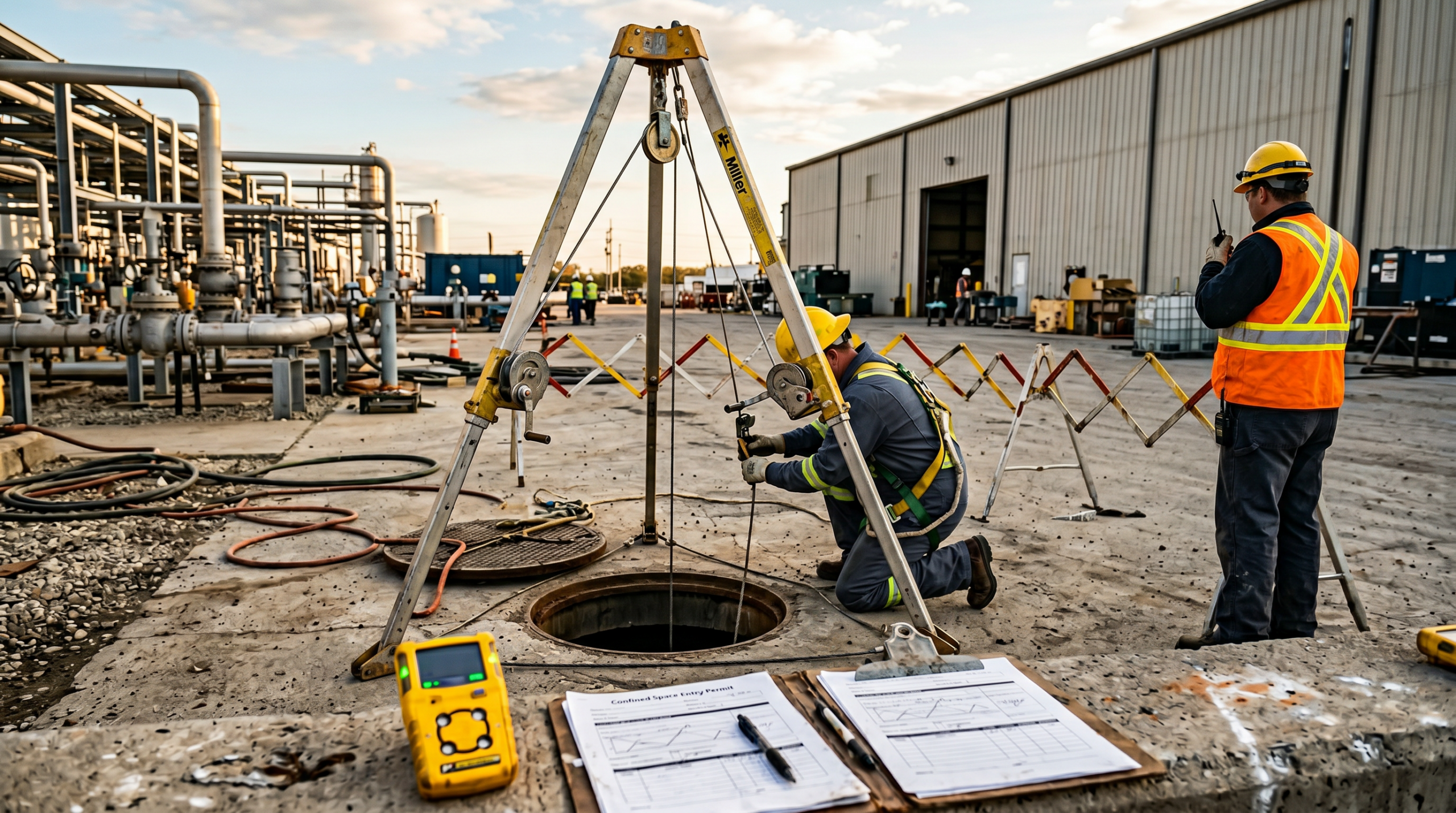
Confined Space Safety 2026: OSHA Enforcement and What Enterprise Programs Must Document
Confined space citations are among the most costly OSHA violations. What enterprise EHS programs must document and how inspection software creates the evidence chain regulators require.