Written by Hewitt Roberts, CEO, Certainty Software
If a customer has ever emailed you a spreadsheet called a CMRT, you’ve already met the conflict minerals reporting template. Maybe they even asked you to “fill it in by Friday.” Either way, you’ve probably felt how quickly it turns into a scramble across suppliers you barely have contact details for. The CMRT (Conflict Minerals Reporting Template) is the industry-standard form for declaring whether tin, tantalum, tungsten and gold in your products come from responsible sources. Its sibling, the EMRT, extends the same discipline to battery and energy-transition minerals like cobalt, lithium and natural graphite. This guide explains what the CMRT and EMRT are, who has to report, and how to complete the template step by step. It also covers how to turn a once-a-year data chase into a supply chain control you can actually stand behind.
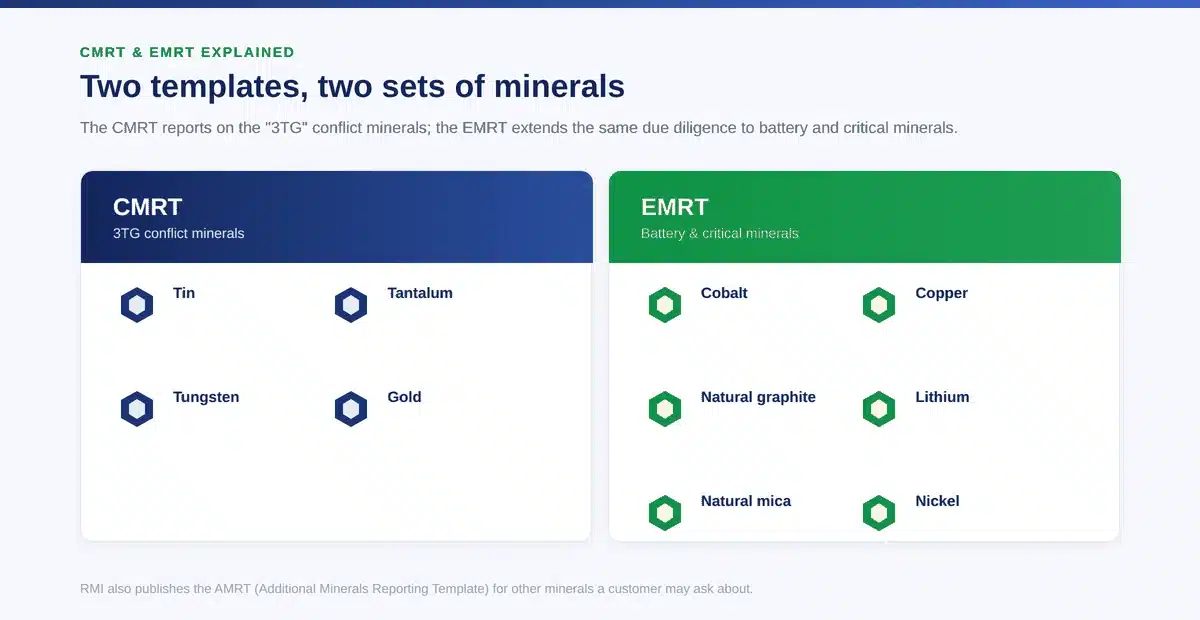
Summary: The CMRT is a free, standardised template from the Responsible Minerals Initiative (RMI). It is used to collect and pass on due-diligence information about the smelters and refiners that process the “3TG” minerals — tin, tantalum, tungsten and gold — in a product. The EMRT does the same job for battery and critical minerals (cobalt, copper, natural graphite, lithium, natural mica and nickel). Companies complete them to meet US Dodd-Frank §1502 disclosure, the EU Conflict Minerals Regulation, and — most commonly — direct customer flow-down demands. The strongest programs don’t treat the template as an annual form to survive. They treat it as living supplier evidence — collected once, verified across tiers, and improved year over year.
By the numbers
- RMI released CMRT v6.6, EMRT v2.11 and AMRT v1.31 on 17 April 2026 — the recommended template set for the current reporting year. CMRT 6.6 is the 30th version of the template. (Responsible Minerals Initiative, 2026)
- The CMRT covers four minerals — the “3TG”: tin, tantalum, tungsten and gold — while the EMRT now covers six: cobalt, copper, natural graphite, lithium, natural mica and nickel. (Responsible Minerals Initiative, 2026)
- The EU Conflict Minerals Regulation (EU) 2017/821 has imposed binding supply-chain due-diligence duties on 3TG importers since 1 January 2021. (EUR-Lex, Regulation (EU) 2017/821)
- Under the EU Battery Regulation, a digital Battery Passport becomes mandatory from 18 February 2027 for EV, LMT and industrial batteries above 2 kWh. (EUR-Lex, Regulation (EU) 2023/1542)
What are the CMRT and EMRT?
The CMRT — the Conflict Minerals Reporting Template — is a free, standardised Excel workbook maintained by the Responsible Minerals Initiative (RMI). Its job is simple to describe and hard to do. It captures, in one consistent format, whether the tin, tantalum, tungsten and gold in a company’s products originate from responsible sources. It also names the smelters and refiners that process those minerals. Because everyone uses the same template, a declaration you complete for one customer can be reused for the next. Data can flow up a supply chain without every buyer inventing their own questionnaire.
The EMRT — the Extended Minerals Reporting Template — applies the same structure to a different set of materials. Where the CMRT is about the 3TG conflict minerals, the EMRT is about battery and energy-transition minerals. As of version 2.11, it covers cobalt, copper, natural graphite, lithium, natural mica and nickel. (RMI also publishes a third template, the AMRT — Additional Minerals Reporting Template — for other minerals a customer may ask about.) All three are voluntary industry tools, not government forms. But they have become the de facto language of mineral due diligence, and most large OEMs will only accept data submitted on them.
How often do the templates change?
RMI refreshes the templates roughly once a year. The current set — CMRT v6.6, EMRT v2.11 and AMRT v1.31 — was released on 17 April 2026. Version 6.6 added new fields for “Requester Product Number” and “Requester Product Name.” It also refreshed the ISO country and region short names, and updated the underlying Smelter Reference List and Standard Smelter List. Using the current version matters: customers increasingly reject declarations submitted on outdated templates because the embedded smelter lists are stale.
Who must report conflict minerals?
Three forces pull companies into conflict minerals reporting, and most manufacturers feel at least two of them. The template is the same; the reason you’re completing it usually is not.
US Dodd-Frank Section 1502 (SEC issuers)
Section 1502 of the US Dodd-Frank Act applies to companies listed on US stock exchanges. It requires them to determine whether 3TG “necessary to the functionality or production” of their products originated in the Democratic Republic of the Congo or an adjoining country. They must then disclose the results to the SEC on an annual Form SD. The rule has been in force for reporting years since 2013. It’s worth being precise about its current status. The SEC still requires the annual Form SD filing, but certain elements of the independent-private-sector-audit and Conflict Minerals Report requirements have not been actively enforced since 2017. In practice, issuers keep filing — and keep asking their suppliers for CMRTs to do it.
EU Conflict Minerals Regulation (EU) 2017/821 (importers)
The EU took a different route. Rather than a disclosure rule aimed at listed companies, Regulation (EU) 2017/821 places binding supply-chain due-diligence obligations directly on EU importers of tin, tantalum, tungsten and gold above defined volume thresholds. In force since 1 January 2021, it requires those importers to build management systems, identify and assess risks in their mineral supply chain, and act on those risks. They must also commission independent third-party audits of their due diligence and report publicly each year. It is modelled on the OECD Due Diligence Guidance for Responsible Supply Chains of Minerals from Conflict-Affected and High-Risk Areas — the framework that underpins the whole system.
Customer flow-down (everyone else)
For the majority of suppliers, neither Dodd-Frank nor the EU regulation applies directly — yet they still complete CMRTs constantly. That’s because the obligations flow down contractually. A private component supplier isn’t an SEC filer, but its automotive or electronics customer is, and that customer requires a completed template as a condition of doing business. This cascade is why conflict minerals reporting reaches far beyond the companies the laws name — and why the ability to respond quickly and credibly is itself a competitive advantage. It’s the same tiered-visibility challenge you face across tier 1, tier 2 and tier 3 suppliers.
3TG vs battery and critical minerals
The single most important idea in both templates is that reporting is done at the level of the smelter or refiner — not the mine, and not the direct supplier. Minerals from thousands of mine sites are commingled when they’re processed, so the smelter/refiner is the “pinch point” in the supply chain where origin can realistically be verified. Both templates ask you to identify the smelters and refiners in your products’ supply chains and check them against RMI’s Standard Smelter List and the accompanying Smelter Reference List. Together, those are the master catalogue of known processing facilities embedded in the workbook.
CMRT vs. EMRT at a glance
| Attribute | CMRT (conflict minerals) | EMRT (battery / critical minerals) |
|---|---|---|
| Minerals covered | 3TG: tin, tantalum, tungsten, gold | Cobalt, copper, natural graphite, lithium, natural mica, nickel |
| Current version (2026) | v6.6 (released 17 Apr 2026) | v2.11 (released 17 Apr 2026) |
| Primary drivers | Dodd-Frank §1502; EU Reg 2017/821; OECD guidance | Customer/ESG demand; EU Battery Regulation; forced-labour scrutiny |
| Reporting unit | Smelters & refiners | Smelters, refiners & processors |
| Conformance program | RMAP (conformant for 3TG + cobalt) | RMAP (cobalt); developing for copper, lithium, mica, nickel; no dedicated list yet for graphite |
The distinction matters because the two sets of minerals carry different risk stories. The 3TG focus is on financing armed conflict in and around the DRC. Battery and critical minerals raise a broader set of concerns. Cobalt is associated with child and artisanal labour in the DRC, and mica with child labour in India and Madagascar. The whole basket also sits at the centre of the energy transition, where demand is surging and scrutiny with it. That’s also where conflict minerals due diligence starts to overlap with forced-labour import controls such as the UFLPA — polysilicon and battery inputs draw attention on both fronts.
How to complete the CMRT, step by step
The workbook has several tabs — Company Information, Declaration, Product List, Smelter List, a Checker, and the reference lists. Worked in order, it’s methodical rather than mysterious.
1. Complete the company information
Fill in your company details, a unique company identifier, contact and authoriser names, and the effective date of the declaration. This sounds trivial, but incomplete contact and authoriser fields are one of the most common reasons a customer bounces a submission back.
2. Set the declaration scope
Declare whether your answers apply company-wide, to a product (or product category), or to a user-defined list. Scope drives everything that follows. A company-level declaration is faster to give but less precise; a product-level declaration is more work but far more useful to a customer verifying a specific part.
3. Answer the seven declaration questions per metal
For each of the four metals, you answer a standard set of questions. Is the metal intentionally present? Is it necessary to the product’s function? Does it originate in the covered countries, and so on. Consistency here is critical — the Checker tab flags answers that contradict each other (for example, claiming a metal is present but listing no smelters for it).
4. Build the smelter list
Identify every smelter or refiner in scope and enter it, using the embedded Standard Smelter List to select recognised facilities and their Smelter IDs rather than free-typing names. Accurate smelter identification is the analytical heart of the template — and the part that depends most on data you have to gather from suppliers, not information you hold yourself.
5. Answer the policy questions
A set of company-level policy questions asks whether you have a conflict minerals policy and whether suppliers source from validated smelters. It also asks whether you conduct due diligence consistent with the OECD framework, among other things. These describe the maturity of your program, and buyers read them closely.
6. Validate and submit
Run the Checker, resolve every flag, and only then submit. A CMRT that clears its own validation on the first pass signals a supplier who has their data in order. That’s exactly the reputation you want with a customer who reviews hundreds of them.

The EMRT for battery and energy-transition minerals
If you supply into EV, energy-storage, electronics or aerospace chains, expect the EMRT to land in your inbox alongside — or instead of — the CMRT. It works the same way: company information, a declaration scope, a processor/smelter list checked against RMI’s reference data, and policy questions. The scope of minerals is what differs. EMRT 2.0 expanded coverage, and version 2.11 now spans cobalt, copper, natural graphite, lithium, natural mica and nickel — the materials at the core of batteries and the energy transition. RMI anticipates the next EMRT release in spring 2027, so the current version has a reasonable shelf life.
One practical note: the assurance landscape for battery minerals is younger than for 3TG. RMAP conformance is well established for tin, tantalum, tungsten, gold and cobalt, but validated-smelter coverage for minerals like lithium and natural graphite is still developing. That means an EMRT will more often surface smelters that aren’t yet on a conformant list — which is a finding to manage, not a box to ignore. The practical response is engagement with the supplier and the processor, documented over time. That’s precisely the kind of recurring, evidence-backed follow-up that structured supply chain due diligence is built to handle.
RMI and RMAP conformance
Behind the templates sits the Responsible Minerals Assurance Process (RMAP) — RMI’s independent, third-party audit program for smelters and refiners. An RMAP assessment checks a facility’s management systems and sourcing practices against RMI’s Global Responsible Sourcing Due Diligence Standard and the relevant mineral-specific standards. Facilities that pass appear as “Conformant” on the RMI public list. When you build your smelter list in the CMRT or EMRT, that conformant status is the signal you’re looking for. A smelter that is RMAP-conformant has been independently validated; one that isn’t represents a gap to investigate.
RMAP also carries regulatory weight. The European Commission formally recognised RMAP as the first supply-chain due-diligence scheme meeting the requirements of the EU Conflict Minerals Regulation. That means importers who source through RMAP-aligned channels can lean on it to demonstrate compliance. For a reporting company, the takeaway is straightforward: the goal of the template isn’t just to list smelters, but to move your supply chain toward conformant ones over time. That is the difference between collecting a declaration and improving a supply chain.
The EU Battery Regulation and the Battery Passport
The reason battery-mineral reporting is intensifying now is a specific piece of law. The EU Battery Regulation (Regulation (EU) 2023/1542) entered into force in 2023 and progressively replaces the old Batteries Directive. It sets sustainability, carbon-footprint, recycled-content and due-diligence requirements across the battery life cycle — and it introduces the digital Battery Passport.
From 18 February 2027, EV batteries, LMT (light means of transport, such as e-bike and e-scooter) batteries, and industrial batteries above 2 kWh placed on the EU market must carry a Battery Passport. It’s a machine-readable record, reachable via a QR code, holding data on the battery’s composition, carbon footprint, supply-chain due diligence, state of health and recycling information. The precise data format and submission mechanisms are still being finalised, but the deadline is fixed. For anyone in a battery supply chain, the EMRT data you gather today is a down payment on the passport information you’ll need to surface in 2027. That includes smelter identities, mineral origins, and due-diligence evidence. Portable and SLI batteries fall outside the passport requirement but remain subject to the regulation’s other duties.
Common conflict minerals reporting errors
Most rejected or unreliable templates fail for a handful of recurring, avoidable reasons.
- Using an outdated template version. Submitting on an old CMRT or EMRT means an old Smelter Reference List — customers increasingly reject anything not on the current version (CMRT 6.6 / EMRT 2.11).
- Company-level answers that hide product reality. A blanket company-wide declaration is quick to give but often can’t be verified against a specific part, so buyers push back and ask again.
- Free-typed or mismatched smelter names. Entering smelters by hand instead of selecting from the Standard Smelter List introduces typos and duplicates that break the Checker and undermine the data.
- Ignoring Checker flags. Internal contradictions — a metal marked present with no smelters listed, or scope mismatches — signal a rushed submission and erode customer trust.
- Treating it as once-a-year. Data collected in a last-minute scramble is stale by design. Supplier lists, smelters and conformant status all move during the year.
From reporting to improvement
The uncomfortable truth about conflict minerals reporting is that a perfectly completed CMRT changes nothing on its own. It’s a snapshot. The value comes from what you do next. That means chasing the smelters that aren’t conformant, re-sourcing away from the ones that stay that way, and building a record that shows the supply chain getting cleaner year over year. That’s a reliability problem and an evidence problem — exactly the ground a purpose-built platform covers.
How Certainty helps
Certainty helps you run conflict minerals reporting as a standing process rather than an annual fire drill. That means standardised data-collection forms and workflows to gather CMRT and EMRT inputs from suppliers, plus automated follow-ups so you’re not chasing responses by email. It also means configurable dashboards that show smelter conformance and completion at a glance, and audit-ready reporting that ties the whole thing to your wider supplier audit program. The point isn’t to fill in the template faster. It’s to trace your minerals, evidence your due diligence, and improve where your supply chain sources from — with the record to prove it.
Turn the annual CMRT scramble into a standing supplier control. Certainty centralises CMRT and EMRT data collection, automates supplier follow-ups, and tracks smelter conformance across tiers. So your next reporting cycle starts with evidence already in hand, not a blank spreadsheet. This is the same infrastructure that powers supply chain due diligence and CSDDD compliance programs.
Key Takeaways:
- The CMRT is RMI’s standard conflict minerals reporting template for the 3TG — tin, tantalum, tungsten and gold; the EMRT extends the same format to battery and critical minerals.
- Use the current versions — CMRT v6.6 and EMRT v2.11 (both released 17 April 2026) — because outdated smelter lists get declarations rejected.
- Reporting is driven by Dodd-Frank §1502, the EU Conflict Minerals Regulation (2017/821), and — for most suppliers — customer flow-down.
- Reporting happens at the smelter/refiner level; RMAP-conformant status is the signal to look for, and the EU recognises RMAP for its Conflict Minerals Regulation.
- The EU Battery Passport (mandatory 18 Feb 2027) makes today’s EMRT data a head start — treat reporting as a living control, not an annual form.
You might also be interested in

Supply Chain Due Diligence
How to evidence due diligence across your supplier base under CSDDD, LkSG and CSRD.

UFLPA Compliance
Forced-labour import rules, CBP enforcement, and building a defensible due-diligence program.

The German Supply Chain Act (LkSG)
What LkSG demands, who it reaches beyond Germany, and how to evidence compliance.
Frequently Asked Questions (FAQs)
What is the CMRT?
The CMRT (Conflict Minerals Reporting Template) is a free, standardised Excel template from the Responsible Minerals Initiative (RMI). It’s used to collect and communicate information about the smelters and refiners that process the “3TG” minerals — tin, tantalum, tungsten and gold — in a company’s products. Because it’s a common format, a completed CMRT can be reused across customers and passed up the supply chain.
What is the difference between the CMRT and the EMRT?
The CMRT covers the four conflict minerals (3TG). The EMRT (Extended Minerals Reporting Template) uses the same structure but covers battery and critical minerals — as of version 2.11, cobalt, copper, natural graphite, lithium, natural mica and nickel. Many companies now receive both from their customers.
What are 3TG minerals?
3TG is shorthand for the four conflict minerals: tin, tantalum, tungsten and gold. They’re grouped together because their trade has been linked to financing armed conflict, particularly in and around the Democratic Republic of the Congo. They’re also the minerals covered by US Dodd-Frank §1502 and the EU Conflict Minerals Regulation.
Which CMRT version should I use in 2026?
Use CMRT version 6.6, released by RMI on 17 April 2026, alongside EMRT 2.11 and AMRT 1.31. Using the current version matters because each release updates the embedded Smelter Reference List and Standard Smelter List, and customers increasingly reject declarations submitted on outdated templates.
Is conflict minerals reporting still required in 2026?
Yes. US SEC issuers still file an annual Form SD under Dodd-Frank §1502, though certain audit and Conflict Minerals Report elements have not been actively enforced since 2017. EU importers of 3TG have had binding due-diligence duties since 1 January 2021 under Regulation (EU) 2017/821. And most suppliers report because their customers require completed CMRTs contractually.
How does the EU Battery Passport relate to the EMRT?
The EU Battery Regulation (2023/1542) requires a digital Battery Passport from 18 February 2027 for EV, LMT and industrial batteries above 2 kWh. It will surface supply-chain and due-diligence data via a QR code — much of which overlaps with the smelter, origin and due-diligence information companies already gather through the EMRT. Building solid EMRT data now is a head start on passport readiness.
Stop chasing CMRTs by email
Certainty centralises CMRT and EMRT data collection, automates supplier follow-ups, and tracks smelter conformance across tiers — turning conflict minerals reporting into an audit-ready, improving supply chain control.