Written by Hewitt Roberts, CEO, Certainty Software
An auditor asks you to demonstrate that the load was inspected before it shipped. You know it was. The person who did it is standing beside you. But the photographs are on a device, the record is in a folder someone named by date, and nobody can put the two together while the auditor waits. For the purposes of that audit, it did not happen.
Summary: Objective evidence is data supporting the existence or verity of something — records, statements of fact, measurements and observations that are relevant to the criteria being assessed and, above all, verifiable (ISO 19011:2026). Most organizations do not have an evidence problem. They have a retrieval problem: the evidence exists, but it cannot be produced when it is asked for — and an auditor, a customer, or a regulator cannot tell the difference.
By the numbers
- “Data supporting the existence or verity of something” — the standard definition of objective evidence (ISO 19011:2026, 3.9)
- Audit evidence — what an audit actually tests — is “records, statements of fact or other information, which are relevant to the audit criteria and verifiable” (ISO 19011:2026, 3.10)
- 1 hour of operating time recovered per export load once evidence capture moved to the point of work (Certainty Software, Nissan Mexicana case study, 2026)
- 30 days for a carrier to acknowledge a cargo claim in writing — unless it has already paid or declined it in that period (49 CFR §370.5)
- 120 days to pay, decline, or “make a firm compromise settlement offer,” with written status updates every 60 days after that (49 CFR §370.9)
What is objective evidence?
Objective evidence is data supporting the existence or verity of something. ISO 19011:2026 defines it that way at clause 3.9, in the same words the ISO 9000 vocabulary standard uses, and adds that it can be obtained through observation, measurement, test or other means.
The condition that does the real work sits one clause further on. What an audit actually tests is audit evidence: records, statements of fact or other information that are relevant to the audit criteria and — the word everything turns on — verifiable.
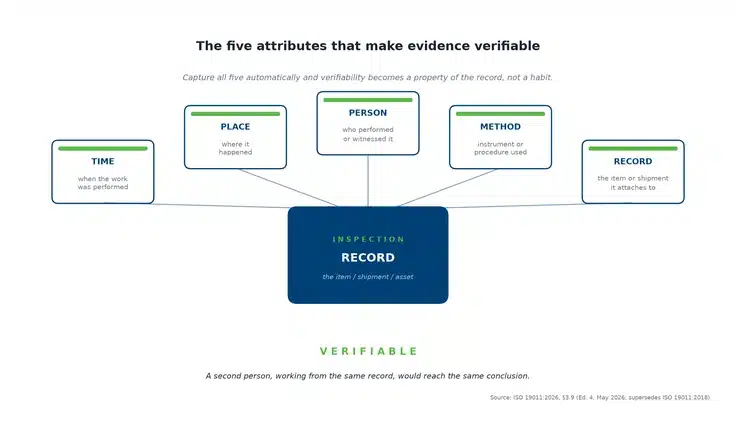
The word “objective” causes most of the confusion. Evidence is not objective because the person presenting it is being impartial about it. It is objective because a second person, working from the same record, would reach the same conclusion. Impartiality is a quality of the auditor. Verifiability is a quality of the record.
The phrase is also used in medicine and law, where it carries a different meaning — objective medical findings, objective evidence in a disability claim. In quality management it is narrower and more demanding, and that is the sense used throughout this article.
What qualifies as objective evidence — and what doesn’t
Evidence qualifies as objective when it is verifiable, relevant to the criteria being assessed, and traceable to a specific time, place, and person.
Qualifies:
- A completed inspection record tied to a specific item, shipment, or asset
- A measurement recorded with the instrument used and the date it was taken
- A timestamped photograph attached to the record it documents
- A signed statement of fact from someone who performed or witnessed the work
- A system log showing when an action occurred and who performed it
Does not qualify:
- Recollection, however confident and however senior the person recalling it
- A photograph with no link to what it documents — an image of a scuffed bumper proves a scuffed bumper existed somewhere, at some point
- An opinion about whether the work was done well, unless it is anchored to a measured criterion
- A record that cannot be located inside the window in which it is needed
That last one is where most organizations quietly fail, and it is worth stating plainly: a record nobody can retrieve is not weaker evidence. Functionally, it is no evidence at all. In aerospace and defense the term of art is objective quality evidence, or OQE, and the retrieval standard there is explicit — but the principle is identical in every sector.
Most organizations have a retrieval problem, not an evidence problem
The photographs get taken. The forms get filled in. What breaks is the chain between capturing the evidence and the record it has to live in.
The typical chain runs like this: an operator documents the work on a device, walks to a workstation, downloads the images, sorts them, and files them into a structure that depends entirely on one person’s discipline. Every one of those steps is a place where the link between the evidence and the thing it evidences can quietly come apart.
The chain also costs operating time. And it fails at precisely the wrong moment — the day an auditor asks, or a customer claims, and the complete set cannot be produced on demand.
“During operations, we received customer claims for logistics-related damage occurring in transit. Complete evidence was not immediately available, since the process was manual and required going to a computer to download the images, which caused delays in handling and responding to those claims.”
— Carlos Alexis Arriaga L., Logistics SCO, Nissan Mexicana
How Nissan Mexicana made its objective evidence producible
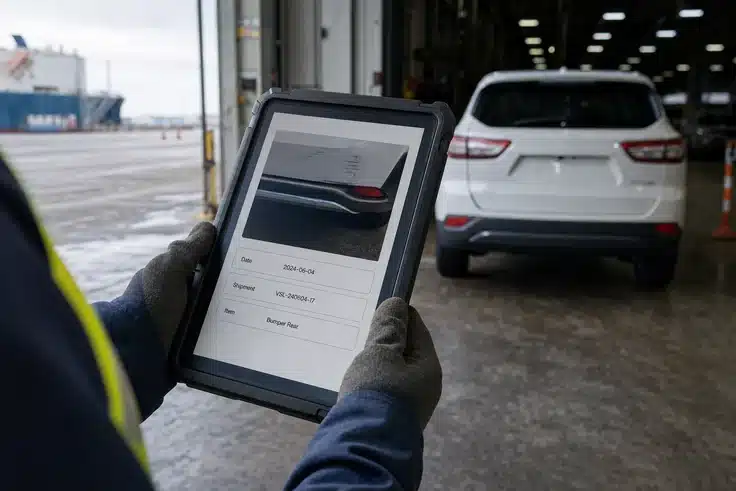
Nissan Mexicana moved evidence capture out of the office and onto the loading bay, attaching photographs to inspection records at the moment of capture, tagged to the specific shipment they document.
There is no download step, no sorting step, and no filing step left in the process. The record is complete when the load departs, and it is already indexed against the shipment it evidences. Producing it is a lookup rather than a search.
The selection was as much about risk as capability. The platform already met the certification requirements set by the export authorities, and it was already running at several sister Nissan plants — which standardized the evidence across sites instead of inventing a new standard for one. Configurability mattered too, because a template nobody can complete under time pressure produces no evidence at all. The ability to attach photos and documents directly to inspection records is what makes capture at the point of work practical.
“The templates are easy for our operations staff to use and offer multiple configuration options that adapt to different parts of the operation.”
— Carlos Alexis Arriaga L., Logistics SCO, Nissan Mexicana
The result was an hour of operating time back on every export load, evidence indexed and ready before any claim arrives, and a documentary trail that holds across plants.
“The implementation allowed us to optimize operating times, have concrete evidence on hand, and address logistics needs, strengthening internal control and the traceability of shipments.”
— Carlos Alexis Arriaga L., Logistics SCO, Nissan Mexicana
Proof — Certainty works in global automotive logistics
Nissan Mexicana captures photographic evidence of load condition at the loading bay, attached to a shipment-specific inspection record at the moment of capture. As a result, complete evidence is on hand the moment a customer claim arrives, traceability holds across sister plants, and the team recovered one hour of operating time on every export load.
Auditing an automotive process? Our Automotive QMS Process Audit Checklist sets out the criteria your objective evidence has to satisfy, question by question. Get the checklist →
Four rules for capturing objective evidence at the point of work
Evidence is usable when it can be produced — complete, verifiable, and attributable — inside the window in which it is asked for. Four design rules get you there.
1. Capture where the work happens
If the record is finished before the operator leaves the bay, there is nothing left to lose between the device and the file. Every handling step you remove is a failure mode you remove with it.
2. Bind the evidence to the record, not the folder
A folder structure is a convention that depends on discipline. A record tied to a specific item or shipment is a relationship the system enforces. Discipline degrades under time pressure; a data model does not.
3. Make it verifiable by design
Time, place, person, method, and the record it attaches to — capture all five automatically and verifiability stops being something anyone has to remember to establish after the fact.
4. Standardize so evidence is comparable across sites
Multi-site operations are judged on the weakest site’s records. Running the same templates everywhere makes evidence comparable, portable, and defensible — the same discipline that governs quality audits across the rest of the operation.
Objective evidence in an audit versus in a dispute
The standard is the same in both. The clock is not, and the clock is what catches people out.
An auditor asks during the audit, and a delay of a few minutes is survivable. A customer claim arrives weeks later and runs against fixed deadlines: under 49 CFR Part 370, a carrier must acknowledge a cargo claim in writing within 30 days — unless it has already paid or declined it — and must then pay, decline, or make a firm compromise settlement offer within 120, with written status updates every 60 days for as long as the claim stays open. In finished vehicle logistics, inspection turnaround and record retention are set by the AIAG M-22 damage handling guideline, now in its 6th edition, and by the OEM contracts that reference it.
Evidence that satisfies an auditor on request but takes a week to assemble passes the first test and fails the second. It is also worth being clear about what you are producing evidence for: the difference between an audit and an inspection determines which criteria your evidence has to be relevant to.
The fix, in both cases, is not more evidence. It is fewer steps between the evidence and the record it belongs to.
Key Takeaways:
- Objective evidence is data supporting the existence or verity of something — verifiable, relevant to the criteria, and traceable to a time, place, and person.
- Evidence is objective because the record is verifiable, not because the person presenting it is impartial.
- A record that cannot be retrieved inside the window it is needed is functionally not evidence at all.
- The common failure is retrieval, not capture — the manual chain between the device and the filing system.
- Nissan Mexicana recovered one hour of operating time per export load by capturing evidence at the point of work.
- Capturing time, place, person, method, and the linked record automatically makes verifiability a property of the system rather than a habit.
You might also be interested in

Audit vs. Inspection: Learn Their Key Differences
Audits and inspections answer different questions against different criteria. Knowing which is which decides what evidence you need.

What Are Quality Assurance Inspections?
How QA inspections work, what they check, and how they produce the records a quality system depends on.

Where the auditor stands changes what evidence they can see for themselves — and what you have to be able to produce.
Frequently Asked Questions (FAQs)
What is objective evidence?
Objective evidence is data supporting the existence or verity of something. It can be obtained through observation, measurement, test, or other means (ISO 19011:2026, 3.9). In an audit, what gets tested is audit evidence — records, statements of fact or other information that are relevant to the audit criteria and verifiable (ISO 19011:2026, 3.10).
What is the ISO definition of objective evidence?
ISO 19011:2026 defines objective evidence at clause 3.9 as “data supporting the existence or verity of something,” with a note that it can be obtained through observation, measurement, test or other means. The standard takes that definition from ISO 9000:2026, 3.8.6. The earlier 2018 edition carried a second note about records and verifiability; in the current edition that wording stands on its own as the definition of audit evidence, at clause 3.10.
What are examples of objective evidence?
A completed inspection record tied to a specific item, a measurement recorded with its instrument and date, a timestamped photograph attached to the record it documents, a signed statement of fact from someone who performed the work, and a system log showing who did what and when.
What is the difference between objective and subjective evidence?
Objective evidence is verifiable — a second person working from the same record reaches the same conclusion. Subjective evidence rests on recollection, impression, or opinion, and cannot be independently confirmed. An unanchored judgment that work was done well is subjective; a measurement against a stated criterion is objective.
What is objective quality evidence (OQE)?
Objective quality evidence is the same concept as it is applied in aerospace, defense, and other regulated manufacturing sectors: verifiable, documented proof that a quality requirement has been met. The retrieval and retention expectations are usually stated explicitly in the contract or the standard.
Does a photograph count as objective evidence?
Only if it is verifiable. A photograph on its own shows a condition without establishing what it documents, when, or where. Attached to an inspection record for a specific item, with a time and the identity of the person who captured it, the same photograph becomes objective evidence.
How long does objective evidence need to be retained?
It depends on the standard or contract that governs the work. In finished vehicle logistics, damage reporting and retention timeframes come from the AIAG M-22 guideline — now in its 6th edition — and from the OEM contracts that reference it, so confirm the edition your customers actually hold you to. Set retention by the longest applicable requirement, not the shortest.
Make your evidence producible on demand.
See how Certainty captures verifiable inspection and audit records at the point of work, across every site.