EHS Software: The Complete Guide
EHS software (Environment, Health and Safety software) is the digital system of record a safety-driven enterprise uses to plan, capture, investigate, and improve the work that protects people, the environment, and the license to operate. A modern EHS platform — sometimes called EHS management software, HSE software, or environmental health and safety software — replaces paper inspection sheets, scattered incident reports, and Excel-based hazard registers with one defensible source of truth for inspections, observations, incidents, hazards, permits, and corrective actions — and the connective execution layer to the training, environmental, and ERP systems that complete the EHS picture. It is the backbone that supports OSHA recordkeeping, ISO 45001, ISO 14001, NFPA 70E, EPA reporting, and the multi-site reality of construction, manufacturing, energy, mining, and utilities.
The EHS software market splits into three camps. First, monolithic enterprise EHS suites from legacy vendors — long implementations, heavy IT involvement, rigid workflows that struggle to keep up with a changing regulatory environment. Second, single-purpose tools that handle one process well (incident reporting only, or contractor onboarding only) but fall apart when the safety director needs one place to see inspection completion, near-miss trend, contractor compliance, and environmental exceedance across twenty sites. Third, configurable, mobile-first, defensible-evidence platforms that consolidate the work and survive a regulator’s audit. That last category is what most modern EHS leaders are buying — and what this guide is about.
EHS at a glance
| What it is | A configurable platform that runs the EHS processes a regulated employer is audited and litigated against — inspections, incidents, hazards, permits, contractors, training, environmental compliance |
| Who uses it | EHS Managers, Safety Directors, HSE Managers, Compliance Directors, Plant Managers, multi-site safety leaders |
| Core capabilities | Inspection and audit, incident reporting and investigation, hazard identification and risk assessment (HIRA), permit-to-work and LOTO, contractor management, training, environmental compliance |
| Standards covered | OSHA (29 CFR 1910 / 1926), ISO 45001, ISO 14001, NFPA 70E, EPA, UK HSE, Canadian OHS, EU OSH framework |
| Deployment | Cloud (SaaS) — typically multi-site, multi-language, mobile-first with offline capture; on-premise is now rare outside classified work |
| Outcome | Lower TRIR and DART, faster Verified Closure of incidents, defensible evidence in litigation, audit-ready every day, real-time enterprise risk visibility |
Table of contents
- What is EHS software?
- Core capabilities of a best-of-breed EHS stack
- Defensible evidence — what it means in EHS
- Regulatory framework EHS software addresses
- Escape Spreadsheet Hell — modernizing EHS workflows
- How to choose EHS software — buyer’s framework
- EHS implementation roadmap
- EHS KPIs and benchmarks
- EHS across industries
- Frequently Asked Questions (FAQs)
- Related resources

What is EHS Software?
EHS software is the digital system of record an employer uses to plan, capture, investigate, and improve the inspections, observations, incidents, hazards, permits, and corrective actions that govern its safety and environmental program across one site or many — integrating with the training, environmental, and ERP systems that complete the picture. It enforces inspection schedules, captures incidents and near-misses at the point of work, drives investigations to Verified Closure, manages permit-to-work and lockout/tagout, coordinates contractor and training requirements with your HRIS and LMS, and reports OSHA, ISO 45001, and environmental performance against the standards the business is regulated under. In short, EHS software is what makes an EHS system run — without it, the “system” is a stack of inspection binders, an inbox full of incident emails, and a spreadsheet that nobody trusts.
The acronym landscape is its own problem. “EHS” is the dominant North American label (Environment, Health and Safety). “HSE” is more common in the UK, Europe, and the oil and gas sector (Health, Safety and Environment). “SHE” appears in some Australian and South African organizations. They describe the same scope. Software buyers searching “what is EHS” or “EHS management software” are looking for the same thing as buyers searching “HSE software” or “safety management software”. This guide uses EHS as the umbrella term and notes regional or sector variants where they matter.
EHS vs HSE vs Safety Management Software — disambiguation
Three terms collide in this category. They overlap, but they are not interchangeable.
- EHS software — the umbrella category. Any digital platform that manages multiple EHS processes (inspections, incidents, hazards, permits, contractors, training, environmental) under one roof. Most buyers searching “ehs software” or “ehs management software” are looking for this.
- HSE software — same scope as EHS in most use cases, with a regional or sector flavor. UK and European employers, and oil and gas operators worldwide, use HSE. A platform that markets as HSE generally serves the same buyer with the same capabilities.
- Safety management software — narrower. Focused on the health-and-safety side (inspections, incidents, hazards, training) without the environmental and sustainability scope. Many EHS platforms can run in safety-only mode for buyers who do not need environmental compliance.
Picking the right term for your buyer
The simplest way to choose between them: if you need to manage air, water, waste, and GHG reporting alongside safety, you need EHS. If you only need to manage workplace safety, safety management software covers the use case. If you are in oil and gas or operate in the UK, your stakeholders will call the platform HSE — the underlying software is the same.
Who uses EHS software
EHS software is bought and used by safety and environmental leaders, but the buying committee usually extends well beyond the EHS function.
- EHS Manager / Safety Manager. Day-to-day owner of the system. Configures inspections, manages incident workflow, runs hazard assessments, prepares for OSHA and ISO 45001 audits.
- Safety Director / HSE Manager. Multi-site rollup, executive reporting, regulator-facing posture across the enterprise. The buyer signing the contract.
- Compliance Director. Cares about defensible evidence, audit readiness, and the litigation profile. Often the budget approver in regulated industries.
- Plant Manager / Operations Manager. Uses the platform to see real-time inspection completion, open hazards, and contractor compliance on their site. Sponsors supervisor-level safety walks.
- Environmental Manager. Owns the environmental side — air emissions, water discharge, waste manifests, GHG reporting under EPA or equivalent regulators.
- IT / Information Security. Validates authentication, audit trail, data residency, and integration with HRIS, ERP, and ServiceNow.
For multi-site organizations, the buying committee typically includes EHS, Operations, Legal, IT, and Finance — and the buying process usually takes 8–16 weeks for a configurable platform versus 9–18 months for a legacy enterprise EHS suite.
Industries served
EHS software is used across every industry where workplace hazards, environmental risk, or contractor exposure create regulator, customer, or insurer scrutiny. The largest concentrations are in:
- Manufacturing — OSHA general industry, ISO 45001, multi-site rollup, machine safety, ergonomics
- Construction — OSHA 1926, subcontractor management, daily JSAs, permit-to-work, fall protection
- Energy, oil and gas — process safety (PSM), permit-to-work, contractor management, environmental, NORM (Naturally Occurring Radioactive Material), behavioral-based safety
- Mining — MSHA in the US, equivalent regulators worldwide, contractor management, environmental, tailings, dust
- Utilities — NFPA 70E electrical safety, switching authorizations, vegetation management, environmental discharge
- Chemicals and pharmaceutical operations — OSHA PSM, EPA RMP, GHS, industrial hygiene, environmental
- Food, beverage, and CPG — OSHA general industry, Hazard Analysis and Critical Control Point (HACCP), environmental, contractor management at scale
The same configurable platform serves all of these industries when it can model their specific permit types, incident hierarchies, and regulatory recordkeeping. Industry-specific EHS platforms exist (construction-only, oil-and-gas-only), but the market is consolidating around multi-industry configurable platforms because most enterprises operate across more than one regulatory regime — a manufacturer also has construction work during expansions, and an energy operator runs contractors that touch every other industry’s rule set.
Core capabilities of a best-of-breed EHS stack
EHS software spans a spectrum — from focused execution platforms that run the daily EHS work (inspections, observations, incidents, hazards, permits, and corrective actions) to full enterprise suites that also bundle a training LMS and environmental data management. Few buyers need all of it in one box, and the modern trend is decisively toward configurable, best-of-breed execution layers that integrate with the LMS, ERP, and environmental tools an organization already runs — rather than ripping them out for a monolithic suite. The modules below make up the category; the real question is which you run as one system and which you integrate.
EHS module map
| EHS module | What it does | Why it matters | Regulatory anchor |
|---|---|---|---|
| Inspection and audit | Scheduled and ad-hoc safety inspections, environmental audits, behavior-based safety observations | Captures the day-to-day evidence regulators and insurers expect to see | OSHA, ISO 45001 Clause 9.2, EPA |
| Incident reporting and investigation | Capture incidents, injuries, near-misses, environmental events; drive investigation to root cause and Verified Closure | The single most-scrutinized EHS workflow — feeds OSHA 300/301 and ISO 45001 Clause 10 | OSHA 29 CFR 1904, ISO 45001 |
| Hazard identification and risk assessment (HIRA) | Job hazard analysis (JHA / JSA), process hazard analysis (PHA), risk registers, control hierarchy | The proactive layer — finds and ranks hazards before they become incidents | ISO 45001 Clause 6, OSHA PSM |
| Permit-to-work and LOTO | Hot work, confined space, working at heights, energy isolation (lockout/tagout) | High-consequence work that needs explicit authorization and verification | OSHA 1910.147, NFPA 70E |
| Contractor management | Pre-qualification, training validation, on-site sign-in, contractor incident tracking | Contractors are over-represented in serious incidents, so contractor oversight is critical — many platforms integrate with dedicated prequalification systems (ISN, Avetta, Veriforce) rather than replacing them | ISO 45001 Clause 8.1.4.2 (contractors), 8.1.4.3 (outsourcing) |
| Training and competency | Role-based training matrices, expiration tracking, refresher cadence, in-app competency assessments | Required by every standard; the bridge between document control and observed work | OSHA training requirements across 29 CFR 1910 subparts (e.g. 1910.1200(h) HazCom, 1910.147(c)(7) LOTO, 1910.95(k) noise), ISO 45001 Clause 7.2 |
| Environmental compliance | Air emissions, water discharge, waste manifests, GHG inventory, chemical inventory and SDS | The E in EHS — increasingly required for ESG reporting and CSDDD due diligence | EPA, ISO 14001, GHG Protocol |
Inspection and audit management
Inspections are where most EHS programs first prove (or fail to prove) that the system is alive. A modern EHS platform runs all inspection types in one place: supervisor safety walks, environmental compliance audits, BBS observations, layered safety audits, contractor work-area inspections, and emergency-equipment checks. Templates are configurable by the EHS team, not the vendor. Mobile capture, photo evidence at the question, and offline mode are mandatory — most inspections happen on a plant floor, a construction deck, a wellhead, or a substation where Wi-Fi is unreliable. For a deeper look at this module, see our safety inspection software pillar guide.

Incident reporting and investigation
This is the section most EHS deployments get wrong, and the one with the highest legal and human stakes. An incident — injury, illness, near-miss, environmental release, property damage, security event — must be captured at the point of work, routed to the right investigator, driven through a structured investigation (5 Whys, fishbone, TapRooT, or ICAM), and closed only after corrective and preventive actions are verified effective. The CAPA discipline matters here as much as it does in quality: a closed incident report without Verified Closure is the same as no investigation at all. EHS platforms that pretend “closed” and “effective” are the same event will look fine internally and lose at every external audit.
Hazard identification and risk assessment (HIRA)
HIRA is the proactive backbone of an EHS program. A best-of-breed EHS stack supports job hazard analysis (JHA / JSA) at the task level, process hazard analysis (PHA) for high-consequence operations, risk registers at the site and enterprise level, and the hierarchy of controls (elimination, substitution, engineering, administrative, PPE) for every identified hazard.
Permit-to-work and LOTO management
High-consequence work — hot work, confined space, working at heights, electrical energization, line breaking — happens under explicit, time-bound authorization. The EHS platform manages the permit lifecycle: request, hazard review, authorization, on-site verification, work execution, closure. Lockout/tagout (LOTO) per 29 CFR 1910.147 sits alongside permits in the same workflow — see the supporting guide on lockout/tagout for the operational detail. The test that separates a real permit system from a digitized form: can the platform stop a permit from being issued when a conflicting permit is already active on the same equipment?
Contractor management and onboarding
In manufacturing, energy, and construction, the contractor population is often larger than the employee population — and contractors are over-represented in fatalities, serious injuries, and citations. A modern EHS platform runs the full contractor lifecycle: pre-qualification questionnaire, insurance verification, training validation, site-specific induction, daily sign-in, in-app JSA acknowledgment, and post-job incident tracking. Multi-tier visibility (contractor’s subcontractor) is becoming a buyer requirement under CSDDD, GFSI for food sites, and customer-driven supplier standards.
Training and competency tracking
Every EHS standard requires the right people to be trained on the right work. A best-of-breed EHS stack tracks training matrices by role and site, automatic refresher triggers, expiration alerts for time-bound qualifications (fall protection, confined space, hot work, MEWP operator), competency assessments tied to job descriptions, and integration with the HRIS for new-hire onboarding. Training data feeds inspections — an operator cannot be marked compliant on a task they are not trained for.
Environmental compliance — air, water, waste, GHG
The E in EHS is increasingly the load-bearing letter. A best-of-breed EHS stack supports air emissions inventories and Title V reporting, water discharge monitoring against NPDES limits, hazardous and non-hazardous waste manifests with cradle-to-grave tracking, chemical inventory and SDS management with GHS classification, GHG inventory per the GHG Protocol, and the reporting surface that ESG and CSDDD due diligence will increasingly demand. Environmental compliance is also where regulators are most aggressive — EPA fines for late reporting, missed limits, or unreported releases routinely run into seven figures.
Defensible evidence — what it means in EHS
Term: Defensible evidence in EHS is the standard in which every record (inspection, incident report, training acknowledgment, permit, hazard assessment, environmental reading) carries a timestamp, the user identity, the action taken, the geo or asset reference, the document or standard revision it was performed against, and any attached photo, video, or signature — and that complete record is tamper-evident, reproducible on demand, and admissible in a regulator audit or a courtroom.
The job of an EHS platform is not to pass a compliance audit — it is to make every day a defensible day. The legal and regulatory environment around occupational safety and environmental performance has shifted decisively toward evidence-based scrutiny. OSHA inspectors, EPA investigators, certification auditors, plaintiff’s attorneys, and corporate insurers all ask the same set of questions: what happened, by whom, when, against what procedure, with what evidence? An EHS program that cannot answer those questions in minutes has already lost.
Why most safety incidents lose lawsuits
Three patterns repeat across post-incident litigation and OSHA citations. First, records exist but are not contemporaneous — inspections were “done” but transcribed onto paper hours later from memory, with photos taken on a personal phone and never linked. Second, the audit trail is unverifiable — the same supervisor’s name appears on twelve inspections completed during a shift they were not on site, because the spreadsheet does not check. Third, closure was signature-only — the corrective action box is ticked but there is no verification step, no follow-up evidence, no demonstration that the hazard is actually mitigated. In each case the program looked fine internally. None of them survived discovery.
A defensible EHS platform inverts each pattern. Records are captured at the point of work, on the device the worker is holding, with timestamps the system controls. Every action carries a user ID bound to the login. Closure is a two-step event — complete (the action was performed and evidence attached) and verified (a follow-up demonstrates effectiveness). We treat Verified Closure as a brand-defining capability — the same discipline that drives a CAPA-forward quality management software program.
Audit trail requirements
A defensible audit trail captures, at minimum, on every record: who performed the action, what action, when (date and timestamp), at what location or asset, against what version of the procedure or standard, with what evidence attached. Electronic signatures must be bound to the record — not the form. Records must be tamper-evident — changes are logged, not silently overwritten, and deleted records remain in the audit trail with the deletion event itself attributed and timestamped.
EPA retention varies by program — three years for TRI / EPCRA § 313 (40 CFR 372.10), three years minimum for RCRA hazardous-waste manifests (40 CFR 262.40), three years for NPDES self-monitoring (40 CFR 122.41), five years for Title V air operating permits (40 CFR 70.6), and generally five years for TSCA § 8 records (with some PMN-related categories up to 30 years). OSHA injury records (300, 301, 300A) are retained five years from the end of the calendar year per 29 CFR 1904.33. ISO 45001 certification records follow the certification body’s stated retention; litigation hold is indefinite.
Photo, video, and signature capture standards
Modern EHS capture is multimedia. A safety inspection with no photo evidence is a description. A near-miss report with no photo is a guess. Without a photo of the locked device, the LOTO verification is just a claim. The platform must capture photos and short video clips at the question, store them at full resolution in the audit trail, and present them to the auditor or investigator as part of the record — not as a separate evidence folder that needs to be reconciled. Signatures (operator, supervisor, contractor) must be bound to the record, the user, and the timestamp — not just an image of a scribble.
Multi-site rollup for enterprise risk visibility
For multi-site enterprises, defensible evidence is also about visibility. A safety director who cannot see, in real time, which sites are running open high-severity hazards, which contractors are overdue on training, and which environmental thresholds are trending toward exceedance is leading on a lag. The platform must roll up site-level data into a corporate view with drill-down to source records, with role-based access that respects site boundaries, and with the ability to slice by region, business unit, or contractor population.
Regulatory framework EHS software addresses
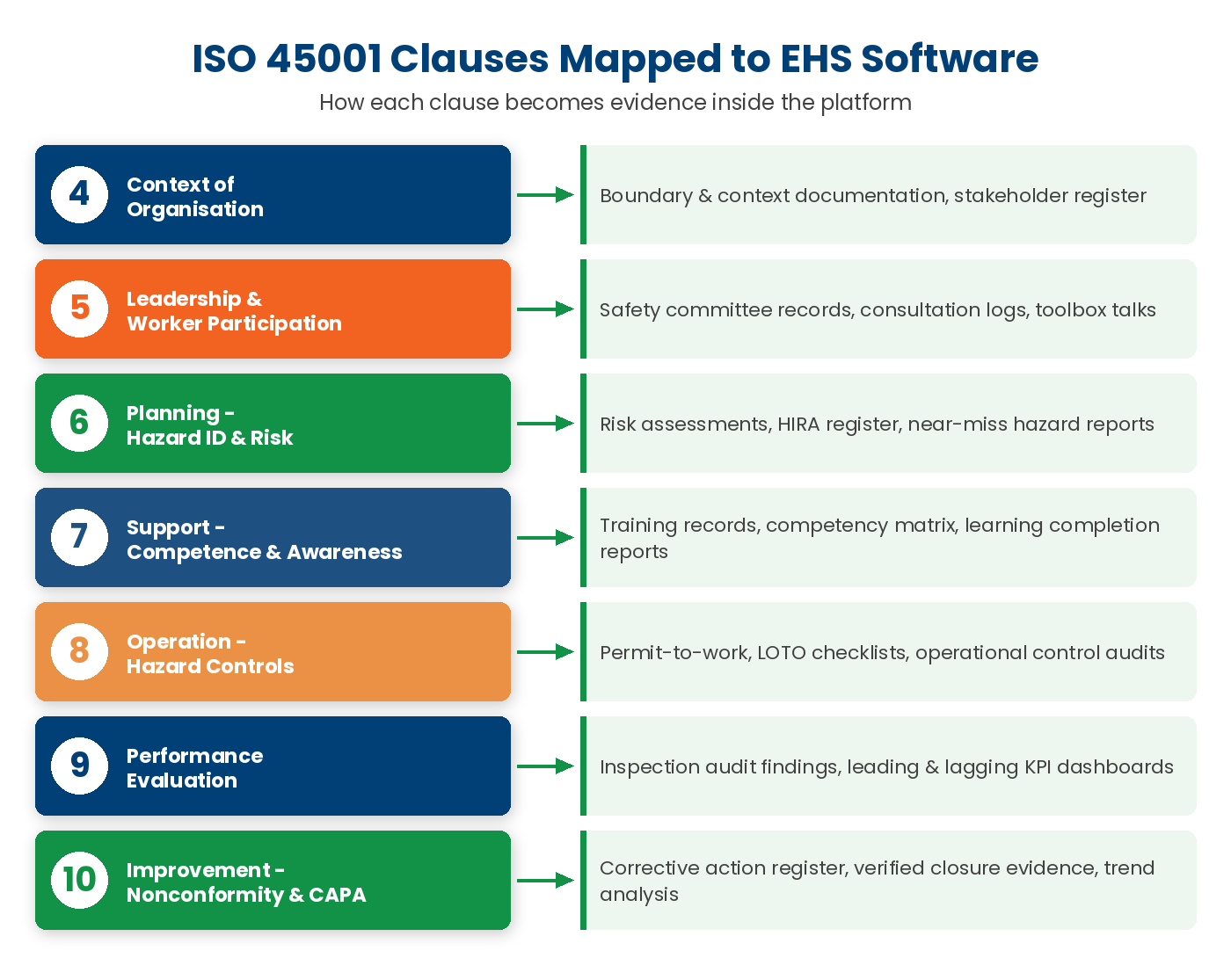
A best-of-breed EHS stack supports the major workplace-safety and environmental standards in one configurable platform. The standards below cover the majority of EHS use cases in North America, the UK, the EU, and most regulated international jurisdictions — OSHA 29 CFR 1904/1910/1926, ISO 45001, ISO 14001, NFPA 70E, EPA programs, UK HSE, Canadian OHS, and the EU OSH Framework Directive.
| Standard | What it covers | Jurisdiction | EHS modules required |
|---|---|---|---|
| OSHA 29 CFR 1910 | General industry safety | United States | Inspection, incident (300/301), training, PSM, GHS |
| OSHA 29 CFR 1926 | Construction safety | United States | Inspection, incident, JSA, fall protection, permit |
| OSHA 29 CFR 1904 | Injury and illness recordkeeping | United States | Incident, 300/301 logs, e-submission |
| ISO 45001:2018 | Occupational health and safety management | International | All — inspections, incidents, HIRA, training, audit |
| ISO 14001:2015 | Environmental management | International | Environmental compliance, audit, document control |
| NFPA 70E | Electrical safety in the workplace | US-anchored, used internationally | Permit-to-work, LOTO, training, JSA |
| EPA programs | Air, water, waste, GHG, RMP | United States | Environmental compliance, incident (release reporting) |
| UK HSE | UK health and safety framework | United Kingdom | All — RIDDOR (Reporting of Injuries, Diseases and Dangerous Occurrences Regulations 2013), COSHH (Control of Substances Hazardous to Health), CDM 2015 (Construction (Design and Management) Regulations 2015) for construction |
| Canada (federal / provincial) | OSH framework, environmental | Canada | All — varies by province |
| EU OSH Framework Directive | EU occupational health and safety | European Union | All — varies by member state |
OSHA — recordkeeping, 300 logs, GHS, PSM
In the US, OSHA is the load-bearing regulator. 29 CFR 1904 requires covered employers to record work-related injuries and illnesses on the OSHA 300 log, document each on the 301 incident report, post the 300A annual summary, and electronically submit to OSHA each year. A modern EHS platform automates the 300/301/300A workflow and produces the electronic submission file natively. 29 CFR 1910 (general industry) covers everything from machine guarding to LOTO to hazard communication. 29 CFR 1926 covers construction. Process Safety Management (29 CFR 1910.119) layers additional requirements onto chemical operations above threshold quantities.
GHS (Globally Harmonized System) requirements live inside HazCom — Safety Data Sheets, container labeling, and worker training on hazardous chemicals. The EHS stack’s chemical inventory and SDS management module is what makes GHS compliance auditable. The recordkeeping difference between an event that goes on the log and one that does not is covered in our supporting blog on OSHA recordable vs reportable.
ISO 45001 — health and safety management
ISO 45001:2018 is the international Occupational Health and Safety Management System standard. It replaced OHSAS 18001 and follows the ISO’s Harmonized Structure (formerly Annex SL, renamed by ISO in 2021) shared with ISO 9001 and ISO 14001 — context, leadership, planning, support, operation, performance evaluation, and improvement. A certified ISO 45001 program needs documented hazard identification and risk assessment, worker consultation and participation, operational controls, incident investigation, internal audit, and management review. An EHS stack that supports ISO 45001 must model each clause as a workflow and produce the evidence the certification body asks for during surveillance.
ISO 14001 — environmental management
ISO 14001:2015 is the international Environmental Management System standard. It uses the same Harmonized Structure (formerly Annex SL) as ISO 45001 and covers aspects and impacts, legal compliance evaluation, environmental objectives, operational controls (waste, water, air, energy), emergency preparedness and response, monitoring and measurement, and management review. For multi-standard certified employers (ISO 9001 + 14001 + 45001), the EHS platform must share a common audit and CAPA workflow across all three management systems.
NFPA 70E — electrical safety
NFPA 70E defines the standard for electrical safety in the workplace — arc flash analysis, PPE selection, energized work permits, qualified worker training, and lockout/tagout for electrical hazards. While anchored in the US, NFPA 70E is used as the reference standard in many international utilities and manufacturers. The EHS platform handles energized work permits, arc flash boundary data, qualified-worker training, and the incident reporting that follows electrical events.
EPA and state environmental compliance
US environmental compliance is layered. EPA sets federal limits and reporting; state environmental agencies (CARB, TCEQ, NJDEP, and dozens more) layer on state-specific requirements. The EHS stack handles air emissions inventories (Title V, NSPS, NESHAP), water discharge permits (NPDES), hazardous and non-hazardous waste manifests, Toxic Release Inventory (TRI) reporting under EPCRA § 313 — applicable to facilities that meet all three of: (a) a covered NAICS code (manufacturing 31–33 and listed sectors), (b) ≥10 full-time employees or 20,000 total hours worked in the reporting year, and (c) > 25,000 lb manufactured or processed, or > 10,000 lb otherwise used, of a listed toxic chemical per calendar year (lower thresholds apply for PBTs, dioxins, and PFAS), Risk Management Program (RMP) for chemicals above threshold quantities, GHG inventory under the GHG Reporting Program, and Tier II chemical inventory under EPCRA.
International — UK HSE, Canada, EU OSH
Outside the US, the EHS platform must handle the local regulator’s structure. UK employers operate under the Health and Safety Executive, which enforces the Health and Safety at Work Act, COSHH (Control of Substances Hazardous to Health), and CDM 2015. Canadian federally regulated industries fall under the Canada Labour Code Part II, while each province enforces its own OHS act. EU member states operate under the OSH Framework Directive (89/391/EEC), which each state transposes into national law. A multi-national EHS platform must support multi-language operator interfaces, multi-jurisdiction recordkeeping rules, and data residency in the EU per GDPR.
Escape Spreadsheet Hell — modernizing EHS workflows
If we had to identify the single biggest source of EHS program risk in mid-market enterprises, it would not be a missing standard or an untrained worker. It would be the spreadsheet. EHS programs that run on Excel, SharePoint folders, and email threads accumulate risk faster than they accumulate evidence — and every safety director who has lived through a serious incident knows the moment the lawyer asks for “the spreadsheet you used to track training” and the spreadsheet has been overwritten, lost, or emailed in seventeen versions.

Why Excel and email is the #1 EHS risk
Spreadsheets fail at EHS for five reasons that are not opinions. First, they have no controlled audit trail — anyone can edit any cell at any time, and the change history is at best a Track Changes log that nobody reads. Second, they have no role-based access — the same file that a supervisor uses to record inspections is editable by anyone with the link. Third, they have no enforcement of mandatory fields, conditional logic, or escalation — a missed inspection looks identical to a completed one with empty cells. Fourth, they have no mobile-first capture — workers transcribe paper into the spreadsheet at the end of the shift, hours after the event. Fifth, they have no rollup — a multi-site safety director rolling up TRIR across twelve sites is reconciling twelve separate files with twelve slightly different column headers.
Mobile-first inspection capture
The point of an EHS platform is to capture EHS data at the point of work. Inspections done at a desk an hour after the shift, transcribed from paper, are unreliable and slow. A modern EHS platform runs natively on a tablet or phone, captures photo and video evidence at the question, works offline in connectivity-poor areas (wellheads, refrigerated rooms, basements, tunnels, contractor sites), and syncs when the device reconnects. If the vendor’s demo is desktop-only, the platform is not mobile-first — and your inspection completion rate will tell the story.
Real-time dashboards vs end-of-month reports
A safety director running on end-of-month reports is leading on a thirty-day lag. A safety director running on real-time dashboards is leading on a real-time data stream. The difference is the difference between intervening on a developing hot spot and reading about it after the incident. Modern EHS platforms provide role-based dashboards: supervisor sees today’s open hazards and overdue inspections; plant manager sees site-wide TRIR trend, open high-severity incidents, and contractor compliance; corporate sees multi-site rollup with site comparison and drill-down to source records.
Integration with HRIS, ERP, and ServiceNow
The EHS platform does not live alone. New hires flow from the HRIS into the EHS training matrix; assets and locations flow from ERP into the inspection schedule; high-severity incidents flow into ServiceNow or a ticketing system for cross-functional follow-up; environmental data flows out to ESG and CSDDD reporting systems. A modern EHS platform exposes a REST API and supports common integration patterns — without integration, the platform becomes another data silo, which is the problem it was supposed to solve.
How to choose EHS software — buyer’s framework
EHS selection failures are almost always traceable to one of five errors: buying a custom-coded platform that requires vendor consultants for every change, ignoring multi-site requirements, treating mobile as an afterthought, miscounting integration depth, or under-specifying the audit trail. The criteria table and framework below are built to prevent each of them.
| Criterion | What to test for | Failure mode if you skip it |
|---|---|---|
| Configurable workflows | EHS team can change forms, workflows, escalations without the vendor | Every change becomes a quote and a six-week delay |
| Multi-site enterprise deployment | One corporate dashboard with live data from every site; site-scoped access | Twelve “deployments” that don’t reconcile |
| Mobile + offline capture | Native iOS/Android app, photo at the question, offline mode | Workers transcribe paper into a desktop the next day |
| ERP / HRIS / ITSM integration depth | REST API, pre-built connectors for SAP, Workday, ServiceNow | EHS becomes another data silo |
| Defensible evidence audit trail | Timestamp, user, action, document revision, attached evidence on every record; tamper-evident | Records exist but won’t survive litigation discovery |
Configurable workflows vs out-of-box templates
The single biggest selection mistake is buying a platform that requires a vendor consultant to make any change. A regulator updates a rule, a customer adds a contractor requirement, a new hazard emerges in your operation — and every change becomes a change request, a quote, and a delay. A configurable EHS platform lets the EHS team itself adjust inspection templates, incident workflows, permit forms, dashboards, and routing without IT or vendor intervention. Test for it in the demo: ask the vendor to add a question to an inspection, change an escalation routing, and create a new dashboard view in front of you.
Multi-site enterprise deployment
If you operate more than one site — and most EHS buyers do — the platform must handle multi-site natively. That means site-scoped data with cross-site visibility, site-specific inspection templates with global master templates, site-specific KPIs with consolidated rollup, and role-based access that respects site boundaries. Many platforms claim multi-site but implement it as separate tenants with manual reconciliation. Verify it by asking to see one corporate dashboard with five live sites and one corporate TRIR trend.
For international employers, multi-language is the corollary requirement. Workers and contractors need the platform in their working language, even when the controlled procedure is in English. Spanish, French, Portuguese, Mandarin, Polish, German, and Vietnamese are the most common needs in North American manufacturing and construction.
Mobile capability and offline mode
The platform must run natively on a phone or tablet, capture photo and video evidence at the question, and work offline. EHS work happens in places where Wi-Fi is unreliable — basements, tunnels, refrigerated rooms, ship holds, wellheads, substations, contractor trailers. A platform that requires connectivity to capture an inspection is a platform that will not be used.
ERP, HRIS, and ITSM integration depth
Pre-built connectors save months. The platform should integrate with SAP, Oracle, Microsoft Dynamics, or NetSuite on the ERP side; Workday, SuccessFactors, or BambooHR on the HRIS side; and ServiceNow on the ITSM side. For the EHS team specifically, integration with BI tools (Power BI, Tableau, Looker) and with environmental data sources (continuous emissions monitoring, water quality monitoring) is increasingly common. Verify the integration depth — a “REST API” can mean anything from a fully documented OpenAPI spec to a single undocumented endpoint.
Defensible evidence requirements
The platform must produce records that hold up under scrutiny — not just internally, but in a regulator audit, a customer audit, or a courtroom. That means every record carries a timestamp, the user identity, the action taken, the asset or location, and the procedure revision. Records must be tamper-evident. Electronic signatures must be bound to the record, the user, and the timestamp. The audit trail must be reproducible on demand for the retention window your industry requires.
A short checklist before issuing an RFP
- Can the EHS team configure inspection templates, incident workflows, and dashboards without the vendor?
- Does the platform run natively on mobile with offline capture and photo at the question?
- Does multi-site work as a true rollup, not separate tenants?
- Can incident management enforce Verified Closure, not just signature closure?
- Does the audit trail capture timestamp, user, action, asset, and procedure revision on every record?
- What is the realistic implementation timeline — and which customer reference can confirm it?
- What is the pricing model — per user, per site, per contractor — and how does it scale at 2× and 5× volume?
A vendor that hedges on any of these is signalling a problem that will surface six months into your deployment.
See how Certainty handles your safety inspections
Configurable · Mobile-first · Multi-site · Defensible evidence on every record · Verified Closure on every CAPA
See Certainty’s safety inspections solutionEHS implementation roadmap
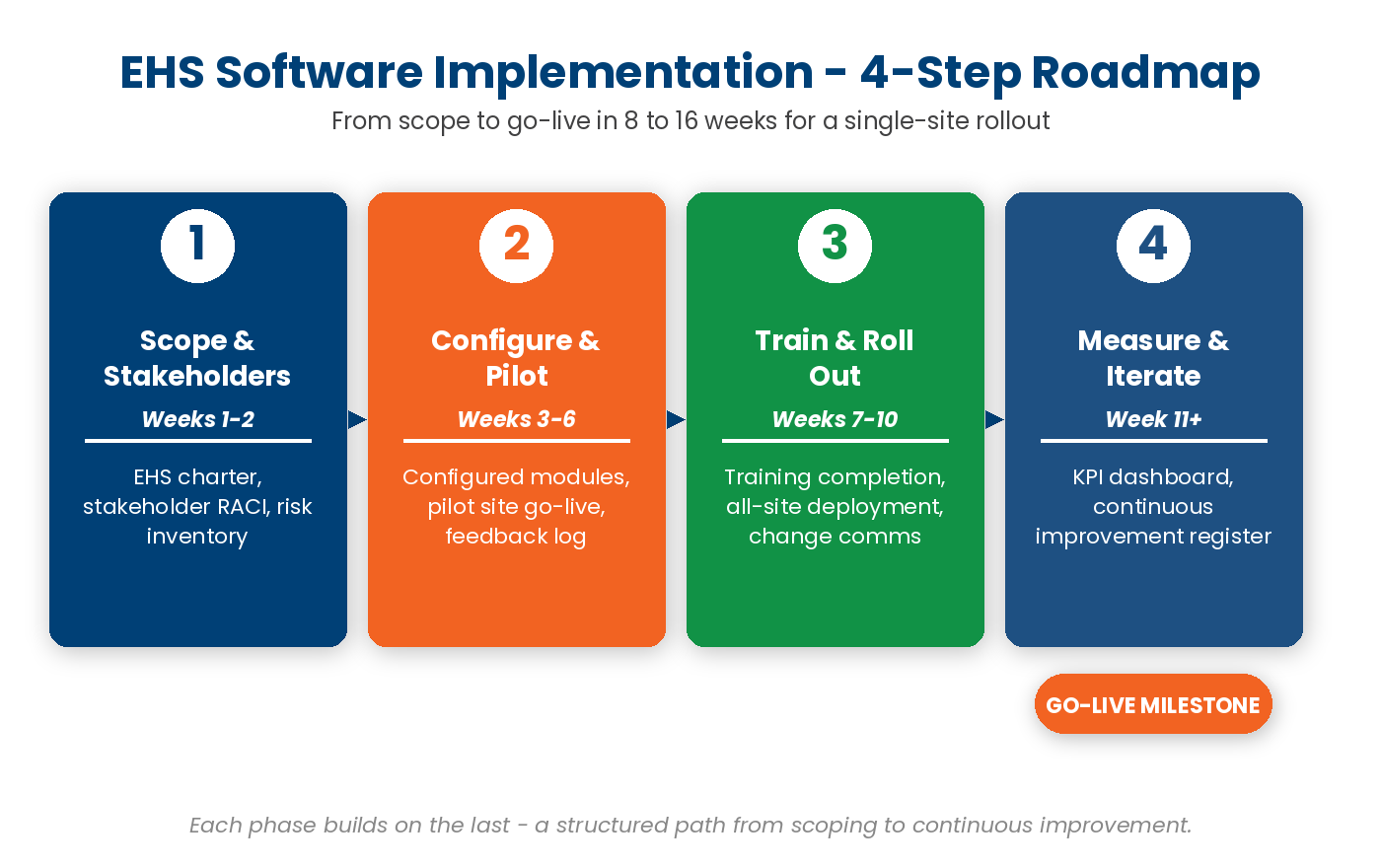
A configurable EHS implementation does not need to be a twelve-month change-management project. The diagram above shows the four high-level deployment phases — Scope, Configure, Train, Measure. Within those phases, the six implementation steps below are what we see succeed across mid-market and enterprise EHS programs — 8 to 16 weeks for a single-site rollout and 4–6 months for a multi-site enterprise.
Step 1 — EHS process inventory
Before any platform is configured, document how EHS actually runs today. List every inspection type and frequency, every incident classification, every permit type, every contractor onboarding step, every environmental reporting requirement, every training matrix, every report your EHS team produces. Mark which are mature (working as designed) and which are broken (paper, spreadsheet, “the way we’ve always done it”). The output is a one-page current-state map that becomes the implementation backlog.
This step is also where you discover redundancy — six slightly different inspection checklists for the same equipment, three competing contractor sign-in processes, two parallel incident logs. Consolidation in step 1 saves months later.
Step 2 — Risk register and HIRA setup
EHS programs run on risk, not paperwork. Build the enterprise risk register first: top hazards by site, control hierarchy in place, residual risk rating, owner. Configure the HIRA workflow — JHA at the task level, PHA for high-consequence operations, hazard reporting for in-the-moment observation. Risk feeds inspection: the high-risk hazards become the high-frequency inspection questions. Risk feeds permit: the high-consequence work becomes the permit catalog. Spend a week here and the rest of the rollout aligns naturally.
Step 3 — Inspection template configuration
Build the inspection templates the business actually uses — supervisor safety walks, environmental compliance audits, behavior-based safety observations, contractor work-area inspections, equipment pre-use checks, emergency equipment checks. Each template is anchored to a question library, an evidence requirement (photo, signature, reading), and an escalation path. Keep templates short and observable — most failing EHS programs have checklists that are too long, too subjective, and never get completed in field conditions.
For multi-site rollouts, build the corporate-standard template first, then allow site-level variants for site-specific equipment or process. Resist the urge to let every site invent its own checklist.
Step 4 — Incident workflow stand-up
Configure the incident workflow as a closed loop: report → triage → investigation → root-cause analysis → corrective and preventive action → Verified Closure. Set the verification step as a separate gate, not an automatic closure. Specify which roles can verify (typically not the same person who performed the action), what evidence is required (follow-up inspection, sample data, photographic confirmation), and what the verification window is (30, 60, or 90 days depending on severity).
Map your incident classifications to OSHA recordability so that every reportable incident automatically flows into the 300/301 log without re-keying. Map serious-incident escalation to the executive notification chain so the safety director doesn’t learn about a hospitalization from LinkedIn.
Step 5 — Contractor onboarding portal
Stand up the contractor onboarding portal as a separate-but-connected workflow. Pre-qualification questionnaire, insurance verification, training validation, site-specific induction, daily sign-in, in-app JSA acknowledgment, post-job incident tracking. Map your contractor population — who is on site this week, this month, this quarter — and load it. Set training expiration alerts so that the supervisor knows before the contractor shows up that their qualifications are expiring. For multi-tier exposure (contractor’s subcontractor), map the chain and require the prime contractor to maintain their sub’s records.
Step 6 — Reporting and dashboard rollout
Once the platform is capturing data, build the reports and dashboards. Supervisor-level: today’s inspections, today’s hazards, today’s open incidents. Plant manager: site TRIR trend, open high-severity hazards, contractor compliance, environmental exceedance flags. Corporate: multi-site TRIR / DART, near-miss ratio, contractor compliance rollup, environmental compliance posture. Hook the dashboards into the monthly EHS review and the quarterly executive review. Hook the underlying records into the regulator-facing exports — OSHA 300A, EPA TRI, ISO 45001 management review — so the reports build themselves.
We cover specific KPI benchmarks in EHS KPIs and benchmarks below.
EHS KPIs and benchmarks
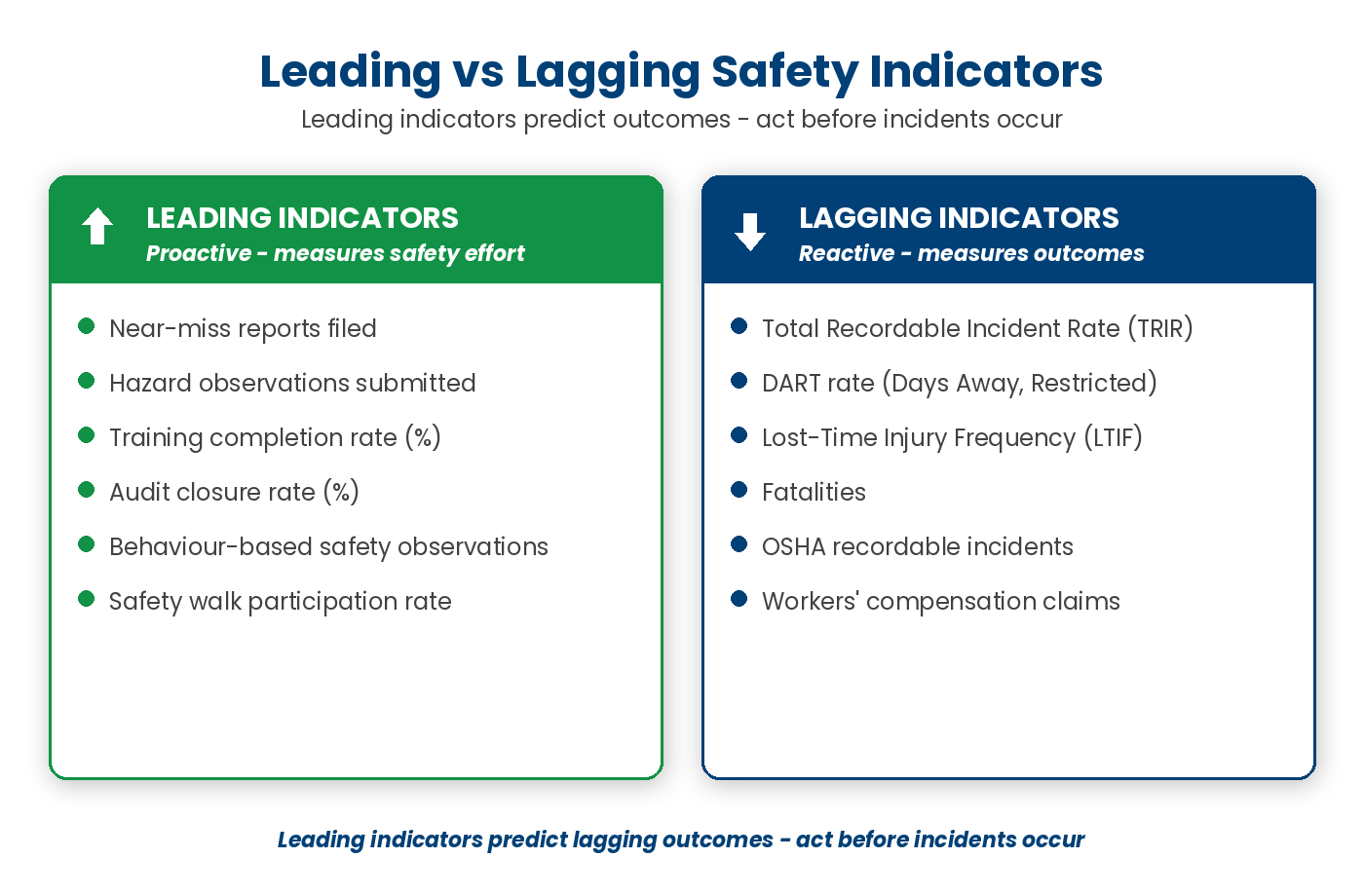
An EHS platform without KPIs is documentation infrastructure. An EHS platform with the right KPIs is a competitive advantage — and a defensible posture under regulator and insurer scrutiny. EHS leaders run two sets of measures: leading indicators that predict whether the system is working, and lagging indicators that show whether safety and environmental performance is actually improving.
Leading indicators (measure program health)
| KPI | Definition | Mature-program benchmark |
|---|---|---|
| Inspections completed on schedule | % of scheduled inspections completed within their window | ≥ 95% |
| Near-miss reporting rate | Near-misses reported per 100 employees per month | ≥ 5 — under-reporting indicates a fear-of-reporting culture |
| Hazards closed within target | % of identified hazards closed within the severity-based target window | ≥ 90% |
| Training completion on current revision | % of role-affected workers trained on the current procedure | ≥ 95% |
| Contractor compliance rate | % of active contractors with current pre-qualification, insurance, and training | ≥ 95% |
| Permit-to-work compliance | % of high-consequence work executed under a valid permit | 100% — this is a yes/no metric |
Leading indicators are the early warning system. If inspection completion drops below 90%, the lagging indicators will follow 2–3 quarters later. If near-miss reporting drops sharply, it is almost never because the workplace got safer — it is because workers stopped reporting.
Lagging indicators (measure safety outcomes)
| KPI | Definition | Notes |
|---|---|---|
| TRIR — Total Recordable Incident Rate | (Recordable injuries × 200,000) / total hours worked | OSHA’s anchor metric; benchmarked by NAICS |
| DART — Days Away, Restricted, Transferred | (DART cases × 200,000) / total hours worked | Subset of TRIR; the most expensive cases |
| Severity rate | (Lost workdays × 200,000) / total hours worked | Captures the depth, not just the count |
| Recordable injury count | Absolute count of OSHA-recordable injuries | Feeds the 300A annual summary |
| Lost-time injury count | Absolute count of injuries causing days away from work | Insurer- and customer-facing |
| Environmental exceedance count | Count of permit limit exceedances (air, water, waste) | Trend should be flat or downward |
| Serious injury and fatality (SIF) count | Actual or potential SIF events | Zero target; every event triggers executive review |
TRIR and DART are the metrics that customers, insurers, and prequalification platforms ask for. The lagging indicators are where executive attention belongs; the leading indicators are where the EHS team’s daily attention belongs. A platform that surfaces both, drilled-down to source records, is the platform you want.

EHS across industries
The core EHS architecture is consistent across industries, but the regulatory overlay, hazard profile, and operational specifics vary. Here is how it differs in the five largest industry segments — construction, manufacturing, oil and gas, mining, and utilities.
Construction
Construction has the highest absolute count of fatalities of any single sector in the US — over 1,000 deaths per year on average per the BLS Census of Fatal Occupational Injuries. The EHS stack must run OSHA 1926, support daily JSAs at the work-package level, manage subcontractor sign-in and qualification at scale (a single project can run hundreds of subs), enforce fall protection and scaffolding inspections, and handle permit-to-work for hot work, confined space, and energized electrical work. Multi-project visibility matters — a regional construction VP watches twenty sites and needs a single dashboard. CDM 2015 layers on UK construction work; Canadian construction adds provincial overlays.
Manufacturing
Manufacturing EHS runs on OSHA 1910, ISO 45001, ISO 14001, and customer-driven supplier safety requirements. Machine safety (LOTO, guarding, robotics), ergonomics, hazardous chemicals, and environmental compliance (air permits, hazardous waste) are the load-bearing modules. Multi-site rollup matters — a Tier 1 supplier runs plants on multiple continents and the corporate EHS function rolls up TRIR, near-miss, environmental exceedance across all of them. Integration with the quality management software platform is often required because incidents trigger CAPAs that may also affect product quality.
Oil and gas, energy
Oil and gas EHS is permit-heavy and contractor-heavy. Process Safety Management (29 CFR 1910.119) is the dominant standard. Permit-to-work, LOTO, confined space, hot work, and line breaking are the daily workflow. Behavioral-based safety (BBS) is widely used. Contractor management at scale — drilling, completions, workover, maintenance — is non-negotiable. Environmental compliance covers air emissions, produced water, NORM, and spill reporting. EHS for offshore and remote operations requires offline mobile capture as a hard requirement.
Mining
Mining EHS in the US sits under MSHA, not OSHA, with its own inspection and citation regime. Internationally, mining regulators vary by jurisdiction. The platform must run task-level JHAs at the working face, permit-to-work for high-consequence operations, contractor onboarding at scale, dust and noise monitoring, tailings management, and environmental compliance. Multi-jurisdiction operators need a platform that can handle MSHA in the US, provincial regulators in Canada, and DMP/DMRS-equivalent regulators in Australia and elsewhere.
Utilities
Utility EHS is dominated by electrical safety (NFPA 70E), switching authorizations, working at heights, and vegetation management. Storm response and mutual-aid work bring contractors in waves. Environmental compliance covers PCB management, SF6 leak detection, and vegetation-management herbicide application. EHS reporting feeds public-utility-commission filings and ESG disclosures. Many utility EHS programs are also responsible for industrial hygiene under industrial hygiene frameworks.
Utilities priority areas
Key Takeaways:
- A modern EHS platform is the digital system of record for inspections, incidents, hazards, permits, contractors, training, and environmental compliance — replacing paper, email, and spreadsheets with one defensible source of truth.
- The EHS capability spectrum spans inspection and audit, incident reporting and investigation, hazard identification and risk assessment (HIRA), permit-to-work and LOTO, contractor oversight, training, and environmental compliance — Certainty owns the execution core (inspections, observations, incidents, hazards, permits, audits, CAPA) and integrates with the LMS and environmental systems that complete the picture.
- Defensible evidence — timestamped, user-attributed, tamper-evident records with attached photo and signature evidence — is the brand-defining EHS posture under regulator, insurer, and litigation scrutiny.
- Verified Closure treats “complete” and “effective” as two separate events; it is what auditors look for under ISO 45001 Clause 10.2 and what differentiates programs that learn from incidents from those that repeat them.
- EHS software supports OSHA (29 CFR 1904/1910/1926), ISO 45001, ISO 14001, NFPA 70E, EPA programs, UK HSE, Canadian OHS, and the EU OSH framework in one configurable platform.
- The buyer’s framework: configurable workflows, multi-site native, mobile-first with offline mode, HRIS/ERP/ITSM integration depth, and defensible evidence audit trail.
- Escape Spreadsheet Hell — Excel and email is the #1 EHS program risk in mid-market enterprises; modern EHS platforms close the gap in 8–16 weeks per site.
- Measure leading indicators (inspection completion, near-miss reporting, hazard closure, training compliance, contractor compliance) and lagging indicators (TRIR, DART, severity rate, recordables, lost-time injuries, environmental exceedances) — both, every month.
Frequently Asked Questions (FAQs)
What is the difference between EHS and HSE?
EHS (Environment, Health and Safety) and HSE (Health, Safety and Environment) describe the same scope of work — workplace safety, occupational health, and environmental compliance — under different regional conventions. EHS is the dominant North American label; HSE is more common in the UK, Europe, the Middle East, and the oil and gas sector worldwide. The underlying capabilities of EHS software and HSE software are functionally identical; the choice between them is a labeling decision, not a technology decision.
Is EHS software required for ISO 45001 certification?
No — ISO 45001:2018 does not require software. The standard requires a documented Occupational Health and Safety Management System, hazard identification and risk assessment (Clause 6.1.2), operational planning and control (Clause 8), incident investigation and corrective action (Clause 10.2), internal audit (Clause 9.2), and management review (Clause 9.3). These can be implemented on paper. In practice, certification is significantly easier with EHS software because the audit trail, version control, multi-site rollup, and traceability requirements are difficult to satisfy with spreadsheets alone at any meaningful enterprise scale.
How does EHS software differ from a quality management system?
A quality management system (QMS) governs product and process quality — documents, internal audits, non-conformances, CAPA, supplier quality, and training against ISO 9001, IATF 16949, AS9100, or FDA cGMP. EHS software governs worker safety and environmental performance — inspections, incidents, hazards, permits, contractors, training, and environmental compliance against OSHA, ISO 45001, ISO 14001, and EPA. The disciplines overlap (both run audits, both have CAPA, both require training), and modern enterprises often run one configurable platform across both — but the regulatory regime, the data model, and the stakeholder set are distinct.
Can EHS software handle multi-site and international deployment?
Modern EHS software is built for multi-site, multi-language, multi-jurisdiction operation. The platform should support site-scoped data with corporate rollup, site-specific inspection templates with global master templates, worker interfaces in local working languages, and recordkeeping rules that match the local regulator (OSHA in the US, HSE in the UK, provincial regulators in Canada, member-state OSH authorities in the EU). Verify the multi-site claim by asking the vendor to demo one corporate dashboard with live data from sites in two countries.
How long does EHS implementation take?
A configurable, cloud EHS platform for a single site typically goes live in 8 to 16 weeks: process inventory and configuration in weeks 1–3, inspection templates in weeks 4–6, incident workflow in weeks 7–9, contractor and training in weeks 10–12, environmental and reporting in weeks 13–16. Multi-site enterprise rollouts run 4–6 months. Legacy enterprise EHS suites still quote 9–18 months because of heavy professional services and rigid data models.
What is OSHA recordkeeping?
OSHA recordkeeping is the regime under 29 CFR 1904 that requires covered employers to record work-related injuries and illnesses on the OSHA 300 log, document each on the OSHA 301 incident report, post the 300A annual summary in the workplace from February 1 to April 30 each year, and electronically submit the 300A (and for larger employers, the 300 and 301) to OSHA each year. A best-of-breed EHS stack automates the entire 300/301/300A workflow as a byproduct of incident management.
What is HIRA?
HIRA (Hazard Identification and Risk Assessment) is the proactive EHS process of identifying workplace hazards, assessing the risk each hazard presents, and applying the hierarchy of controls (elimination, substitution, engineering, administrative, PPE) to reduce risk to an acceptable level. HIRA is required by ISO 45001 Clause 6.1.2 and is the foundation of any credible safety program. Typical HIRA outputs include the enterprise risk register, job hazard analyses (JHAs) at the task level, and process hazard analyses (PHAs) for high-consequence operations.
How does EHS software help with contractor management?
Contractor management in an EHS software stack covers the full lifecycle: pre-qualification questionnaire (insurance, EMR, OSHA logs, training), document collection, site-specific induction, daily sign-in (often with QR code or geofencing), JSA acknowledgment in the worker’s language, in-flight incident tracking against the prime contractor, and post-job performance review. For enterprises with hundreds of contractors and multi-tier exposure, the platform must support multi-tier visibility and link contractor performance to procurement and site-access decisions. Integration with third-party prequalification platforms is common.
How does EHS software handle OSHA 300/301 logs?
A best-of-breed EHS stack automates the OSHA 300/301/300A workflow as a byproduct of incident management. When an incident is reported, the system walks the recordability decision (work-related, new case, days-away/restricted/transferred, medical-treatment-beyond-first-aid, loss of consciousness, fatality), classifies the case, populates the 301 incident report, generates the 300 log line, and rolls up the 300A annual summary. At year end, the platform produces the electronic submission file for the OSHA Injury Tracking Application.
What is Verified Closure in EHS?
Verified Closure is the discipline of treating “complete” and “effective” as two separate events in an incident or hazard workflow. A corrective action is complete when the assigned owner has performed it and provided evidence. An incident or hazard is closed only after a second verification — typically a follow-up inspection, a sample reading, or a fresh data point demonstrating the corrective action prevents recurrence. Verified Closure is what regulators, certification auditors, and insurers look for under ISO 45001 Clause 10.2 and OSHA enforcement practice.
Does EHS software help with ESG and CSDDD reporting?
Yes. EHS software is increasingly the system of record for the social and environmental data that ESG reporting frameworks (GRI, SASB, ISSB) and due-diligence regimes (EU CSDDD, German LkSG, French Devoir de Vigilance) require. TRIR, DART, fatality counts, training completion, contractor compliance, environmental emissions, water use, waste generation, and chemical inventory all live in the EHS stack. The platform must expose this data via API or scheduled export to the ESG reporting tool and produce the audit trail that external assurance providers will test against.
Related resources
EHS standards and regulatory foundations
- What is EHS and How Do You Stay Compliant?
- Industrial Hygiene: A Comprehensive Guide
- What is LOTO (Lockout/Tagout)?
- OSHA Recordable vs Reportable
- Spreadsheet errors in safety programs — why they’re more common than you think
- ISO 45001:2018 — Occupational Health and Safety Management Systems
- OSHA 29 CFR 1904 — Recordkeeping
EHS sub-disciplines and adjacent guides
- Safety Inspection Software: The Complete Guide
- Quality Management Software: The Complete Guide
- CAPA Software: The Complete Guide
Audit programs and checklists
- Safety Inspections Solution
- Audit Management Software
- Supplier Audits Solution
- The Benefits of a Layered Process Audit
Certainty platform resources
- Layered Process Audits: The Complete Guide
- A Comprehensive Guide to Root Cause Analysis
- 8D Problem Solving: A Guide for Businesses
- Poka Yoke: The Ultimate Guide to Error Prevention
Ready to modernize your EHS program?
Most EHS programs do not fail because the standards are unclear or the team is uncommitted. They fail because the evidence does not hold up — the inspection records were transcribed from memory, the contractor sign-ins live on paper, the incident closure was a tick-box. Defensible evidence and Verified Closure change the trajectory.
See how Certainty’s configurable, mobile-first platform handles safety inspections, incident reporting, hazard management, permits, and contractor oversight on one platform, with defensible evidence built into every record.