Supply Chain Compliance Software to Start Measuring Reliability for Audits.

Certainty turns supplier audits into defensible, audit-ready evidence with comparable data and verified closure through delegated actions and workflows. Remove adoption barriers so suppliers respond, not ignore.
Offline + mobile capture • Evidence attachments • Actions & workflows • Power BI reporting • SSO & enterprise governance
Why do supplier audit programs become an endless chase?

When supplier audits live in email threads, spreadsheets, and shared folders, you get partial responses, inconsistent evidence, and findings that never truly close.

Most supply chain teams spend the majority of their time chasing suppliers for data and only a fraction of their time actually managing performance. The risk is not just missed requirements. It is the inability to prove what was found, fixed, and sustained when customers, leadership, or regulators ask.

Legacy tools fail because they force rigid portals on suppliers who refuse to use them. This fragmentation creates a data black hole where you cannot report on risk or performance without manual collation.
What is defensible supplier evidence management?
Defensible supplier evidence management is an operational methodology that prioritizes high supplier adoption rates and audit-grade evidence over rigid portal controls. Unlike traditional systems that require complex logins, defensible evidence platforms use tokenized access to allow suppliers to submit sustainability, ESG and compliance data without barriers. This creates a single source of truth where every audit result is backed by context. Who completed it, when it happened, what was observed, and the supporting documentation needed to stand up to scrutiny. With Certainty, you can:
Attach photos, documents, and files directly to findings

Delegate actions in your supplier audit process
Configure checklist and action workflows
Maintain an evidence-grade system of record

How does Certainty turn supplier findings into verified closure?

Finding a nonconformance is step one. Certainty is built to drive verified closure, so issues get resolved, not just documented.

Digitize

Capture supplier audit data consistently (forms, mobile, offline support).

Standardize

Standardize results so metrics are comparable across suppliers, regions, and programs.

Act

Delegate actions and workflows to drive corrective action.

Optimize

Close with required evidence and clear accountability, with supporting analytics.

How do you get consistent, comparable supplier audit data at scale?

A supplier program only works if the data is consistent enough to compare. Certainty helps you standardize collection by:
Using your own supplier audit forms, or starting from the Certainty checklist library and adapting them
Enabling multi-step workflows so the right people can participate in audits, verification, and follow-up
Supporting structured answer types (signature, dropdown, ratings, GPS, barcode, conditional logic)

How does Certainty compare to traditional supplier portals?

Features at a Glance

Feature
Traditional Portals
Certainty Software
Feature
Supplier Access
Traditional Portals
Account creation & passwords (high friction)
Certainty Software
Tokenized access links (zero friction)
Feature
Data Submission
Traditional Portals
Desktop-heavy; difficult for frontline workers
Certainty Software
Mobile-first & email-integrated; works for any supplier
Feature
Primary Use Case
Traditional Portals
Annual compliance reporting (static)
Certainty Software
Operational reliability (dynamic quality, ESG, safety)
Feature
Adoption Rate
Traditional Portals
Low (requires constant chasing)
Certainty Software
High (removes the supplier barrier)
Feature
Workflow
Traditional Portals
Collect and store
Certainty Software
Collect, correct, and improve (automated CAPA)
Feature
Evidence Quality
Traditional Portals
Attachments in shared folders
Certainty Software
Audit-grade system of record with defensible evidence

How do you track nonconformances and corrective actions across your supply chain?

Track issues at the supplier level, or roll up by region, category, or program. With Certainty you can:
Create and delegate corrective actions while auditing
Set ownership and due dates, add evidence requirements, and document completion
Use automated notifications and escalations so issues do not disappear between teams

What regulations does Certainty help supply chain teams address?

The regulatory landscape for supply chain due diligence is accelerating. Certainty is pre-configured to handle data collection for major emerging and established frameworks:

How does Certainty turn ESG ambition into regulatory-grade evidence?

From policy to proof

Most organizations already have ESG commitments and reporting frameworks. The gap is between policy and proof. Regulators evaluating CSDDD, LkSG, and emerging due diligence mandates are not looking for scores or glossy sustainability reports. They want evidence of reasonable due diligence. Which suppliers you assessed, how you assessed them, what you found, and what corrective actions you took. Certainty gives you that evidence trail. Every supplier assessment, finding, and CAPA resolution is documented with ownership, timestamps, and supporting evidence in a single, auditable system of record.

Due diligence in weeks, not years

Standing up a CSDDD-grade supplier due diligence program does not have to be an 18-month platform project. Unlike large ESG or third-party risk management platforms that require dedicated implementation teams and internal change programs, Certainty is designed to get you operational quickly. Pre-configured program templates give you a starting framework aligned to major regulatory standards. Build your own due diligence checklist or use/modify one from our library to meet your needs. And structured onboarding means your team and your suppliers can begin submitting evidence without months of training or portal adoption friction.

What this enables:

Pre-configured program templates for CSDDD, LkSG, and ESG due diligence
Build your own due diligence checklist or use/modify one from the Certainty checklist library to meet your needs
Structured onboarding for internal teams and external suppliers
Workflow-driven CAPA tracking that creates the documented remediation trail regulators expect

What reporting do supply chain leaders need to prove due diligence?
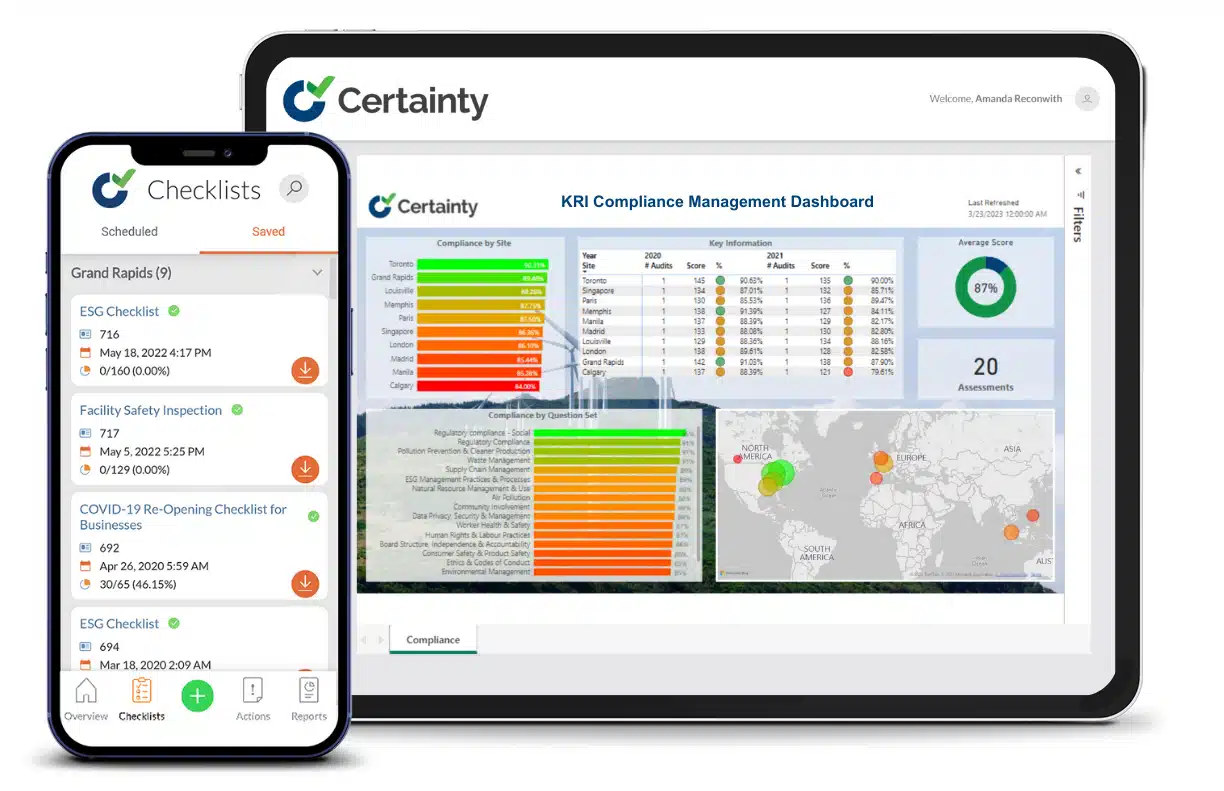
Certainty provides real-time dashboards and analytics so you can move from “we think” to “we can prove.”
With audit-ready reporting for leadership, customers, and regulatory readiness initiatives, you can:
View supplier performance trends and drill into supporting evidence
Filter and sort by supplier, region, checklist, finding type, or timeframe
Use Certainty’s powerful System Reports and Microsoft Power BI dashboards for executive-level visibility

How do you track nonconformances and corrective actions across your supply chain?

Track issues at the supplier level, or roll up by region, category, or program. With Certainty you can:
Multilingual support
Configurable access privileges and role-based controls
Single Sign-On (SSO)
Custom reporting
Data integration via APIs and OData feeds
Proof that Certainty works in enterprise supply chains
How DNV utilizes Certainty to manage global audits and inspections with ease.
Delivering world-renowned testing, certification, and technical advisory services to the energy value chain including renewables, oil and gas, and energy management, DNV is one of the world’s leading certification bodies that help businesses ensure the performance of their organizations, products, people, facilities throughout supply chains.
Read case study
DNV has Certainty

Set it so you don't forget it.

Certainty offers a range of notification features to ensure the follow through, completion and closure of all actions and tasks. These features include:
Configurable notifications and reminders for scheduled audits and inspections
Configurable and automated notifications based on the results of completed audits and inspections
Automated creation and delegation of corrective actions based on the result of completed audits and inspections
Configurable and automated escalation and notifications triggered by overdue actions
More automation features

Frequently Asked Questions About Supplier Audits

Yes. Supplier audits can be completed via browser or mobile workflows, with offline support where needed.

CAPA (Corrective and Preventive Action) assigns ownership, due dates, and evidence requirements so supplier findings move to verified closure, not just documentation.

Yes. You can create and manage multiple audit forms and workflows, standardize collection, and report comparable metrics across suppliers and programs.

Yes. Dashboards and analytics provide a real-time view of supplier performance and findings. You can extend reporting through Microsoft Power BI.

Certainty supports enterprise requirements like multilingual operation, role-based access, SSO, custom reporting, and integrations via APIs and OData feeds.

Yes. Certainty uses an adoption-first approach with tokenized access that removes login barriers. Even low-tech suppliers (like farmers or small factories) can submit data via mobile web forms or email links without training or complex login credentials.

Certainty automates remediation by triggering a Corrective Action (CAPA) workflow the moment a nonconformance is flagged during an audit. The system tracks the issue until the supplier uploads proof of the fix.

Yes. Certainty is designed to replace the spreadsheet-and-shared-folder trap by centralizing fragmented email attachments into a single, searchable dashboard for risk and performance.

Yes. Certainty supports intermediary workflows, making it the ideal platform for audit firms and consultancies managing multiple client supply chains with white-label capabilities.

For supply chain-focused ESG due diligence, yes. Certainty handles supplier assessments, evidence collection, CAPA-driven remediation, and audit-ready reporting without requiring a standalone ESG or third-party risk management platform. Organizations with broader ESG reporting needs beyond the supply chain (such as Scope 1–2 emissions accounting or investor-facing sustainability disclosures) may use Certainty alongside those tools, with Certainty serving as the operational evidence layer for supplier-facing programs.

Ready to replace email-chasing with evidence?

Build supplier reliability with defensible evidence and verified closure.