This blog is intended to serve as a guide for those leading their organizations through the changeover process. From project planning to ongoing support, we will discuss the key steps necessary in change management. You’ll learn how to successfully implement your new system while minimizing your risk of negative consequences […]
5 Certifications That Will Help Improve Your Business’s ESG Performance
Are you looking to improve your business’s ESG performance? Have you considered the benefits of ESG certification? In today’s world, where sustainable and socially responsible practices are increasingly important to stakeholders, ESG certification can help your business stand out as a leader in environmental, social, and governance responsibility. […]
The 6-Step Process to Supply Chain Sustainability Management: Reducing Human Rights and Environmental Risks in Your Supply Chain
Businesses in today’s market are under greater pressure to make sure that their entire supply chain is managed in a socially and environmentally sustainable manner. This pressure is driven by a number of factors. Some of these include increasing reputational awareness of the environmental and social impact of business operations from customers, investors, stakeholders, and regulatory bodies, and the volatility of supply chain disruptions. […]
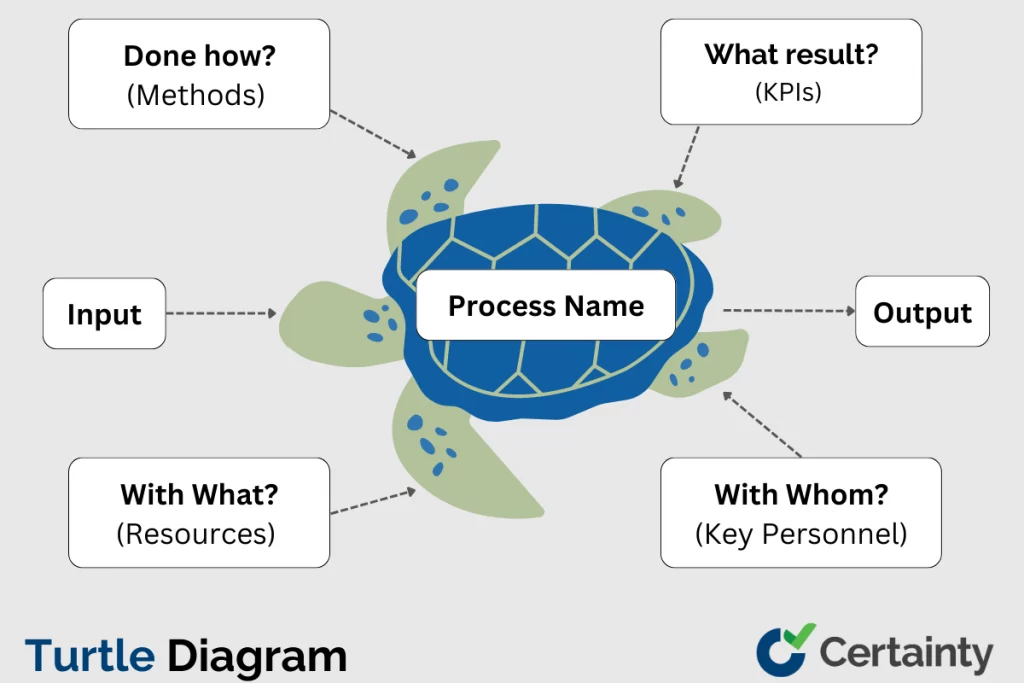
Turtle Diagram: Simplifying Your QMS Processes
Summary: A Turtle Diagram is a visual quality management tool that maps the inputs, outputs, resources, and controls of any process in a simple, intuitive format. It is widely used during ISO 9001, IATF 16949, and VDA 6.3 process audits to evaluate whether processes are adequately defined, resourced, and performing as intended. By breaking complex […]
ESG Metrics: A Guide to Sustainable Decision Making
The world of business is constantly evolving, and in recent years, there has been a shift toward sustainability and responsible investing. Companies are recognizing that their operations have an impact on the environment, society, and governance, and are taking steps to ensure that they are conducting their business in a more sustainable manner. As a result, more and more companies are turning to ESG metrics to measure their sustainability performance, identify risks, and make better decisions. But with so many metrics out there, are you tracking the right ones? […]
What are Supply Chain Risks and How to Manage and Mitigate Them
Supply chain disruptions and risks are becoming increasingly common, affecting businesses of all sizes and across various industries. The data speaks for itself – recently released by Resilinc’s EventWatchAI monitoring database, supply chain disruptions in Europe increased by 38% in 2022. To ensure business continuity and success in today’s global market, it’s crucial for companies to understand the various types of supply chain risks and implement effective risk management strategies. […]
Uncovering Hidden Risks in Your Supply Chain: The Importance of Supply Chain Due Diligence
Supply Chain Due Diligence is a critical process that companies must undertake to ensure that their sourcing, procurement, and supplier management practices align with responsible business standards and regulations. With the increasing focus on environmental, social, and governance (ESG) issues, the practice has become a vital aspect of risk management for companies of all sizes. […]
What is Supply Chain Sustainability and How to Manage it?
As consumers become more conscious of the impact their choices have on the environment and society, businesses are increasingly being held accountable for the sustainability of their global supply chain. With companies allocating upwards of 80% of their budget to procurement, supply chain sustainability has become a crucial aspect of corporate social responsibility. […]
ESG Materiality and Double Materiality: What They are and How to Assess
In sustainable investing, Environmental, Social, and Governance (ESG) considerations have gained significant momentum in recent years. Companies and investors alike are recognizing the importance of assessing and addressing ESG factors in their decision-making. Materiality and double materiality are key concepts within this realm of ESG investing. […]
What is a Supplier Risk Assessment – Why it’s Important
The general purpose of a supplier risk assessment is to ensure that a business is working with reliable and trustworthy suppliers. This is important because a company’s suppliers play a critical role in its overall operations, as they provide the raw materials, components, and services that are necessary to produce and deliver products and services to customers. […]