A FEOC — a foreign entity of concern — is a company that is owned by, controlled by, or subject to the jurisdiction of a “covered nation” the US government treats as an adversary: China, Russia, Iran, or North Korea. It was first defined in the 2021 Infrastructure Investment and Jobs Act for a Department of Energy battery-grant program, then imported by the Inflation Reduction Act as an eligibility test for electric-vehicle tax credits. In 2026 it has become one of the sharpest supply-chain screening problems in the market: a single FEOC-linked supplier buried three tiers down can now disqualify an entire battery, solar or critical-minerals project from federal clean-energy tax credits. This guide explains what a foreign entity of concern is, where the FEOC rules come from, who they now affect, and how to screen your supply chain for FEOC exposure before it costs you a credit. FEOC screening is one strand of a wider supplier program — for the full picture, see our complete guide to supplier and supply chain risk management.
Summary: FEOC — a “foreign entity of concern” — is a company owned by, controlled by, or subject to the jurisdiction of China, Russia, Iran, or North Korea, and a single FEOC link buried in your supply chain can disqualify a federal clean-energy or EV tax credit. First defined in the 2021 Infrastructure Investment and Jobs Act and expanded by the 2025 One Big Beautiful Bill Act to the §45X, §45Y and §48E clean-energy credits, FEOC is now a mapping, screening and evidence problem across every tier. The strongest programs don’t just collect supplier declarations — they verify them, document them, and improve them.
FEOC by the numbers
- 4 covered nations anchor the FEOC definition — China, Russia, Iran and North Korea. (US Department of Energy final interpretive guidance, 2024)
- A 25% ownership or control threshold — board seats, voting rights or equity held by a covered-nation government — is one trigger for FEOC status. (US DOE, 2024)
- The §30D battery-component FEOC bar applied from 2024, and the critical-minerals bar from 2025 — up to $7,500 of clean-vehicle credit turns on it. (US Treasury final rule, 26 CFR 1.30D-6)
- The One Big Beautiful Bill Act extended prohibited-foreign-entity rules to 3 energy credits — §45X, §45Y and §48E — signed into law on 4 July 2025. (IRS; Bipartisan Policy Center, 2025)
What is a Foreign Entity of Concern (FEOC)?
A foreign entity of concern is, at its core, a company the US government considers too closely tied to a hostile state to be trusted inside supply chains that receive federal support. The FEOC label doesn’t turn on what a company makes or sells — it turns on who owns it, who controls it, and whose laws it answers to. That is a very different question from the ones supply-chain teams are used to asking about price, lead time or quality, and it is why FEOC screening so often falls between the cracks of existing supplier processes.
The US Department of Energy’s interpretive guidance frames FEOC status around three tests: an entity is a FEOC if it is owned by, controlled by, or subject to the jurisdiction of a “covered nation.” Each test captures a different kind of exposure — a majority foreign shareholder, a controlling contractual relationship, or simply being incorporated and operating inside a covered nation. An entity only has to satisfy one of them. That breadth is deliberate: the rules are designed to catch control that a simple ownership check would miss.
Where the FEOC rules come from
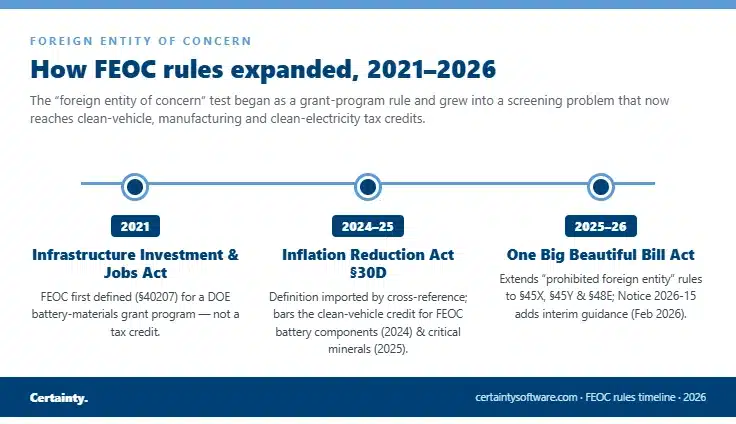
FEOC is not a single statute you can read cover to cover. It was first defined in the 2021 Infrastructure Investment and Jobs Act — for a Department of Energy battery-material grant program — and has since been written into several tax laws and interpreted through agency guidance. Two sources matter most for supply-chain teams today: the Inflation Reduction Act’s clean-vehicle credit, and the 2025 tax law that extended FEOC-style rules across the clean-energy economy.
The Inflation Reduction Act §30D clean-vehicle credit
The FEOC restriction most people first encountered came through Section 30D of the tax code — the up-to-$7,500 credit for new clean vehicles. The Inflation Reduction Act tied that credit to two escalating sourcing tests. First, for vehicles placed in service after 31 December 2023, the credit is unavailable if the battery contains any battery components manufactured or assembled by a FEOC. Second, from 2025, the credit is also unavailable if the battery contains critical minerals extracted, processed or recycled by a FEOC. (US Treasury final rule, 26 CFR 1.30D-6; Federal Register, 6 May 2024)
In May 2024 the Department of Energy issued final interpretive guidance defining what “foreign entity of concern” actually means, and Treasury issued a companion final rule explaining how automakers must trace and certify their battery supply chains. The practical effect was immediate: several EV models lost eligibility overnight because a component or mineral traced back to a covered-nation supplier. It was the first time many manufacturers had been forced to map their battery chain deep enough to know. (US DOE, 2024)
The One Big Beautiful Bill Act (2025)
The bigger shift came on 4 July 2025, when the One Big Beautiful Bill Act (OBBBA) was signed into law. It carried FEOC-style restrictions well beyond electric vehicles and into the core clean-energy tax credits — the advanced manufacturing production credit (§45X) and the technology-neutral clean-electricity credits (§45Y and §48E). In place of the §30D “FEOC” label, the new law uses the term “prohibited foreign entity” (PFE), and layers in a “material assistance” test that looks at how much of a project or component traces back to a prohibited entity. (IRS; Hogan Lovells, 2025) We unpack those provisions in more detail below — they are where most of the 2026 complexity now lives.
The covered nations and the ownership & control tests
Every FEOC analysis starts with the same four “covered nations”: the People’s Republic of China, the Russian Federation, the Islamic Republic of Iran, and the Democratic People’s Republic of (North) Korea. China is by far the most consequential in practice, given its position in battery, solar and critical-minerals supply chains. The harder part is the second question — how closely a supplier has to be tied to one of those nations to become a FEOC. The DOE guidance sets out the tests below.
| FEOC test | What triggers it |
|---|---|
| Subject to jurisdiction | The entity is incorporated or headquartered in — or performs the relevant activities (manufacturing, extraction, processing) in — a covered nation. Location alone can make a supplier a FEOC. |
| Owned or controlled (25% test) | A covered-nation government — including a senior official or the dominant political party — holds 25% or more of the entity’s board seats, voting rights, or equity interest, wherever the entity operates. |
| Effective control (licensing & contracts) | A licensing agreement, technology contract, or other arrangement gives a covered-nation entity effective control over production — for example, control over the workforce, the process, or key inputs — even without an equity stake. |
The “effective control” test is the one that surprises people. A US or third-country company with no covered-nation shareholders can still be captured if a licensing or technology-transfer arrangement hands a covered-nation partner real control over how a product is made. That is precisely the kind of relationship that lives deep in a bill of materials and never shows up in a standard supplier onboarding form — which is why FEOC exposure is a mapping problem before it is a legal one.
The July 2025 tax-law changes: prohibited foreign entities
The One Big Beautiful Bill Act reframed and widened the FEOC concept for clean-energy credits. Under the new rules, a prohibited foreign entity (PFE) is either a specified foreign entity (SFE) or a foreign-influenced entity (FIE). An SFE covers the entities closest to a covered nation — think government-linked and covered-nation companies. An FIE reaches further: an entity is foreign-influenced if a single SFE owns more than 25% of it, if one or more SFEs own 40% in aggregate, if SFEs hold at least 15% of its debt, or if an SFE has the authority to appoint a board member or officer. It can also be captured — for §45X, §45Y and §48E — through payments to an SFE under a contract that gives the SFE effective control over a project or production. These ownership, debt and board thresholds are set in the statute and were left undisturbed by Notice 2026-15. (IRS; White & Case, 2026)
Alongside the ownership and control tests, OBBBA introduced a “material assistance cost ratio.” In plain terms, it measures how much of a project’s or component’s direct costs trace back to prohibited foreign entities versus everything else, and requires that non-prohibited share to sit above a threshold percentage. The thresholds are set by statute and ratchet up each year. For clean-electricity facilities (§45Y and §48E) the required non-PFE share runs 40% for construction beginning in 2026, then 45%, 50% and 55% across 2027–2029, and 60% from 2030; for energy-storage technology it is steeper — 55% in 2026 rising to 75% by 2030. The §45X manufacturing credit sets its own per-component schedules that climb higher still, up to 85% for solar and battery components by 2030. A supply chain that clears the ratio today may fail a tighter one in a couple of years. (IRS; White & Case, 2026)
The effective dates differ by credit. Broadly, the material-assistance restriction for the clean-electricity credits (§45Y and §48E) applies to facilities that begin construction after 31 December 2025, while the §45X manufacturing credit applies to components sold in tax years beginning after the law’s July 2025 enactment. On 12 February 2026, Treasury and the IRS issued Notice 2026-15 to provide interim guidance on how to determine whether a project or component received “material assistance” from a prohibited entity. (IRS; White & Case; Nixon Peabody, 2026) Because these dates and thresholds are detailed and still developing, treat this section as a map, not a substitute for current legal advice — and verify the specifics that apply to your projects.
Who is affected by FEOC rules?
FEOC exposure started with automakers and their battery suppliers. It no longer stops there. If your business claims — or sells into a customer who claims — the affected federal credits, FEOC and prohibited-foreign-entity screening is now part of your supply-chain reality.
- EV and battery makers — the original §30D population: automakers, cell and pack manufacturers, and their component and cathode/anode suppliers.
- Clean-energy manufacturers — solar, wind, inverter, and battery-storage component makers claiming the §45X advanced-manufacturing credit.
- Project developers and owners — utility-scale solar, wind and storage projects relying on the §45Y and §48E clean-electricity credits, where a prohibited-entity link can jeopardise the whole project’s credit.
- Critical-minerals and processing supply chains — miners, refiners and recyclers of lithium, graphite, cobalt, nickel and rare earths, where covered-nation processing is common and hard to trace.
- Tier-2 and tier-3 suppliers — component and sub-component makers who may never claim a credit themselves but whose FEOC status flows up into their customers’ eligibility.
That last group is the crux. FEOC risk is inherited. A prohibited-entity relationship at a supplier you’ve never heard of, several tiers down, becomes your problem the moment it lands in a product you’re claiming a credit on. Understanding the difference between your tier 1, tier 2 and tier 3 suppliers — and being able to see through them — is the starting point for any credible FEOC program.
How to map and screen your supply chain for FEOC exposure
FEOC screening is manageable when you treat it as a repeatable program rather than a one-off scramble before a filing deadline. The work breaks into a clear sequence.
1. Map the products and chains in scope
Start with the credits you (or your customers) claim, and work back to the products that feed them. Build a bill of materials that reaches past your tier-1 suppliers to the components, minerals and processing steps that carry FEOC risk — batteries, cells, wafers, cathode/anode materials, and the critical minerals inside them.
2. Screen suppliers on ownership, control and jurisdiction
For each relevant supplier, run the three FEOC tests: where are they incorporated and operating, who owns 25% or more, and do any licensing or technology arrangements hand a covered-nation partner effective control? This is not a one-line country-of-origin check — it is a structured question set applied consistently across the base.
3. Trace sourcing to the material and processing level
Ownership isn’t the only exposure. A supplier with a clean cap table can still process minerals in — or buy components from — a covered nation. Trace critical minerals and key components back through extraction, processing and recycling, and capture where each step happens. This is the same deep-tier tracing that a mature supply chain due diligence program already does for forced-labour and ESG risk.
4. Collect and verify supplier attestations
Standardise how you ask suppliers to declare FEOC/PFE status, ownership structure and sourcing, and — critically — don’t stop at the declaration. Verify it against corporate records, prior audits and independent data, and follow up on the gaps. A declaration you haven’t checked is a liability, not evidence.
5. Reassess on a schedule, not just at onboarding
Ownership changes. Suppliers get acquired, licensing deals get signed, and the material-assistance thresholds tighten over time. Rescreen on a defined cadence and whenever a triggering event occurs, so a supplier that qualified last year doesn’t quietly become a FEOC exposure this year.
Documentation and evidence: proving FEOC compliance
With FEOC, the answer and the evidence for the answer are two different deliverables — and only one of them survives an audit. Treasury’s §30D framework already requires manufacturers to document and certify their battery supply chains, and the OBBBA material-assistance rules push the same expectation across §45X, §45Y and §48E. Your program needs a defensible record: which suppliers were screened, against which tests, on what date, with what supporting documentation, and what you did when something looked wrong.
That means capturing supplier attestations with timestamps and version history, storing the corporate-ownership and sourcing evidence behind each determination, logging follow-ups and corrective actions, and being able to reproduce the whole trail on demand. Recurring supplier audits turn one-off declarations into an evidenced, repeatable record — the difference between saying you’re FEOC-compliant and being able to prove it.
Turn FEOC screening into a repeatable supplier program. If your FEOC checks live in spreadsheets and email threads, every filing season starts from zero. Certainty lets you standardise the screening questions, collect and verify supplier attestations, and keep an audit-ready evidence trail across every tier — so you don’t just collect the data, you can prove it and improve it. See how supply chain due diligence works in Certainty →
FEOC vs OFAC sanctions screening: how they differ
Teams sometimes assume their existing OFAC sanctions screening already covers FEOC. It doesn’t. They overlap in spirit — both keep you away from adversary-linked entities — but they answer different questions, carry different consequences, and require different data. Running one does not clear you on the other.
First, a quick definition. OFAC is the US Treasury’s Office of Foreign Assets Control — the agency that administers and enforces US economic and trade sanctions in support of national-security and foreign-policy goals. OFAC screening is the process of checking your customers, suppliers, and their owners against OFAC’s sanctions lists — principally the Specially Designated Nationals and Blocked Persons (SDN) list — to confirm you are not transacting with a sanctioned party. Under OFAC’s “50 percent rule,” an entity is also treated as blocked if it is 50% or more owned, in aggregate, by one or more sanctioned persons — even if the entity itself isn’t named on a list. A match is a hard stop: it generally makes the transaction legally prohibited, not merely ineligible for a credit.
| FEOC screening | OFAC sanctions screening | |
|---|---|---|
| Core question | Is a supplier owned/controlled by, or subject to the jurisdiction of, a covered nation? | Is a party on a US sanctions list (SDN/blocked), or otherwise prohibited from dealing? |
| Basis | Tax-credit eligibility rules (IRA §30D; OBBBA §45X/§45Y/§48E) and agency guidance. | Economic sanctions administered by the US Treasury’s Office of Foreign Assets Control. |
| What it turns on | Ownership %, control, jurisdiction, and sourcing/processing of components and minerals. | Identity matching against named lists, plus the 50%-ownership rule for blocked persons. |
| Consequence of a hit | Loss of a tax credit — for you or your customer — and the value tied to it. | Legal prohibition on the transaction; potential civil or criminal penalties. |
| Reaches deep tiers? | Yes — FEOC status flows up from tier-2/3 suppliers into your eligibility. | Primarily the counterparties you transact with, though supply-chain diligence is expected. |
The practical takeaway: a supplier can be perfectly clear of OFAC sanctions and still be a FEOC that costs you a credit — for example, a company that isn’t on any sanctions list but is 25% owned by a covered-nation government, or that processes minerals inside a covered nation. FEOC needs its own screening logic, layered onto the sanctions checks you already run.
Building a repeatable FEOC screening program with Certainty
The organisations that handle FEOC well don’t treat it as an annual legal fire drill. They build it into the way they already manage suppliers — the same infrastructure they use for forced-labour, ESG and quality checks. Certainty gives that program a backbone: configurable forms to run the ownership, control and sourcing questions consistently; multi-stage workflows to collect and verify supplier attestations; dashboards to see exposure across your base at a glance; and audit-ready reporting to evidence every determination. The point isn’t to run one screening and file it. It’s to trace FEOC exposure across tiers, monitor it as ownership and thresholds shift, and improve control cycle after cycle — with the evidence to prove it. Don’t just collect the declarations. Verify them, document them, and make the program stronger each time you run it.
Key Takeaways:
- A FEOC (foreign entity of concern) is an entity owned by, controlled by, or subject to the jurisdiction of a covered nation — China, Russia, Iran or North Korea.
- The FEOC definition originated in the 2021 Infrastructure Investment and Jobs Act; the IRA §30D clean-vehicle credit imported it (battery components from 2024, critical minerals from 2025), and the One Big Beautiful Bill Act expanded it dramatically in July 2025.
- Prohibited-foreign-entity and material-assistance rules now reach the §45X, §45Y and §48E clean-energy credits — and FEOC status flows up from deep-tier suppliers into your eligibility.
- FEOC screening is not the same as OFAC sanctions screening — a supplier can pass one and fail the other, so you need both.
- Treat FEOC as a living supply-chain control: map, screen, verify, evidence and reassess — don’t just collect declarations, prove and improve them.
You might also be interested in

UFLPA Compliance
Forced-labour import rules, CBP enforcement, and building a defensible due-diligence program.

Supply Chain Due Diligence
How to evidence due diligence across your supplier base — the same infrastructure FEOC screening needs.

The German Supply Chain Act (LkSG)
What LkSG demands, who it reaches beyond Germany, and how to evidence compliance across tiers.
Frequently Asked Questions (FAQs)
What does FEOC stand for?
FEOC stands for “foreign entity of concern.” It describes an entity that is owned by, controlled by, or subject to the jurisdiction of a “covered nation” — China, Russia, Iran or North Korea. The term is used in US law to restrict which supply chains can qualify for certain federal clean-vehicle and clean-energy tax credits.
Which countries count as covered nations for FEOC?
The four covered nations are the People’s Republic of China, the Russian Federation, the Islamic Republic of Iran, and North Korea. An entity incorporated, headquartered, or performing relevant activities in any of these — or sufficiently owned or controlled by their governments — can be a foreign entity of concern.
What ownership percentage makes a company a FEOC?
Under the Department of Energy’s interpretive guidance, an entity is a FEOC if a covered-nation government — including a senior official or the dominant political party — holds 25% or more of its board seats, voting rights, or equity interest. Control can also arise through licensing or contractual arrangements that grant effective control, even without meeting the 25% ownership threshold.
How did the One Big Beautiful Bill Act change FEOC rules?
Signed in July 2025, the One Big Beautiful Bill Act extended FEOC-style restrictions beyond electric vehicles to the clean-energy credits under §45X, §45Y and §48E. It introduced “prohibited foreign entity” rules — covering “specified foreign entities” and “foreign-influenced entities” — and a “material assistance cost ratio” test that limits how much of a project or component can trace back to a prohibited entity.
What is OFAC, and what is OFAC screening?
OFAC is the US Treasury’s Office of Foreign Assets Control, the agency that administers and enforces US economic and trade sanctions. OFAC screening is the process of checking parties you deal with — and their owners — against OFAC’s sanctions lists, chiefly the Specially Designated Nationals and Blocked Persons (SDN) list. Under the “50 percent rule,” an entity 50% or more owned by sanctioned persons is itself blocked. A match legally prohibits the transaction, which is why sanctions screening is standard practice before onboarding any supplier or customer.
Is FEOC screening the same as OFAC sanctions screening?
No. OFAC screening checks whether a party is on a US sanctions list and legally off-limits. FEOC screening checks whether a supplier’s ownership, control, jurisdiction or sourcing disqualifies a supply chain from a tax credit. A supplier can pass an OFAC check and still be a FEOC, so the two screens are complementary and both are needed.
How do I screen my supply chain for FEOC exposure?
Map the products tied to the credits you claim, then screen the relevant suppliers on ownership, control and jurisdiction, and trace critical minerals and components back through processing. Collect and verify supplier attestations, document the evidence behind each determination, and reassess on a schedule. A compliance platform like Certainty standardises the questions, verifies responses, and keeps an audit-ready record across every tier.
Make FEOC screening a repeatable control, not a scramble
Certainty standardises supplier screening, verifies attestations, and turns FEOC checks into an audit-ready evidence trail across every tier — so you can prove eligibility and improve it cycle after cycle.