Summary: A HAZOP analysis is a structured process safety method that helps teams identify hazards and operability problems before abnormal conditions lead to incidents, downtime, or compliance failures. By examining how a process could deviate from intended design or operating parameters, HAZOP gives EHS and process safety leaders a disciplined way to prioritize controls under OSHA PSM and ISO 45001 frameworks. Its value is not just hazard identification, but earlier risk reduction in high-consequence operations.
Table of contents

A HAZOP (Hazard and Operability) analysis is a structured, team-based risk assessment method used to identify potential hazards and operational problems in industrial processes before they result in accidents, injuries, or costly failures. Process safety incidents cost the global economy more than $20 billion per year, causing deaths, environmental harm, and lasting reputational damage. For EHS managers, safety directors, and compliance officers working under OSHA PSM (29 CFR 1910.119) or ISO 45001 frameworks, HAZOP analysis is a foundational tool for proactive hazard identification and regulatory compliance.
Process safety focuses on locating and controlling potential risks and hazards in industrial processes. Despite its critical importance, many organizations struggle to implement effective process safety management systems — often lacking the structured methodology, cross-functional expertise, or digital tools required to conduct thorough hazard identification and risk assessment. HAZOP analysis directly addresses this gap.
Using a HAZOP study, safety teams can systematically predict potential risks and operational deviations in industrial processes. Founded on the principle of deviation analysis — examining what could happen if a process deviates from its intended design or operating parameters — HAZOP brings together a cross-functional team to surface hidden or unanticipated hazards that other risk assessment methods may miss. The result is a documented, auditable record of identified risks and recommended safeguards, directly supporting OSHA compliance and ISO 45001 continual improvement requirements.
What is a HAZOP Analysis?
HAZOP analysis is a systematic process hazard identification technique that evaluates how deviations from design intent in process parameters — such as flow, temperature, pressure, or composition — can lead to unsafe conditions or operational failures. Originally developed by Imperial Chemical Industries (ICI) in the 1960s to improve the safety and reliability of chemical engineering facilities, HAZOP has since become an industry standard across oil and gas, pharmaceuticals, power generation, nuclear, and chemical manufacturing sectors. It is explicitly referenced in IEC 61882:2016, the international standard for HAZOP studies, and aligns with the process hazard analysis (PHA) requirements of OSHA’s Process Safety Management standard (29 CFR 1910.119).
The primary goals of HAZOP analysis are to enhance workplace safety, prevent process accidents, and improve operational reliability. It achieves this by systematically evaluating each process node against a set of guide words to generate potential deviations — for instance, a change in flow rate, temperature, pressure, level, or chemical composition. Each deviation is then assessed for its potential causes, consequences, and existing safeguards, with new safeguard recommendations raised where gaps are identified.
HAZOP analysis offers several distinct advantages over other hazard identification and risk assessment methodologies, including:
- It is proactive and preventive — identifying hazards and operational deviations before they produce accidents, regulatory violations, or production losses.
- It is comprehensive — systematically addressing all process nodes and credible deviation scenarios rather than relying on experience alone.
- It is creative and inventive — the structured guide word methodology surfaces non-obvious failure modes that brainstorming or checklist-based approaches can miss.
- It is collaborative and participative — drawing on a diverse team of engineers, operators, safety professionals, and stakeholders to ensure multiple perspectives are captured and documented.
Key Objectives of the HAZOP Analysis
The three primary objectives of HAZOP analysis are to identify deviations from design intent, analyze their potential consequences, and recommend safeguards for each process node. For EHS and compliance teams, these objectives directly map to the hazard identification and risk control requirements of ISO 45001:2018 (Clause 6.1) and OSHA 29 CFR 1910.119.
Consider a process that involves heating a liquid in a reactor vessel. The team begins by defining the nodes (e.g., reactor vessel, heating system) and process parameters (e.g., temperature, pressure). Guide words such as “high,” “low,” and “no” are then applied to each parameter to generate deviations (e.g., high temperature, low pressure, no flow). The team then assesses the severity and likelihood of each deviation’s probable consequences — fire, explosion, equipment damage — before recommending safeguards such as high-temperature alarms, pressure relief valves, or revised operating procedures.
The following are the major objectives of HAZOP analysis:
- Identify potential deviations: What could go wrong in the process — covering all credible failures in flow, temperature, pressure, level, composition, and timing?
- Examine the consequences: What are the likely safety, environmental, and operational outcomes of each deviation — and how severe could they be?
- Recommend safeguards: What engineering controls, administrative procedures, or protective systems should be implemented to prevent or mitigate each identified deviation?
Fulfilling these objectives requires a methodical, structured approach. Process complexity can make deviation identification challenging; limited data can complicate consequence assessment; and cost or feasibility constraints can restrict safeguard selection. For safety directors managing multiple sites or complex operations, purpose-built audit and inspection software can significantly reduce the administrative burden of HAZOP documentation and action tracking.
How to Conduct a HAZOP Analysis
Understanding what HAZOP analysis is and why it matters is only the beginning. The real value lies in executing it rigorously and consistently. The following steps outline a proven, structured approach for conducting a HAZOP analysis — from team assembly through safeguard implementation — aligned with IEC 61882:2016 and OSHA PSM requirements.
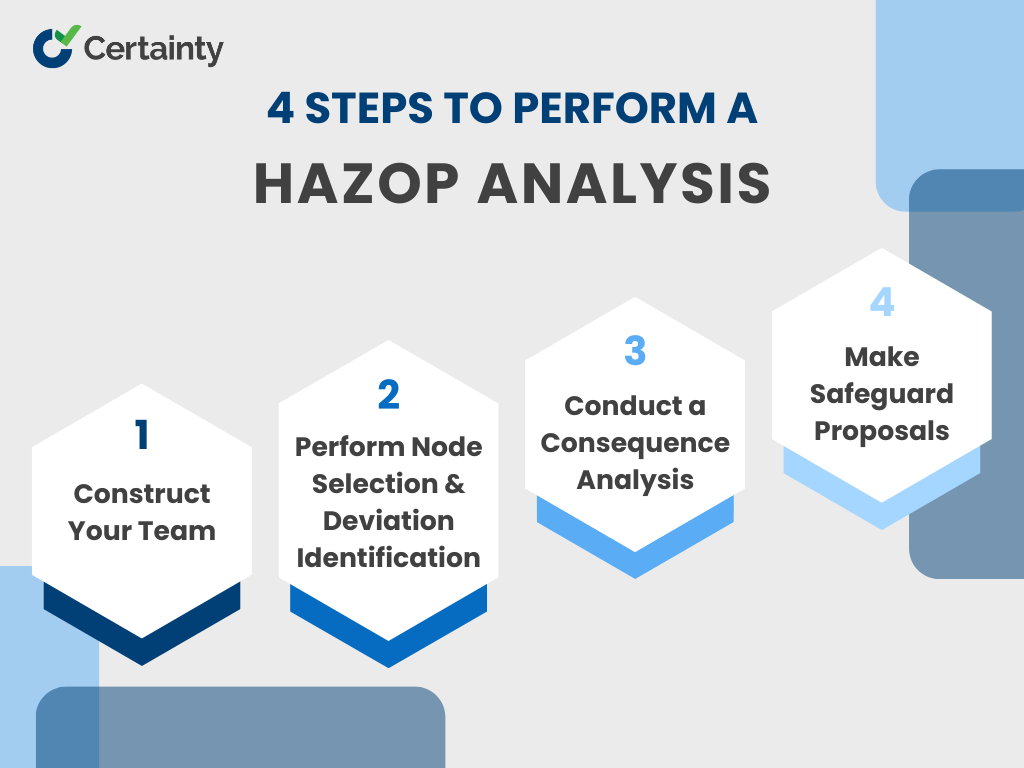
Step 1: Team Composition
A successful HAZOP analysis depends fundamentally on the quality and diversity of the team conducting it. The HAZOP team should include cross-functional specialists with complementary knowledge of process design, operations, safety, and compliance. Under ISO 45001 and OSHA PSM requirements, the team’s qualifications and participation must be documented as part of the formal process hazard analysis record. Your team should ideally contain the following roles:
- A leader or facilitator who guides the team through the HAZOP methodology, keeps sessions on track, ensures all nodes and guide words are addressed, and documents findings and action items in real time.
- A process engineer who provides technical expertise on process design, operating windows, control systems, and equipment performance.
- An operator who brings hands-on experience with day-to-day process execution, control, and maintenance — often the first to recognize realistic deviation scenarios.
- A safety specialist who advises on potential hazards, regulatory requirements (OSHA, NFPA, ISO 45001), and the hierarchy of controls.
- Other key stakeholders — such as quality assurance, environmental, maintenance, and management representatives — who provide input on process requirements, regulatory obligations, and business impact.
Effective team collaboration requires clear communication channels, well-defined roles, and documented expectations. All team members should receive adequate preparation on the HAZOP methodology and the specific process under review. Regular review meetings help monitor progress, ensure completeness, and maintain the quality of the HAZOP study throughout its duration.
Step 2: Node Selection and Deviation Identification
The second step is to define the process nodes — specific components or sections of the process at which deviations can occur. A node may be a pipe section, a valve, a pump, a heat exchanger, or a storage tank. Node selection should be guided by an up-to-date Process Flow Diagram (PFD) or Piping and Instrumentation Diagram (P&ID), which depicts the layout and connectivity of all process components. Nodes should be granular enough to enable meaningful deviation analysis without being so narrow that the study becomes unmanageable.
Once nodes are defined, the team identifies deviations for each — any divergence from the intended or normal operation of that node. Deviations are generated by systematically applying standardized guide words (GW) to each process parameter. This structured approach ensures that the team considers every credible failure mode, not just the obvious ones.
Common HAZOP guide words and their meanings include:
- No — complete absence of the intended parameter (e.g., no flow)
- More — increase above the intended value (e.g., high pressure)
- Less — decrease below the intended value (e.g., low temperature)
- Part of — only some components present (e.g., partial composition)
- Reverse — flow or process in the opposite direction
- As well as — additional components or contaminants present
- Other than — completely different substance or condition than intended.
A rigorous deviation identification process should capture all credible events that could affect each node — neither so broad as to be impractical nor so narrow as to miss critical scenarios.
The table below illustrates how nodes and deviations are selected and identified for a basic process involving heating water in a tank:
| Node | Parameter | Guide Word | Deviation |
| Tank | Temperature | No | No Temperature |
| Tank | Temperature | More | High Temperature |
| Tank | Temperature | Less | Low Temperature |
| Tank | Pressure | No | No Pressure |
| Tank | Pressure | More | High Pressure |
| Tank | Pressure | Less | Low Pressure |
| Tank | Level | No | No Level |
| Tank | Level | More | High Level |
| Tank | Composition | As well as | Water Contaminated |
| Tank | Composition | Other than | Water Replaced |
Best practices to optimize node selection and deviation identification include:
- Use PFDs and P&IDs that are current, accurate, and formally approved — outdated drawings are a leading cause of incomplete HAZOP studies.
- Break large, complex processes into smaller sub-processes or functional sections to maintain focus and thoroughness.
- Apply consistent terminology and units for process parameters across all nodes to ensure comparability.
- Select guide words that are relevant and appropriate for each specific parameter — not all guide words apply to every parameter.
- Use digital HAZOP tools to capture, organize, and track deviations, consequences, and recommendations in real time — reducing documentation burden and improving audit traceability.
Step 3: Consequence Analysis
The third step is to evaluate the probable consequences of each identified deviation. A consequence is any outcome or effect that could result from a process deviation — including worker injury, environmental release, product defect, equipment damage, or production loss. Each consequence is assessed against two dimensions: severity (the degree of harm or damage) and likelihood (the probability or frequency of occurrence). This risk matrix approach aligns with the risk assessment requirements of ISO 45001:2018 Clause 6.1 and supports OSHA PSM consequence documentation.
- Severity — the degree of harm or damage caused by a consequence. Measured on scales such as: Minor (no significant harm), Moderate (some harm requiring medical attention), Major (significant harm with lasting impact), or Catastrophic (fatalities, major environmental release, or facility destruction).
- Likelihood — the probability or frequency of a consequence occurring. Measured on scales such as: Rare (extremely unlikely under normal conditions), Unlikely (could occur but not expected), Possible (likely to occur at least once during the process lifetime), or Probable (expected to occur regularly without effective controls).
A thorough consequence analysis considers both short-term and long-term impacts, and both direct effects (worker injury, equipment damage) and indirect effects (regulatory penalties, production downtime, reputational harm). Supporting tools such as Fault Tree Analysis (FTA) or Event Tree Analysis (ETA) provide graphical models of how deviations escalate into consequences, and are particularly valuable for high-hazard processes subject to OSHA PSM or EPA RMP regulations.
The table below illustrates how consequences are assessed for selected deviations in the simple process of heating water in a tank:
| Deviation | Consequence | Severity | Likelihood |
| No Temperature | Water not heated | Minor | Rare |
| High Temperature | Water boils and overflows | Moderate | Unlikely |
| High Temperature | Water vaporizes and causes pressure build-up | Major | Possible |
| High Temperature | Water reacts with tank material and forms corrosive products | Major | Possible |
| High Pressure | Tank ruptures and releases water and steam | Catastrophic | Probable |
| No Level | Tank empty and heating system damaged | Moderate | Unlikely |
| Low Level | Tank partially empty and heating system inefficient | Minor | Possible |
Step 4: Safeguard Recommendations
The final step is to develop and document safeguard recommendations that reduce or eliminate identified hazards. A safeguard is any engineering control, administrative procedure, or protective device that prevents or mitigates the occurrence or impact of a deviation. Recommendations should be evaluated against three criteria: effectiveness (how well the safeguard prevents or reduces the deviation), feasibility (how readily it can be implemented and maintained), and cost (the resources required). OSHA’s hierarchy of controls — widely adopted across ISO 45001 programs — provides the preferred ranking for safeguard selection:
- Elimination: Remove the hazard or deviation source entirely from the process design — the most effective control level.
- Substitution: Replace the hazardous material, process parameter, or equipment with a lower-risk alternative.
- Engineering controls: Design or modify process equipment or systems to physically reduce the hazard — pressure relief valves, interlocks, automated shutdowns, containment systems.
- Administrative controls: Establish safe operating procedures, permit-to-work systems, training requirements, and inspection schedules to reduce human error and operational deviations.
- Personal protective equipment (PPE): Provide appropriate PPE as the last line of defense when engineering and administrative controls cannot fully eliminate residual risk.
The table below illustrates safeguard recommendations for selected deviations in the simple process of heating water in a tank:
| Deviation | Safeguard Recommendation | Effectiveness | Feasibility | Cost |
| No Temperature | Install a thermostat to monitor and control the temperature. | High | Easy | Affordable |
| High Temperature | Install a pressure relief valve to release excess steam. | High | Moderate | Expensive |
Benefits and Importance
Accident Prevention
The most critical benefit of HAZOP analysis is its proven ability to prevent catastrophic accidents and incidents. By systematically identifying and managing potential hazards and operational deviations before they escalate, HAZOP directly reduces the probability and severity of high-consequence events across industrial operations. Specific accident categories it helps prevent include:
- Fires, explosions, or toxic chemical releases that can result in worker fatalities, serious injuries, and significant environmental damage — with corresponding OSHA recordable and reportable incident consequences.
- Product quality failures, contamination events, or customer complaints that damage your organization’s reputation, market share, and regulatory standing.
- Production losses, unplanned downtime, or equipment damage that directly reduce operational throughput and profitability.
The historical record demonstrates HAZOP’s effectiveness in preventing major industrial accidents. HAZOP analysis was applied in the design of the Apollo spacecraft that landed on the moon in 1969, enabling engineers to identify and eliminate critical hazards in advance. Following the 1988 Piper Alpha oil platform disaster — which killed 167 workers and caused $3.4 billion in damages — HAZOP analysis became mandatory practice in the offshore oil and gas industry to prevent repeat tragedies of similar scale.
Regulatory Compliance
HAZOP analysis is a recognized and often required element of regulatory compliance frameworks applicable to high-hazard industries. OSHA’s Process Safety Management standard (29 CFR 1910.119) explicitly requires process hazard analysis (PHA) — for which HAZOP is one of the approved methodologies — for processes involving highly hazardous chemicals above threshold quantities. ISO 45001:2018 requires organizations to establish a systematic process for hazard identification and risk assessment (Clause 6.1.2), which HAZOP directly fulfills. NFPA and EPA Risk Management Program (RMP) regulations similarly emphasize documented hazard identification as a prerequisite for operational authorization.
Beyond avoiding regulatory penalties, fines, and enforcement actions, a well-documented HAZOP program provides competitive and commercial advantages:
- Improved credibility and trust with customers, investors, insurers, and regulatory bodies — demonstrating a mature, proactive safety management system.
- Enhanced market access and contract eligibility for clients and industries that require documented process safety management programs as a qualification criterion.
- Reduced insurance premiums and liability exposure — insurers frequently offer favorable terms to organizations that can demonstrate systematic, documented risk management capabilities.
Operational Excellence
Beyond safety and compliance, HAZOP analysis delivers measurable operational performance improvements by identifying and resolving latent process inefficiencies and reliability risks. Safety directors and operations managers consistently find that thorough HAZOP studies uncover optimization opportunities alongside hazard controls. Specific operational benefits include:
- Reduced waste, energy consumption, and environmental emissions by eliminating unplanned process deviations, shutdowns, and off-spec production runs.
- Increased process yield, throughput, and capacity utilization by resolving bottlenecks and reliability constraints identified during the HAZOP study.
- Improved product quality, consistency, and specification compliance through better process control, documented operating limits, and reduced variability.
HAZOP analysis also provides a structured foundation for process improvement and innovation:
- Identifying opportunities to introduce improved technologies, automation, or process modifications that simultaneously enhance safety and operational efficiency.
- Generating insights that inform new product or service development by exposing underutilized process capabilities or constraints.
- Building a documented knowledge base of process hazards and controls that supports onboarding, competency development, and management of change (MOC) programs.
With HAZOP integrated into your safety management system, you build a sustainable path to operational excellence — improving TRIR, inspection completion rates, and regulatory audit readiness while demonstrating the kind of proactive safety culture that ISO 45001 and OSHA recognize as best practice.
Challenges and Considerations
Resource Intensity
Despite its significant benefits, HAZOP analysis presents real implementation challenges that EHS managers and safety directors must plan for carefully. The most significant is resource intensity — the considerable time, expertise, and organizational commitment required to conduct a thorough HAZOP study for complex industrial processes.

30+ Audit and inspection checklists free for download.
A comprehensive HAZOP analysis involves multiple demanding activities that must be carefully coordinated:
- Preparing and verifying current process documentation — accurate PFDs, P&IDs, operating manuals, equipment data sheets, and safety data sheets — before the study begins.
- Assembling, scheduling, and preparing a cross-functional HAZOP team with the right mix of expertise across engineering, operations, safety, and compliance disciplines.
- Facilitating structured HAZOP sessions, capturing deviations, consequences, safeguards, and action items in real time with full traceability.
- Tracking, assigning, and verifying completion of all recommended safeguard actions — a critical step for regulatory compliance and ISO 45001 continual improvement.
Managing HAZOP resource requirements also demands sustained organizational commitment:
- Allocating adequate budget, personnel time, and specialized tools for the full scope of the HAZOP study, including follow-up action tracking and revalidation cycles.
- Scheduling HAZOP sessions with sufficient frequency and duration to maintain thoroughness — particularly for large, multi-unit facilities or processes subject to frequent management of change.
- Managing team dynamics effectively — minimizing groupthink, authority bias, and confirmation bias that can compromise the quality and independence of the analysis.
Practical strategies to streamline HAZOP while maintaining rigor include:
- Prioritizing the highest-risk or most complex process nodes and systems for detailed HAZOP analysis, applying risk-based scheduling to manage scope.
- Using purpose-built safety audit and inspection software to automate data collection, deviation tracking, safeguard recommendation management, and regulatory reporting.
- Clearly defining the HAZOP study’s objectives, scope, boundaries, and success criteria at the outset to prevent scope creep and ensure focused, productive sessions.
Human Factors
Human factors represent the second major challenge in HAZOP analysis — both as a source of quality and as a source of risk. The effectiveness of a HAZOP study is directly dependent on the people conducting it: their expertise, judgment, communication, and cognitive integrity throughout the process.
Human factors can enhance HAZOP quality when team members contribute positively:
- Providing creative, experience-based insights that surface non-obvious deviations or innovative safeguard recommendations that structured guide word application alone would not generate.
- Building team motivation and engagement through collaborative discussion, shared ownership of findings, and mutual accountability for action completion.
- Creating learning opportunities that build team competence, process knowledge, and safety culture — directly supporting ISO 45001’s worker participation requirements.
However, the same human factors can compromise HAZOP quality when not actively managed:
- Human errors — mistakes, oversights, or omissions during deviation identification or consequence assessment — can result in incomplete or inaccurate HAZOP findings, leaving real hazards unaddressed.
- Cognitive biases — including anchoring on familiar failure modes, confirmation bias toward expected outcomes, and groupthink — can distort the analysis and produce false confidence in the completeness of the study.
- Social pressures — conformity to authority, group polarization, or reluctance to challenge senior team members — can suppress valid concerns and result in critical deviations being overlooked or understated.
Streamlining the HAZOP Analysis Process
One of the core challenges of HAZOP analysis is managing the significant resource intensity — particularly the time and effort required to collect, track, document, and report accurate HAZOP data across multiple process nodes and study cycles. For EHS managers overseeing complex operations, manually managing HAZOP worksheets, action registers, and revalidation schedules creates real compliance risk: missed actions, outdated documentation, and gaps in audit readiness. Purpose-built audit and inspection software resolves these challenges by digitizing and automating the HAZOP workflow from study planning through corrective action closure.
With Certainty Software, safety teams can build and customize HAZOP study forms and checklists — or leverage ready-made templates from a comprehensive library — tailored to their specific process types and regulatory requirements. HAZOP sessions can be conducted online or offline using the mobile app or web-based platform, ensuring no data is lost even in remote or low-connectivity environments. Corrective actions identified during the study can be assigned, tracked, and escalated directly within the platform, with automated reminders that ensure nothing falls through the cracks. The analytics dashboard provides real-time visibility into HAZOP action closure rates, outstanding risks, and compliance status — giving safety directors the performance data they need for regulatory audits and ISO 45001 management reviews. And with enterprise-level data sharing capabilities, your HAZOP team can collaborate securely across sites and departments without the version-control problems of spreadsheet-based tracking.
If you’re ready to learn more about how Certainty Software can support your HAZOP goals – and overall safety goals, don’t hesitate to reach out to us for a 1-on-1, no obligations demo.
Frequently Asked Questions (FAQs)
What is the difference between HAZOP and a standard risk assessment?
A standard risk assessment typically evaluates known hazards against established criteria. HAZOP goes further by using a structured guide word methodology to systematically generate and evaluate credible process deviations — including scenarios that might not be identified through conventional risk assessment approaches. HAZOP is particularly suited to complex process systems where the interaction between parameters can create non-obvious hazard combinations.
How often should a HAZOP study be revalidated?
OSHA PSM (29 CFR 1910.119) requires process hazard analyses to be updated and revalidated at least every five years, or whenever significant process changes occur under the management of change (MOC) procedure. ISO 45001 also requires periodic review of hazard identification and risk assessment as part of the continual improvement cycle. Many high-hazard operations conduct partial HAZOP revalidations more frequently, particularly following incidents, near misses, or major equipment modifications.
What industries are required to conduct HAZOP analysis?
HAZOP is most commonly required in industries covered by OSHA’s Process Safety Management standard — including chemical manufacturing, petroleum refining, oil and gas, pharmaceuticals, and utilities. However, HAZOP best practices are applied broadly across any industry where process deviations can result in serious harm to workers, the public, or the environment — including food and beverage, mining, pulp and paper, and water treatment.
Can HAZOP software replace a qualified HAZOP facilitator?
No — HAZOP software is a tool that supports and enhances the work of a qualified HAZOP facilitator and team, not a replacement for human expertise and judgment. The value of software lies in streamlining documentation, action tracking, and reporting — freeing the team to focus on the quality of the analysis itself. A competent, experienced HAZOP facilitator remains essential to ensuring the study is thorough, unbiased, and aligned with regulatory requirements.
You might also be interested in: