Summary: Force field analysis is a change management tool that identifies the driving forces supporting a desired change and the restraining forces working against it. By systematically mapping and scoring these opposing forces, quality teams can develop targeted strategies to strengthen drivers and weaken barriers, leading to more successful process improvements. This technique is particularly effective when implementing quality management system changes, Lean initiatives, or corrective actions required by ISO 9001 or IATF 16949 audits.
Table of contents
What is Force Field Analysis?
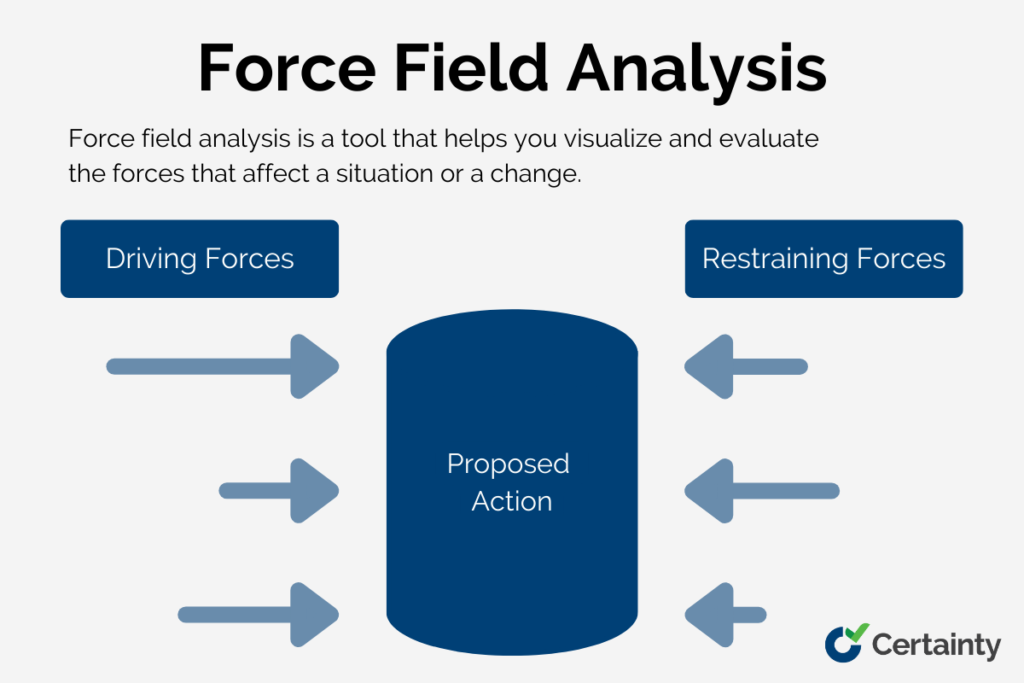
Force field analysis is based on the idea that any current situation or state is the result of a balance of power between driving forces and restraining forces. Driving forces are those that push for the desired change while restraining forces are those that resist or hinder it. To achieve the desired state, you need to either increase the driving forces, decrease the restraining forces, or both.
For Quality Managers, Plant Managers, and Process Improvement Leads working within frameworks like ISO 9001 or IATF 16949, force field analysis provides a structured way to evaluate the factors influencing quality initiatives. Whether you are trying to reduce non-conformance rates, improve first pass yield (FPY), or lower cost of poor quality (COPQ), understanding the balance between driving and restraining forces is essential for making data-driven decisions.
Force Field Analysis Origins
Force field analysis was developed by Kurt Lewin, a social psychologist and pioneer of organizational development. Lewin used the analogy of a field of forces to describe how the behavior of individuals and groups is influenced by various factors in their environment. He applied this concept to various fields, such as group dynamics, action research, change management, etc.
Today, QA Directors, Quality Engineers, and Lead Auditors apply Lewin’s methodology when managing transitions within quality management systems. Whether implementing FDA cGMP requirements in pharmaceutical manufacturing, rolling out VDA 6.3 process audits in automotive supply chains, or establishing HACCP controls in food production, force field analysis helps quality professionals systematically assess what is accelerating or impeding compliance and continuous improvement efforts.
What are the Advantages?
Force field analysis has several advantages as a decision-making tool for quality and process improvement professionals. Some of them are:
- Identify and prioritize the factors that affect your quality outcomes, such as audit completion rates, non-conformance trends, and corrective action cycle times.
- Assess the strength and impact of each factor on your goal or desired state, whether that is achieving ISO 9001 certification or reducing COPQ.
- Visualize the current state of your situation or change and compare it with your goal or desired state.
- Generate ideas for actions that can increase the driving forces and decrease the restraining forces, helping Quality Supervisors and QA Managers move from paper-based audits to digital workflows.
- Evaluate the feasibility and effectiveness of your actions and plan accordingly, using quality KPIs like FPY and time to resolution as benchmarks.
How to Perform a Force Field Analysis in Seven Steps
To perform a force field analysis, you need to follow these steps:
- Define the current state and the desired state of the situation you want to change. Be as specific and realistic as possible. For example, a VP of Quality Assurance may define the current state as a 12% non-conformance rate and the desired state as reducing it to under 5% within two quarters.
- Identify and list all the driving forces and restraining forces that affect the situation. You can use brainstorming techniques, stakeholder analysis, SWOT analysis, or other methods to generate ideas. Quality Engineers may identify driving forces such as management commitment to ISO 9001 compliance, and restraining forces such as audit fatigue across multiple sites.
- Assign a score to each force based on its strength and importance. You can use a scale from 1 to 5, where 1 is weak and 5 is strong. Alternatively, you can use qualitative labels, such as low, medium, or high.
- Draw a diagram that shows the current state, the desired state, and the opposing forces on each side. You can use arrows of different sizes or colors to indicate the scores of each force.
- Analyze the results and identify the most critical forces that need to be addressed. Look for common restraining forces in quality environments, such as manual corrective action processes, lack of cross-site comparability in audit data, or resistance to transitioning away from paper-based systems.
- Develop an action plan that outlines how you will increase the driving forces and/or decrease the restraining forces. You should also specify the roles and responsibilities of the decision-makers and stakeholders involved in the change process.
- Monitor and evaluate the progress and impact of your action plan using quality KPIs such as audit completion rates, FPY, COPQ, and time to resolution. Be prepared to adjust your plan as needed based on feedback and changing circumstances.
Example
Here’s a quick example of implementing a Force Field Analysis for a production company looking to improve both output and quality performance.
Goal or desired state: To increase the production capacity by 20% in the next six months while maintaining or improving first pass yield (FPY).
Driving forces:
- Customer demand is increasing and the company needs to meet it.
- The company has secured a new contract with a large client that requires more output.
- The company has access to new technology and equipment that can improve efficiency and quality.
- The company has a skilled and motivated workforce that is willing to learn and adapt.
Restraining forces:
- The company has limited space and resources to expand its facilities.
- The company faces competition from other manufacturers that offer lower prices or faster delivery.
- The company has to comply with strict safety and environmental regulations that may limit its options or increase its costs.
- The company may encounter resistance from some employees or suppliers who are used to the current way of working or who fear losing their jobs or business.
Diagram:
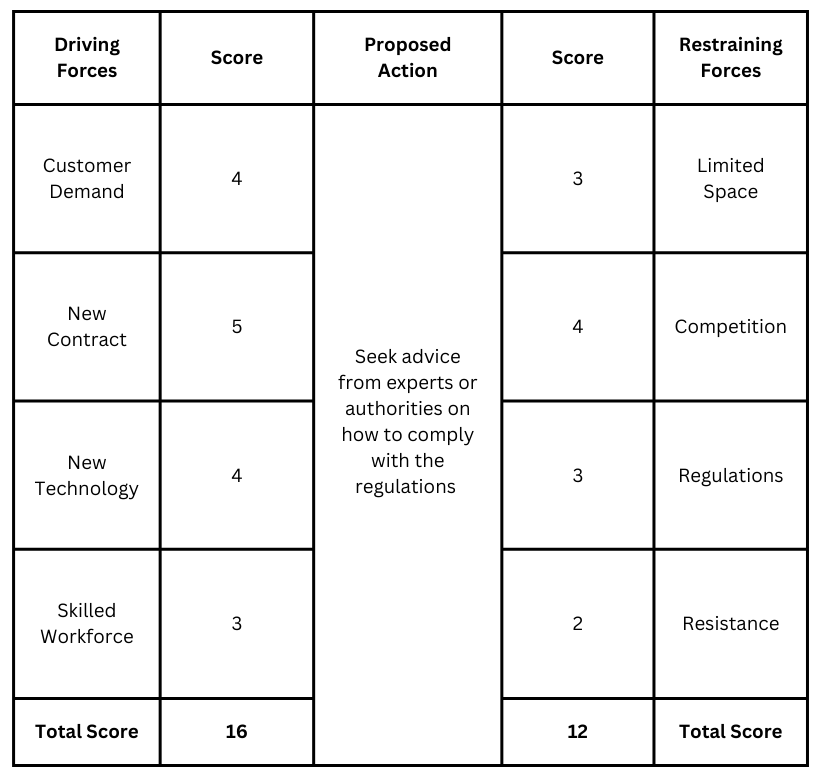
Total score: Driving forces = 16, Restraining forces = 12
Difference: 16 – 12 = 4
Analysis: The driving forces are stronger than the restraining forces, which means that the goal is achievable and the current state is favorable for change. However, the difference is not very large, which means that the situation is not very stable and the restraining forces could still hinder the change. Therefore, the company needs to take action to increase the driving forces and decrease the restraining forces. For example, the company could:
- Negotiate with the landlord or look for alternative locations to increase its space.
- Improve its marketing and customer service to differentiate itself from its competitors and retain its loyal customers.
- Seek advice from experts or authorities on how to comply with the regulations without compromising its performance or profitability.
- Communicate with its employees and suppliers about the benefits and challenges of the change and involve them in the planning and implementation process.

30+ Audit and inspection checklists free for download.
How Certainty Can Help
Certainty can help Quality Managers, Plant Managers, and Process Improvement Leads conduct force field analysis and make better decisions for your change management initiatives. Whether you are working toward ISO 9001 compliance, managing IATF 16949 audits, or overseeing FDA cGMP processes, Certainty helps you improve this analysis process in the following ways:
- Create and customize your own force field analysis forms or use pre-built templates aligned with your quality management system requirements
- Collect data online or offline using any device, such as a smartphone, tablet, or laptop, eliminating paper-based audit inefficiencies
- Assign scores and weights to each driving and restraining forces
- Generate and share real-time reports and dashboards that show the current state, the desired state, and the opposing forces with full cross-site comparability
- Create and delegate corrective actions to address the critical forces and monitor their progress, reducing time to resolution
- Integrate with other systems and tools, such as Excel, Power BI, Tableau, or SharePoint
Certainty is used by hundreds of thousands of users across various industries and sectors, such as manufacturing, construction, energy, healthcare, hospitality, and more. QA Directors, Quality Supervisors, and Lead Auditors rely on Certainty to ensure compliance, reduce risk, and improve performance with easy-to-use forms, real-time reports, and complete action management.
Book a quick demo with our team to see how we can help you with force field analysis and other inspection and audit needs.
Frequently Asked Questions (FAQs)
What is force field analysis and who developed it?
Force field analysis is a change management tool that helps you analyze the factors that support or oppose a proposed change, and make better decisions. It was developed by Kurt Lewin, a social psychologist and pioneer of organizational development.
What are the advantages of using force field analysis?
Force field analysis helps you identify and prioritize the factors that affect your situation or change, assess the strength and impact of each factor, visualize the current state and the desired state, generate ideas for actions, and evaluate the feasibility and effectiveness of your actions.
How do you perform a force field analysis?
To perform a force field analysis, you need to define the current state and the desired state, identify and list the driving forces and restraining forces, assign a score to each force, draw a diagram, analyze the results, and develop an action plan.
What is an example of using force field analysis in practice?
An example of using force field analysis in practice is a production company that wants to increase its production capacity by 20% in the next six months. The company uses this analysis to identify the driving forces (such as customer demand, new contracts, new technology, etc.) and restraining forces (such as limited space, competition, regulations, etc.) that affect its goal, and then plans actions to increase the driving forces and decrease the restraining forces.
How can force field analysis support quality management systems like ISO 9001?
Force field analysis is a valuable tool for quality professionals implementing or maintaining standards such as ISO 9001, IATF 16949, or FDA cGMP. It helps QA Managers and Quality Engineers systematically identify driving forces (such as leadership commitment, digital audit tools, and real-time data visibility) and restraining forces (such as paper-based audits, audit fatigue, lack of cross-site comparability, and manual corrective action processes) that affect quality outcomes. By scoring and addressing these forces, quality teams can build more effective action plans that improve KPIs like audit completion rates, non-conformance rates, first pass yield, and cost of poor quality.
You might also be interested in:

Spend Time On Prevention
Not Paperwork
Watch our overview video to see how your organization can benefit from Certainty.
Watch Video