Summary: Lockout/tagout protects workers and employers by isolating hazardous energy before maintenance or servicing begins, preventing unexpected startup and energy release. The benefits of LOTO include fewer serious injuries, stronger OSHA compliance, less equipment damage, and clearer accountability during high-risk tasks. For employers, a disciplined LOTO program lowers legal exposure and reinforces a safety culture built around controlled work, not shortcuts.
Table of contents

Working with energy-consuming or energy-storing equipment creates a significant risk of dangerous energy releases. In particular, this risk increases during maintenance, repair, or servicing activities when an unexpected startup can occur. The consequences can be catastrophic, including serious injuries, fatalities, equipment damage, and environmental harm. According to OSHA, hazardous energy incidents cause approximately 120 fatalities and 50,000 injuries every year in U.S. workplaces alone.
Lockout/Tagout (LOTO) is the federally mandated safety procedure for isolating hazardous energy sources before any service or maintenance work begins. Specifically, LOTO prevents machines and equipment from being energized accidentally or without authorization. As a result, it protects both workers performing the task and others in the surrounding area.
Furthermore, LOTO is not only an EHS best practice — it is a legal requirement. OSHA’s Control of Hazardous Energy standard, 29 CFR 1910.147, requires employers to establish a written energy control program. Employers must also train authorized and affected employees and conduct annual periodic inspections of LOTO procedures. Non-compliance is consistently one of OSHA’s most frequently cited violations. Most importantly, it carries substantial penalties and significant risk to worker safety.
Hazardous energy sources covered by LOTO requirements include electrical, mechanical, hydraulic, pneumatic, chemical, thermal, and gravitational energy. In other words, any form of energy that could injure a worker if released unexpectedly falls under these requirements.
Benefits of Loto for Workers and Employers
A well-implemented LOTO program delivers measurable safety and operational benefits across the organization. For workers, it provides direct protection from the most severe categories of workplace injury. These include electric shocks, arc flash burns, crush injuries, amputations, and falls caused by unexpected machine movement. Additionally, LOTO prevents explosions and fires. These are not theoretical risks — they are the documented outcomes of LOTO failures in workplaces across every industry.
For employers, the business case for LOTO compliance is equally compelling. A properly maintained LOTO program reduces unplanned downtime caused by equipment damage. It also lowers workers’ compensation costs and associated liability. Moreover, it shields the organization from OSHA citations and reputational damage. OSHA’s maximum penalty for a willful LOTO violation can exceed $156,000 per instance under current guidelines.
Beyond injury prevention, effective LOTO implementation supports broader operational goals. For example, it improves maintenance quality, extends equipment service life, and increases worker confidence. Employees who trust that energy hazards are properly controlled work more efficiently. Consequently, this directly impacts productivity and morale.
Under ISO 45001, LOTO falls within the operational controls framework (Clause 8.1). Specifically, organizations must plan, implement, and maintain processes to control hazardous energy as part of their overall occupational health and safety management system.
6 Steps of the Loto Procedure
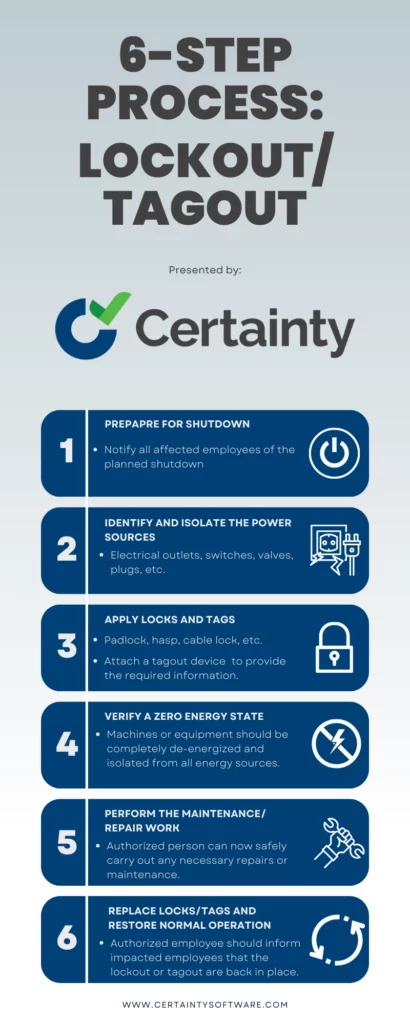
Six fundamental steps make up the energy control procedure under OSHA 29 CFR 1910.147. As such, authorized personnel — workers with the training, credentials, and authority to service machinery — must follow each step precisely and in sequence. Skipping or abbreviating any step creates uncontrolled energy hazard exposure.
1. Prepare for shutdown
Before any work begins, the authorized employee must notify all affected employees about the planned shutdown. Specifically, affected employees are those who operate or use the equipment subject to LOTO. The notification must cover the shutdown’s purpose and expected duration. As a result, this step ensures no worker attempts to operate the equipment during the maintenance window. Additionally, it establishes clear communication about the scope of the energy isolation activity.
2. Identify and isolate the power sources
The authorized employee must identify and isolate every hazardous energy source supplying power to the equipment. These sources include electrical disconnects, switches, valves, plugs, and stored or residual energy sources. For example, pressurized systems, springs, capacitors, and gravity-loaded components all require isolation. Complex equipment often has multiple energy sources. Therefore, the written LOTO procedure for each piece of equipment must enumerate all of them to ensure complete isolation.
3. Apply locks and tags
The authorized employee must apply a lockout device to each energy-isolating device. For instance, this device — such as a padlock, hasp, or cable lock — uses a unique key or combination. Consequently, it physically prevents the device from being operated or repositioned during the work.
In addition, a tagout device must be attached to each lockout device. The tag clearly identifies the authorized employee, the date and time of the LOTO application, and the reason for the lockout. Tags must warn all other employees not to operate or remove the lockout device. Where tagout-only programs exist (when lockout is not feasible), additional protective measures must follow 29 CFR 1910.147(c)(3).
4. Verify a zero energy state
Before performing any maintenance or repair work, the authorized employee must verify that the equipment is completely de-energized. To that end, the employee attempts to operate it using normal controls — switches, buttons, and levers — while all locks and tags remain in place. This “try-out” test confirms that the energy-isolating devices are in the correct position. Additionally, it confirms that no energy remains in the system.
Furthermore, calibrated testing instruments — such as voltmeters, clamp meters, and pressure gauges — must check for any residual stored energy. The zero-energy state must be verified both before work begins and re-verified if the worker leaves and returns. OSHA 29 CFR 1910.147(d)(6) explicitly requires this verification step.

30+ Audit and inspection checklists free for download.
5. Perform the maintenance or repair work
With zero energy verified, the authorized employee may now safely perform the required service, repair, or maintenance work. Throughout this phase, the worker must use appropriate tools, PPE, and follow the equipment manufacturer’s operating procedures. Moreover, the work area must remain secured, and unauthorized personnel must stay out. The authorized employee must maintain continuous control of their personal lockout device at all times.
6. Replace locks and tags and restore normal operation
Upon completing the work, the authorized employee must verify that the equipment is safe to return to service. Specifically, all materials, tools, and debris must be removed from the work area. Similarly, all guards and safety devices must be reinstalled, and all personnel must be clear of the equipment.
Only the same authorized employee who applied the locks and tags may remove them — OSHA prohibits removing another employee’s lock except under specific, documented emergency procedures. Affected employees must receive notification that LOTO devices have been removed before the equipment is re-energized. A final inspection and reenergization test then confirms that the equipment operates correctly and safely before returning to normal production.
Types of Locks and Tags Used for Loto
Locks and tags are the physical enforcement mechanism of the LOTO procedure. They must be substantial enough to prevent energy-isolating devices from being operated accidentally. Additionally, they must be durable enough to withstand the environmental conditions of the workplace. OSHA 29 CFR 1910.147(c)(5) specifies requirements for lockout/tagout device durability, standardization, and identifiability. Common LOTO device types include:
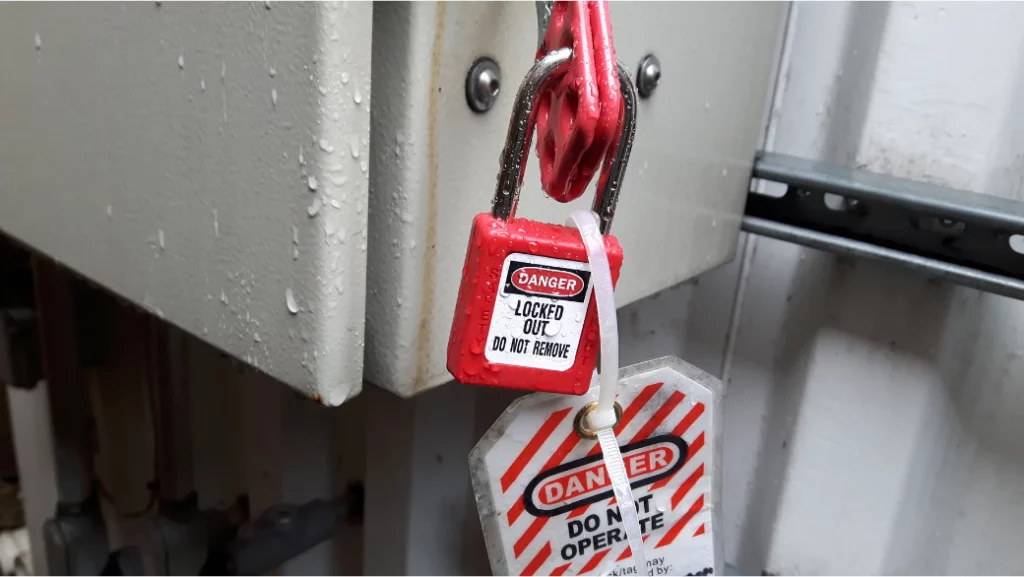
Padlocks
Padlocks are the most common lockout device. Workers use them to secure energy-isolating components such as electrical disconnects, switches, valves, and plugs. Each padlock must have a unique key — meaning only the authorized employee who applied it holds the key. OSHA requires padlocks to withstand at least 50 pounds of force. Consequently, they must be manufactured to prevent removal without excessive force or unusual techniques.
Hasps
Hasps are multi-hole devices that allow multiple padlocks on a single energy-isolating point. This is critical in group LOTO situations where multiple authorized employees work on the same equipment. Each worker applies their personal padlock to the hasp. As a result, the equipment cannot be re-energized until every worker removes their lock and confirms their work is complete. Manufacturers must make hasps from durable, non-conductive materials.

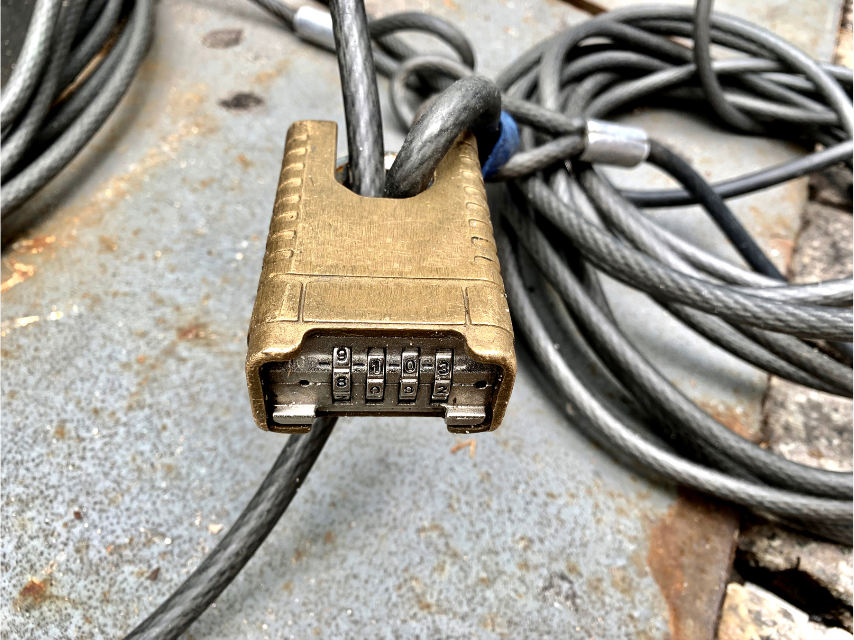
Cable Locks
Cable locks are flexible lockout devices designed for large or irregularly shaped energy-isolating components. For example, they secure levers, pipelines, valve handles, and multi-point energy sources that cannot accommodate a standard padlock. The cable loops around the energy-isolating device and a padlock or integrated mechanism secures it. Manufacturers must make cable locks from non-conductive, cut-resistant materials appropriate for the energy hazard present.
Valve Covers
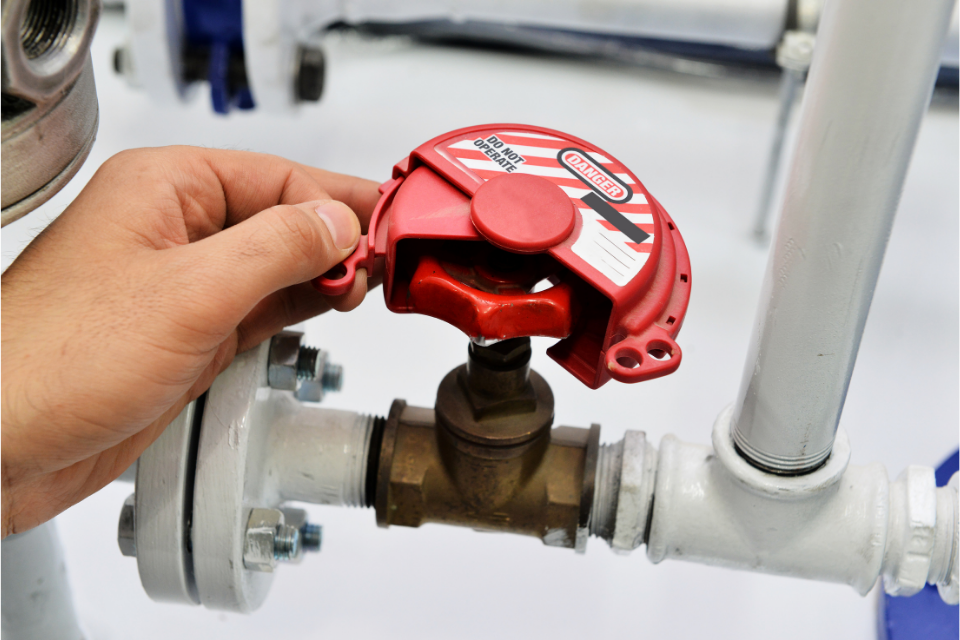
Valve covers (also called valve lockout devices) are rigid enclosures that fit over gate valves, ball valves, butterfly valves, and other handle-equipped energy-isolating devices. They physically block valve operation, and a padlock secures the cover in place. Notably, valve covers must fit tightly and consist of non-conductive rigid materials. They must also match the specific valve type and pipe diameter to prevent improvised bypasses.
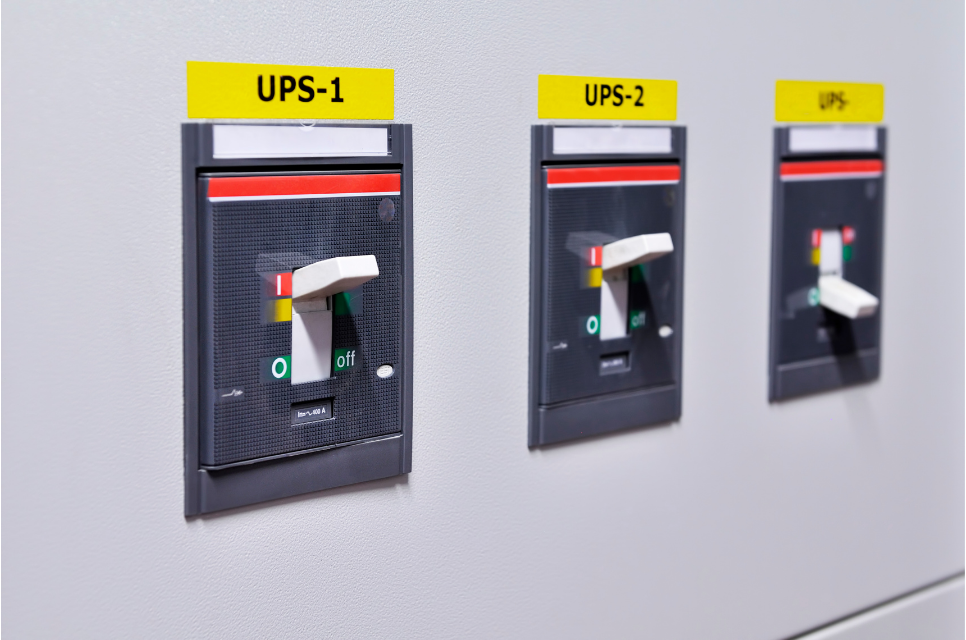
Circuit Breakers
Circuit breaker lockout devices secure electrical circuit breakers in the off position. This prevents the circuit from being re-energized during maintenance. They attach directly to the breaker toggle or handle, and a padlock secures them. In accordance with NFPA 70E requirements for electrical safety, these devices must be non-conductive. Above all, they must prevent the breaker from being switched on regardless of the force applied.
Warning Signs & Labels
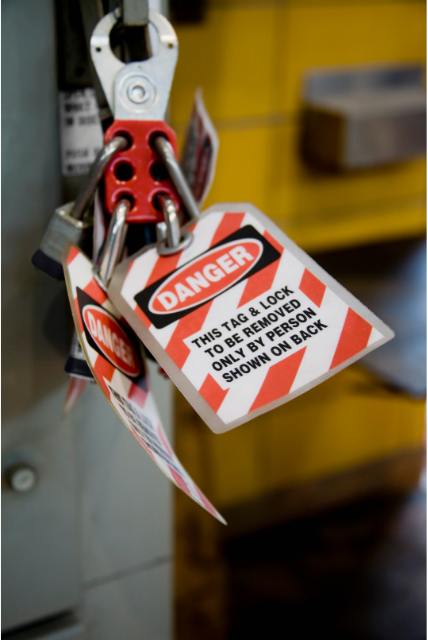
Tagout devices — warning signs and labels — provide the communication component of LOTO. They must be visible, legible, and durable enough to withstand the environmental conditions at the point of use. Per OSHA 29 CFR 1910.147(c)(5)(ii), tags must include a warning statement against hazardous operation. They must also show the identity of the authorized employee and the date of application. However, tags alone do not provide the physical restraint of a lockout device. They supplement locks and serve as the only option when equipment design does not accommodate lockout.
Roles and Responsibilities of Employees Involved in LOTO
OSHA 29 CFR 1910.147 defines three distinct employee roles in the LOTO process. Each role has specific training requirements and responsibilities. In fact, understanding and communicating these roles is essential for compliance. It also ensures every worker near LOTO-controlled equipment knows what to expect.
Authorized employees: Authorized employees receive training and qualifications to apply and remove LOTO devices. In addition, they perform maintenance or repair on equipment subject to LOTO. These workers bear primary responsibility for following the documented LOTO procedure precisely. They must verify zero energy state and ensure the safety of themselves and anyone else working on the same equipment. OSHA requires authorized employees to receive training specific to the energy sources and equipment they service.
Affected employees: Affected employees operate or use the machines subject to LOTO. Their responsibility is to comply with the LOTO program. Specifically, they must not attempt to restart, re-energize, or interfere with any LOTO device during maintenance. Affected employees must learn to recognize LOTO devices. Furthermore, they must understand that removing another employee’s lock or bypassing LOTO controls is strictly prohibited.
Other employees: Other employees work in areas where LOTO takes place but have no direct role in the service or maintenance work. They must learn about LOTO procedures and recognize LOTO devices. Most importantly, they must never interfere with lockout or tagout devices or attempt to operate locked or tagged equipment. Effective hazard communication — including visible signage and pre-task briefings — is critical for this group.
Common Mistakes and Challenges of LOTO Implementation
LOTO failures are a leading cause of catastrophic workplace injuries. In fact, OSHA’s annual list of most-cited standards consistently places 29 CFR 1910.147 in the top 10. This reflects persistent compliance gaps across industries. Understanding the most common LOTO implementation failures enables safety teams to prioritize their corrective action efforts:
Lack of training: Workers who have not received documented, role-specific LOTO training may not understand the risks of hazardous energy. Similarly, they may apply and remove LOTO devices incorrectly. OSHA requires retraining whenever there is reason to believe a worker’s knowledge is inadequate. For example, retraining must occur after procedural changes or observed non-compliance.
Lack of communication: Workers not informed of active LOTO operations may unknowingly approach locked-out equipment. In some cases, they may attempt to operate it. Therefore, clear pre-job briefings, visual communication at the point of lockout, and a site-wide LOTO log are critical safeguards.
Lack of coordination: In group LOTO situations or complex multi-energy-source lockouts, inadequate coordination between workers can cause problems. For instance, locks may be applied or removed out of sequence. Similarly, workers returning to a task may skip zero-energy verification. Documented group LOTO procedures with a designated coordinator are essential for managing these risks.
Lack of compliance: Workers under time pressure may take shortcuts — bypassing LOTO entirely or applying it incompletely. However, a strong safety culture, supervisory oversight, and periodic unannounced LOTO inspections are the most effective countermeasures. Organizations with ISO 45001 certification must demonstrate systematic control of LOTO compliance as part of their OH&S management system audit.
Lack of documentation: Failing to maintain written LOTO procedures, training records, and inspection logs creates both compliance risk and operational confusion. OSHA 29 CFR 1910.147(c)(4) explicitly requires written energy control procedures. In addition, 29 CFR 1910.147(c)(6) requires annual periodic inspections — both documented and certified.
Best Practices and Tips for Effective LOTO Management
Sustainable LOTO compliance requires more than a written program. In fact, it requires ongoing management, training, auditing, and continuous improvement. The following best practices reflect guidance from OSHA, ISO 45001, and industry experience across high-hazard industries:
- Conduct annual periodic inspections of each LOTO procedure (required by 29 CFR 1910.147(c)(6)) and document the inspection, the employee who performed it, the date, the machines covered, and any deficiencies identified. Use these inspections to update procedures when equipment or maintenance tasks change.
- Provide initial and refresher LOTO training to all authorized and affected employees. Training must be role-specific, cover the hazardous energy sources relevant to each employee’s work, and be documented with employee acknowledgment. Retrain whenever procedure changes, equipment changes, or observed non-compliance warrant it.
- Establish standardized communication protocols — including pre-job briefings, LOTO logs, and visual signage — so that all workers in the area know when LOTO is active, what equipment is affected, and who holds the locks.
- Standardize and inventory LOTO devices by equipment type and energy source. Use color coding or numbered systems to match devices to specific machines or procedures. Conduct regular audits of LOTO device inventory to ensure availability and serviceability.
- Implement a group LOTO system for complex equipment or multi-employee maintenance tasks. Use a lock box or multi-lock hasp to store and secure individual LOTO device keys, ensuring the equipment cannot be re-energized until every worker has removed their personal lock and confirmed completion of their portion of the work.
- Enforce a strict individual accountability policy: only the authorized employee who applied a LOTO device may remove it. Emergency removal procedures — for situations where the authorized employee is unavailable — must be documented, require supervisor authorization, and must verify the employee has vacated the work area before removal.
How Certainty Helps in LOTO Safety
Certainty provides audit and inspection management tools that help EHS teams maintain rigorous LOTO compliance. Specifically, these tools cover everything from procedure verification to corrective action tracking. Available checklists for LOTO and related safety programs include:
- Facility Safety Inspection Checklist
- Jobsite Safety Inspection Checklist
- Warehouse Safety Inspection Checklist
- Behavioral Based Safety Observation Checklist
- Hot Work Permit Checklist
By using Certainty and its inspection checklists, you can ensure that your LOTO program stays current, relevant, and compliant with 29 CFR 1910.147 and ISO 45001 requirements. Additionally, Certainty’s platform enables you to identify procedure gaps, assign corrective actions, track closure, and generate audit-ready documentation. This documentation proves essential during OSHA inspections or management system audits. Explore how Certainty supports your safety inspection and compliance performance.
Frequently Asked Questions (FAQs)
What does LOTO stand for in safety?
LOTO stands for Lockout/Tagout. It is a workplace safety procedure — mandated by OSHA under 29 CFR 1910.147 — that requires the isolation and physical securing of hazardous energy sources before authorized employees perform service or maintenance on machinery or equipment. Lockout involves applying a physical locking device to an energy-isolating mechanism; tagout involves applying a warning tag when lockout is not feasible.
What are the 6 steps of a LOTO procedure?
The six steps of a LOTO procedure are: (1) Prepare for shutdown by notifying affected employees; (2) Identify and isolate all hazardous energy sources; (3) Apply locks and tags to all energy-isolating devices; (4) Verify a zero energy state using normal controls and calibrated test instruments; (5) Perform the maintenance or repair work safely; and (6) Remove locks and tags and restore normal operation after verifying the equipment is clear and safe.
Who is responsible for LOTO compliance?
OSHA places responsibility for LOTO compliance on the employer, who must establish a written energy control program, provide training for all authorized and affected employees, and conduct annual periodic inspections. Within that framework, authorized employees are responsible for correctly applying and removing LOTO devices, affected employees are responsible for not interfering with LOTO controls, and supervisors are responsible for enforcing compliance and escalating observed deficiencies.
How often should LOTO procedures be reviewed?
OSHA 29 CFR 1910.147(c)(6) requires at least annual periodic inspections of each energy control procedure. Inspections must be conducted by an authorized employee other than the one using the procedure, must verify that the procedure is adequate and being followed, and must be certified in writing with the machine name, inspection date, employee name, and inspector name. Procedures should also be reviewed and updated whenever equipment changes, maintenance tasks change, or inspection findings identify deficiencies.