Open the root-cause analysis on almost any major process-safety incident — Piper Alpha, Texas City, Buncefield, the headline near-misses of the last five years — and the same finding recurs in the same place. Specifically, the permit-to-work system was meant to catch this, and it didn’t. Importantly, permit-to-work failures rarely look like missing paperwork. Instead, they look like signatures on the paperwork without the verification those signatures should have evidenced. Critically, the audit is what catches that — before the next incident does.
Summary: A permit-to-work (PTW) audit verifies that the controls a permit should enforce — isolation, hazard identification, condition checks, pre-job verification, closeout — actually took place — and didn’t just get signed for. Most PTW failures are verification failures, not paperwork failures. A 7-element audit framework, applied to each permit type and run on a regular cadence, surfaces the gaps before they become incidents. Done well, it is one of the highest-leverage EHS audits in the program.
Permit-to-work audits by the numbers
- 124 workers died in workplace incidents across Great Britain in 2024/25 (provisional), down from 138 the prior year — with construction the highest-fatality sector at 35 deaths, where PTW controls govern most of the high-risk work (HSE, Work-related fatal injuries in Great Britain, 2024/25).
- The U.S. Chemical Safety Board has documented over 60 fatalities since 1990 from explosions and fires caused by hot-work activities on or near tanks alone — and identifies hot work as one of the most common causes of worker death across CSB investigations (CSB, Safe Hot Work Practices).
- Permit-to-work failures are cited in root-cause analyses of Piper Alpha (1988), Texas City (2005) and Buncefield (2005), and in the February 2017 PCA DeRidder explosion that killed 3 workers and injured 7 during welding near a foul-condensate tank (CSB, PCA DeRidder final report, 2018).
- OSHA 1910.147 (Lockout/Tagout) ranked in OSHA’s FY2024 Top 10 most-cited standards with ~1,990 citations — the energy-control element that underpins safe isolation in every PTW system (OSHA Top 10 Most Frequently Cited Standards, FY2024).
- NFPA 51B-2024 — the canonical North American hot-work standard — requires written hot-work permits, a designated permit-authorizing individual, a 35-ft hazard zone around hot-work locations, and a fire watch maintained for at least 60 minutes after work ends (NFPA 51B, 2024 edition).
Contents
What a permit-to-work audit is — and what it isn’t
A permit-to-work audit reviews whether the team actually carried out the control measures a permit promised — before, during and after the job. Specifically, it examines the physical conditions (did anyone de-pressurize the line?), the procedural steps (did the issuer verify the isolation independently of the executor?) and the evidence (does the permit record reflect what the audit team finds on the floor right now?). Importantly, it is not a paperwork audit. After all, a complete permit binder can describe a job that didn’t happen the way the paper says — and that gap is exactly what a PTW audit exists to surface.
This is why PTW audits sit one level above generic safety inspections — see our safety inspection software guide for the broader program structure. An inspection checks whether a control exists; a PTW audit checks whether the specific high-risk control that this permit named — hot work fire watch, confined space monitoring, lockout verification — the team actually carried out the way the permit obligated. For an introduction to the broader PTW system, our companion article the risks of paper permit-to-work systems covers the procedural foundations.
The 7-element framework at a glance
The 7-element PTW audit framework
What each element checks — and the failure pattern it catches
Question:
Was the job planned, with scope, hazards and method documented before issue?
Catches:
Permits issued for vague or expanded scope.
Question:
Were energy sources isolated and verified independently of the executor?
Catches:
Single-signature isolation; missing LOTO.
Question:
Were all live and emergent hazards listed, with controls for each?
Catches:
Generic checklists; missed adjacent risks.
Question:
Were gas test, atmosphere, weather and site conditions verified at start of work?
Catches:
Stale gas tests; deferred condition checks.
Question:
Did an independent verifier sign before work started — and were they competent?
Catches:
Self-verification; “tick the box” sign-offs.
Question:
Was the area returned to safe state and the permit formally closed at end of work?
Catches:
“Left open” permits; no return-to-service check.
Question:
Is there time-stamped, photo-backed evidence — gas readings, isolation tags, verifier IDs, closeout records — that a regulator, customer or incident investigator could verify independently?
Catches:
Paper permits that describe the intended work, with no evidence that it did.
Source: Certainty Software, drawing on HSE, CCPS and OSHA PTW-incident analyses.
Five places PTW programs quietly fail
Permit-issuer fatigue. One issuer signing 30 permits a shift loses the ability to verify each one. The signatures keep coming; the verification stops. Audit teams catch this by reviewing the issuer-to-permit ratio against the time available for each verification.
Self-verification. The executor confirms their own isolation. The fire watch is the same person doing the welding. Independence is the entire point of verification, and it is the discipline that erodes first when production pressure rises.
Stale condition checks. A gas test performed at 07:00 is not the gas test at 14:00. Conditions change — ambient temperature, atmospheric composition, adjacent operations — and the permit’s controls don’t update unless the program forces a re-check at defined intervals.
Scope creep mid-job. A “remove and replace a flange” permit becomes “remove and replace four flanges and a section of line.” The original permit’s hazard identification and controls no longer fit the work being done. Programs fail to require a new permit for materially changed scope.
Closeout gaps. The job finishes, the team leaves, the permit is never formally closed. Tools stay on the floor, isolations stay in place, the next shift inherits an unclear state. Audit teams find these by sampling closed-out permits against the physical state of the area in the hour after closeout.

Gap patterns by permit type
Hot work permits fail most often on adjacent-hazard identification and fire-watch independence. Crews understand the work itself well. However, the failure pattern lives in the volatile environment around it — open lines, residual hydrocarbons, dust accumulation in adjacent areas. As a result, a PTW audit should specifically test whether the fire watch operates independently of the welder, and whether the briefing covered the specific adjacent hazards present rather than the generic ones.
Confined space entry fails most often on atmosphere re-testing during the work, rescue plan adequacy and the assumption that initial conditions persist. Notably, industrial-hygiene programs and PTW audits overlap here. As a result, the audit should test both — the entry permit and the atmospheric monitoring record that supports it.
Energized work / LOTO fails on two patterns: weak independence of verification and the practice of “shortcutting” lockout for a “quick” task. Specifically, audit teams find this by reviewing the lockout register against the permit log for the same shift. In addition, they walk the floor with the verifier rather than reading the paper alone.
Working at height fails on anchorage verification, fall-arrest competency and the assumption that a previously approved scaffold remains compliant after subsequent work nearby. Therefore, the PTW audit should test recency. For example: did anyone inspect this scaffold after the modification three days ago?
Excavation fails most often on utility verification and on conditions changing across a multi-day permit — weather, water table, adjacent loading. A PTW audit should specifically check whether daily-condition re-verification is happening or whether the team treats the permit as static for the duration.
Auditing your PTW system? Download our free Permit-to-Work Audit Checklist — the 7-element framework as a working checklist with permit-type-specific gap patterns built in.
From paper permits to digital evidence
Element 7 of the framework — evidence — is where most paper PTW systems quietly fail an audit. Paper records describe the intended work; they rarely contain evidence that it did. A digital PTW with mobile capture replaces signatures with time-stamped, geo-located, photo-backed events: the gas reading at the moment the entry started, the isolation tag photograph, the verifier’s biometric or device-bound sign-off. The result is a record that a regulator, an incident investigator or an insurer can verify independently.
That shift also changes what the audit team does. Instead of pulling paper at random and walking the floor to compare, they pull a digital record that already shows whether evidence exists for each control point — and use floor-walk time to test the high-risk gaps the digital record flagged. The audit gets sharper because the underlying record is denser. The same shift toward verified closure we’ve described for CAPA applies here: a permit is “closed” only when the team has tested the closeout evidence — not when someone filled in a signature line.
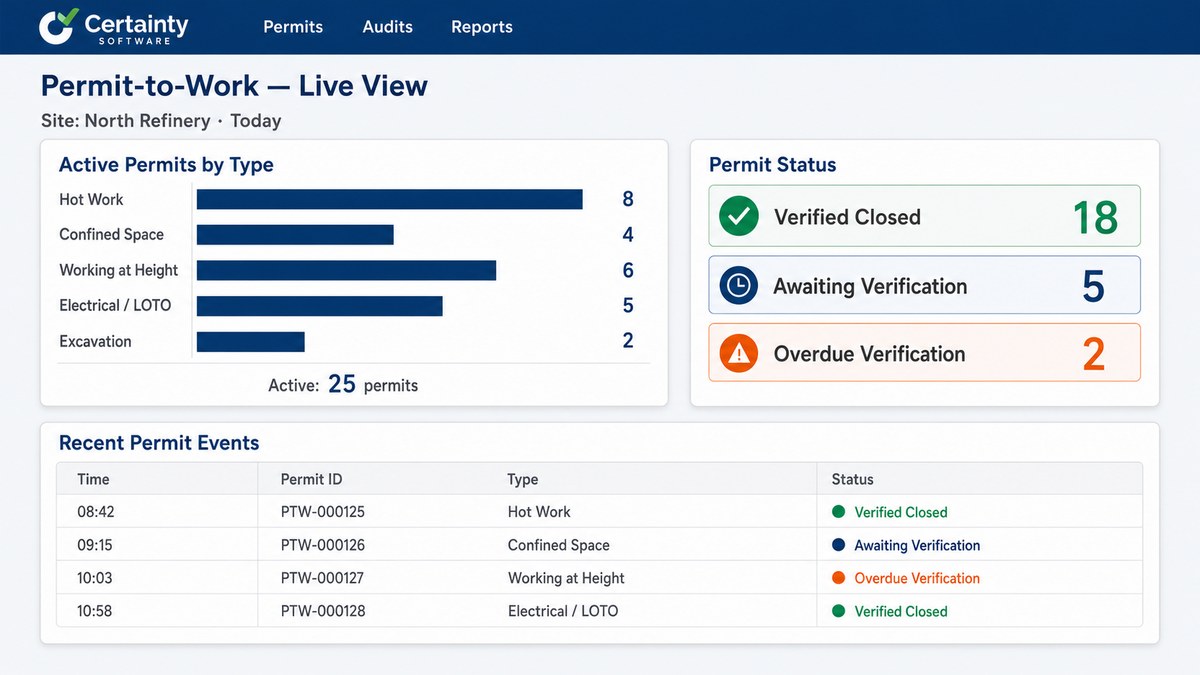
Audit cadence, escalation and leading indicators
A PTW audit is not a one-off. Effective programs audit a percentage of permits each week, weighted by risk: 100% of confined-space permits, a high percentage of hot work and energized work, a sample of the lower-risk types. Findings route to named owners with due dates and an evidence requirement; overdue findings escalate automatically; repeat findings on the same permit type or the same issuer trigger a deeper review. The audit becomes a continuous leading indicator, not a periodic snapshot.
The metric to lead with is the verification-evidence rate by permit type — what share of audited permits in each category had complete, independently-testable evidence for every control element. That number predicts the next near miss far better than the count of permits issued. It also gives executives a clear signal: when the rate drifts down on one permit type, the controls on that work category are eroding, and the team needs to intervene before the incident.
Key Takeaways:
- PTW failures are almost always verification failures — the audit tests whether controls were carried out, not whether boxes were ticked.
- Five failure modes — issuer fatigue, self-verification, stale condition checks, mid-job scope creep, closeout gaps — quietly break most programs.
- The 7-element framework — preparation, isolation, hazards, conditions, verification, closeout, evidence — applies across every permit type.
- Each permit type has its own gap pattern; the audit should be tuned to it (hot work, confined space, energized work, working at height, excavation).
- Digital evidence is what makes element 7 auditable; lead the dashboard with verification-evidence rate by permit type.
You might also be interested in
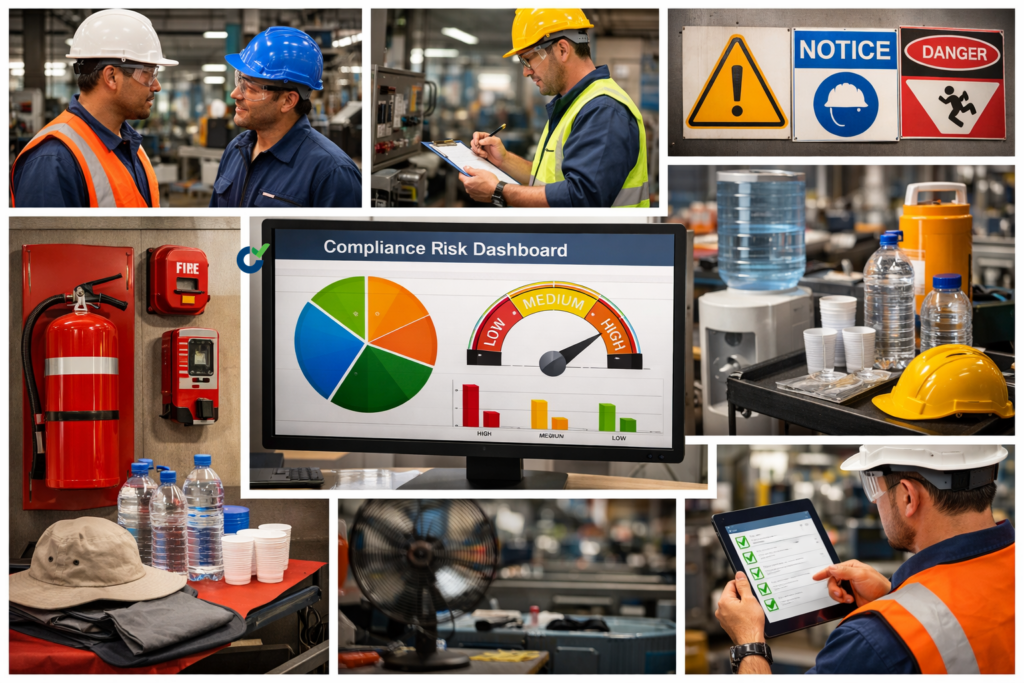
The Risks of Paper PTW Systems
The companion article — why paper permits fail under operational pressure and what to look for in a digital PTW.
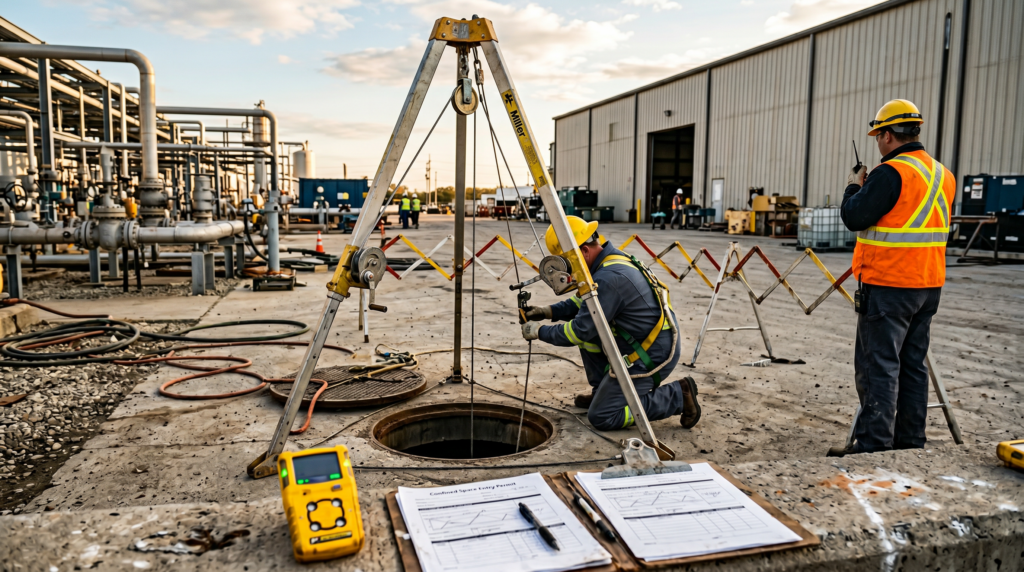
Confined Space Safety in 2026
What’s changed in confined-space enforcement and how it intersects with the entry permit.

HIRA — The 6-Step Process
How hazard identification and risk assessment feed the controls that the permit should enforce.
Frequently Asked Questions (FAQs)
What is a permit-to-work audit?
A structured review of whether the control measures a permit promised were actually carried out — before, during and after the job. It tests the physical state, the procedural steps, and the evidence backing both, not just the paperwork itself.
How often should we audit PTW?
Cadence should be weighted by risk. The strongest programs audit 100% of confined-space permits, a high percentage of hot work and energized work, and a representative sample of lower-risk types — weekly at a minimum. The metric to lead with is the verification-evidence rate by permit type.
What should a PTW audit cover?
The 7-element framework: preparation, isolation, hazard identification, condition check, verification, closeout and evidence. Each element has a question the audit asks and a failure pattern it catches — and element 7 (evidence) cuts across the other six.
Hot work vs confined space permits — what’s the difference for audit purposes?
Hot work audits focus on adjacent-hazard identification, fire-watch independence and competency, and atmospheric conditions in the surrounding area. Confined space audits focus on atmosphere re-testing during the work, rescue plan adequacy, and verification of conditions through the duration of the entry rather than only at start.
How do I prove PTW compliance to a regulator?
By producing time-stamped, photo-backed evidence for every control element on every permit — gas test readings, isolation tag photos, verifier identities, closeout records — held in a tamper-evident system of record. Paper permits typically cannot meet that bar.
Catch the PTW gaps before they cost lives
See how Certainty audits permit-to-work systems with verifiable, time-stamped evidence on every control.