Summary: Hazard Identification and Risk Assessment (HIRA) is the systematic process of identifying workplace hazards, evaluating the risks they pose, and implementing control measures to protect workers and ensure regulatory compliance. The four-step HIRA process — hazard identification, risk evaluation, control implementation, and monitoring — provides organizations with a structured framework to prioritize safety investments, meet ISO 45001 and OSHA requirements, and reduce workplace incidents.
Table of contents
Hazard Identification and Risk Assessment (HIRA) is the systematic process of identifying workplace hazards, evaluating the risks they pose, and implementing control measures to eliminate or reduce those risks — protecting workers and ensuring compliance with occupational health and safety regulations. In today’s regulatory environment, where OSHA citations, ISO 45001 certification requirements, and industry-specific safety codes carry significant financial and operational consequences, a well-implemented HIRA process is not optional. It is the foundation of every effective workplace safety management system.
This guide explores the essentials of HIRA — breaking down the four-step process, explaining how to calculate risk ratings, and discussing the strategic value of embedding HIRA into your organization’s safety culture.
What is HIRA?
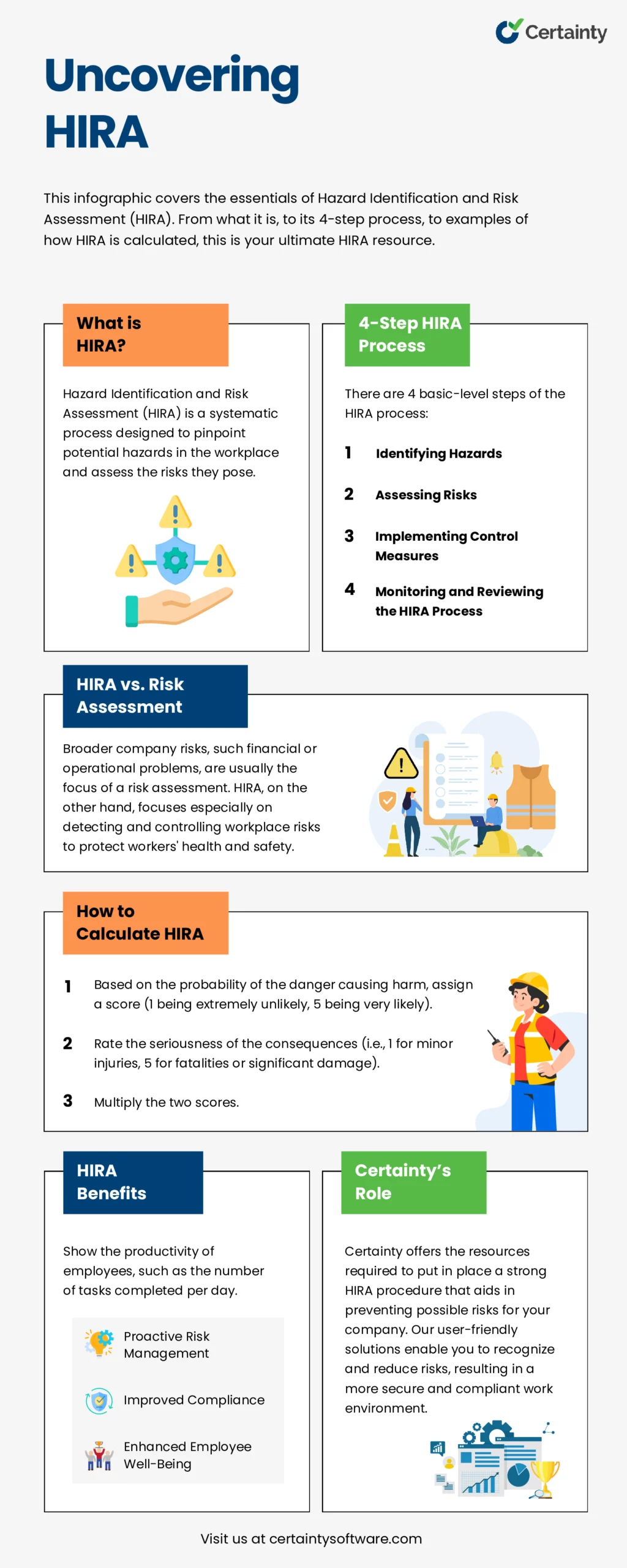
Hazard Identification and Risk Assessment (HIRA) is a structured, proactive process that systematically identifies potential hazards in the workplace, assesses the likelihood and severity of harm they could cause, and establishes control measures to reduce or eliminate those risks. The objective is straightforward: prevent workplace incidents before they occur by addressing hazards at their source rather than reacting after injury, illness, or regulatory violation has already happened.
HIRA applies across every industry and work environment — from construction sites and manufacturing plants to chemical facilities, healthcare settings, and office environments. The categories of hazard addressed include physical risks from machinery and slippery surfaces, chemical exposure, ergonomic stressors, and biological hazards. Under ISO 45001:2018, HIRA is a required element of the occupational health and safety management system — specifically addressed in Clause 6.1, which mandates systematic hazard identification and assessment of OH&S risks as part of planning. OSHA’s General Duty Clause similarly requires employers to identify and address recognized hazards in the workplace, making HIRA an essential compliance tool for organizations operating under US federal and state safety regulations.
The Four Steps of the HIRA Process
The HIRA process follows four sequential steps that build on each other to deliver a comprehensive, structured approach to workplace risk management. Each step moves from identification through assessment to control and ongoing review — creating a continuous improvement cycle aligned with modern safety management standards.
1. Identifying Hazards
The first and most critical step in HIRA is a thorough identification of all potential hazards present in the workplace. Hazard identification must be systematic — not reactive — covering all job tasks, work areas, equipment, substances, and environmental conditions that could harm workers. Common categories of workplace hazards to evaluate include:
- Physical hazards — machinery with unguarded moving parts, slippery or uneven surfaces, working at height, noise above OSHA’s 85 dBA action level, and extreme temperatures
- Chemical hazards — exposure to toxic substances, solvents, heavy metals, vapors, and flammable or reactive materials covered by OSHA’s Hazard Communication Standard (29 CFR 1910.1200)
- Ergonomic hazards — repetitive motion, awkward postures, excessive force, and poorly designed workstations that lead to musculoskeletal injuries
- Biological hazards — exposure to harmful pathogens, bacteria, viruses, or allergens particularly relevant in healthcare, food processing, and agricultural settings
Effective hazard identification requires a structured review of the workplace — including physical walkthroughs, worker interviews, review of incident and near-miss records, and analysis of Safety Data Sheets (SDS). Certainty offers streamlined inspection solutions that make hazard identification consistent, documentable, and scalable across multi-site enterprise operations. With digital checklists and real-time data capture, every hazard finding is recorded, assigned for follow-up, and available for trend analysis. See HIRA workflows in safety inspection software for the full feature set.
We also offer free-to-download hazard assessment checklists to give your safety team a structured starting point for your next hazard inspection.
2. Assessing Risks
Once hazards are identified, each must be assessed to determine the level of risk it presents. Risk assessment evaluates two dimensions: the likelihood that the hazard will result in harm, and the severity of that harm if it occurs. Combining these factors produces a risk rating that guides prioritization decisions.
The most widely used tool for this step is the risk matrix — a grid that plots likelihood against severity to categorize each hazard as low, medium, high, or critical risk. A well-constructed risk matrix, calibrated to your industry and operational context, ensures that limited EHS resources are directed toward the hazards that pose the greatest threat to worker health and safety. This step also fulfills the risk assessment requirements of ISO 45001:2018 Clause 6.1.2 and supports documented evidence of OSHA General Duty Clause compliance.
3. Implementing Control Measures
With risk ratings established, the HIRA process moves to implementing controls proportionate to the level of risk identified. Control measures should follow the Hierarchy of Controls — prioritizing elimination and substitution over administrative controls and PPE, which address the symptoms of hazard exposure rather than its root cause. Effective control measures for workplace hazards include:
- Engineering controls — machine guarding, local exhaust ventilation, interlocks, noise enclosures, and other physical modifications that reduce or eliminate hazard exposure at the source
- Administrative controls — changes to work procedures, rotation schedules, permit-to-work systems, safety training programs, and toolbox talks that change the way work is performed to reduce exposure
- Personal Protective Equipment (PPE) — the last line of defense when higher-level controls cannot fully eliminate the hazard; selection must be based on a formal hazard assessment per OSHA 1910.132
Every control measure implemented must be evaluated for effectiveness, documented in the HIRA record, and updated as workplace conditions, equipment, or regulatory requirements change. Creating layered controls — rather than relying on a single measure — provides the most resilient protection for workers.
4. Monitoring and Reviewing the HIRA Process
HIRA is not a one-time activity — it is a continuous process. Regular monitoring and structured reviews ensure that control measures remain effective as the workplace evolves. New equipment, process changes, regulatory updates, and the findings from incident investigations and near-miss reports all require HIRA documentation to be revisited and updated. ISO 45001:2018 Clause 9.1 explicitly requires organizations to monitor, measure, analyze, and evaluate their OH&S performance on an ongoing basis — HIRA review is a core mechanism for fulfilling this requirement.
This step also includes reviewing and maintaining emergency response plans, which must reflect current hazard profiles and control measures to be effective in real incident scenarios.
HIRA vs. Risk Assessment: What’s the Difference?
The terms HIRA and risk assessment are frequently used interchangeably in occupational health and safety contexts, but there is a meaningful distinction. A general risk assessment often addresses broader organizational risks — financial exposure, operational disruptions, strategic threats, and legal liability. HIRA, by contrast, is specifically focused on workplace hazards and their potential to cause injury, illness, or harm to workers.
In practical terms, HIRA is the safety-specific subset of risk assessment that directly addresses worker protection. It produces the granular, task- and location-specific hazard data that underpins safety compliance, training programs, emergency response planning, and regulatory audit preparation. Both processes are valuable — but HIRA provides the depth of hazard intelligence that occupational health and safety management systems, including ISO 45001-certified programs, require.
How Do You Calculate HIRA?
The standard method for calculating risk in HIRA uses a risk matrix that multiplies two scores: the likelihood of a hazard causing harm and the severity of that harm. This produces a numerical risk rating that enables objective prioritization of control measures. The formula is:
- Likelihood: Score the probability that the hazard will cause harm on a defined scale (e.g., 1 = rare / almost never occurs, 5 = almost certain / occurs regularly).
- Severity: Score the worst-case consequence if the hazard results in an incident (e.g., 1 = minor first-aid injury with no lost time, 5 = fatality or permanent disability).
- Multiply the two scores to produce a risk rating: Risk Rating = Likelihood × Severity
Example:
Your team identifies a slippery floor in a high-traffic production area as a hazard during a routine inspection.
- Likelihood: Workers cross this area dozens of times per shift; wet conditions occur regularly. Score = 3 (moderate probability).
- Severity: A slip in this area could result in a fall onto hard concrete, with potential for fractures or head injury. Score = 4 (serious injury).
Risk rating calculation:
Risk Rating = 3 (Likelihood) × 4 (Severity) = 12
A risk rating of 12 indicates a moderate-to-high risk requiring prompt corrective action. Based on this assessment, the safety team prioritizes installing non-slip flooring, adding wet floor warning systems, and updating the cleaning schedule to reduce standing water accumulation. The action is documented in the HIRA record with an assigned owner and target completion date — ensuring accountability and providing an audit trail for compliance verification.

30+ Audit and inspection checklists free for download.
The Benefits of Implementing HIRA
A consistently implemented HIRA process delivers measurable safety, compliance, and operational benefits to organizations across every industry:
- Proactive Risk Management: HIRA addresses hazards before they result in incidents, reducing Total Recordable Incident Rates (TRIR), Days Away, Restricted, or Transferred (DART) rates, and the associated workers’ compensation costs. Organizations that embed HIRA into their safety programs consistently outperform reactive safety programs on every key safety metric.
- Improved Regulatory Compliance: OSHA standards, ISO 45001:2018, and many industry-specific codes require systematic hazard identification and risk assessment. A documented HIRA process provides the evidence trail regulators look for during inspections and certification audits — reducing exposure to citations, fines, and enforcement actions.
- Enhanced Employee Well-Being and Engagement: A workplace where hazards are proactively identified and controlled signals to workers that their safety is genuinely valued. This drives higher safety engagement, better near-miss reporting rates, and a culture where workers actively participate in identifying hazards rather than working around them.
HIRA is not just a compliance requirement — it is a strategic investment in the resilience, productivity, and sustainability of your organization’s operations. Every hazard controlled before an incident occurs represents avoided costs: avoided injuries, avoided investigations, avoided citations, and avoided reputational harm.
Certainty’s Role in Risk Management
Certainty provides the digital infrastructure that makes enterprise HIRA programs scalable, consistent, and defensible. From structured hazard identification workflows and digital risk matrices to automated corrective action assignment and centralized reporting dashboards, Certainty replaces fragmented, paper-based HIRA processes with an integrated platform that gives EHS Managers, Safety Directors, and site-level supervisors real-time visibility into their organization’s risk profile.
Book a demo to see how Certainty can support your HIRA process and help your organization build a safer, more compliant workplace.
You might also be interested in:
Frequently Asked Questions (FAQs)
What does HIRA stand for in safety?
HIRA stands for Hazard Identification and Risk Assessment. It is a systematic process used in occupational health and safety management to identify workplace hazards, evaluate the risks they present, implement controls to reduce those risks, and monitor the effectiveness of those controls over time.
Is HIRA required by OSHA or ISO 45001?
ISO 45001:2018 explicitly requires HIRA as part of the OH&S management system planning process (Clause 6.1). OSHA does not mandate HIRA by name, but the process directly supports compliance with the General Duty Clause and numerous OSHA standards that require hazard assessment — including the PPE assessment requirement under 1910.132 and hazard communication requirements under 1910.1200. For OSHA VPP (Voluntary Protection Programs) participation, documented hazard identification and risk assessment processes are a core requirement.
How is HIRA different from a Job Safety Analysis (JSA)?
HIRA is a broader workplace-wide hazard identification and risk assessment process that covers all hazards across an entire site, department, or operation. A Job Safety Analysis (JSA) is a task-specific analysis that breaks down individual job steps to identify hazards associated with that particular task. JSA is best understood as a tool that can be used within an HIRA program to provide task-level detail for high-risk job activities.
How often should HIRA be conducted?
HIRA should be reviewed and updated whenever significant changes occur in the workplace — including new equipment, process modifications, new chemicals, changes to work procedures, or regulatory updates. It should also be reviewed after any incident or near-miss that reveals a previously unidentified or inadequately controlled hazard. At a minimum, a full HIRA review should be conducted annually as part of the management review cycle required under ISO 45001:2018.