Summary: Industrial hygiene is the science of anticipating, recognizing, evaluating, and controlling workplace environmental hazards — including chemical, biological, physical, and ergonomic stressors — that could cause worker illness or injury. A robust industrial hygiene program integrates exposure monitoring, hazard assessments, and engineering controls within the broader occupational health and safety framework, helping organizations meet OSHA requirements and protect worker well-being proactively.

What is Industrial Hygiene?
Industrial hygiene is the science and practice of anticipating, recognizing, evaluating, and controlling workplace environmental hazards — including chemical, biological, physical, and ergonomic stressors — that could cause illness, injury, or impaired well-being among workers. Defined by the American Industrial Hygiene Association (AIHA) and aligned with OSHA’s regulatory framework, industrial hygiene provides the systematic methodology organizations use to protect worker health from occupational exposures before those exposures cause harm. Certified Industrial Hygienists (CIHs) apply these principles across industries ranging from manufacturing and construction to healthcare, mining, and laboratory research.
The Importance of Industrial Hygiene in the Workplace
A well-implemented industrial hygiene program delivers measurable outcomes across safety, compliance, and operational performance. Organizations that invest in systematic hazard anticipation, recognition, and control consistently report fewer occupational illness cases, lower workers’ compensation costs, improved employee productivity and morale, and reduced regulatory exposure. OSHA standards require employers to assess and control workplace health hazards across multiple regulatory frameworks — from the Hazard Communication Standard (29 CFR 1910.1200) to substance-specific exposure limits (PELs) codified in 29 CFR 1910 Subpart Z. Industrial hygiene programs provide the technical foundation for meeting these requirements, maintaining ISO 45001:2018 conformance, and demonstrating to regulators, insurers, and workers that occupational health risks are being managed with genuine rigor.
The Core Principles of Industrial Hygiene
Anticipation
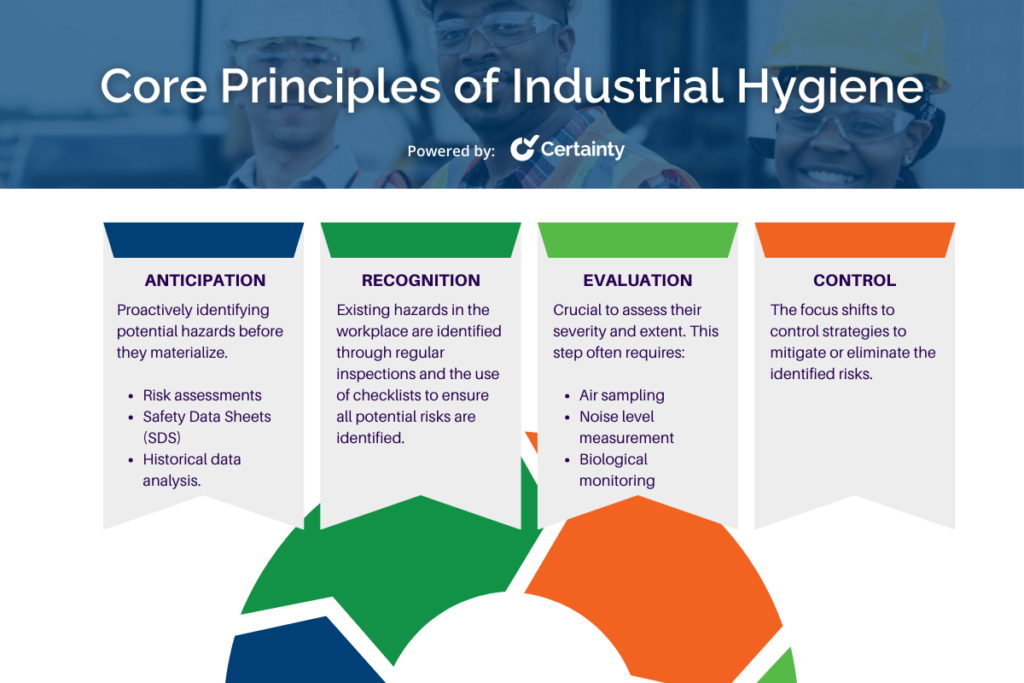
Anticipation is the forward-looking foundation of industrial hygiene practice. It involves proactively identifying potential health hazards before they materialize — analyzing proposed processes, new chemicals, equipment changes, and facility modifications to predict what exposures workers might encounter. In a chemical manufacturing facility, for example, industrial hygienists anticipate hazards by reviewing the properties and exposure limits of volatile organic compounds (VOCs) used in production, modeling worst-case dispersion scenarios, and recommending control measures before the process is commissioned. Anticipation prevents hazards from being designed into operations inadvertently.
Tools used in anticipation include:
- Hazard and risk assessments (including HIRA and HAZOP) conducted during project planning stages
- Safety Data Sheets (SDS) reviewed against OSHA’s Hazard Communication Standard (29 CFR 1910.1200)
- Historical occupational illness and injury data analysis to identify recurring exposure patterns
Recognition
Once potential hazards have been anticipated, recognition involves systematically identifying hazards that exist in the current workplace. This is accomplished through regular structured inspections, use of validated inspection checklists, worker health and exposure interviews, and review of OSHA 300 logs for occupational illness patterns. Recognition is not a passive exercise — it requires active field presence and the application of occupational health expertise to identify hazards that may not be immediately visible to untrained observers.
Common industrial hygiene hazard categories recognized during workplace assessments include:
- Chemical Hazards: Airborne concentrations of toxic substances, solvents, heavy metals, isocyanates, and vapors that may exceed OSHA Permissible Exposure Limits (PELs) or ACGIH Threshold Limit Values (TLVs).
- Physical Hazards: Noise levels above OSHA’s 85 dBA action level, ionizing and non-ionizing radiation, extreme temperatures, and vibration.
- Biological Hazards: Pathogenic microorganisms, allergens, and biohazardous materials — particularly relevant in healthcare, food production, wastewater treatment, and agricultural settings.
- Ergonomic Hazards: Repetitive motions, forceful exertions, awkward postures, contact stress, and poorly designed workstations that contribute to work-related musculoskeletal disorders (WMSDs).
Effective hazard recognition relies on the expertise of Certified Industrial Hygienists (CIH) who hold credentials from the American Board of Industrial Hygiene (ABIH) and can accurately identify, classify, and prioritize workplace health hazards.

30+ Audit and inspection checklists free for download.
Evaluation
Following hazard recognition, evaluation quantifies the severity of each hazard through objective measurement and comparison to established occupational exposure standards. Quantitative evaluation is critical because many occupational health hazards — including chemical vapors, noise, and radiation — are not perceptible at concentrations or intensities that still cause long-term harm. Evaluation methods commonly employed by industrial hygienists include:
- Personal and area air sampling to measure airborne contaminant concentrations against OSHA PELs and NIOSH RELs
- Noise dosimetry and sound level measurements to assess compliance with OSHA’s Occupational Noise standard (29 CFR 1910.95)
- Biological monitoring — measurement of biomarkers of exposure in blood or urine — for substances with dermal absorption routes or where air sampling alone is insufficient
Advanced analytical instrumentation — including direct-reading instruments, photoionization detectors (PIDs), gas chromatographs, and dosimeters — provides the precise exposure data that informs control decisions. For example, air sampling that reveals worker exposures to respirable asbestos fibers above OSHA’s Permissible Exposure Limit of 0.1 f/cc demands immediate engineering controls and medical surveillance under 29 CFR 1910.1001.
Control
When evaluation confirms that hazardous exposures exceed safe thresholds, the industrial hygiene program moves to control — implementing measures that reduce worker exposure to acceptable levels. Control strategies follow the Hierarchy of Controls, which prioritizes permanent, source-based solutions over personal protective equipment:
- Elimination: Removing the hazard from the workplace entirely — for example, discontinuing the use of a carcinogenic cleaning solvent and switching to a safer cleaning method that eliminates worker exposure.
- Substitution: Replacing a hazardous substance or process with a less dangerous alternative — such as substituting a lower-toxicity paint formulation to reduce isocyanate exposure in a spray painting operation.
- Engineering Controls: Physical modifications to the work environment or equipment that reduce hazard exposure at the source — including local exhaust ventilation (LEV) systems, enclosures, sound dampening, and process isolation.
- Administrative Controls: Changes to work practices, schedules, and procedures that limit exposure duration or frequency — including job rotation to reduce ergonomic strain, restricting access to high-noise areas, and implementing permit-to-work systems for chemical handling tasks.
- Personal Protective Equipment (PPE): Respiratory protection, hearing protection, gloves, and other PPE that reduce individual worker exposure when higher-order controls cannot fully eliminate the hazard. PPE selection must comply with OSHA’s PPE standards (29 CFR 1910.132–1910.138) and be accompanied by a documented hazard assessment and a formal fit-testing and training program.
Key Elements of an Industrial Hygiene Program
Worksite Analysis
A systematic worksite analysis is the operational foundation of every industrial hygiene program. This process involves comprehensive physical inspections of all work areas, equipment, and processes to identify potential exposure hazards and evaluate the effectiveness of existing control measures. Worksite analysis must be ongoing — not a one-time baseline activity — because work environments change continuously with new processes, equipment modifications, personnel changes, and seasonal factors that affect exposure profiles. A key priority in every worksite analysis is indoor air quality: poor ventilation, off-gassing from building materials, and chemical processes can drive airborne contaminant concentrations that impair respiratory health, cognitive function, and overall worker productivity.
Hazard Prevention and Control
Effective hazard prevention requires control measures that are tailored to the specific exposures identified in the worksite analysis — not generic off-the-shelf solutions. Each hazard requires its own control strategy, selected and engineered to address the source, pathway, and worker receptor of the exposure. Controls must be monitored continuously for effectiveness and adjusted when exposure measurements indicate that they are no longer meeting their design objectives. For example, if noise dosimetry data from a manufacturing facility shows that hearing conservation program enrollees are still experiencing significant noise dose despite existing engineering controls, additional source-level noise reduction — such as vibration isolation mounts or acoustic enclosures — must be evaluated and implemented.
Health Surveillance
Medical surveillance programs are an essential complement to exposure control in any comprehensive industrial hygiene program. Regular health monitoring — including periodic medical examinations, audiometric testing, pulmonary function tests, and biological exposure index (BEI) assessments — detects early signs of occupational disease at a stage when intervention can prevent progression and permanent harm. OSHA requires medical surveillance for workers exposed to specific substances above action levels, including asbestos (1910.1001), benzene (1910.1028), lead (1910.1025), and others. Health surveillance data also provides valuable feedback on whether current control measures are achieving their intended protective effect — serving as a biological validation of the industrial hygiene program’s performance.
Training and Education
Comprehensive, role-specific training is the mechanism through which industrial hygiene knowledge translates into protective worker behaviors. Workers must understand the specific hazards they encounter, the health effects of uncontrolled exposure, the purpose and correct use of control measures and PPE assigned to their tasks, and their rights under OSHA’s Hazard Communication Standard to access Safety Data Sheets and exposure information. Training programs must be conducted in languages and formats accessible to the workforce — a critical consideration in multilingual industrial environments. OSHA’s hazard communication standard requires initial training at assignment and updated training when new hazards are introduced. Beyond regulatory minimums, continuous education keeps workers engaged in recognizing and reporting hazards — converting every employee into an active participant in the industrial hygiene program.
What are the Common Industrial Hygiene Hazards?
Chemical Hazards
Chemical hazards represent one of the most complex and prevalent categories of occupational health risk across industrial sectors. They include exposure to:
- Toxic substances such as heavy metals (lead, cadmium, hexavalent chromium), which can cause systemic organ damage with chronic low-level exposure;
- Organic solvents including benzene, toluene, and xylene, which carry carcinogenic or neurotoxic risks;
- Heavy metals and metal fumes from welding operations;
- Vapors and gases from chemical processes, cleaning agents, and industrial coatings
Managing chemical hazard risks requires:
- A complete chemical inventory with current SDS for all hazardous substances, maintained in compliance with OSHA’s Hazard Communication Standard (29 CFR 1910.1200);
- Engineering controls — local exhaust ventilation, enclosed processes, and dilution ventilation — to keep airborne concentrations below OSHA PELs;
- Appropriate PPE including chemically resistant gloves, respiratory protection, and eye and face protection selected for the specific chemical hazard;
- Spill containment procedures, emergency response plans, and decontamination capabilities for high-consequence chemical releases.
According to OSHA, proper management of chemical hazards can prevent over 500,000 illnesses and injuries each year in the United States alone.
Physical Hazards
Physical hazards — including occupational noise, radiation, vibration, and temperature extremes — cause significant occupational illness and injury even though they are invisible and often not immediately perceptible as harmful. Noise-induced hearing loss (NIHL) is one of the most prevalent occupational illnesses in the United States, with OSHA estimating that approximately 22 million workers are exposed to potentially damaging noise levels each year. Controls for physical hazards must be matched to the specific hazard type: noise reduction through engineering controls and hearing conservation programs; radiation protection through shielding, distance, and time limits; temperature management through climate control, acclimatization protocols, and appropriate work-rest schedules per OSHA heat illness prevention guidance.
Biological Hazards
Biological hazards — including pathogenic bacteria, viruses, fungi, and allergens — are particularly prevalent in healthcare, veterinary services, food processing, agricultural operations, and wastewater treatment. Managing biological hazards requires a multi-layered approach: maintaining rigorous standards of workplace hygiene and sanitation, implementing vaccination programs where applicable (such as hepatitis B vaccination under OSHA’s Bloodborne Pathogen Standard, 29 CFR 1910.1030), providing appropriate PPE including gloves, eye protection, and respiratory protection for high-exposure tasks, and conducting regular health monitoring to detect early signs of occupational infection or sensitization.
Ergonomic Hazards
Ergonomic hazards are the leading cause of work-related musculoskeletal disorders (WMSDs) — including back injuries, rotator cuff injuries, carpal tunnel syndrome, and tendinitis — which collectively account for a disproportionate share of lost workday injuries and workers’ compensation costs across all industries. Effective ergonomic hazard management requires systematic ergonomic risk assessments using validated tools (such as the NIOSH Lifting Equation, RULA, or REBA), workstation redesign to improve posture and reduce forceful exertions, selection of ergonomically designed tools and equipment, and training workers on body mechanics, early symptom recognition, and reporting procedures.
Regulatory Framework and Compliance Relating to Industrial Hygiene
OSHA Standards and Guidelines
OSHA establishes and enforces the comprehensive regulatory framework for industrial hygiene in the United States. Employers are required to comply with OSHA’s horizontal standards — which apply across all industries — as well as vertical standards specific to their industry and processes. Key OSHA requirements directly relevant to industrial hygiene programs include:
- Regular hazard assessments to identify chemical, physical, biological, and ergonomic exposures (General Duty Clause, Section 5(a)(1) of the OSH Act);
- Provision and maintenance of appropriate PPE at no cost to workers, with documented hazard assessments (29 CFR 1910.132);
- Accurate recording and reporting of occupational injuries and illnesses, including occupational diseases, on OSHA Forms 300, 300A, and 301 (29 CFR 1904);
- Hazard communication training and SDS maintenance for all hazardous chemicals used or stored in the workplace (29 CFR 1910.1200).
International Standards
For multinational organizations, compliance with international occupational health standards is an operational and reputational priority. The International Labour Organization (ILO) publishes conventions and guidelines on occupational health and safety that align with — and in some areas exceed — OSHA requirements. ISO 45001:2018, the internationally recognized occupational health and safety management system standard, incorporates industrial hygiene principles throughout — particularly in Clause 6.1 (hazard identification and risk assessment), Clause 8.1 (operational planning and control), and Clause 9.1 (performance monitoring and measurement). Organizations operating across multiple jurisdictions that align their industrial hygiene programs with ISO 45001 achieve a consistent global safety standard while satisfying local regulatory requirements in each country of operation.
Certainty’s Connection to Industrial Hygiene Management
Certainty is a leading enterprise audit, inspection, and compliance management platform designed to give EHS Managers, Safety Directors, and industrial hygiene professionals the visibility, structure, and data they need to run effective occupational health programs at scale. Our platform is built for organizations that need to manage complex, multi-site industrial hygiene programs with consistent standards, real-time data, and defensible compliance documentation. Certainty supports every phase of the industrial hygiene program lifecycle — from worksite hazard assessments and corrective action tracking to health surveillance program management and regulatory audit preparation.
Features Relevant to Industrial Hygiene
Certainty offers a purpose-built feature set that directly supports industrial hygiene program requirements:
- Real-Time Hazard Monitoring: Certainty’s platform captures inspection findings, near-miss reports, and hazard observations in real time — providing EHS teams with immediate notification of new exposures and enabling swift corrective action before hazardous conditions lead to occupational illness or regulatory citation.
- Risk Assessment Tools: Structured digital risk assessment workflows guide teams through systematic hazard identification and risk scoring — ensuring that every hazard is evaluated consistently, assigned an appropriate risk rating, and linked to documented control measures and corrective actions.
- Incident and Occupational Illness Reporting: Certainty simplifies the capture and management of occupational illness reports, near-miss events, and exposure incidents — ensuring OSHA 300 log accuracy, supporting root cause analysis, and providing the traceability required during regulatory inspections and workers’ compensation proceedings.
- Auditing and Inspections: Certainty’s configurable inspection and audit framework supports scheduled and unannounced industrial hygiene audits across all sites and processes — with automated scoring, photo documentation, action item assignment, and management-level reporting dashboards that give leadership real-time visibility into program performance.
Interested in learning how Certainty can support your industrial hygiene and occupational health management program? Book a demo with our team today for a personalized platform walkthrough.
You might also be interested in:
Frequently Asked Questions (FAQs)
What is the role of an industrial hygienist?
An industrial hygienist anticipates, recognizes, evaluates, and recommends controls for workplace environmental hazards that could cause occupational illness or injury. Certified Industrial Hygienists (CIH) hold credentials from the American Board of Industrial Hygiene and apply scientific methods — including exposure sampling, quantitative risk assessment, and health surveillance program design — to protect worker health and ensure regulatory compliance across the full spectrum of occupational hazards.
What is the difference between industrial hygiene and occupational health?
Industrial hygiene focuses on the identification, measurement, and control of workplace environmental hazards — the engineering and scientific disciplines applied to prevent occupational exposure. Occupational health is the broader medical and health management discipline that addresses worker well-being, including medical surveillance, treatment of occupational illnesses and injuries, fitness-for-duty assessments, and return-to-work programs. In practice, the two disciplines work closely together — industrial hygiene defines the exposure picture; occupational health responds to its consequences and monitors its health effects.
What OSHA standards are most relevant to industrial hygiene?
Key OSHA standards for industrial hygiene programs include: 29 CFR 1910.1200 (Hazard Communication), 29 CFR 1910.95 (Occupational Noise Exposure), 29 CFR 1910.132-138 (Personal Protective Equipment), 29 CFR 1910 Subpart Z (Toxic and Hazardous Substances, including substance-specific standards for asbestos, lead, benzene, and others), and 29 CFR 1910.1030 (Bloodborne Pathogens). Construction industry employers must also comply with equivalent standards under 29 CFR 1926.
How does industrial hygiene support ISO 45001 compliance?
ISO 45001:2018 requires organizations to systematically identify OH&S hazards, assess the risks they present, implement controls, and monitor performance — all of which are core functions of an industrial hygiene program. Specifically, the anticipation, recognition, evaluation, and control framework of industrial hygiene directly supports Clause 6.1 (hazard identification and risk assessment), Clause 8.1 (operational controls), and Clause 9.1 (performance monitoring) of the standard. Organizations with mature industrial hygiene programs are well-positioned to achieve and maintain ISO 45001 certification.
Make your industrial hygiene program audit-ready
See how Certainty standardizes exposure monitoring and IH inspections across every site — with corrective actions tracked to verified closure and audit-ready evidence on demand.