Summary: Supplier sustainability due diligence is now a core supply chain requirement because companies are expected to identify, assess, prevent, and mitigate human rights and environmental risks across their value chains. For procurement and compliance leaders, the stakes include financial penalties, legal exposure, import restrictions, and reputational damage under laws such as CSDDD and LkSG. Strong due diligence programs combine supplier data, risk prioritization, and ongoing corrective action.
Table of contents

Supplier sustainability due diligence is the process by which companies identify, assess, prevent, and mitigate human rights and environmental risks across their supply chains. Indeed, it is now a legal obligation for thousands of global corporations under a growing body of mandatory due diligence legislation. For example, the EU Corporate Sustainability Due Diligence Directive (CSDDD), formally adopted in 2024, requires large EU and non-EU companies to conduct structured due diligence across their entire value chains. In addition, companies must also report on this process under the Corporate Sustainability Reporting Directive (CSRD).
Similarly, Germany’s Supply Chain Act (LkSG), in force since January 2023, applies the same requirements to companies with 1,000 or more employees in Germany. As a result, companies that fail to comply face financial penalties, legal liability, import bans, and lasting reputational damage.
In fact, the consequences of non-compliance can be severe. For instance, penalties include substantial financial fines, class action lawsuits, and long-lasting damage to a company’s reputation, revenue, and brand value. Under CSDDD, penalties can reach up to 5% of global net turnover for violations. Similarly, under LkSG, fines of up to €800,000 (or 2% of global annual revenue for companies with turnover above €400 million) can be imposed for each violation.
To illustrate the scope and significance of today’s regulatory landscape, here are the key supply chain sustainability and due diligence requirements that companies must navigate in 2025–2026:
- German Supply Chain Act (LkSG) — in force since January 2023, requiring human rights and environmental due diligence for companies with 1,000+ employees in Germany
- EU Corporate Sustainability Due Diligence Directive (CSDDD) — formally adopted in 2024, with phased compliance beginning in 2027 for the largest companies
- Canada – Bill C-311
- Dutch Child Labour Due Diligence Law, in force 2022
- Norwegian Transparency Act
- Swiss Due Diligence Law
- French Duty of Vigilance Act
- United States Uyghur Forced Labor Prevention Act (UFLPA)
In the following sections, we explore the challenges companies face in managing supplier sustainability due diligence. We also provide effective, practical strategies for navigating these complexities. Ultimately, these strategies help build the supply chain integrity required by today’s regulatory environment.
The Challenge: Tackling the Complexities of Supplier Sustainability Due Diligence
Navigating supplier sustainability due diligence is a formidable undertaking even for well-resourced organizations. Indeed, under CSDDD and LkSG, companies must now conduct meaningful, documented due diligence across their entire supply chain. Notably, this includes tier 2 and tier 3 suppliers, rather than focusing solely on direct contractual relationships.
Specifically, companies must identify which suppliers carry the greatest human rights and environmental risks. They must then conduct risk assessments and implement preventive measures. Additionally, they need to establish corrective action processes and report transparently on their due diligence activities under CSRD. In practice, this can feel overwhelming. However, effective strategies and technology make it achievable.
Here are the key challenges businesses face when implementing supplier sustainability due diligence programs:
1. Managing a Multitude of Suppliers: Global organizations often work with hundreds or thousands of suppliers across multiple tiers. Accordingly, CSDDD and LkSG require risk-based prioritization. In other words, this means focusing deeper due diligence on suppliers with the highest human rights and environmental risk profiles. Therefore, building a comprehensive supplier register with risk-scored records is an essential first step that many organizations currently lack.
2. Complex Global Supply Chains: Modern supply chains span dozens of countries and involve intricate multi-tier networks. As a result, tracing the flow of goods and services across these networks presents significant challenges. Specifically, identifying which portions of the chain fall within the scope of CSDDD, LkSG, or UFLPA obligations requires structured supply chain mapping. Consequently, organizations must go beyond traditional tier 1 supplier management.
3. Data Collection and Assessment: Gathering relevant ESG and human rights data from suppliers is critical — and often the most operationally challenging element of due diligence. Furthermore, collecting, managing, and analyzing data on supplier policies, labor practices, environmental performance, and compliance status requires a structured, technology-enabled platform. In other words, ad hoc spreadsheet processes are insufficient for this purpose.
4. Ensuring Supplier Compliance: Engaging suppliers to actively participate in sustainability assessments, share information transparently, and implement corrective actions requires effective communication. In addition, clear supplier codes of conduct and a collaborative due diligence partnership are also essential. Moreover, overcoming language barriers, cultural differences, and varying levels of sustainability maturity across supplier markets demands both technology support and relationship management capabilities.
Despite these challenges, proven strategies and technology solutions can help businesses implement effective supplier sustainability due diligence programs. Notably, these programs satisfy CSDDD, LkSG, CSRD, and other regulatory requirements. Furthermore, they drive real supply chain improvement over time.
How to Ensure Compliance With Regulations
Supplier sustainability due diligence compliance under CSDDD, LkSG, and related regulations is a transformative process — not a checkbox exercise. In particular, companies that approach due diligence as a genuine opportunity to build supply chain transparency consistently outperform those focused solely on minimum regulatory compliance. Ultimately, by partnering with suppliers on improvement and harnessing structured assessment programs, global corporations can drive measurable, lasting improvements in human rights and environmental performance across their supply chains.
The following five practical steps guide global corporations through effective supplier sustainability due diligence compliance:
Step 1: Identifying Your Suppliers – The Foundation of Sustainable Sourcing
Begin by building a comprehensive, accurate record of all your suppliers. Specifically, this record should include their names, locations, business activities, and risk profiles. Under CSDDD, companies must identify not only tier 1 suppliers but also tier 2 and tier 3 suppliers. Most importantly, this is especially relevant in sectors or geographies with elevated human rights and environmental risks.
Establish direct communication with dedicated sustainability contacts at each supplier. Additionally, map suppliers against risk factors such as country-level human rights conditions, sector-specific labor risk, and environmental impact. As such, this supplier register forms the foundation of your CSDDD-compliant due diligence program. It also provides the supply chain visibility required for CSRD value chain reporting.
Step 2: Defining the Sustainability Standard to Assess Supplier Compliance
Leading organizations use structured, standardized checklists and assessment frameworks to evaluate supplier sustainability compliance. In turn, this approach reduces complexity, improves comparability, and enables consistent reporting across the supply chain. For this reason, under CSDDD and LkSG, companies must define the sustainability standards against which they assess suppliers. Specifically, these standards cover human rights (including labor rights, child labor, forced labor, and health and safety), environmental protection, and anti-corruption. Here are key assessment frameworks that provide a starting point:
- German Supply Chain Act (LkSG) Due Diligence Checklist: Designed to align with LkSG requirements, this checklist provides a comprehensive framework for evaluating supplier human rights and environmental compliance — covering the risk areas specified in the Act, including forced labor, child labor, occupational safety, land use rights, and environmental damage.
- Supplier Social and Environmental Compliance Checklist: This checklist assesses suppliers’ commitment to responsible social and environmental practices — covering labor rights, community impact, environmental management, and anti-corruption — making it directly applicable to CSDDD due diligence requirements.
- SMETA Checklist: The SMETA (Sedex Members Ethical Trade Audit) checklist enables organizations to evaluate suppliers’ ethical trade practices, covering labor rights, health and safety, environmental performance, and business ethics — a widely recognized standard applicable to CSDDD value chain due diligence.

30+ Audit and inspection checklists free for download.
Step 3: Scheduling Supplier Self-Assessments
Inviting suppliers to complete structured self-assessments is a practical and scalable approach to supplier sustainability due diligence. In particular, this is especially important for extending oversight to tier 2 and tier 3 suppliers at scale. Indeed, self-assessments empower suppliers to evaluate their own social, environmental, and ethical performance. They also enable suppliers to share relevant information including policies, procedures, and codes of conduct.
When communicating self-assessment requirements to suppliers, emphasize the shared purpose. Ultimately, the goal is to collectively manage and improve sustainability performance across the supply chain. As a result, this achieves the compliance outcomes required by CSDDD, LkSG, and related regulations. Furthermore, automated scheduling and multi-language support — available in platforms like Certainty Software — dramatically improve supplier participation rates and data quality.
Step 4: Completing Supplier Self-Assessments
As suppliers complete their self-assessments, your supply chain compliance team plays a critical role. Specifically, they review responses, analyze data, identify compliance gaps, and assign appropriate corrective actions. Notably, under CSDDD, the corrective action process is a formal legal requirement. For this reason, companies must establish, communicate, and monitor remediation measures for identified human rights and environmental risks.
In turn, this collaborative review process enables a culture of continuous improvement. It also helps suppliers progressively strengthen their sustainability performance. Moreover, technology platforms that support real-time assessment completion monitoring, risk-based prioritization, and structured corrective action management significantly reduce the resource burden of this critical compliance step.
Step 5: Monitoring and Reporting – Tracking Progress and Driving Change
Ongoing monitoring and transparent reporting are the final — and ongoing — elements of an effective supplier sustainability due diligence program. Accordingly, under CSDDD and CSRD, companies must not only complete annual due diligence cycles but also maintain continuous monitoring of known high-risk suppliers. They must also report on their due diligence processes, findings, and corrective actions in their CSRD sustainability reports.
Through systematic review of supplier self-assessment responses and supporting documentation, your supply chain compliance team can identify patterns and benchmark performance across the supply base. They can also track improvement over time. Additionally, transparent reporting — shared internally with leadership and externally with stakeholders — builds accountability and demonstrates regulatory compliance. Ultimately, it also provides the evidence base required for CSRD external assurance.
Above all, this continuous cycle of assessment, corrective action, monitoring, and reporting creates a supply chain compliance mindset that drives genuine improvement. Consequently, it satisfies the documented due diligence evidence requirements of CSDDD, LkSG, and CSRD simultaneously.
Leveraging Technology for Efficient Supplier Sustainability Due Diligence
Given the scale, complexity, and regulatory requirements of managing supplier sustainability due diligence across global supply chains, companies are accordingly turning to cloud-based software solutions like Certainty.
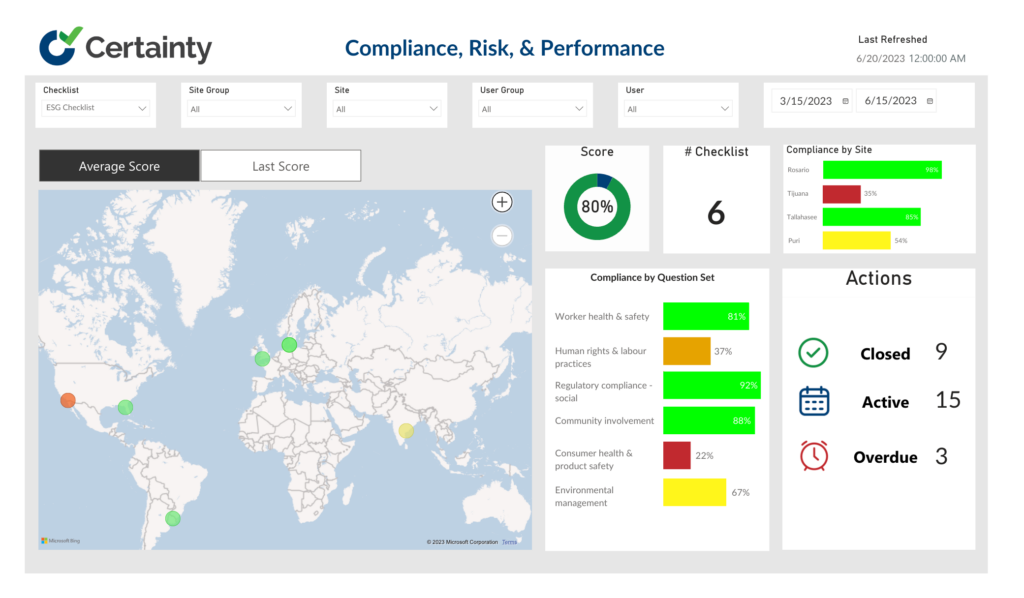
Certainty Software provides the end-to-end capabilities organizations need to implement CSDDD-compliant and LkSG-aligned supplier due diligence at scale. In particular, key benefits include:
- Streamlined Supplier Identification and Mapping: Easily locate, register, and risk-map suppliers across global supply chains — including tier 2 and tier 3 suppliers — providing the holistic supply chain visibility required for CSDDD due diligence and CSRD value chain reporting.
- Customizable Sustainability Checklists: Build sustainability assessment checklists tailored to CSDDD, LkSG, UFLPA, and other regulatory requirements — ensuring comprehensive, comparable evaluations across your entire supplier network.
- Efficient Supplier Self-Assessments: Enable suppliers to complete due diligence assessments in their preferred language, improving participation rates, data quality, and supplier engagement across diverse global markets.
- Automated Scheduling and Reminders: Simplify the planning and management of supplier self-assessments with automated notifications and reminders — ensuring complete, on-time due diligence cycles aligned with CSRD reporting deadlines.
- Real-Time Monitoring and Benchmarking: Track self-assessment completion rates, compliance scores, risk distributions, and corrective action status in real time — empowering data-driven decisions and demonstrating proactive due diligence oversight to regulators and auditors.
- Collaborative Corrective Action Management: Review supplier assessments, establish CSDDD-compliant corrective action plans, assign responsibilities, set deadlines, and monitor implementation — driving continuous improvement in supplier sustainability performance.
- Consistent and Comparable Reporting: Generate comprehensive reports providing a clear, auditable overview of supplier compliance status, performance benchmarks, and corrective action outcomes — ready for CSRD external assurance and LkSG regulatory documentation requirements.
By harnessing the power of technology, you can confidently and efficiently meet your supplier sustainability due diligence obligations under CSDDD, LkSG, and CSRD. At the same time, you foster transparency, accountability, and positive change throughout your global supply chain.
Frequently Asked Questions (FAQs)
What is supplier sustainability due diligence?
Supplier sustainability due diligence is the structured process by which companies identify, assess, prevent, and mitigate human rights and environmental risks across their supply chains. Specifically, it involves mapping suppliers, conducting risk assessments, and collecting compliance data through self-assessments and audits. Companies then implement corrective actions and report transparently on outcomes. Most importantly, under CSDDD (EU), LkSG (Germany), and other mandatory supply chain laws, due diligence is a legal requirement — not merely a best practice.
What regulations require supplier sustainability due diligence?
Key regulations requiring supplier sustainability due diligence include the EU CSDDD (formally adopted 2024, phased compliance from 2027) and Germany’s LkSG Supply Chain Act (in force January 2023). Similarly, France’s Duty of Vigilance Act, Norway’s Transparency Act, and Switzerland’s Due Diligence Law also apply. Additionally, the US Uyghur Forced Labor Prevention Act (UFLPA) and Canada’s Fighting Against Forced Labour and Child Labour in Supply Chains Act (Bill S-211, annual reporting required from 2024) are relevant. Moreover, various national Modern Slavery Acts further expand this regulatory landscape. Furthermore, CSRD requires companies to report on their due diligence processes and outcomes as part of their annual sustainability disclosure.
What are the penalties for non-compliance with CSDDD?
Under CSDDD, penalties for non-compliance can reach up to 5% of global net turnover. In addition, civil liability provisions allow affected individuals and communities to bring claims against companies for harms caused by inadequate due diligence. Similarly, under LkSG, fines range up to €800,000 per violation. For companies with turnover above €400 million, fines can accordingly reach up to 2% of global annual revenue. Moreover, non-compliant companies can face exclusion from public procurement processes for up to three years.
How does Certainty Software support supplier due diligence compliance?
Certainty Software provides a comprehensive platform for managing every step of the supplier sustainability due diligence process. Specifically, this covers everything from supplier identification and risk mapping to self-assessment scheduling and completion. It also includes corrective action management and CSRD-aligned compliance reporting. Furthermore, the platform supports customizable assessment templates aligned with CSDDD, LkSG, and UFLPA requirements. Additionally, it offers multi-language supplier engagement, real-time monitoring dashboards, and automated reporting. As a result, organizations can meet their regulatory due diligence obligations efficiently and at scale.
You might also be interested in: