Summary: A supply chain audit delivers value only when its scope and objectives are clearly defined before fieldwork begins. For supply chain managers, that means deciding which suppliers, processes, risks, regulations, and performance measures the audit will cover so resources focus on the highest-impact issues. A well-scoped supply chain audit improves compliance, uncovers inefficiencies, and creates a practical roadmap for supplier and process improvement.
Table of contents

A supply chain audit is a systematic, comprehensive evaluation of your supply chain processes — from procurement to final delivery — designed to identify risks, close compliance gaps, and drive continuous improvement. In 2025–2026, conducting regular supply chain audits is no longer optional: regulations such as the EU Corporate Sustainability Due Diligence Directive (CSDDD), the EU Corporate Sustainability Reporting Directive (CSRD), and Germany’s Supply Chain Act (LkSG) mandate that large companies perform documented due diligence across their entire supplier network. Research consistently shows that even incremental improvements to supply chain management deliver measurable financial returns — for example, reducing supply chain costs from 9% to 4% can double profits.
In this ultimate guide, we walk you through the key steps and best practices for conducting a successful supply chain audit. You will also find practical tips and tools to help you optimize supply chain performance, achieve regulatory compliance, and build a resilient, sustainable supplier base.
Understanding the Scope and Objectives of a Supply Chain Audit
Before starting a supply chain audit, define its scope and objectives clearly. The scope depends on your organization’s size, the complexity of your supplier network, applicable regulations (including CSDDD, CSRD, and LkSG), and the specific risk areas you want to address. A well-defined scope prevents audit fatigue and ensures resources are focused where they deliver the greatest compliance and operational value.
Common components and areas to include in a supply chain audit are:
- Procurement: The sourcing, purchasing, and contracting of raw materials, components, and services from external providers — including supplier qualification and ESG screening under CSDDD and LkSG obligations.
- Inventory management: The storage, handling, and tracking of materials and products throughout the supply chain, with attention to traceability requirements under emerging import regulations such as the UFLPA.
- Manufacturing process: The transformation of raw materials into finished goods, including verification of safe working conditions, fair labor practices, and environmental controls.
- Logistics: The transportation, distribution, and delivery of goods and services to customers, including Scope 3 emissions tracking for CSRD reporting.
- Quality control: The inspection, testing, and validation of products and processes to ensure they meet quality standards and specifications.
- Supplier relationships: The communication, collaboration, and evaluation of suppliers and their performance against defined human rights, social, and environmental requirements.
- Cybersecurity: The protection of data, systems, and networks from unauthorized access, theft, or damage across the supply chain ecosystem.
- Sustainability: The environmental, social, and economic impact of supply chain activities, including GHG emissions, forced labor risks, and biodiversity impacts as required under CSDDD and CSRD frameworks.
The objectives of your supply chain audit should align with your organizational goals, regulatory obligations, and stakeholder expectations. Common objectives include:
- Identifying inefficiencies, bottlenecks, and waste in supply chain processes and workflow.
- Mitigating risks such as disruptions, delays, errors, fraud, or breaches in supply chain operations — including human rights violations that trigger LkSG or CSDDD liability.
- Ensuring compliance with legal and regulatory requirements, including the German Supply Chain Act (LkSG), EU CSDDD, CSRD, and customer codes of conduct.
- Driving continuous improvement in supply chain performance, productivity, and profitability.
- Enhancing customer satisfaction and loyalty by delivering high-quality products and services on time and at a competitive price.
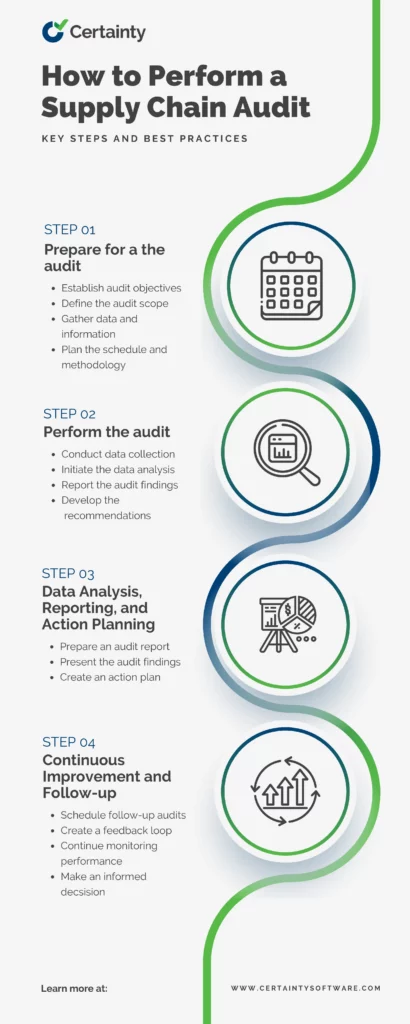
Preparing for a Supply Chain Audit
Thorough preparation is the foundation of a successful supply chain audit. Companies subject to CSDDD or LkSG must document their preparation process as part of their due diligence obligations. Follow these steps before beginning the assessment:
1. Establish audit objectives
Based on your scope definition, specify what you want to achieve from the audit. For example, you may want to assess inventory management effectiveness, evaluate supplier cybersecurity posture, or verify compliance with LkSG human rights requirements. Define the criteria or standards — such as ISO 20400, GRI Standards, or CSDDD due diligence thresholds — that you will use to measure audit results.
2. Define the audit scope
Identify the specific segments of your supply chain that require attention — a particular product line, geographic region, or supplier tier. Under CSDDD and LkSG, scope must extend to direct (Tier 1) suppliers and, where there is substantiated knowledge of risk, to indirect (Tier 2 and beyond) suppliers. Determine the time frame for data collection and analysis.
3. Assemble an audit team
Select the right people to conduct the audit. Consider including internal auditors from procurement, sustainability, legal, and compliance functions, as well as external auditors from accredited third-party firms where independent verification is required. Under CSRD, third-party assurance of sustainability data is increasingly expected. Assign clear roles and responsibilities to each team member before the audit begins.
4. Gather necessary documentation and data
Collect the relevant information and evidence that will support audit findings and recommendations. This includes contracts, supplier codes of conduct, invoices, certificates, environmental permits, labor compliance records, and corrective action history. You may also need data from ERP systems, supplier portals, IoT sensors, or third-party ESG data providers. Ensure all documentation is accurate, complete, and current before the audit begins.
5. Plan the audit schedule and methodology
Plan the timing and approach of your audit activities. This may require coordinating with suppliers, customers, or other stakeholders to arrange on-site visits, remote interviews, or document reviews. Decide on the methods and tools you will use — including checklists, questionnaires, and audit management software. A risk-based approach, prioritizing higher-risk suppliers and geographies, is best practice under both LkSG and CSDDD frameworks.
If you are looking for a detailed, ready-to-use checklist to quickly get started, Certainty offers a free-to-download Supplier Social and Environmental Compliance Checklist and German Supply Chain Act (LkSG) Due Diligence Checklist.

30+ Audit and inspection checklists free for download.
Conducting the Supply Chain Audit
With preparation complete, you are ready to execute the assessment. A rigorous, evidence-based audit process is essential for satisfying regulatory due diligence requirements under CSDDD and LkSG and for producing findings that are defensible to investors, customers, and regulators.
1. Perform data collection
Gather the necessary information and evidence from supply chain sources using document review, data analysis, on-site visits, supplier interviews, or remote observations. For suppliers in high-risk regions — particularly relevant under CSDDD’s geographic risk lens — prioritize in-person verification where possible. Ensure data collection is objective, consistent, and comprehensive across all audit areas.
2. Conduct data analysis
Analyze collected data using techniques such as benchmarking against industry standards (e.g., GRI, SASB, or sector-specific ESG frameworks), gap analysis against CSDDD or LkSG requirements, root cause analysis for identified non-conformances, or SWOT analysis for strategic supply chain risk. Ensure data analysis is reliable, valid, and directly relevant to your audit objectives.
3. Report your audit findings
Identify and document the strengths and weaknesses of supply chain processes and performance. Highlight the risks — including human rights risks, environmental non-conformances, and regulatory compliance gaps — and the opportunities discovered through the audit. Under CSRD, material ESG findings must be disclosed in your sustainability report. Ensure findings are clear, concise, and supported by evidence.
4. Develop recommendations
Provide targeted, actionable recommendations for improving supply chain processes and performance. Propose corrective actions and preventive measures for each identified risk or non-conformance, prioritized by severity and regulatory exposure. Where LkSG or CSDDD violations are identified, corrective action timelines must be realistic and documented. Ensure all recommendations are feasible and aligned with your organizational goals and compliance obligations.
Data Analysis, Reporting, and Action Planning
After conducting the audit, communicating and implementing findings is critical — particularly for organizations that must demonstrate due diligence compliance to regulators or publish CSRD-aligned sustainability disclosures.
1. Prepare an audit report
Prepare a formal document summarizing the results and outcomes of the supply chain audit. Your audit report should include an executive summary, a detailed description of scope, objectives, methodology, findings, and recommendations, as well as a conclusion and supporting evidence. For CSDDD and LkSG compliance, the audit report serves as a core piece of documented due diligence and should be retained for regulatory review. Ensure the report is accurate, complete, and professionally formatted.
2. Present the audit findings
Present and discuss audit results with your stakeholders — including senior management, supply chain and ESG professionals, risk managers, and external parties such as suppliers, investors, or regulators. The audit presentation should highlight key insights, compliance exposures (including any CSDDD or LkSG obligations triggered), and the expected benefits of implementing your recommendations. Solicit feedback from stakeholders to refine the action plan and strengthen buy-in.
3. Create an action plan
Develop an action plan for implementing audit recommendations. The plan should include specific actions, owners, timelines, required resources, and success metrics for each recommendation. Assign clear accountability to the individuals responsible for carrying out each action. Where CSDDD or LkSG corrective actions are required, timelines must be documented and communicated to affected suppliers. Ensure the action plan is realistic, measurable, and achievable.
Continuous Improvement and Follow-up
A supply chain audit is not a one-time event — it is the foundation of an ongoing due diligence program. CSDDD, LkSG, and CSRD all require companies to establish and maintain continuous improvement processes, not just conduct point-in-time assessments. Monitor and evaluate the progress and performance of your action plan using the following steps:
1. Regularly schedule follow-up audits
Conduct regular follow-up audits to verify the status and effectiveness of implemented recommendations. Use similar techniques and tools as in the initial supply chain audit. Under LkSG, companies are required to conduct risk analyses at least annually and whenever there are substantive changes; CSDDD imposes similar periodic review obligations. Ensure follow-up audits are timely, consistent, and comprehensive.
2. Create a feedback loop
Collect and analyze feedback from stakeholders on the implementation and impact of your audit recommendations. Effective tools at this stage include structured surveys, supplier interviews, and focus groups. Prioritize honest, constructive feedback from frontline suppliers, workers, and affected communities — input that is increasingly required by the grievance mechanism provisions of CSDDD.
3. Continue to monitor your performance
Measure and track the outcomes and benefits of your audit recommendations using KPIs such as cost savings, quality improvement, customer satisfaction, risk reduction, and supplier ESG score improvement. Monitoring against CSRD-aligned Scope 3 metrics (e.g., supplier emissions, water use, and labor conditions) is increasingly expected by investors and regulators. Ensure performance monitoring is objective, reliable, and valid.
4. Make an informed decision
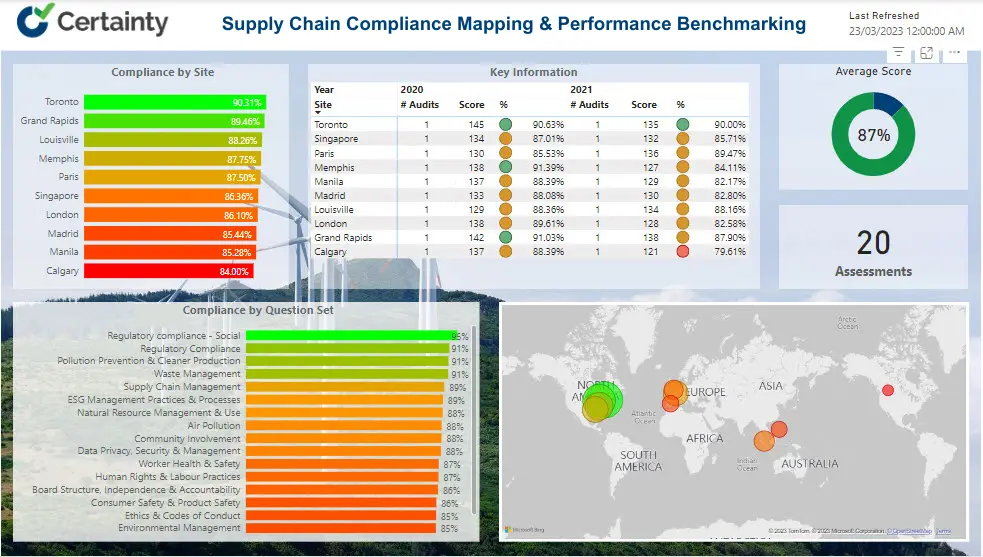
Use performance monitoring data to make informed, data-driven decisions for improving supply chain operations. Tools such as compliance dashboards, reports, and benchmarking charts enable proactive, strategic decision-making. Decisions should be aligned with your organizational sustainability strategy and with your obligations under CSDDD, LkSG, and CSRD.
Conclusion
A supply chain audit is one of the most valuable tools available for enhancing supply chain functionality, sustainability, and profitability — and in 2025–2026, it is increasingly a legal requirement. By following the key steps and best practices in this guide, your organization can conduct a successful supply chain audit that identifies and eliminates risks, ensures compliance with CSDDD, LkSG, CSRD, and other regulatory requirements, and drives continuous improvement across your supplier network.
If you need help conducting a supply chain audit or implementing a supply chain compliance management system, Certainty can assist. As a provider of software solutions for auditing, inspecting, and validating supply chain processes and performance, Certainty enables you to plan, conduct, report, and follow up on supply chain audits using customizable checklists, automated workflows, and real-time analytics aligned with CSDDD and LkSG due diligence requirements.
If you’d like to learn more about how Certainty can assist with your specific audit and inspection needs, book a quick call and we’ll be happy to help.
Frequently Asked Questions (FAQs)
What is a supply chain audit?
A supply chain audit is a systematic evaluation of an organization’s supply chain processes — including procurement, manufacturing, logistics, and supplier relationships — to identify risks, verify regulatory compliance, and drive continuous improvement. In 2025–2026, supply chain audits are a core component of due diligence obligations under the EU CSDDD, Germany’s LkSG, and CSRD.
How often should a supply chain audit be conducted?
Best practice and most regulatory frameworks — including LkSG and CSDDD — require supply chain risk assessments at least annually, with more frequent audits for high-risk suppliers or geographic regions. Follow-up audits should also be triggered by significant changes in supplier operations, new regulatory developments, or identified non-conformances.
What regulations require supply chain audits in 2025–2026?
Key regulations requiring supply chain due diligence and audits include: the EU Corporate Sustainability Due Diligence Directive (CSDDD), Germany’s Supply Chain Due Diligence Act (LkSG), the EU Corporate Sustainability Reporting Directive (CSRD) for Scope 3 reporting, the US Uyghur Forced Labor Prevention Act (UFLPA), and the UK and Australian Modern Slavery Acts. Each regulation has distinct scope thresholds, documentation requirements, and enforcement timelines.
What is the difference between a supply chain audit and a supplier assessment?
A supplier assessment is typically a questionnaire-based self-assessment used to screen suppliers for ESG and compliance risks at scale — often as an initial triage tool. A supply chain audit involves deeper, evidence-based verification of supplier practices, usually through on-site visits, document review, and interviews. Both are complementary components of a comprehensive supply chain due diligence program.
How can software help with supply chain audits?
Supply chain audit software like Certainty streamlines the entire audit lifecycle — from scheduling and checklist deployment to data collection, non-conformance management, corrective action tracking, and compliance reporting. Purpose-built audit software reduces manual effort, improves data quality and consistency, and generates the documented audit trails required by CSDDD, LkSG, and CSRD regulators.
You might also be interested in: