Summary: A safety meeting is a structured forum for discussing hazards, incident trends, regulatory updates, and safe work practices so employees leave better prepared to prevent injuries. The best safety meetings are not generic reminders; they focus on relevant safety topics, reinforce expectations clearly, and create space for workers to raise concerns before risks escalate. For EHS leaders, consistent safety meetings are one of the simplest ways to strengthen safety culture and keep compliance communication active throughout the year.
Table of contents

Effective safety meetings are one of the most direct tools an EHS manager has for reducing incident rates and reinforcing regulatory compliance. Moreover, they play a key role in building a proactive safety culture. Selecting the right workplace safety meeting topics — and covering them with specificity and supporting evidence — determines whether your team leaves better equipped to prevent injuries or simply checks a box. The 16 topics below cover the essential areas that EHS leaders, safety directors, and site managers should address systematically throughout the year.
But first: what exactly is a workplace safety meeting, and how is it different from other safety communications?
What is a Safety Meeting?
A safety meeting — sometimes called a safety brief — is a regularly scheduled, structured gathering of employees and safety managers. Its purpose is to discuss workplace safety topics, review incident trends, and address emerging hazards or compliance obligations.
Indeed, safety meetings deliver measurable value across the organization. They provide a structured forum for communicating updates to safety procedures and regulatory requirements. Additionally, they give employees a channel to raise hazard concerns. They also reinforce the safety behaviors identified in your behavior-based safety (BBS) program. Depending on the organization’s size, industry risk profile, and regulatory environment, safety meetings typically occur weekly or monthly. Furthermore, meetings should be documented to support OSHA recordkeeping and ISO 45001 audit requirements.
Safety meetings are not the same as toolbox talks. Toolbox talks are brief, informal safety discussions conducted at the job site before a specific task begins. They focus on a single hazard or procedure. In contrast, safety meetings are more formal in structure and cover a broader range of safety themes. They typically involve a larger cross-section of the workforce. Both are valuable; however, they serve different purposes in a comprehensive safety communication strategy.
How to Make Your Safety Meetings More Engaging
Use evidence
Every safety meeting discussion should be grounded in evidence — whether from internal inspection data, incident investigation findings, industry statistics, or regulatory guidance. Using real data from your own workplace makes safety discussions immediately relevant to employees. Moreover, it demonstrates that meetings are driven by actual risk, not routine. Reference structured tools such as Certainty’s Facility Safety Inspection Checklist or Lifting and Lowering Ergonomic Assessment Checklist to anchor discussions in verifiable, actionable findings.
Encourage participation
Employee participation transforms safety meetings from one-way presentations into genuine safety conversations. Invite employees to share observations, near misses, and improvement ideas. Use interactive formats — quizzes, scenario-based questions, small group discussions — to test comprehension and drive engagement. Additionally, OSHA’s Workplace Safety and Health Quiz resources provide ready-to-use interactive elements suitable for safety meeting use. Most importantly, recognize and acknowledge employee contributions openly to reinforce a culture where speaking up about safety is valued and expected.
Change up the topics
Varying workplace safety meeting topics prevents habituation and ensures the full spectrum of workplace hazards and compliance obligations is covered across the year. Prioritize topics based on your most recent inspection findings, near miss reports, and TRIR trends. Furthermore, include emerging and evolving topics — mental health, cybersecurity, workplace violence prevention — alongside foundational safety topics. A rotating topic calendar, linked to your inspection and incident data, ensures your meetings address the hazards that are most active in your specific workplace.
Use visual aids
Visual aids — slides, videos, infographics, photographs from actual workplace inspections — make safety concepts more concrete and easier to remember. For example, a photograph of an actual hazard identified during a recent internal audit is far more impactful than a generic stock image. The OSHA safety training presentation example from the Institute of Occupational Health and Safety (IOSH) is a useful reference for structuring visual safety training content.
Follow up
The value of a safety meeting comes through follow-up, not just attendance. Distribute meeting minutes summarizing key discussion points, commitments made, and corrective actions assigned. Additionally, track newly identified hazards and near misses through your incident reporting system. Review the effectiveness of actions taken at subsequent meetings. Ultimately, demonstrating that safety meeting discussions lead to visible improvements is the most powerful driver of ongoing employee engagement.
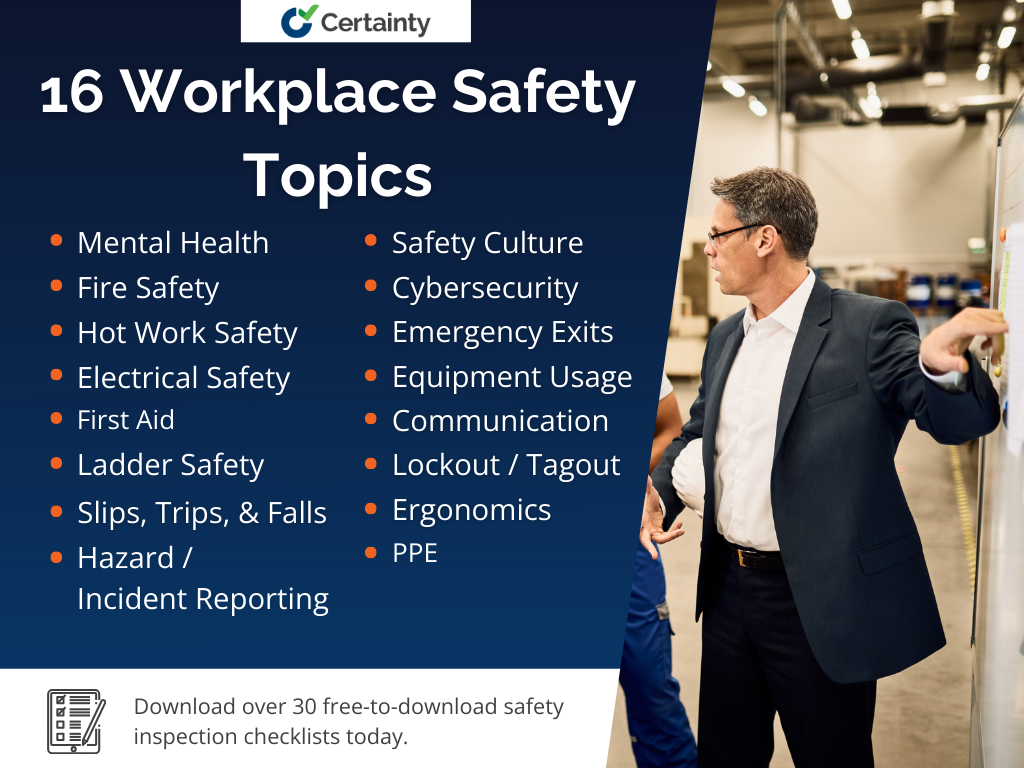
16 Safety Talk Topics
Your specific corporate safety culture, risk profile, and regulatory environment will shape which topics you prioritize. The 16 topics below represent the core safety areas that EHS professionals across industries consistently identify as essential. Each one ties to measurable injury prevention and compliance outcomes. Ultimately, together they form a comprehensive annual safety meeting calendar.
Mental Health
Mental health is a foundational component of a complete occupational health and safety program. OSHA’s Voluntary Protection Programs (VPP) and ISO 45001 Clause 6.1.2 both recognize psychological hazards as legitimate workplace risks requiring assessment and control. In fact, depression, anxiety, and burnout impair cognitive function, decision-making, and situational awareness. Consequently, they directly contribute to workplace accidents.
Notably, research published in peer-reviewed occupational health literature indicates that depression reduces cognitive performance approximately 35% of the time. In your safety meeting, communicate the mental health resources available through your Employee Assistance Program (EAP). Additionally, reduce stigma around seeking help. Furthermore, discuss practical strategies for stress management and workload balance.
Fire Safety
Fire safety is a regulatory requirement under OSHA’s Fire Prevention Plan standard (29 CFR 1910.39) and NFPA 1 (Fire Code) across most industries. In the construction sector alone, OSHA data indicates an average of 36 fire-related fatalities per year. Safety meetings on fire safety should therefore cover several key areas. These include fire extinguisher locations and proper operation (PASS technique), emergency evacuation routes, and assembly point (muster point) locations. Additionally, cover fire risk categories relevant to your site, hot work permit requirements, and how to report fire hazards. Reinforce your fire safety discussions with structured documentation tools.
Hot Work Safety
Hot work — welding, cutting, grinding, brazing, and any operation that produces sparks or open flames — ranks among the most significant fire and explosion hazard categories in industrial and construction environments. Accordingly, NFPA 51B (Standard for Fire Prevention During Welding, Cutting, and Other Hot Work) provides the authoritative framework for managing these risks.
Key topics for a hot work safety meeting include the hot work permit process and who has authorization to issue permits. Additionally, cover fire watch requirements and duration, combustible material removal and clearance distances, and gas testing in confined and enclosed spaces. Furthermore, discuss appropriate PPE for each specific hot work activity and emergency response if ignition occurs.
Electrical Safety
Electrical hazards cause approximately 1,000 workplace fatalities annually in the U.S. Consequently, OSHA addresses these hazards under 29 CFR 1910 Subpart S and NFPA 70E (Standard for Electrical Safety in the Workplace). A safety meeting on electrical safety should cover recognition of electrical hazards. These include wet conditions, damaged outlets, exposed wiring, overloaded circuits, and unauthorized equipment modifications. Moreover, discuss prevention measures such as insulated tools, appropriate PPE (including arc flash rated PPE where required), equipment de-energization before maintenance, and lockout/tagout (LOTO) procedures under 29 CFR 1910.147.
First Aid
OSHA’s first aid standard (29 CFR 1910.151) requires employers to ensure that medical assistance is readily available in the workplace. Safety meetings focused on first aid can cover the locations of all first aid kits and AEDs. They should also address who holds current first aid and CPR certification. Additionally, discuss when to call emergency services versus administering first aid. Furthermore, explain how to report injuries to initiate the OSHA recordkeeping process. Even brief refreshers on CPR technique, bleeding control, or chemical exposure treatment can significantly improve response capability. As a result, the severity of injuries decreases when incidents do occur.
Ladder Safety
Falls from ladders are a leading cause of serious workplace injuries and fatalities across industries. According to the U.S. Bureau of Labor Statistics, there were 161 fatal ladder-related workplace fatalities in 2020. Additionally, tens of thousands of non-fatal injuries were also reported that year. OSHA’s ladder safety standards (29 CFR 1926.1053 for construction, 29 CFR 1910.23 for general industry) provide detailed requirements.
Safety meetings can go well beyond the “three points of contact” reminder. Specifically, cover pre-use ladder inspection criteria and recognition of defects requiring removal from service. Additionally, discuss proper setup angles and securing methods. Address weight rating and duty class requirements as well. Most importantly, explain when an aerial lift or scaffolding is the safer alternative.
Personal Protective Equipment (PPE)
PPE is the last line of defense in the hierarchy of controls. OSHA addresses it under 29 CFR 1910.132 (general industry) and 29 CFR 1926.95 (construction). Safety meetings on PPE should address the hazard assessments that drive PPE selection. They should also cover proper donning and doffing procedures for each PPE type used on site. Additionally, explain how to inspect PPE for defects before use. Discuss procedures for removing defective PPE from service as well.
Furthermore, emphasize the employee’s role in self-policing PPE compliance rather than waiting for a formal inspection. Interactive demonstrations and hands-on practice with PPE — particularly respirators and hearing protection — significantly improve correct usage rates.
Hazard and Incident Reporting
The Occupational Safety and Health Administration (OSHA) requires employers to record and report workplace injuries, illnesses, and certain incidents under 29 CFR 1904. Beyond regulatory compliance, a strong reporting culture is the single most important leading indicator of safety program maturity.
Safety meetings on this topic should explain what must be reported and what is encouraged to be reported, including near misses. Additionally, demonstrate how to use your incident reporting system. Discuss the non-punitive reporting policy and why it matters. Furthermore, explain what happens after a report is submitted — including how investigations are conducted and corrective actions assigned.
Safety Culture
A high-performance safety culture — characterized by leadership commitment, employee engagement, and continuous improvement — is the most reliable predictor of low injury rates. For this reason, dedicating a safety meeting to safety culture reinforces that safety is a shared organizational value, not just a compliance obligation.
In particular, use this meeting to communicate leadership’s safety commitments. Additionally, recognize teams or individuals for exemplary safety behaviors. Share improvements made as a result of employee reporting and feedback. Furthermore, articulate the connection between individual behavior and collective outcomes. Notably, ISO 45001 Clause 5 requires demonstrated top management leadership on health and safety. Safety culture meetings are therefore one concrete way to demonstrate that commitment.
Cybersecurity
In an era of increasing operational technology (OT) connectivity and digital safety management systems, cybersecurity has become a legitimate workplace safety topic. Compromised safety systems — from access control to process monitoring to incident reporting platforms — can create direct physical safety risks. In 2022, 1,802 U.S. businesses experienced data compromises affecting over 420 million individuals.
Safety meetings on cybersecurity should cover phishing recognition and password hygiene. Additionally, address proper handling of safety-critical system access credentials. Discuss reporting procedures for suspected security incidents as well. Furthermore, explain the organizational consequences of data breaches that expose safety records or compliance documentation.
Emergency Exits
OSHA’s Exit Routes standard (29 CFR 1910.34–37) requires that emergency exit routes be clearly marked, unobstructed, and maintained at all times. A dedicated safety meeting on emergency exits can cover several critical areas. These include the locations of all emergency exits and evacuation routes relevant to each employee’s work area. Additionally, discuss designated assembly points (muster points) for each exit. Identify who serves as evacuation wardens as well.
Furthermore, explain procedures for accounting for all personnel after evacuation. Most importantly, stress the importance of never propping exit doors open or blocking exit routes with equipment or materials. Notably, this is a common OSHA citation that many workplaces still receive.
Proper Use of Equipment
Indeed, equipment misuse and operator complacency are significant drivers of workplace injury. This is particularly true in manufacturing, construction, and logistics environments where heavy machinery and powered tools are in daily use.
Safety meetings on this topic can cover pre-use inspection criteria for specific equipment types. They should also address proper operating techniques and common misuse patterns. Additionally, discuss signs of equipment defects requiring immediate removal from service. Cover safe shutdown and storage procedures as well. Furthermore, explain the process for reporting equipment issues before they become incidents. Linking this discussion to recent near miss reports from your own site makes the content directly relevant and credible.
Communication
Effective hazard communication is both a safety best practice and an OSHA regulatory requirement. Specifically, the HazCom standard (29 CFR 1910.1200) requires that employees receive information about chemical hazards through Safety Data Sheets (SDS), container labeling, and training.
More broadly, safety meetings on communication should reinforce the channels available for reporting hazards, near misses, and safety concerns. They should also confirm that those channels are genuinely open and non-punitive. Moreover, ISO 45001 Clause 7.4 establishes communication as a core element of the occupational health and safety management system. Specifically, it requires defined processes for internal and external safety communications.
Lockout and Tagout
Lockout/Tagout (LOTO) is one of OSHA’s most frequently cited standards (29 CFR 1910.147). Indeed, it is also one of the most critical procedures for preventing catastrophic injuries during equipment maintenance and servicing. OSHA estimates that compliance with 29 CFR 1910.147 prevents 120 fatalities and 50,000 injuries annually.
Safety meetings on LOTO should cover the six steps of the LOTO procedure. They should also address the roles and responsibilities of authorized, affected, and other employees. Additionally, discuss how to recognize and report missing or bypassed LOTO devices. Furthermore, explain the consequences of non-compliance. Regular refresher coverage of LOTO in safety meetings is therefore a practical way to maintain awareness between annual procedural inspections.
Ergonomics
Notably, musculoskeletal disorders (MSDs) are consistently among the leading causes of lost-workday injuries. They account for a significant share of OSHA-recordable cases across manufacturing, healthcare, construction, and office environments. OSHA’s ergonomics guidance and ISO 45001’s requirement to control physical hazards make ergonomics a mandatory consideration for any serious safety program.
Safety meetings on ergonomics should address proper manual handling techniques, including specific lifting and lowering protocols. They should also cover the use of mechanical lifting aids and workstation adjustment for computer-based tasks. Additionally, discuss how to report early signs of MSD symptoms before they become recordable injuries. In particular, visual aids and hands-on demonstrations are especially effective for ergonomics content.
Slips, Trips, and Falls
Slips, trips, and falls are among the leading causes of workplace injuries in every industry. In fact, the U.S. Department of Labor reported over 211,640 reported slip, trip, and fall incidents in 2020. OSHA’s Walking-Working Surfaces standard (29 CFR 1910 Subpart D) and the construction fall protection standard (29 CFR 1926 Subpart M) establish the regulatory baseline.
Safety meetings on this topic should cover the specific causes most prevalent in your workplace. These include cluttered walkways, unattended spills, unsecured cords, inadequate lighting, or wet surfaces. Additionally, discuss the inspection and housekeeping procedures that prevent these conditions from developing. Furthermore, near miss data from your reporting system is powerful supporting evidence for this discussion.
30+ Audit and inspection checklists free for download.
Book a demo today to discover how Certainty supports safety audits, inspections, and meeting documentation.
Frequently Asked Questions (FAQs)
What is a safety meeting?
A safety meeting is a regularly scheduled, structured gathering of employees and safety managers to discuss workplace safety topics, review hazard trends, and communicate updates to safety procedures and regulatory requirements. Safety meetings are a key mechanism for maintaining OSHA compliance, supporting ISO 45001 management system requirements, and building a proactive safety culture.
Are safety meetings and Toolbox Talks the same?
No. Toolbox talks are brief, informal pre-task safety discussions conducted at the job site, focused on a specific hazard or procedure relevant to the immediate work. Safety meetings are more formal in structure, cover a wider range of safety topics, typically involve larger groups, and are documented as part of the organization’s safety program records. Both serve important but distinct roles in a comprehensive workplace safety communication strategy.
What are some safety meeting topics?
- Mental health
- Fire safety
- Hot work safety
- Electrical safety
- First aid
- Ladder safety
- Personal Protection Equipment (PPE)
- Reporting of hazards and incidents
- Safety culture
- Cyber security
- Emergency exits
- Proper use of equipment
- Communication
- Lockout and Tagout
- Ergonomics
- Slips, Trips, and Falls
What are 5 ways to make safety meetings more engaging?
- Use evidence such as data from internal safety audits and inspections
- Encourage participation and open discussion
- Change the topic of discussion regularly
- Use visual aids such as infographics, slides, videos
- Follow up often to ensure safety meetings are effective