Summary: Understanding tier 1, tier 2, and tier 3 suppliers is no longer optional because supply chain due diligence obligations increasingly extend beyond direct vendors. Familiarity with lower-tier suppliers improves continuity of supply, exposes hidden human rights or environmental risks, and strengthens compliance with CSDDD, LkSG, CSRD, and UFLPA expectations. For procurement teams, multi-tier supplier visibility is the foundation for credible supplier risk management and defensible ESG oversight.
Tier 1, 2, and 3 suppliers refer to the layered structure of companies that contribute to a finished product: Tier 1 suppliers deliver directly to the buying company, Tier 2 suppliers provide materials and components to Tier 1, and Tier 3 suppliers produce the raw inputs that feed Tier 2. Understanding and managing all three tiers has become a regulatory imperative in 2025–2026 — the EU’s Corporate Sustainability Due Diligence Directive (CSDDD), Germany’s Supply Chain Act (LkSG), the Corporate Sustainability Reporting Directive (CSRD), and the Uyghur Forced Labor Prevention Act (UFLPA) all require companies to demonstrate due diligence across their full supplier network, not just their direct (Tier 1) relationships. Yet according to a recent industry survey, only 6% of companies have clear visibility of their entire supply chain — a critical gap that regulators and auditors are now actively scrutinising.
The Benefits of Having Familiarity With Your Different Tier Suppliers
Tier-1 suppliers often receive the most attention from procurement and compliance teams. However, regulatory frameworks like the LkSG (which has been enforced since January 2023) and the CSDDD explicitly extend due diligence obligations to indirect suppliers — making visibility into Tier 2 and Tier 3 not just beneficial, but legally required. A clear understanding of your complete supply chain and the different tiers enables your organisation to:
- Ensure continuity of supply and reduce single-source dependency risks
- Improve supply chain resilience against geopolitical disruption, climate events, and material shortages
- Reduce costs through proactive risk identification and supplier performance management
- Improve your customers’ experience through consistent quality and on-time delivery
- Support your sustainability, ESG, and Scope 3 emissions reporting goals under CSRD
- Improve quality control and traceability across all production inputs
- Maintain compliance with current supply chain legislation, including the German Supply Chain Act (LkSG), EU CSDDD, UFLPA, and applicable Modern Slavery Acts
What are Tier 1 Suppliers and Why Are They Important?
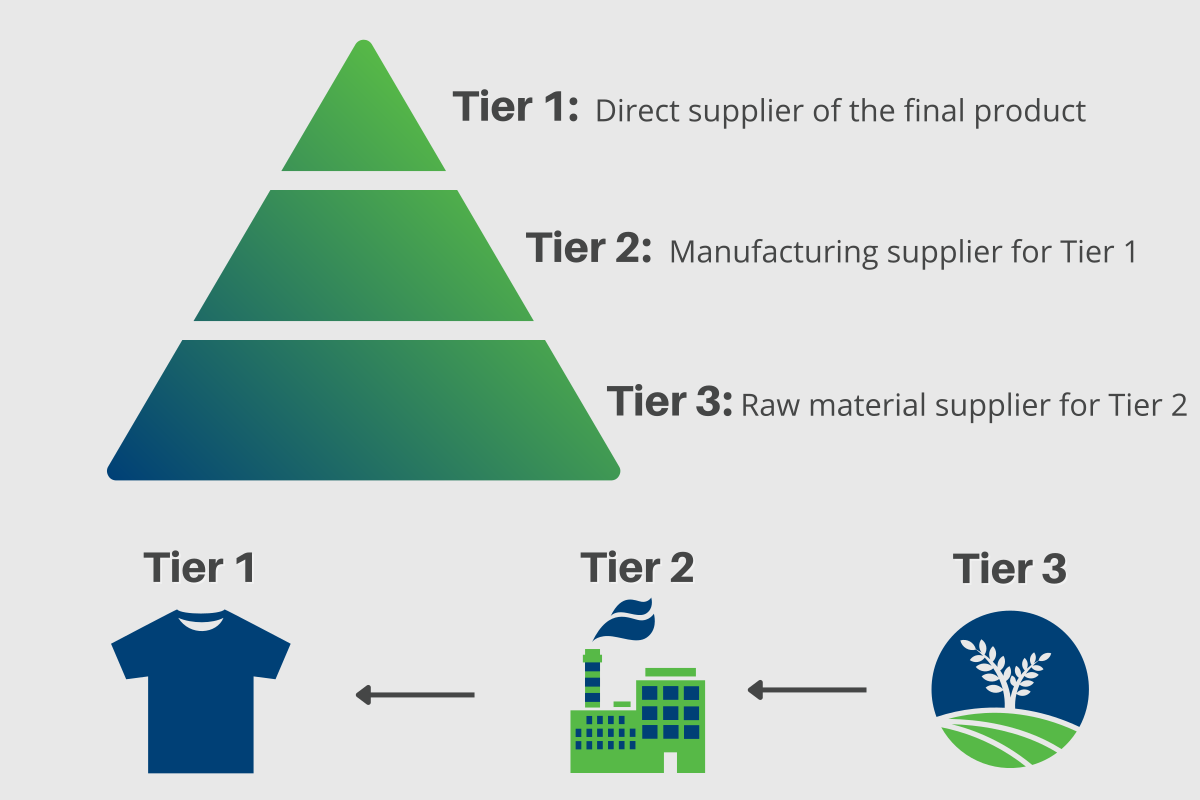
Tier 1 suppliers are the direct suppliers of the final product — the companies your procurement team contracts with and with whom you have the closest commercial relationship. They are responsible for delivering high-quality goods on time and meeting the specifications, quality standards, and compliance requirements of the end-product company. In 2025, Tier 1 supplier compliance obligations extend well beyond quality: they must demonstrate adherence to human rights standards, environmental protections, and social compliance requirements as mandated by the LkSG and CSDDD. Buyers who fail to verify Tier 1 compliance face direct regulatory penalties, supply disruption risk, and reputational damage.
An example of a Tier 1 supplier could be a factory that assembles cotton t-shirts for a clothing company. The factory needs to ensure that the t-shirts are made with durable and comfortable fabric, that they have the right size and colour, and that they are free from defects or damages. The factory also needs to follow ethical and sustainable practices in terms of labour rights, waste management, energy consumption, and emissions — all areas subject to SMETA audit assessment and CSRD environmental disclosure requirements.
How Tier 2 Suppliers Support Tier 1 Suppliers in the Supply Chain
Tier 2 suppliers are suppliers or subcontractors that provide goods or services to Tier 1 suppliers. They are responsible for ensuring that their goods or services meet the quality and quantity requirements of the Tier 1 suppliers, and must also comply with the safety, quality, environmental, and social standards that cascade down from the end-product company’s regulatory obligations. Under the EU CSDDD, companies are required to conduct due diligence not just on their direct suppliers but on indirect suppliers where they have substantiated concerns — making Tier 2 visibility a legal necessity, not merely best practice.
An example of a Tier 2 supplier could be a fabric mill that produces cotton fabric for a factory that assembles t-shirts for a clothing company. The fabric mill needs to ensure that the fabric is made with high-quality cotton, that it has the right texture and weight, and that it is free from contaminants or defects. The fabric mill also needs to follow ethical and sustainable practices in terms of sourcing, processing, waste management, energy consumption, and emissions — areas that are now covered under extended CSDDD due diligence requirements and CSRD Scope 3 reporting.
Where Tier 3 Suppliers Fit in the Supply Chain and What They Provide
Tier 3 suppliers are the producers of raw materials that Tier 2 suppliers use to manufacture their goods or services. They are the furthest removed from the end product company but often carry the highest social and environmental risk — raw material extraction and agriculture are frequently associated with forced labour, environmental degradation, and human rights violations. The UFLPA, for example, specifically targets forced labour risks at the raw material level, and both the LkSG and CSDDD require companies to identify and manage these risks even in indirect supply chain tiers when there is substantiated knowledge of violations.
An example of a Tier 3 supplier could be a cotton farm that grows and harvests cotton for a fabric mill that produces cotton fabric for a factory that assembles t-shirts for a clothing company. The cotton farm needs to ensure that the cotton is grown with high-quality seeds, that it is harvested at the right time and condition, and that it is free from pests or diseases. The cotton farm must also follow ethical and sustainable practices in terms of land use, water use, fertiliser use, pesticide use, and labour rights — areas that are directly referenced in the human rights risk categories of the LkSG and CSDDD.
How to Collect and Manage Performance and Compliance Data for Your Suppliers
Collecting performance and compliance data for any tier supplier can be a complicated task, particularly as regulatory requirements now extend obligations deep into indirect supply chains. Certainty’s Supplier Social and Environmental Compliance Checklist can help improve your supply chain management and reduce supply chain risk. This free-to-download checklist is an excellent starting point for improving your supply chain visibility and sustainability — and for building the documented due diligence evidence trail required by the LkSG, CSDDD, and CSRD.
Managing supplier compliance across multi-site locations and extensive supply chain configurations is inherently challenging. While Tier 1 relationships may be manageable through direct engagement, the same depth of oversight is rarely possible for Tier 2 and Tier 3 suppliers without systematic tooling. Yet in 2025, regulators under the LkSG and CSDDD expect companies to demonstrate active risk management across all supplier tiers — not just the ones they know best. Tiered visibility is the foundation of a structured supplier risk management program — see how to build a supplier risk management program for the program-design steps that translate tier mapping into ongoing risk oversight.
Using Certainty, you unlock greater control and visibility of your entire supply chain network. Compliance of Tier 1 suppliers alone is no longer sufficient as enforced legislation such as the LkSG, EU CSDDD, and CSRD place supplier compliance responsibility on you to manage all your supplier tiers. With Certainty’s multilingual enterprise-level reporting, action delegation, inspection scheduling, data integration APIs, and much more, you can manage your supply chain with greater confidence and demonstrate the documented due diligence that regulators and auditors now require.
Frequently Asked Questions (FAQs)
Q: What is the difference between Tier 1, Tier 2, and Tier 3 suppliers?
A: Tier 1 suppliers deliver directly to the buying company and have the closest commercial relationship. Tier 2 suppliers provide materials and components to Tier 1 suppliers. Tier 3 suppliers produce the raw materials or basic inputs used by Tier 2 suppliers. Each tier is progressively more distant from the end product but can carry significant compliance, social, and environmental risk.
Q: Why does supply chain visibility matter for regulatory compliance in 2025?
A: The EU CSDDD, Germany’s LkSG, the CSRD, and the UFLPA all require companies to conduct due diligence not just on direct suppliers but on their broader supply chains. Companies that can only demonstrate Tier 1 visibility risk regulatory penalties, supply disruption, and reputational damage. Despite this, only 6% of companies have clear visibility into their entire supply chain — leaving the vast majority exposed to compliance gaps.
Q: How can Certainty Software help manage multi-tier supplier compliance?
A: Certainty Software provides a centralised platform for scheduling supplier assessments, distributing multilingual compliance checklists, tracking corrective actions, and generating real-time compliance dashboards across all supplier tiers. This systematic approach supports the documented due diligence requirements of the LkSG, CSDDD, and CSRD.
You may also be interested in: