Summary: Construction safety starts with proper tools and equipment, because workers who begin tasks without the right PPE or job-specific gear face immediate injury and compliance risk. For safety leaders, the fix is not just issuing equipment once, but building a reliable system for task-based readiness, fast access, inspection, and accountability so crews can work safely even when job demands change quickly.
The top 7 safety issues facing the construction industry in 2025-2026 include inadequate tools and equipment, insufficient ongoing training, gaps in compliance tracking, subcontractor safety alignment, budget-versus-safety trade-offs, an aging workforce, and deeply ingrained poor habits. Construction remains one of the most hazardous industries in the world — accounting for approximately 1 in 5 worker fatalities in the United States annually, according to the Bureau of Labor Statistics. How can construction companies build a robust safety program and sustain genuine employee buy-in? We spoke with industry professionals Steve Mellard, National Safety Director at Anning Johnson, and Desire’e Ropel, Safety Manager at Hermanson, to get an insider perspective on managing safety in the construction industry.
Previously in our construction safety series, we discussed ways to increase employee buy-in to your organization’s safety culture. In this post we’ll take a detailed look at the top 7 safety issues currently facing the construction industry — and practical strategies to overcome each one.
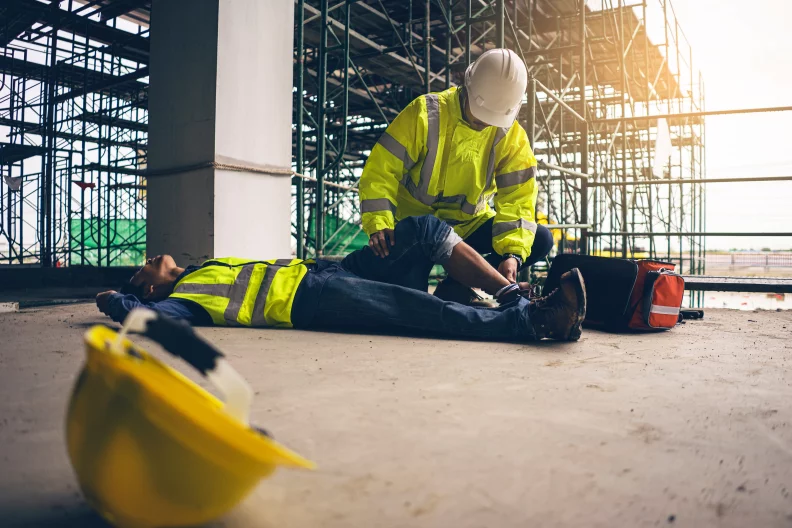
1. Workers Need Proper Tools & Equipment
It is surprisingly common for workers to begin a task without the correct tools and equipment, particularly when rapidly switching between jobs on a busy construction site. OSHA standards — including 29 CFR 1926 Subpart E (Personal Protective and Life Saving Equipment) — require that workers have and use appropriate PPE for every task. Your organization’s safety program must reinforce that no job, however brief or routine, should begin without all required tools and construction safety equipment. Accidents take seconds to happen. Pre-task toolbox talks and Job Safety Analysis (JSA) reviews are effective mechanisms to ensure equipment readiness is verified before work begins.
2. Continuous Safety Training is Necessary
Regulations and safety standards governing construction work change frequently — driven by new OSHA rulemakings, updated NFPA codes, incident learnings, new equipment introductions, and evolving project scopes. Safety training is not a one-time onboarding event. OSHA’s construction standards mandate competency-based training for specific hazards including falls (29 CFR 1926.503), excavations (29 CFR 1926.651), and scaffolding (29 CFR 1926.454). Conducting regular, documented safety training — both to introduce new practices and reinforce established ones — is fundamental to construction worker safety and regulatory compliance. Training records should be centrally maintained and easily accessible for OSHA inspections and internal audits.
3. Tracking For Compliance
Even a robust safety program will underperform if compliance is not systematically tracked and verified. Organizations need a centralized system to confirm that safety procedures are being followed across all teams, shifts, and job sites — and to generate the documented evidence required during OSHA inspections or ISO 45001 audits. Without reliable tracking, inspection completion rates drop, corrective actions stall, and compliance gaps go undetected until they become incidents. If you’re looking for a solution to manage and report business risk, compliance, and performance metrics easily, Certainty Software is here to help — providing real-time dashboards, automated scheduling, and complete audit trails across your entire operation.
30+ Audit and inspection checklists free for download.
4. The Safety Practices of Contracted Organizations
Large construction projects routinely involve multiple general contractors and subcontractors sharing the same job site. When those organizations carry different safety cultures, standards, or training levels, the risk of incidents increases significantly. OSHA holds the controlling employer responsible for ensuring that all contractors on a multi-employer work site comply with applicable safety standards. Management should verify that all contractors abide by the project’s safety rules and procedures, conduct pre-qualification reviews of contractor safety records, and require the same compliance tracking rigor outlined in point 3 above. Written contractor safety agreements and regular joint safety meetings are effective tools for alignment.
5. Prioritizing Safety, Along with Schedule and Budget
Schedule and budget have always dominated construction decision-making. But the true cost of failing to prioritize safety is staggering. Fatal and nonfatal workplace injuries in the construction industry cost the U.S. economy an estimated nearly $13 billion annually — and that figure does not account for regulatory penalties, reputational damage, project delays caused by incident investigations, or the human cost to injured workers and their families. OSHA citations for willful safety violations can reach $16,131 per violation as of 2025. Safety must be embedded as a core operational value, equal in weight to schedule and budget — not treated as a compliance checkbox activated only when regulators appear.
6. Having an Aging Workforce
The construction workforce is aging. Studies consistently show that while older workers experience injuries less frequently than younger workers, their injuries tend to be more severe and result in longer recovery times. Research published in the American Journal of Industrial Medicine confirms that workers’ compensation costs increase with worker age, largely due to greater lost work time per incident. Organizations can meaningfully mitigate this risk by adapting job site design and workflows to the physical demands of an older workforce — including ergonomic tool selection, lighter materials, modified task rotation, and accessible job site layouts. Age-inclusive safety training that acknowledges experience while addressing physical changes is equally important.
7. Poor Habits and Resistance to Change
Unsafe habits developed over years on previous job sites are among the hardest safety challenges to address. New employees may bring ingrained shortcuts from other organizations, while highly experienced workers may resist updated procedures with the attitude that “we’ve done it this way for 20 years — why change now?” Both dynamics increase incident risk. Continuous reinforcement of your safety program — through toolbox talks, BBS observations, visible leadership modeling, and recognition of safe behaviors — is the most effective long-term solution. Where genuine resistance exists, non-punitive coaching conversations and data-driven feedback about observed at-risk behaviors can shift mindsets over time. Celebrating positive change reinforces the message that safety improvement is valued, not just mandated.
In the next blog in our series on construction safety, we’ll discuss the #1 safety issue in construction as told by top safety management leaders.
Stay tuned!
Other blogs in this series you may be interested in:
4 Considerations When Improving Safety In The Construction Industry
What Must A Construction Safety Program Include To Be Effective?
How Leadership Style Affects Safety Performance in Construction
Boosting Employee Buy-In To Your Safety Culture and Construction Safety Program
#1 Safety Issue In Construction As Told By Top Safety Management Industry Leaders
How Has Technology Changed Construction Safety?
Frequently Asked Questions (FAQs)
What are the most common causes of construction fatalities?
OSHA’s “Fatal Four” — falls, struck-by incidents, electrocution, and caught-in/between hazards — account for more than 60% of construction worker deaths each year. Addressing these four hazard categories through engineering controls, proper PPE, regular safety inspections, and thorough worker training is the foundation of any effective construction safety program.
How should construction companies track safety compliance across multiple job sites?
Multi-site compliance tracking requires a centralized digital platform that can capture inspection results, corrective actions, and safety metrics in real time across all locations. Manual spreadsheets and paper-based systems create dangerous visibility gaps. Solutions like Certainty Software provide a unified dashboard where EHS managers can monitor inspection completion rates, outstanding corrective actions, and compliance trends across every site — giving leadership the data needed for informed decision-making and audit readiness.
How often should construction safety training be conducted?
The frequency of safety training depends on the specific hazard and applicable OSHA standard. Some training has defined intervals (for example, OSHA requires annual refresher training for certain confined space and hazard communication programs), while other training should be triggered by new equipment, project changes, incidents, near misses, or the onboarding of new workers and contractors. A best-practice approach documents all training, tracks completion by employee, and generates automated reminders for renewal — functionality available through modern safety management platforms.