Summary: Construction Industry Safety Improvements start with practical changes that reduce risk on real job sites. When construction companies build a strong safety culture, train consistently, plan realistically, and address human factors, they create safer crews, fewer incidents, and stronger project performance.
In this blog series, we examine 4 critical considerations for improving safety in the construction industry. Construction remains one of the most hazardous sectors in the world. Specifically, it accounts for approximately 1 in 5 workplace fatalities in the United States. How can construction companies build effective safety programs and achieve sustained compliance? We’ve spoken with industry professionals Steve Mellard, National Safety Director at Anning Johnson, and Desire’e Ropel, Safety Manager at Hermanson to get an insider look into how to manage safety in the construction industry.
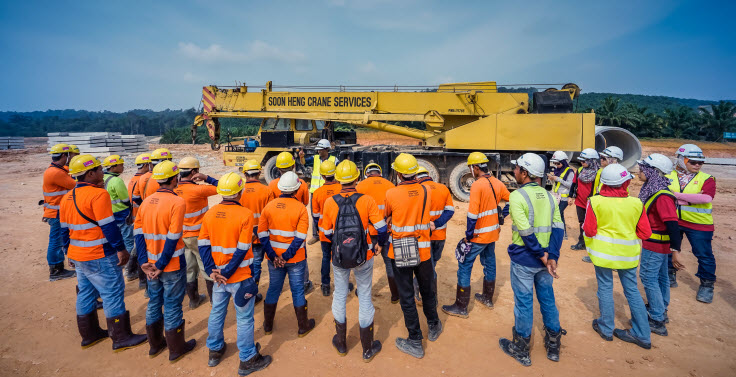
The construction industry presents uniquely complex health and safety challenges. According to OSHA, 1 out of every 5 workplace deaths in the United States occurs in construction. This sobering statistic has driven increasingly rigorous regulation over the past decade. Health and safety processes play a vital role in minimizing those risks. Furthermore, the construction industry faces heavy regulation through frameworks like OSHA 29 CFR 1926 and CFCSA in Canada. However, maintaining a functioning safety management program that ensures consistent compliance remains one of the industry’s greatest operational challenges.
Construction Industry Safety Improvements to Prioritize . Construction Industry Safety Improvements Start With Safety CultureA safety-first workplace culture serves as the most foundational driver of consistent construction industry safety improvements on job sites. When companies embed safety into daily operations rather than treating it as a compliance checkbox, workers at every level identify hazards more readily. They also report near misses and follow safe work procedures more consistently. However, maintaining a strong safety culture in construction proves difficult. Sites regularly integrate workers from multiple subcontractors, labor agencies, and cultural backgrounds.
For example, new personnel may come from environments where cutting corners is normalized. In some cases, safety reporting faces discouragement, and procedural compliance becomes optional. For this reason, leaders cannot assume safety culture exists on its own. Instead, they must actively build, communicate, and reinforce it through consistent leadership behavior, Behavior-Based Safety (BBS) observations, regular toolbox talks, and visible management commitment.
Additionally, ISO 45001:2018 explicitly requires organizations to establish, implement, and continually improve a safety culture within their occupational health and safety management system. A measurably strong culture shows up in lower Total Recordable Incident Rates (TRIR), higher near-miss reporting rates, and faster corrective action closure times.

30+ Audit and inspection checklists free for download.
2. Provide Consistent and Regular Safety Training
Desire’e Ropel, Safety Manager at Hermanson, identifies training consistency as one of the most critical factors in a successful construction safety program. Even procedures that seem like common knowledge need regular reinforcement. Specifically, fall protection, lockout/tagout (LOTO), and PPE use must go through structured training to remain top of mind on a busy job site. Moreover, OSHA’s Construction Standards (29 CFR 1926) mandate training for a wide range of hazardous activities. ISO 45001 also requires organizations to maintain documented evidence of competence for workers performing safety-critical tasks.
Consequently, effective training programs must go beyond one-time onboarding. They should include regular toolbox talks that address site-specific hazards. Teams should also review Job Hazard Analyses (JHA) with crews before high-risk tasks. In addition, refresher courses become necessary when procedures change or incidents occur. Site supervisors and top-level management provide consistent reinforcement that keeps safety procedures active in workers’ daily decision-making. As a result, procedures stay fresh rather than getting filed away in an induction handbook. Furthermore, digital platforms that deliver and track training completion give safety directors the audit trail they need to demonstrate regulatory compliance.
3. Have Realistic Budgets and Deadlines
Construction companies operate under relentless pressure to deliver projects on time and within budget. That pressure defines the nature of the business. However, when schedules slip or costs run over, teams often de-prioritize safety first. Front-line managers and workers racing against deadlines may bypass safety inspections. They may also skip pre-task risk assessments or reduce PPE compliance in the name of speed. This trade-off creates serious danger.
In fact, the cost of a serious incident far exceeds the cost of doing the work safely. Workers’ compensation claims, OSHA fines, project delays, litigation, and reputational damage all add up quickly. Notably, OSHA’s most frequently cited construction violations include fall protection failures (29 CFR 1926.501), scaffolding deficiencies (29 CFR 1926.451), and inadequate hazard communication. These violations often occur in environments where schedule and cost pressures override safety discipline.
Therefore, safety managers and site directors must work with project leadership to set realistic timelines and budgets that account for proper safety procedures. Most importantly, organizations should never position safety as a variable they can adjust when things get tight. Automated inspection scheduling and real-time dashboards help safety teams show where they complete safety processes on time. Similarly, these tools reveal where pressure-driven shortcuts emerge.
4. Consider “The Human Factor”
Steve Mellard from Anning Johnson identifies the “human factor” as one of the most important and often underestimated considerations in construction safety management. The human factor encompasses the behavioral, cognitive, and organizational elements that influence whether workers make safe choices in the moment. Research consistently shows that human error or behavioral decisions contribute to the vast majority of workplace incidents. This holds true even when physical hazards and engineering controls exist.
For example, employees may knowingly take shortcuts, skip PPE, or disregard safe work procedures. Time pressure, complacency, peer influence, or a belief that “it won’t happen to me” often drive these choices. In particular, this explains why Behavior-Based Safety (BBS) programs deliver so much value in construction. These programs systematically observe and reinforce safe behaviors, creating positive feedback loops that shift norms over time.
Moreover, addressing the human factor means designing safety processes that workers find practical and easy to follow. This approach reduces the friction that tempts workers to cut corners. Additionally, near-miss reporting systems, open safety conversations, and non-punitive reporting cultures all serve as evidence-based strategies. These tools surface human-factor risks before they result in recordable incidents.
Instead of facing potential OSHA citations, legal action, workers’ compensation costs, and lost productivity, construction organizations should invest in addressing these four considerations. As a result, they build a safety program that protects workers, reduces financial exposure, and positions them for long-term operational excellence. Ultimately, the data makes it clear: proactive safety management goes beyond a compliance requirement. It delivers a genuine competitive advantage.
In the next blog in our series on construction safety, we cover what a construction safety program must include to be effective.
Construction Industry Safety Improvements work best when leaders connect daily decisions to visible safety expectations. The most effective Construction Industry Safety Improvements are simple enough to apply consistently across crews and subcontractors. Tracking results over time helps organizations turn Construction Industry Safety Improvements into long-term performance gains.
Frequently Asked Questions (FAQs)
What are the most important factors when improving construction site safety?
The four most critical factors are establishing a genuine safety-first culture, providing consistent and regular safety training, setting realistic budgets and deadlines that account for safe work practices, and addressing the human behavioral factors that contribute to most incidents. Together, these elements form the foundation of a construction safety program that meets OSHA requirements and aligns with ISO 45001 best practices.
How does workplace culture affect construction safety performance?
Workplace safety culture directly influences whether workers follow procedures, report hazards, and intervene when they see unsafe behavior. Organizations with strong safety cultures typically record lower TRIR values, higher near-miss reporting rates, and faster corrective action closure times. ISO 45001 identifies leadership commitment and worker participation as the two most important cultural drivers of safety performance.
How can construction companies manage safety across multiple subcontractors?
Managing safety across a diverse workforce requires documented onboarding and induction procedures for all site personnel, site-specific safety orientations, consistent toolbox talks, and inspection tools that capture compliance data across every worker and subcontractor. Digital safety management platforms like Certainty Software allow safety directors to monitor inspection completion and corrective action status across all sites and subcontractors in real time.
Other blogs in this series:
What Must A Construction Safety Program Include To Be Effective?
How Leadership Style Affects Safety Performance in Construction
Boosting Employee Buy-In To Your Safety Culture and Construction Safety Program
7 Significant Safety Issues Facing The Construction Industry
#1 Safety Issue In Construction As Told By Top Safety Management Industry Leaders