Summary: Supply chain risk management is now a strategic priority because supplier failures can trigger legal, financial, operational, and reputational damage at the same time. Regulatory mandates, ESG accountability, and geopolitical disruption have expanded supply chain risk far beyond procurement, making structured SCRM essential for supplier due diligence and business continuity. High-performing teams treat supply chain risk as an ongoing intelligence process, using risk scoring, audit data, and cross-functional action plans to reduce exposure before disruption spreads.
Table of Contents
- Why Supply Chain Risk Is a Strategic Priority Today
- What Is Supply Chain Risk Management (SCRM)?
- 7 Categories of Supply Chain Risk Factors
- Scoring and Prioritizing Supplier Risk
- How High-Performing Teams Operationalize Risk Intelligence
- Why SCRM Programs Falter
- The Untapped Potential of Internal Audit Data
- Why Supply Chain Risk Management Is a Competitive Advantage
- How Certainty Software Supports Resilient, Risk-Ready Supply Chains

Why Supply Chain Risk Is a Strategic Priority Today
Supply chain risk management (SCRM) has become a board-level priority as regulatory mandates, geopolitical instability, and ESG accountability converge to make supplier vulnerabilities more consequential than ever. A single missed compliance obligation or a supplier falling short on due diligence can now trigger cascading legal, financial, and reputational consequences — not just operational delays.
The landscape has changed fundamentally. Risks have grown more complex, more interconnected, and more frequent. Gartner reports that 89% of companies experienced a supplier risk event in the past five years that resulted in significant operational disruptions. These challenges now span well beyond procurement into compliance, sustainability, and enterprise risk — shaped by binding regulations including the EU Corporate Sustainability Due Diligence Directive (CSDDD), the German Supply Chain Act (LkSG), and the Corporate Sustainability Reporting Directive (CSRD), all of which impose formal due diligence and disclosure obligations on companies and their supply networks.
For compliance leaders, proactive supply chain risk management has shifted from minimizing loss to creating a strategic opportunity: building an adaptable, accountable supply network that withstands volatility and satisfies the documentation standards that regulators now demand.
What Is Supply Chain Risk Management (SCRM)?
Supply Chain Risk Management (SCRM) is the systematic process of identifying, evaluating, and mitigating vulnerabilities that affect the movement of goods, services, data, and compliance across the supply network. While the foundational principles remain — assess, manage, and improve — modern SCRM programs are being designed to act as real-time intelligence engines that satisfy both operational resilience goals and regulatory due diligence requirements under frameworks such as CSDDD, LkSG, and CSRD.
Risk management today is tightly woven into daily operations. It is supported by digital tools that can surface early signals — production slowdowns, regulatory shifts, geopolitical tensions — before they evolve into crises or compliance breaches. Mature programs move beyond simply documenting problems; they translate insights into timely decisions across procurement, compliance, ESG, and quality.
The goal is business continuity: uninterrupted operations backed by trustworthy data, transparent suppliers, and systems that adapt at the speed of risk — and the speed of regulation.

30+ Audit and inspection checklists free for download.
7 Categories of Supply Chain Risk Factors That Matter Most to Compliance Teams
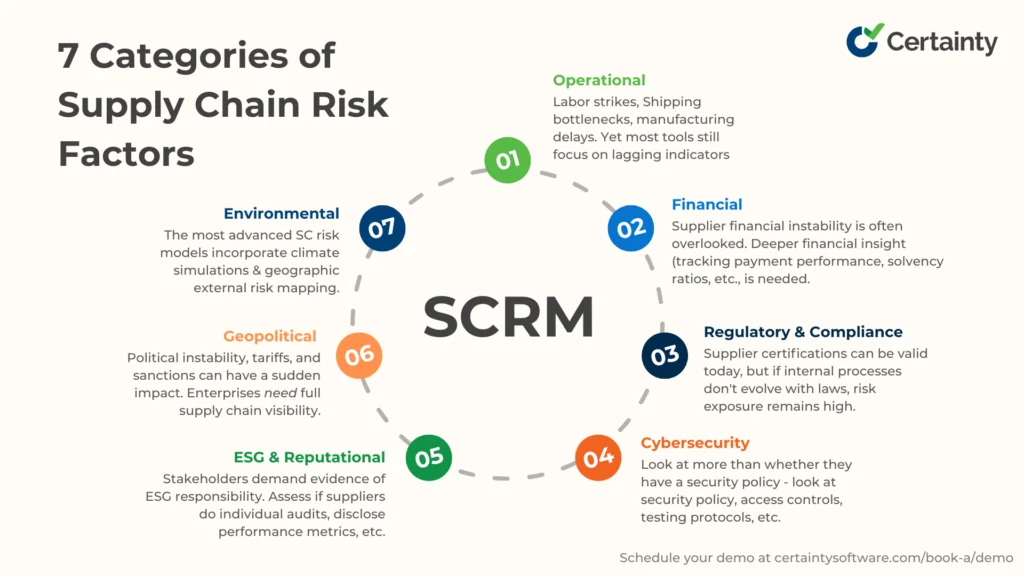
The term “supply chain risk” often conjures images of container ships stuck in ports — like the Suez Canal blockage of 2021 — or delayed deliveries. But the true supply chain threat lies in layered, hidden vulnerabilities that accumulate over time, spanning physical, digital, environmental, and regulatory domains. In 2025–2026, regulatory risk has emerged as one of the most urgent new dimensions, as CSDDD, LkSG, and CSRD create formal legal exposure for compliance gaps that were previously managed informally.
Let’s take a closer look at the key risk areas shaping modern SCRM:
Operational Risk
Disruptions like labor strikes, shipping bottlenecks, and manufacturing delays have become more frequent and less predictable. Yet many management tools still focus solely on lagging indicators like missed shipments. The more effective approach involves tracking predictive signals:
- capacity constraints,
- upstream production volatility,
- and supplier lead time drift.
These early warnings provide the lead time needed to reroute or renegotiate before issues become crises.
Financial Risk
Supplier financial instability is often overlooked, especially if orders are currently being fulfilled. Yet underneath, liquidity issues, mounting debt, or dependency on volatile markets can create potential disruptions. Regular credit checks help, but deeper financial insight comes from tracking payment performance, solvency ratios, and external factors like local currency fluctuations in supplier regions — factors that also intersect with LkSG risk assessments for financially vulnerable suppliers.
Regulatory and Compliance Risk
Regulatory environments are in constant flux — and the stakes have risen dramatically. The EU’s CSDDD requires large companies to identify, prevent, and mitigate human rights and environmental risks throughout their supply chains, with civil liability provisions for failures. Germany’s LkSG (Lieferkettensorgfaltspflichtengesetz) imposes similar obligations on companies operating in or sourcing from Germany, with significant financial penalties for non-compliance. CSRD further requires structured annual sustainability reporting that encompasses supply chain impacts. A supplier’s current certification might be valid today, but if their internal processes haven’t evolved alongside these regulations, risk exposure remains high. Monitoring change management maturity is as important as verifying documentation.
How can you ensure that the compliance data your suppliers provide is trustworthy? We’ve put together a resource that guides you through the signs of untrustworthy supplier data and how to ensure your suppliers are aligned with your compliance goals. Learn more here.

Book a demo today to explore Certainty’s audit and inspection management solution
Cybersecurity Risk
Digital transformation has connected global supply chains — and in doing so, introduced new cyberattack vulnerabilities. Breaches originating in third-party vendors are increasingly common. Evaluating a supplier’s digital posture means looking beyond whether they have a security policy, to reviewing penetration testing protocols, access controls, incident response plans, and system redundancy. Under CSDDD, cybersecurity-related harms in the supply chain can constitute a human rights or governance risk requiring due diligence.
ESG and Reputational Risk
Stakeholders now demand evidence of environmental and social responsibility throughout the value chain — and regulations are converting those expectations into legal obligations. CSDDD requires companies to assess supplier labor practices, emissions data, and governance standards as part of formal due diligence. CSRD mandates disclosure of these findings in annual sustainability reports. Surface-level ESG pledges no longer suffice. Compliance leaders must assess whether suppliers conduct individual audits, disclose performance metrics, and demonstrate improvement over time.
Explore our ESG Management articles to help strengthen your ESG risk avoidance and mitigation.
Geopolitical Risk
Political instability, tariffs, and sanctions can dismantle a supplier network overnight. Organizations need visibility into where their materials originate, what dependencies exist across tiers, and how upstream supply chain disruptions might ripple into production lines or compliance obligations. Evaluating risk at the country level is not enough — and CSDDD’s requirement to assess adverse impacts at each tier of the supply chain demands a more granular approach to geopolitical mapping.
Environmental Risk
Climate-related natural disasters — extreme weather, drought, floods, pandemics, wildfires — have increased in both frequency and severity. A supplier located in a floodplain or wildfire-prone region can disrupt months of inventory planning in a single week. The most advanced supply chain risk models now incorporate climate simulations and geographic external risk mapping to help teams preemptively diversify sourcing. Under CSDDD, environmental risks in the supply chain — including deforestation, water pollution, and biodiversity harm — must be identified and addressed as part of mandatory due diligence.
Expert Insight: A recent KPMG report on 2025’s top geopolitical risks highlights supply chain instability and environmental disruption as two of the most urgent threats facing global businesses. These forces are tightly woven into supply chain resilience — and yet remain under-evaluated in many compliance and procurement programs.
Want to know where you stand compared to other compliance leaders? Then take our Digital Audit and Inspection Management Readiness Quiz.
Scoring and Prioritizing Supplier Risk with Precision
Supply chain failures rarely result from a lack of data — they come from a failure to connect that data into actionable insight. Supplier risk scoring is one of the most misunderstood tools in a compliance leader’s toolkit. Done well, it becomes a compass for decision-making. Done poorly, it becomes another spreadsheet that gathers dust — and leaves organizations exposed to the liability provisions now embedded in CSDDD and LkSG.
The key is context. Instead of treating suppliers as interchangeable checkboxes, leading organizations build nuanced, living risk profiles that reflect inherent risk and criticality to operations. For example, a supplier with moderate ESG risk may pose a greater threat to continuity if they provide a single-sourced input for a key product line. A high score in isolation means little — it’s the downstream implications that matter, including the potential for regulatory liability if risks are not documented and acted upon under CSDDD.
This is where multi-factor models shine. They take into account audit history, operational performance, financial resilience, regional exposure, and even indicators like change in leadership or media-reported incidents. Rather than relying on a one-size-fits-all scoring system, compliance teams are weighting each factor based on what truly moves the needle for their business — and what regulators require them to prioritize.
Risk scoring also needs to be actionable. When a vendor’s risk profile changes — because of an incident, missed audit, or external disruption — an internal system response should be triggered automatically. That might mean escalating to a quarterly audit cycle, issuing a corrective action, or surfacing the supplier for executive review. The most mature programs treat risk scores as a decision-making input woven into procurement, quality, and ESG operations — not as an output. This integrated approach directly supports the documented risk management processes required under CSDDD and LkSG.
Access free-to-download supply chain audit checklists
CTPAT Checklist
ESG Checklist
GSCA Due Diligence Checklist
Supplier Corrective Action Form
Supplier Social & Environmental Compliance Checklist
Pro Tip: Consider layering in external data feeds — such as sanctions databases, geopolitical risk monitors, or ESG news aggregators — to keep scores dynamic. A supplier’s risk status shouldn’t only change when you evaluate them. It should evolve as the world does — and as regulations like CSDDD introduce new categories of risk that must be actively monitored.
How High-Performing Teams Operationalize Risk Intelligence
In most organizations, supplier oversight is fragmented by design:
- Procurement manages pricing and terms,
- Compliance handles audits and regulatory checks,
- ESG teams track sustainability metrics,
- and operations chase on-time performance.
Each team holds a piece of the puzzle — but rarely the full picture. And under CSDDD, regulators expect a coherent, documented risk management program — not a collection of disconnected departmental activities.
Operationalizing supply chain risk management means creating connective tissue between these functions. High-performing teams establish a shared language around risk. They agree on what defines a “high-risk supplier,” how issues are escalated, and what metrics get reported to leadership — and to regulators under LkSG and CSRD disclosure requirements.
Asset: What is a supplier risk assessment?
Technology plays a big role — there is no doubt about this. But alignment comes first. A dashboard is only as good as the definitions it reflects. When procurement sees a flagged supplier, they must be able to trust that the score was derived from criteria relevant to both operational continuity and compliance standards — including the specific due diligence requirements of CSDDD and LkSG. When a corrective action is triggered, the team executing it needs to know where the risk originated and what success looks like.
Some of the most effective organizations embed risk checkpoints directly into procurement workflows. Before renewing a contract or onboarding a new vendor, risk scores are reviewed, flagged issues are surfaced, and escalation rules are applied. This due diligence prevents risk from becoming an afterthought — or worse, a post-incident discovery with regulatory consequences.
Why SCRM Programs Falter Even With Good Intentions
The gap between SCRM policy and SCRM reality usually reveals itself during a crisis — or an audit. A supplier audit gets missed, a non-compliance issue goes unresolved, or a long-trusted vendor fails to deliver during a surge period.
Often, it points back to the same root causes: scattered data, siloed accountability, and blind spots in the supplier base — the very gaps that regulators targeting CSDDD and LkSG compliance are designed to expose.
A most common pitfall is mistaking volume for visibility. A company may conduct hundreds of audits annually, but if the findings sit in disconnected reports or PDF files that no one reviews collectively, the program is merely performative. True risk visibility comes from the number of decisions improved from the findings — and from the documented evidence that regulators can review.
Over-reliance on trust-based relationships is another weak point. Longtime suppliers are often given implicit passes, even when early warning signs — financial strain, shifting leadership, declining performance — start to emerge. Without mechanisms for continuous evaluation, this complacency can snowball into major disruptions or CSDDD liability for undocumented risks.
Visibility itself is often the biggest obstacle. Many companies don’t have a clear line of sight into where their suppliers source materials, how risks are evolving across tiers, or which vendors operate with outdated compliance controls. Without integrated platforms or consistent reporting frameworks, teams rely on stale assessments and assumptions — a posture that is increasingly untenable given the tier-level due diligence requirements embedded in CSDDD.
As for ESG metrics, self-reporting remains a significant trap. Many organizations are leaning heavily on supplier-declared sustainability metrics without validating them. Mature programs now build layered evaluations — combining internal audits, third-party certifications, and observational data — to separate signal from noise and satisfy the verification expectations of CSRD and CSDDD.
The Untapped Potential of Internal Audit Data
Few data sources offer a more direct window into supplier performance than internal audits. These audits capture what happens on the ground — not just what was promised in a proposal or captured in a policy. And under CSDDD, documented audit findings are a core input to the due diligence process that regulators will scrutinize.
Yet audit data is frequently underused. Findings are collected, logged, and maybe filed away. But they are rarely mined for patterns or linked to broader risk profiles — a significant missed opportunity both for operational intelligence and for demonstrating regulatory compliance.
Organizations treating internal audit data as a strategic asset can uncover trends that external benchmarks can’t reveal. Repeated documentation lapses might point to a systemic training issue across regions. High rates of corrective action aging could suggest cultural misalignment or poor change management. These insights are transformative — and they form the evidentiary foundation for demonstrating good-faith due diligence under LkSG and CSDDD.
When audit data is centralized and analyzed alongside supplier performance metrics, incident reports, and ESG evaluations, it becomes the foundation for a truly predictive risk model. Instead of reacting to the same issues year after year, teams can act early — providing retraining, restructuring contracts, or diversifying suppliers to prevent repeat failures and close the documentation gaps that compliance audits expose.
Implementation Tip: Start by tagging audit findings with standardized categories. This makes it easier to spot frequency, severity, and location-based trends over time — and to generate the structured reports that CSRD and CSDDD require.
Why Supply Chain Risk Management Is a Competitive Advantage
Companies thriving in today’s volatile environment treat risk intelligence as a competitive weapon. Treating resilience as merely a defensive play no longer suffices — particularly as CSDDD, LkSG, and CSRD create regulatory differentiation between organizations with mature risk programs and those still operating reactively.
When supply chain risk management is embedded into the organization’s DNA, teams can:
- make faster sourcing decisions backed by verified data,
- shift sourcing strategies with precision,
- and respond to disruption without compromising customer commitments or triggering regulatory liability.
Beyond preserving margins, this agility protects reputation, bolsters investor confidence, and builds long-term trust with regulators and customers alike. Institutional investors are increasingly using operational risk exposure as a proxy for leadership maturity — particularly as part of ESG and governance evaluations that now factor in regulatory compliance with CSDDD and CSRD obligations.
But perhaps most importantly, mature SCRM builds stronger supplier relationships. When providers know that expectations are consistent, performance is tracked fairly, and collaboration is valued, they are more likely to commit to corrective actions, raise issues proactively, and align with your standards. This creates a culture of partnership — not just oversight — that is also more likely to produce the reliable, verifiable data that due diligence regulations require.
Industry Leader Quote:
“You must be able to identify the risk before you can do anything about it, so the first step toward resilience is understanding your exposure. I think what we learned — and continue to learn through the ongoing disruption — is that you’ve got to have visibility to what you are trying to manage.” — Shane Azzi, Chief Supply Chain Officer, Kimberly-Clark (Source)
How Certainty Software Supports Resilient, Risk-Ready Supply Chains
Certainty Software helps global enterprises close the gap between risk awareness and risk action. An extension of your supplier risk assessment management ecosystem, we provide the critical infrastructure for smarter oversight, better decisions, and measurable progress — including the documented due diligence evidence required under CSDDD, LkSG, and CSRD.
Whether your team is building a scalable SCRM program from the ground up or modernizing legacy systems to meet new regulatory requirements, Certainty provides the flexibility and structure needed to succeed across compliance, quality, ESG, and procurement functions.
Our platform empowers teams to:
- Conduct mobile-enabled audits from any location, syncing results instantly to a centralized system
- Use customizable templates aligned with global frameworks like ISO, CTPAT, LkSG, CSDDD, and internal SOPs
- Segment supplier risk by business unit, location, or category for more targeted oversight
- Automate escalation, corrective actions, and audit scheduling for high-risk vendors — creating the documented response trail regulators require
- Visualize trends in real time — spotting patterns before they escalate into disruptions or compliance breaches
- Connect supplier audit data with ESG metrics, financial insights, and operational KPIs for the full-context reporting demanded by CSRD and CSDDD
The result? Less friction. More foresight. And an approach that scales — mitigating risks as your supply chain evolves and as regulatory requirements intensify.
Frequently Asked Questions (FAQs)
What is supply chain risk management (SCRM)?
Supply chain risk management (SCRM) is the systematic process of identifying, assessing, and mitigating vulnerabilities across the supply network — including operational, financial, regulatory, cybersecurity, ESG, geopolitical, and environmental risks. Modern SCRM programs also serve as the operational backbone for meeting regulatory due diligence requirements under frameworks such as CSDDD, LkSG, and CSRD.
How does CSDDD affect supply chain risk management?
The EU Corporate Sustainability Due Diligence Directive (CSDDD) requires large companies to identify, prevent, mitigate, and account for adverse human rights and environmental impacts in their own operations and throughout their supply chains. This means SCRM programs must evolve from reactive risk monitoring to proactive, documented due diligence — with evidence trails that can satisfy regulatory scrutiny and potential civil liability investigations.
What is the difference between LkSG and CSDDD?
Germany’s LkSG (Lieferkettensorgfaltspflichtengesetz, or German Supply Chain Act) was enacted in 2023 and applies to companies with 1,000+ employees operating in Germany, requiring due diligence on human rights and certain environmental risks in their supply chains. The EU’s CSDDD is broader in scope, applying to larger EU companies and those with significant EU turnover, and includes civil liability provisions not present in LkSG. Companies subject to LkSG should treat it as a foundation for broader CSDDD compliance.
What are the most common causes of SCRM program failure?
The most common causes of SCRM program failure are scattered and siloed data, lack of cross-functional alignment, over-reliance on self-reported supplier data, and insufficient visibility beyond Tier 1 suppliers. These gaps create both operational blind spots and regulatory exposure — particularly under CSDDD and LkSG, which require documented due diligence across multiple supply chain tiers.