Summary: A Job Safety Analysis (JSA) is a structured process that breaks each job task into individual steps, identifies hazards at each step, and establishes control measures to eliminate or reduce risk before work begins. While not explicitly mandated by OSHA, JSAs are recognized as a best practice that strengthens hazard prevention, supports regulatory compliance, and engages frontline workers in proactive safety planning — especially when digitized for consistency and real-time tracking.
Table of contents

A job safety analysis (JSA) breaks each job task into steps, identifies hazards, and establishes controls to reduce risk before work begins. It is also known as a Job Hazard Analysis (JHA). Moreover, the JSA is one of the most effective tools for EHS managers, site safety supervisors, and operations teams. It helps prevent workplace incidents and demonstrates OSHA compliance. This guide walks you through exactly how to perform a job safety analysis. Specifically, it covers task selection, hazard identification, implementation, monitoring, and review.
What is Job Safety Analysis (JSA)?
A job safety analysis (JSA), also known as a Job Hazard Analysis (JHA), is a systematic process for breaking down job tasks into individual steps. For each stage, the team identifies specific hazards. Then they implement preventive or corrective controls to eliminate or minimize those risks before injury or illness occurs.
The primary purpose of a JSA is to make every job safer by surfacing hazards before they cause incidents. As a result, organizations that conduct regular job safety analysis reviews build a clear, documented roadmap for safe task completion. This directly contributes to a stronger safety culture and lower TRIR (Total Recordable Incident Rate).
Additionally, JSAs support verified compliance with OSHA standards. These include 29 CFR 1910.132 (PPE) and 1910.147 (Lockout/Tagout). Under ISO 45001:2018, the job safety analysis process also supports the standard’s requirement for systematic hazard identification and risk assessment.
How to Perform a JSA
Step 1: Identify the Job or Task to be Analyzed
The foundation of an effective JSA is selecting the right job for analysis. This critical first step is often rushed. However, methodically choosing which tasks to analyze ensures your safety resources have the greatest protective impact. As a result, your program reflects genuine risk priorities.
Begin by reviewing your workplace’s incident and near-miss history over the past three to five years. Look beyond major accidents. In particular, patterns in first-aid log entries and near-miss reports frequently reveal systemic hazards. These hazards may not yet have resulted in a recordable injury. However, they carry high potential for serious harm. Under OSHA’s recordkeeping requirements (29 CFR 1904), this data is already available to most safety teams.
When selecting tasks for analysis, prioritize based on:
- Accident history and near-miss frequency
- Tasks with the potential for severe injury, illness, or fatality
- Newly established, modified, or non-routine procedures
- Complex jobs involving multiple steps, equipment, or contractors
- Routine tasks that may have become subject to complacency or shortcuts
To bring structure to your selection process, convene key stakeholders. These include supervisors, experienced frontline workers, and your safety team. Together, compile a comprehensive list of all jobs in the work area. For each task, evaluate three key risk factors:
- Potential for injury
- Severity of potential harm
- Frequency of task performance
Practical Example: Risk Scoring
Comparing two tasks using a 1-5 scale for each factor:
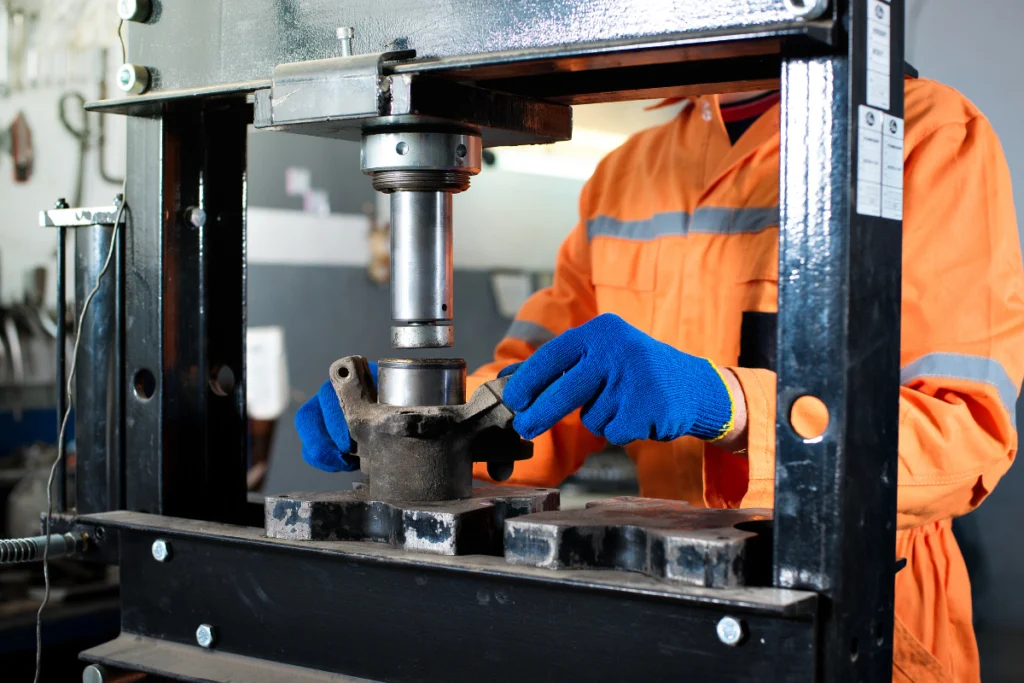
Hydraulic Press Operation:
- Injury potential: 4
- Severity potential: 5
- Frequency: 3
- Total score: 4 x 5 x 3 = 60
Manual Lifting Task:
- Injury potential: 3
- Severity potential: 2
- Frequency: 5
- Total score: 3 x 2 x 5 = 30
This scoring system gives safety managers an objective, defensible basis for prioritizing JSA efforts. Consequently, attention flows to the tasks where uncontrolled hazards pose the greatest risk to workers.
Step 2: Break Down the Job into Sequential Steps
With the target task selected, the next step is to decompose it into component actions. Breaking down a job effectively requires attention to detail. Furthermore, you need an understanding of the appropriate level of granularity. If you go too broad, hazards get missed. If you go too granular, the analysis becomes unworkable.
Observe the task in actual working conditions. Don’t rely on a single worker. Instead, observe two or three experienced employees completing the same job. Variations in technique between workers often highlight tacit risk behaviors or unofficial workarounds. Standard procedures rarely capture these differences. Where possible and with workers’ consent, record the process on video to support accurate documentation.
As you document the process, aim for the right level of detail:
Too general – “Operate machine.”
Just right – “Position material and start cutting.”
Too detailed – “Move right hand to the power switch, grasp switch with thumb and forefinger.”
Example: Breaking Down a Grinding Wheel Change
Here’s how to effectively break down a complex task:
- Pre-task preparation:
- Review the machine manual and specifications
- Gather the required tools and replacement wheel
- Notify nearby workers
- Safety measures:
- Lockout power source per OSHA 1910.147 (Control of Hazardous Energy)
- Verify zero energy state
- Wait for the wheel to stop completely
- Removal and replacement:
- Remove wheel guard
- Inspect replacement wheel for cracks or damage
- Remove and replace the grinding wheel
- Clean mounting surfaces
- Completion and testing:
- Reinstall the guard and verify the security
- Remove lockout device
- Perform test run at safe distance
After documenting steps, validate them with experienced workers. Key questions to ask:
- “What happens before this step?”
- “Is there anything you do between these steps?”
- “Are there any unofficial ‘tricks’ you use?”
Step 3: Identify Potential Hazards for Each Step
With your steps clearly documented, the next phase is the analytical core of the job safety analysis. The goal is to systematically identify what could go wrong at each step. Effective hazard identification requires safety professionals and workers to think both broadly and deeply. Specifically, they must consider not only obvious physical hazards but also energy sources, human factors, and environmental conditions.

30+ Audit and inspection checklists free for download.
Apply multiple lenses to each step of the task. In other words, think of hazard identification as putting on different pairs of glasses. Each pair provides a distinct safety perspective:
- Energy Analysis Perspective Consider all types of energy present:
- Kinetic (moving parts, rotating equipment)
- Potential (lifted loads, compressed springs, elevated materials)
- Electrical (exposed conductors, arc flash risk)
- Thermal (hot surfaces, steam, cryogenic materials)
- Chemical (toxic substances, flammable vapors, reactive compounds)
- Task Factors Perspective Examine the broader operational context:
- Tools and equipment condition and suitability
- Work environment (lighting, noise, confined spaces, weather)
- Time pressures and production demands
- Physical demands and ergonomic stressors
- Concurrent operations and proximity hazards
- Human Factors Perspective Think about the human element:
- Fatigue and time of day (night shifts, extended hours)
- Experience, training, and competency gaps
- Physical capabilities and limitations
- Stress, distractions, and complacency in routine tasks
Practical Example: Grinding Wheel Removal Hazards
Let’s analyze the hazards in our grinding wheel example:
Physical Hazards:
- Sharp edges causing lacerations
- Falling wheel causing foot or crush injury
- Awkward posture and repetitive force leading to musculoskeletal strain
Less Obvious Hazards:
- Stored energy from residual wheel momentum after shutdown
- Poor lighting reducing visibility during removal
- Metal dust inhalation exposure (relevant to OSHA’s PEL for respirable dust)
- Tool slippage or use of incorrect tooling for the specific wheel specification
Explore our library of free-to-download safety checklists to support your hazard identification efforts across a wide range of tasks and industries.
Step 4: Develop Preventative or Control Measures
With hazards identified, the next step is developing control measures that directly address each risk. Effective hazard control is not simply about assigning PPE. Instead, it requires a hierarchical approach aligned with OSHA guidelines. Furthermore, it must meet ISO 45001’s requirements for eliminating hazards at the source wherever practicable.
The Hierarchy of Controls:
- Elimination — The most effective control. Completely remove the hazard from the workplace. Example: Automate a dangerous manual process to remove human exposure entirely.
- Substitution — Replace the hazardous material or process with a less dangerous alternative. Example: Replace solvent-based cleaning agents with water-based equivalents to reduce chemical exposure risk.
- Engineering Controls — Physically isolate workers from the hazard through design changes:
- Machine guarding and interlocks
- Local exhaust ventilation systems
- Sound enclosures to reduce noise exposure below OSHA’s 85 dBA action level
- Light curtains and presence-sensing devices
- Administrative Controls — Change how people work to reduce exposure:
- Documented safe work procedures and permit-to-work systems
- Job-specific training and competency verification
- Warning signs and physical barriers
- Buddy systems and supervision requirements for high-risk tasks
- Personal Protective Equipment (PPE) — The last line of defense; PPE does not eliminate hazards but reduces exposure when higher-level controls are not feasible. Per OSHA 1910.132, employers must perform a formal hazard assessment and select PPE appropriate to the specific hazard. Be specific: “Safety glasses” is insufficient — specify lens rating, impact resistance standard (e.g., ANSI Z87.1), and any relevant side-shield requirements.
Example: Controlling Grinding Wheel Hazards
For the hazard of cuts from sharp edges:
- Engineering Control: Design and implement a dedicated wheel removal tool to minimize hand contact with wheel edges
- Administrative Control: Develop a written wheel removal procedure with mandatory supervisor sign-off
- PPE: Cut-resistant gloves rated to EN 388 Level 4 or equivalent ANSI A4
For metal dust exposure:
- Engineering Control: Local exhaust ventilation (LEV) positioned at the point of dust generation
- Administrative Control: Establish maximum exposure times consistent with OSHA PELs for metal dusts
- PPE:
- NIOSH-approved N95 respirator or higher where LEV is not fully effective
- Disposable coveralls to prevent skin and clothing contamination
Step 5: Implement, Monitor, and Review
Documenting a job safety analysis is only the beginning. The critical phase is translating that analysis into verified, sustained safe practices on the job site. This is where safety leadership is truly tested. Moreover, it is where the difference between a paper compliance exercise and a genuine injury prevention program becomes visible.
Key Implementation Steps:
- Create clear, worker-friendly documentation in plain language — complex language or jargon reduces compliance
- Deliver task-specific training tied directly to the JSA controls, with documented competency verification
- Communicate changes to affected workers, contractors, and supervisors before work resumes
- Establish a monitoring schedule that tracks adherence to JSA controls in practice, not just on paper
Monitoring should include:
- Daily supervisor field observations of task performance against JSA controls
- Weekly safety team spot-checks targeting high-risk tasks
- Monthly comprehensive audits comparing actual practices to JSA documentation
Track these key safety metrics to measure job safety analysis effectiveness:
- Total Recordable Incident Rate (TRIR) for JSA-covered tasks
- Near-miss reports related to analyzed job steps
- Inspection and audit compliance rates
- Worker feedback and hazard observations
Review and update your JSA:
- At least annually as part of your safety management review cycle
- Immediately after any related incident or near-miss event
- Whenever processes, equipment, or work methods change
- When new personnel are assigned to the task or new regulatory requirements apply
A well-maintained job safety analysis is a living document. It should be continuously refined as your workplace evolves. Similarly, it should deepen as your understanding of task-specific risks grows over time.
Is JSA Required by OSHA?
OSHA does not mandate a job safety analysis for all workplaces by name. However, the JSA process directly supports compliance with multiple OSHA standards. These standards require formal hazard assessment and hazard control. In addition, OSHA’s guidelines strongly recommend Job Hazard Analysis (JHA) as a best practice for identifying and controlling workplace hazards before they cause injury or illness.
OSHA’s General Duty Clause (Section 5(a)(1) of the OSH Act) requires employers to provide a workplace free from recognized hazards. Specifically, these are hazards that are causing or are likely to cause death or serious physical harm. The systematic hazard identification in a job safety analysis is one of the most demonstrable ways to satisfy this obligation. Furthermore, several specific OSHA standards also either require or strongly support JSA-equivalent processes.
Relevant OSHA Standards Related to JSA:
- OSHA 1910.132 (Personal Protective Equipment – General Requirements): Employers must conduct a workplace hazard assessment to determine if PPE is required — a process that is effectively a PPE-focused JSA. This assessment must be certified in writing, naming the workplace evaluated and the date of assessment.
- OSHA 1910.147 (Control of Hazardous Energy – Lockout/Tagout): Requires documented energy control procedures for each machine or piece of equipment — essentially a step-by-step hazard control analysis that mirrors the JSA structure. Every LOTO procedure is an application of JSA principles.
- OSHA 1910.269 (Electric Power Generation, Transmission, and Distribution): Mandates job briefings and hazard assessments before each work assignment involving electrical hazards — directly aligned with JSA methodology.
Why Implementing JSAs is a Best Practice
Even where OSHA does not explicitly name JSA as a requirement, incorporating job safety analysis into your program is a proactive strategy. It helps satisfy OSHA’s General Duty Clause and demonstrate due diligence. Additionally, it builds the documented evidence trail that regulators and auditors look for.
Organizations certified to ISO 45001:2018 benefit directly from JSA documentation. Specifically, it supports the standard’s Clause 6.1 requirements for hazard identification and assessment of OH&S risks and opportunities.
Practical Impact: Organizations that implement job safety analysis consistently see measurable reductions in workplace incident rates. They also experience lower workers’ compensation costs and improved regulatory audit outcomes. As a result, safety programs with embedded JSA processes close corrective actions faster and train workers more effectively. Most importantly, they foster a safety culture where hazard identification is a shared responsibility — not a compliance checkbox.
Common Challenges and Solutions in Conducting a JSA
Even well-resourced safety teams encounter obstacles when implementing JSA programs. The most common barriers are not technical — they are organizational. For example, resistance from workers and supervisors, incomplete hazard identification, and inconsistent follow-through on controls are the root causes of most JSA program failures.
Solutions to common challenges:
- Engage Leadership: JSA programs succeed when leadership is visibly committed. Site managers and EHS directors who participate in JSA reviews, act on findings, and reward hazard reporting set the tone for a genuine safety-first culture — not just a compliance exercise.
- Involve Workers Directly: Frontline workers are the most knowledgeable source of task-specific hazard information. Including them in JSA development — not just as observers but as active contributors — improves hazard identification quality and builds worker ownership of the resulting controls.
- Simplify the Process: Overly complex JSA forms and lengthy approval workflows discourage use. Streamlining the JSA process — with digital templates, mobile-friendly data entry, and automated routing for review and approval — increases the frequency and quality of analyses performed across your organization.
How Certainty Supports Your JSA Efforts
Certainty provides a comprehensive digital platform that streamlines every phase of the job safety analysis process. It covers initial hazard identification and risk scoring through to control verification, training documentation, and ongoing monitoring. By replacing paper-based JSA workflows with automated, data-driven processes, Certainty helps EHS Managers and Safety Directors reduce administrative burden. As a result, they can focus resources where risk is highest.
Features of Certainty:
- Automation of JSA Documentation: Certainty’s Vision and Insights machine-learning tools automatically complete and extract actionable information from your safety checklists and JSA forms, reducing documentation time and ensuring consistent, error-free records. Every JSA is stored, searchable, and available as evidence during OSHA inspections or ISO 45001 audits.
- Data Analytics and Safety Metrics: Certainty’s advanced reporting surfaces trends across your JSA data — revealing which tasks, locations, or teams are generating the most hazard findings, tracking corrective action closure rates, and providing the leading-indicator insights EHS leaders need to reduce TRIR and demonstrate continuous improvement.
- Regulatory Compliance Support: Certainty keeps your JSA program aligned with current OSHA standards, ISO 45001 requirements, and industry-specific safety codes. Automated reminders, scheduled review prompts, and built-in compliance frameworks ensure your JSA documentation never falls out of date — keeping your organization prepared for regulatory audits at any time.
Certainty’s tools streamline the job safety analysis process and embed it as a core driver of continuous safety improvement. The platform combines machine learning, real-time data capture, and intuitive reporting. Therefore, Certainty empowers safety managers to build safer, more compliant workplaces — at scale. Request a demo today to see how Certainty can strengthen your organization’s JSA program and overall safety performance.
You might also be interested in:
Frequently Asked Questions (FAQs)
What is the difference between a JSA and a JHA?
A Job Safety Analysis (JSA) and a Job Hazard Analysis (JHA) are the same process referred to by different names. OSHA uses the term “Job Hazard Analysis” in its published guidance, while many industries and organizations use “Job Safety Analysis.” Both describe the systematic breakdown of a job into steps, identification of hazards at each step, and development of controls to eliminate or reduce those risks.
How often should a JSA be reviewed and updated?
JSAs should be reviewed at minimum annually. They must also be reviewed and updated immediately after any related incident or near-miss, whenever the task, equipment, materials, or work environment changes significantly, and when new workers are assigned to the task. ISO 45001:2018 requires organizations to maintain current hazard identification and risk assessment information as a core element of the OH&S management system.
Who should be involved in creating a JSA?
The most effective JSAs are developed collaboratively. The team should include the supervisor responsible for the work area, experienced workers who regularly perform the task, and a safety professional or EHS manager. Involving workers directly in hazard identification produces more accurate, complete results and improves worker buy-in for the resulting controls.
Does OSHA require a written JSA?
OSHA does not require a written JSA for every task by name, but several OSHA standards effectively require documented hazard assessments that mirror the JSA process — including the PPE hazard assessment requirement under 1910.132 and the energy control procedure requirement under 1910.147. Written JSAs also provide critical documentation during OSHA inspections and regulatory audits, demonstrating that the employer has proactively identified and controlled recognized hazards under the General Duty Clause.