Summary: A continuous improvement assessment follows four structured phases — plan, do, check, act — to help organizations systematically identify non-conformances, reduce cost of poor quality (COPQ), and strengthen their quality management systems. For Quality Managers, Plant Managers, and Process Improvement Leads working under ISO 9001 Clause 10 and IATF 16949, this PDCA-based framework maximizes first pass yield, drives down non-conformance rates, and builds the operational resilience needed to meet both customer and regulatory expectations.
Table of contents

For Quality Managers, Plant Managers, and Process Improvement Leads, there is always room to tighten processes and reduce waste. That is the idea behind continuous improvement assessment frameworks, which help organizations identify non-conformances, lower the cost of poor quality (COPQ), and take effective corrective action. This is a key priority for manufacturing organizations, which continue to experience post-pandemic supply chain challenges. As noted by Bloomberg, the average lead time for materials reached a record-breaking 96 days in November 2021 — underscoring why operational resilience matters. Continuous improvement assessments — anchored in standards like ISO 9001 Clause 10, IATF 16949, and FDA cGMP — help ensure that organizations are prepared to maximize first pass yield (FPY), drive down non-conformance rates, and meet both customer and regulatory expectations even when resources are constrained.
Why Does Continuous Improvement Matter?
Continuous improvement matters as an acknowledgment that there is no “perfect” state: Business processes can always be enhanced to reduce waste, improve efficiency, or minimize the risk of defects. For quality professionals — whether you hold the title of QA Director, Quality Engineer, Quality Supervisor, or Lead Auditor — this principle is codified in ISO 9001 Clause 10.3 and reinforced by IATF 16949, VDA 6.3, and FDA cGMP frameworks, making it not just a best practice but a compliance imperative. Continuous improvement is also critical as digital processes become the norm for manufacturing organizations. With digital operations rapidly evolving to include mobile devices and Internet of Things (IoT) enabled sensors and connections, the status quo provides success for shorter and shorter periods of time. To prepare for change and meet the challenge of digital transition head-on, businesses need continuous improvement.
Here are the core benefits of embracing a continuous improvement culture:
- It helps you locate and resolve non-conformances in your company’s procedures, reducing time to resolution for corrective actions.
- You can increase first pass yield (FPY), lower the cost of poor quality (COPQ), and improve client satisfaction and profitability.
- It enables you to maintain cross-site comparability of audit data and stay flexible against competitive pressure.
- It aids in developing a culture of data-driven experimentation and feedback aligned with ISO 9001 and IATF 16949 requirements.
- It empowers employees at every level and acknowledges their accomplishments in driving measurable quality outcomes.
What Does a Continuous Improvement Assessment Accomplish?
A continuous improvement assessment tool helps companies create a framework for ongoing success — and it directly addresses the pain points that Quality Managers and Plant Managers face daily, from paper-based audits and audit fatigue to manual corrective action tracking. By taking the time to assess current operations, pinpoint areas for improvement, and take directed action, manufacturers can make the most of the people and processes they have, while simultaneously identifying the need for additional staff or resources. For quality teams, this means systematically reducing non-conformance rates and improving key metrics like first pass yield (FPY), COPQ, and corrective action cycle time. Consider a production line station that has consistently met time and quality goals. While at first glance there may seem to be no need for improvement, a continuous assessment might identify a process or component that could be modified to improve output times, reduce defect rates, and boost overall efficiency.
The 4 Phases of Continuous Assessment
Continuous improvement assessment methodology leverages four key phases: Plan, Do, Check, and Act — commonly known as the PDCA cycle. This cycle is the backbone of ISO 9001 Clause 10 and is explicitly required by IATF 16949 for process-based quality management in the automotive sector. VDA 6.3 process audits also rely on the PDCA structure to evaluate supplier and manufacturing process maturity. Layered process audits operationalize PDCA at the shop-floor level by turning every audit into a continuous improvement cycle — see layered process audits as a CI mechanism for the supporting evidence and KPIs. The term “cycle” applies because there is no end-state in PDCA — once actions have been taken to improve a specific process the cycle starts again at the planning stage to identify new opportunities for improvement.
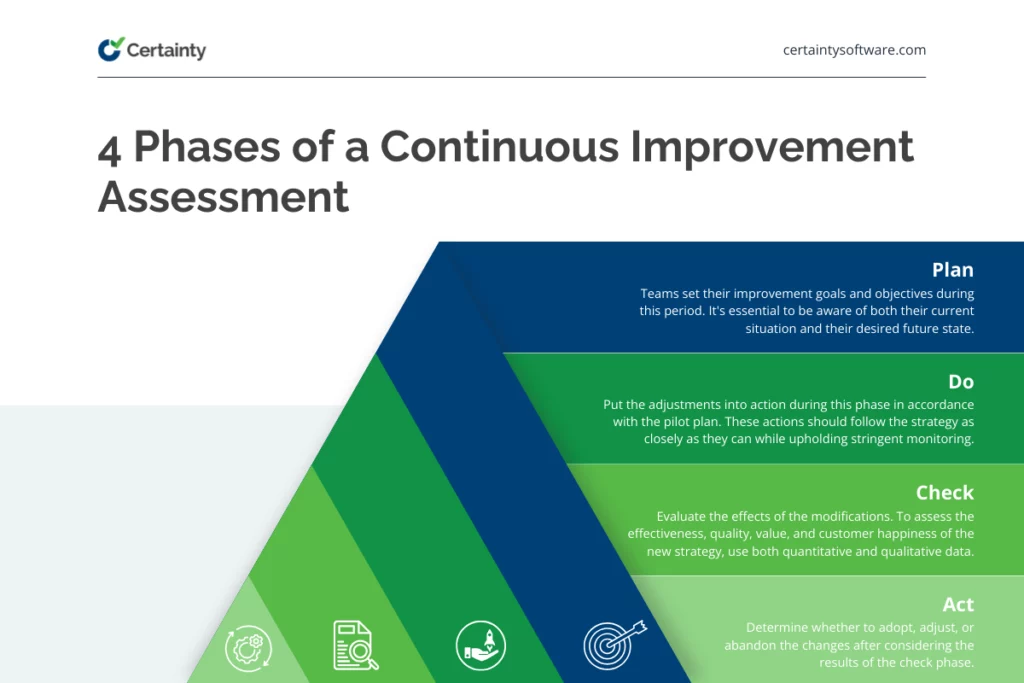
Let’s break down each phase in more detail:
Plan
Teams set their improvement goals and objectives during this period. It’s essential to be aware of both their current situation and their desired future state. They can achieve this by contrasting their present situation with the best practices of their sector or of their peers. This process, known as benchmarking, assists teams in establishing reasonable and doable improvement goals. For Quality Managers and Process Improvement Leads, the Plan phase is where you define target KPIs — such as audit completion rates, non-conformance reduction targets, COPQ thresholds, and first pass yield (FPY) goals — that will serve as measurable success criteria throughout the cycle.
Teams can utilize a variety of approaches or tools for benchmarking, including balanced scorecards, Porter’s five forces, SWOT analyses, and customer satisfaction surveys. Following benchmarking, teams should develop a pilot plan that describes the goals, resources, schedule, and anticipated results of the change program. The next phase’s implementation of the improvements should be guided by the pilot plan, which needs to be clear and comprehensive.
Do
After the Plan stage, you’ll need to put the adjustments into action during this phase in accordance with the pilot plan. These actions should follow the strategy as closely as they can while upholding stringent monitoring of the development and effectiveness of the adjustments. However, be prepared to modify as necessary.
Utilizing small-scale pilot initiatives with a constrained number of participants, locations, or units is one technique to reduce the impact on the organization’s regular operations while evaluating the new strategy. For organizations managing cross-site quality programs under ISO 9001 or VDA 6.3, running pilots at a single facility first helps validate approach effectiveness before enterprise-wide rollout. Quality Engineers should ensure that inspection data and non-conformance reports are captured digitally throughout the pilot — replacing paper-based tracking — so results can be objectively measured in the Check phase. Companies can utilize the lessons they’ve learned from their failures and triumphs from small-scale pilot programs to the following stage.
Check
Now that you have begun implementing your actions, it’s time to measure and evaluate the effects of the modifications. To assess the effectiveness, quality, value, and customer satisfaction of the new strategy, use both quantitative and qualitative data. Quality Engineers and QA Directors should compare quality KPIs — such as FPY, non-conformance rates, COPQ, and corrective action closure rates — against the baselines established in the Plan phase. Also, ensure that you and your team assess whether your goals and objectives set during the planning phase are a success by comparing the results to those goals and objectives.
Using root cause analysis, uncover and understand the underlying causes of the success or failure of the improvements. Deploying a root cause analysis is a highly effective methodical approach to determining what happened, why it happened, and how to stop it from happening again — a practice central to both ISO 9001 corrective action requirements and IATF 16949 problem-solving expectations. From here, you can gain knowledge from any mistakes and sharpen your problem-solving abilities.
Act
Now, at this stage, you need to determine whether to adopt, adjust, or abandon the changes after considering the results of the Check phase. Your team should expand the improvements to include more people, places, or units if they have shown to be efficient and advantageous. Scaling up implies implementing the modifications while preserving their effectiveness and quality in a bigger system or context. Increasing the organization’s efficiency, productivity, profitability, and competitiveness can have a substantial impact on the entire business.
A manufacturing corporation, for instance, may scale up a new quality control system after successfully implementing it in one facility to all of its plants — improving cross-site comparability of audit data, boosting customer satisfaction, and increasing market share. For Quality Supervisors and VPs of Quality Assurance, this is the stage where validated improvements become standardized operating procedures, documented in your QMS for ongoing compliance with ISO 9001, IATF 16949, or FDA cGMP requirements. However, if the alterations have turned out to be unsuccessful or harmful, you may need to abandon the adjustments and return to their prior state or try an alternative strategy.

30+ Audit and inspection checklists free for download.
Methods for Effective Evaluation
How do you effectively implement continuous improvement assessment initiatives across your organization? Several common methods exist, each aligned with established quality management frameworks. One of the most popular is the Kaizen continuous improvement process, which utilizes techniques such as Gemba walks to identify areas for long-term improvement and drive incremental quality gains on the shop floor. Other options include lean manufacturing, lean Six Sigma, and DMAIC (“define, measure, analyze, improve and control”) — all of which map naturally to the PDCA cycle required by ISO 9001 and IATF 16949. In food and pharmaceutical manufacturing, these methods also support HACCP and FDA cGMP compliance by providing traceable, systematic evidence of process improvement.
No matter which assessment process approach you choose, it’s worth laying a solid foundation. Start with purpose-built Gemba Walk checklists or ESG checklists to get a sense of where improvement efforts are working and where they need improvement, and then leverage robust reporting and documentation software to ensure consistent, comparable, and accurate performance metrics — including non-conformance rates, COPQ, and time to resolution — are available to relevant stakeholders in real-time. Moving away from paper-based audits to digital data collection eliminates audit fatigue and enables true cross-site comparability.
While assessment methods differ, assessment results are more straightforward: Companies define desired outcomes and then use on-site data collection to determine effective improvement actions. These may include educational programs for the staff, improvement plans that help address current management system challenges, or specific performance indicators that are negatively affecting strategic planning initiatives.
Frequently Asked Questions (FAQs)
How does the PDCA cycle relate to ISO 9001 and IATF 16949 compliance?
The PDCA cycle is the foundational framework for ISO 9001’s continual improvement requirements, specifically outlined in Clause 10. IATF 16949 builds on this by requiring automotive manufacturers to apply PDCA at both the process and system level. By structuring your continuous improvement assessments around Plan-Do-Check-Act, you create auditable evidence of systematic improvement that satisfies both standards and demonstrates commitment to quality management system maturity.
What quality KPIs should we track during a continuous improvement assessment?
The most impactful KPIs for continuous improvement assessments include first pass yield (FPY), non-conformance rates, cost of poor quality (COPQ), audit completion rates, and time to resolution for corrective actions. These metrics give Quality Managers, Plant Managers, and QA Directors a clear, data-driven view of where processes are underperforming and where improvement efforts are delivering measurable results. Tracking these KPIs across each PDCA cycle allows you to benchmark progress over time and demonstrate compliance during ISO 9001 or IATF 16949 certification audits.
How can continuous improvement assessments reduce audit fatigue?
Audit fatigue typically results from repetitive, paper-based audit processes that lack standardization across sites. Continuous improvement assessments help by digitizing data collection, automating corrective action workflows, and enabling cross-site comparability of audit findings. When audits feed directly into a PDCA-driven improvement cycle, each audit becomes purposeful rather than routine — reducing the burden on Quality Supervisors and Lead Auditors while generating actionable insights instead of just compliance paperwork.
Can the PDCA framework be applied across multiple sites and facilities?
Yes. One of the greatest strengths of the PDCA framework is its scalability. VPs of Quality Assurance and Quality Directors can pilot improvements at a single facility during the Do phase, validate results in the Check phase using standardized KPIs, and then scale successful changes across all sites in the Act phase. Digital assessment tools are essential here — they ensure that data is collected consistently across locations, enabling true cross-site comparability and centralized reporting for multi-facility operations governed by ISO 9001, IATF 16949, or FDA cGMP.
What role does corrective action management play in continuous improvement?
Corrective action management is the mechanism that turns assessment findings into measurable improvements. Within the PDCA cycle, corrective actions are identified during the Check phase through root cause analysis and implemented during the Act phase. For organizations complying with ISO 9001, IATF 16949, or FDA cGMP, documented corrective actions with tracked time to resolution are a regulatory expectation. Replacing manual corrective action processes with automated workflows reduces resolution time, ensures accountability, and creates a complete audit trail for compliance reviews.

Spend Time On Prevention
Not Paperwork
Watch our overview video to see how your organization can benefit from Certainty.
Watch Video