Summary: Muda refers to any activity or process that consumes resources without adding value to the customer, and eliminating it is a core principle of Lean manufacturing and quality management. The seven types of Muda — overproduction, waiting, transport, overprocessing, inventory, motion, and defects — directly impact quality KPIs like first pass yield, cost of poor quality, and non-conformance rates. Systematically identifying and eliminating Muda helps organizations streamline operations, reduce waste, and build a culture of continuous improvement aligned with ISO 9001 and Lean principles.
Table of contents

Imagine running your business like a well-oiled machine. Every process operates smoothly, efficiently, and flawlessly. You deliver exceptional value to your customers with minimal effort, time, and cost. For Quality Managers, Plant Managers, and Process Improvement Leads, achieving higher levels of quality and productivity is not just a dream. In fact, it is within your reach.
The key lies in eliminating muda from your business processes.
Muda, a Japanese term for waste, refers to any activity or resource that fails to add value to your customers or your business. However, whether it appears in manufacturing, service, or administrative processes, muda can hurt your operational performance, costs, and overall business outcomes. For quality professionals working within ISO 9001, IATF 16949, or FDA cGMP frameworks, muda directly contributes to elevated non-conformance rates. Additionally, it increases Cost of Poor Quality (COPQ) and diminishes First Pass Yield (FPY).
In this guide, we walk you through the process of identifying and eliminating muda using proven lean management principles and methodologies. Whether you are a QA Director overseeing multi-site operations or a Quality Engineer driving corrective actions on the floor, this resource will empower you to streamline your processes. Furthermore, it will help you reduce waste, enhance efficiency, and pave the way for sustainable growth within your organization.
What is Muda?
Muda is one of the three types of waste recognized in lean manufacturing thinking, along with Mura (unevenness) and Muri (overburden). Specifically, muda is any activity or resource that consumes time, money, space, or energy without creating any value for the customer or the business.
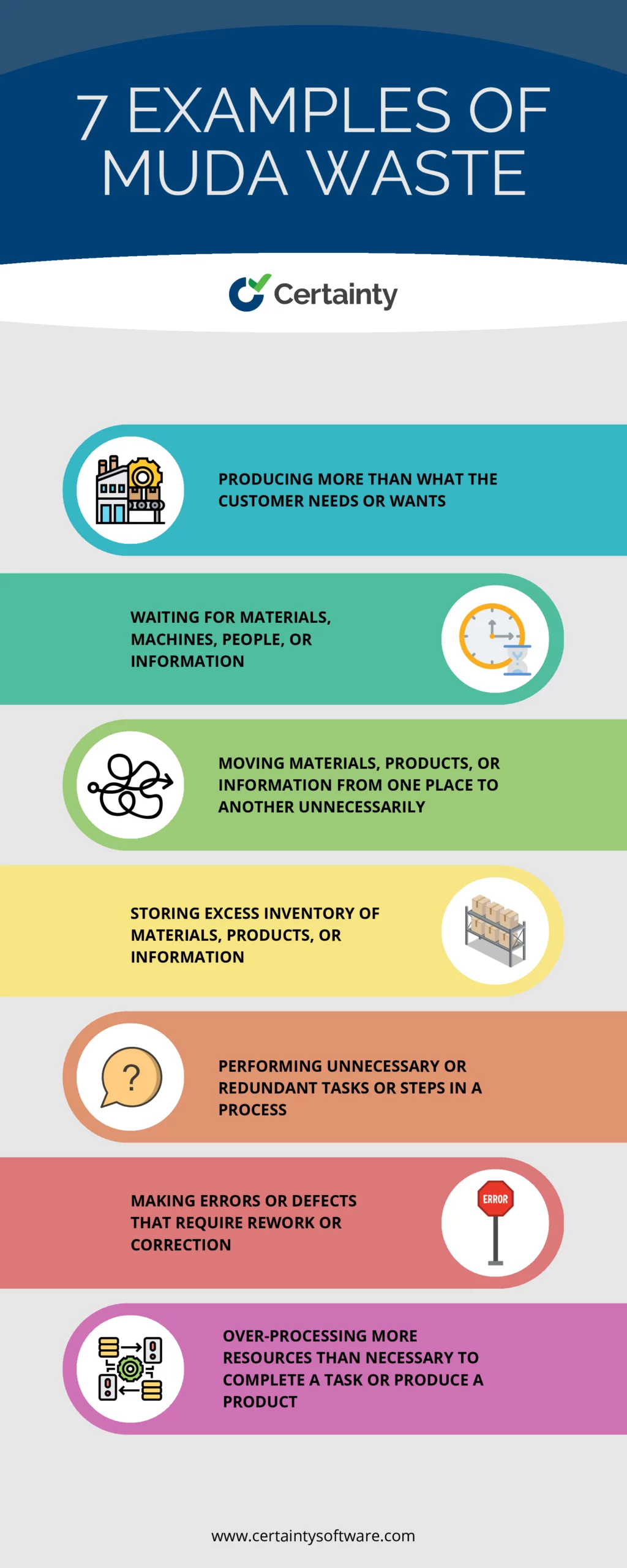
Some examples of muda waste are:
- Producing more than what the customer needs or wants
- Waiting for materials, machines, people, or information
- Moving materials, products, or information from one place to another unnecessarily
- Storing excess inventory of materials, products, or information
- Performing unnecessary or redundant tasks or steps in a process
- Making errors or defects that require rework or correction
- Over-processing more resources than necessary to complete a task or produce a product
You can classify muda into two categories: type 1 and type 2. Notably, type 1 muda is waste that is unavoidable or necessary due to current conditions of the process or the market. For example, safety inspections or regulatory compliance required under ISO 9001 or IATF 16949 fall into this category. Type 2 muda, on the other hand, is waste that is avoidable and can be eliminated by improving the process. Examples include overproduction, defects, or paper-based audit workflows that slow down time to resolution.
The goal of lean thinking is to eliminate type 2 muda as much as possible and minimize type 1 muda wherever you can. By doing so, you increase the value-added activities in your process and improve your First Pass Yield (FPY). Ultimately, this allows you to deliver more quality control and value to your customers.
Why is Eliminating Muda Important?
Muda elimination matters because it helps you improve process performance and outcomes in several ways. For QA Managers, Quality Supervisors, and VP Quality Assurance leaders, eliminating waste directly impacts the KPIs that matter most:
- It increases your productivity and efficiency by reducing the time and resources required to complete a task or produce a product. As a result, audit completion rates and time to resolution improve directly.
- It reduces your costs and resource waste by eliminating unnecessary expenses and consumption. Consequently, your overall Cost of Poor Quality (COPQ) drops.
- It improves your quality and customer satisfaction by reducing errors, breakdowns, downtime, and defects. In particular, non-conformance rates decrease while reliability and consistency increase.
- It enhances your competitiveness and profitability by increasing your value proposition and market share.
Muda elimination also helps you create a culture of continuous improvement. By identifying and removing muda from your processes, you foster a mindset of problem-solving, innovation, and learning among your employees. Moreover, Lead Auditors and Quality Engineers can empower their teams to take ownership of their work. This reduces audit fatigue and builds a proactive quality culture.

30+ Audit and inspection checklists free for download.
The benefits of muda elimination extend beyond your organization. By removing waste from your processes, you create more value for your customers by meeting their needs and expectations better. Similarly, you create more value for your suppliers by reducing their waste and improving their efficiency. For organizations operating under VDA 6.3 or FDA cGMP requirements, waste reduction supports compliance objectives. Furthermore, it strengthens cross-site comparability of quality data across your entire operation.
Understanding the Different Types of Muda
According to lean principles, three main types of muda (waste) can occur in any process:
- Muda of transportation: This is the unnecessary movement of materials, products, or information from one location to another. For example, transporting raw materials from a distant warehouse to the production site, or sending documents back and forth between different departments.
- Muda of inventory: This is the excess amount of materials, products, or information stored or waiting for processing. For example, having too much inventory of finished goods that remain unsold, or having too many unanswered emails in your inbox.
- Muda of motion: This is the unnecessary movement of people or equipment within a process. For example, walking across the shop floor to fetch a tool, or bending over to pick up a part.
To illustrate how these types of muda affect your processes, here are some examples and scenarios relevant to quality teams:
- A manufacturing company produces automotive parts using a batch-and-queue system. Workers transport the parts from one machine to another using forklifts and store them in large bins between each operation. As a result, the company suffers from high transportation costs, high inventory levels, high space requirements, and high cycle times. All of these contribute to poor First Pass Yield and elevated COPQ.
- A quality department relies on paper-based audits to manage inspections across multiple sites. Staff print audit reports, manually review them, and physically route them for sign-off. Consequently, this creates a lack of cross-site comparability, delays corrective action processes, and makes real-time audit completion tracking nearly impossible for QA Directors.
- An administrative company processes insurance claims using a manual system. Employees move from their desks to different stations to access files, forms, computers, printers, and scanners. Therefore, the company suffers from low productivity, high motion costs, high fatigue levels, and low employee morale.
As these examples show, muda can have a significant impact on your process performance and outcomes. For this reason, identifying and eliminating these bottlenecks is essential.
Identifying Muda in Your Processes
How can you detect muda within your organization? For Quality Engineers, Lead Auditors, and Process Improvement Leads, several techniques and approaches can help you identify waste in your processes:
Value Stream Mapping
This tool helps you visualize the flow of materials, products, information, and value from the beginning to the end of a process. It identifies the value-added and non-value-added activities in each step. Additionally, it reveals sources of waste such as transportation, inventory, motion, and waiting time. For teams operating under ISO 9001 or IATF 16949, value stream mapping is an essential method to pinpoint process inefficiencies that drive up non-conformance rates.
Gemba Walks
This practice involves going to the actual place where work happens (Gemba) and observing the process with a critical eye. Consequently, it helps you see the reality of the process as it unfolds and identify problems or opportunities for improvement. In particular, Plant Managers and Quality Supervisors who conduct regular Gemba walks gain firsthand insight into where manual corrective action processes and audit fatigue cost their teams the most.
Process Observation & Analysis
This method involves collecting data and information about process performance using various tools. These include checklists, charts, graphs, timers, and counters. In addition, it helps you measure the current state of the process and identify any gaps or deviations from the desired state. Specifically, tracking KPIs such as audit completion rates, FPY, COPQ, and time to resolution gives quality leaders quantifiable evidence of where muda is hiding.
Strategies for Eliminating Muda
Once you have identified muda in your processes, how do you eliminate it? Several lean principles and methodologies can help you reduce or eliminate waste:
6S Methodology
This system helps you organize your work in a way that eliminates waste and improves efficiency. It consists of six steps: Sort, Set in order, Shine, Standardize, Sustain, and Safety. By applying this methodology, you can eliminate the muda of transportation, inventory, motion, waiting, and correction.
Just-in-Time (JIT) Inventory Management
This system helps you synchronize production with customer demand. You produce only what your customers need, when they need it, and in the exact amount required. As a result, you can eliminate the muda of overproduction, inventory, waiting, and correction.
Kanban Systems
This system helps you control the flow of materials, products, or information using visual signals such as cards, boards, and bins. Similarly to JIT, applying this system lets you eliminate the muda of overproduction, inventory, waiting, and correction.
Implementing These Strategies Into Your Business Processes
To implement these strategies effectively, here are practical steps that QA Managers, Process Improvement Leads, and Quality Engineers can follow:
- Define your value proposition: What value do you deliver to your customers? What are their needs and expectations? How do you measure your value delivery?
- Map your value stream: How do you deliver value to your customers? What steps does your process involve? What are the inputs and outputs of each step? Which activities add value and which do not?
- Identify your sources of waste: Where does muda occur in your process? What causes it, and what effects does it produce? How much waste exists in terms of time, cost, and quality? Download Certainty’s free Gemba Walk Checklist to get started now with identifying wastes.
- Prioritize your improvement opportunities: Which sources of waste have the most impact on your value delivery? Which ones can you eliminate most easily? How can you rank your improvement opportunities based on their importance and feasibility?
- Implement your improvement actions: How can you apply lean principles and methodologies to eliminate or reduce waste in your process? What resources do you need? How will you monitor and evaluate your improvement actions?
- Review and refine your process: How effective are your improvement actions? What results and benefits have they produced? What challenges or barriers did you face? How can you overcome them and sustain your gains?
How to Use Certainty to Eliminate Muda from Your Processes
Certainty is an enterprise-level inspection software solution that helps you eliminate muda from your business processes. Our tool allows you to collect and report inspection data, monitor and measure your process performance, and manage issues and actions effectively. Moreover, it streamlines your processes and reduces waste while ensuring quality assurance and compliance.
Quality teams using Certainty can replace paper-based audits with digital workflows. They can also track audit completion rates in real time and automate corrective action processes. Additionally, the platform provides cross-site comparability of quality data — all within a system built to support ISO 9001, IATF 16949, VDA 6.3, and FDA cGMP compliance requirements.
Certainty is a web-based solution that works online or offline, on any device, and in any location. In fact, hundreds of thousands of users across various industries and sectors trust it. If you want to see how Certainty Software can help you eliminate muda from your processes, book a demo today.
Frequently Asked Questions (FAQs)
How does Muda elimination relate to ISO 9001 and IATF 16949 compliance?
Both ISO 9001 and IATF 16949 emphasize continuous improvement and the elimination of non-value-added activities within quality management systems. Muda elimination aligns directly with these frameworks by targeting process waste that drives up non-conformance rates and COPQ. Therefore, by systematically removing muda, organizations can demonstrate sustained compliance and improve audit outcomes under these standards.
What quality KPIs should I track to measure the impact of Muda elimination?
Key quality KPIs to monitor include First Pass Yield (FPY), Cost of Poor Quality (COPQ), non-conformance rates, audit completion rates, and time to resolution for corrective actions. Tracking these metrics before and after implementing muda elimination strategies gives QA Managers and Quality Engineers clear, quantifiable evidence of process improvement. In fact, this data provides the strongest case for continued investment in waste reduction.
How can digital tools help replace paper-based audits and reduce Muda?
Paper-based audits are a significant source of muda in quality management. They create transportation waste through routing physical documents, inventory waste through storing paper records, and motion waste through manual data entry and filing. Digital inspection platforms like Certainty eliminate these wastes by enabling real-time data capture, automated corrective action workflows, and instant cross-site comparability. As a result, audit completion rates improve dramatically and time to resolution drops.
What is audit fatigue and how does Muda contribute to it?
Audit fatigue occurs when quality teams become overwhelmed by the volume and repetitiveness of audit activities. This leads to reduced thoroughness and engagement. Specifically, muda contributes to audit fatigue through unnecessary process steps, redundant data collection, manual corrective action processes, and lack of standardized workflows. By eliminating these forms of waste, Quality Supervisors and Lead Auditors can streamline audit programs and keep their teams focused on high-value activities.
Can Muda elimination strategies be applied across multiple sites?
Yes. One of the biggest challenges for QA Directors and VP Quality Assurance leaders managing multi-site operations is the lack of cross-site comparability in quality data. However, standardizing muda elimination strategies across all locations — supported by a centralized digital platform — ensures consistent process performance and comparable audit data. Furthermore, it enables unified corrective action tracking. This approach supports compliance with frameworks like VDA 6.3 and FDA cGMP that require consistent quality practices across facilities.

Spend Time On Prevention
Not Paperwork
Watch our overview video to see how your organization can benefit from Certainty.
Watch Video