Summary: Construction safety observations are structured site reviews that identify hazards, unsafe behaviors, and missing controls before they lead to injuries or citations. Effective construction safety observations help crews address recurring risks such as falls, struck-by hazards, PPE misuse, and unsafe equipment practices in real time. For construction safety leaders, they are a practical way to improve OSHA compliance, strengthen field accountability, and prevent incidents proactively.
Construction safety observations are structured, documented assessments of workplace conditions and worker behaviors on construction sites. Their purpose is to identify hazards, prevent incidents, and maintain compliance with OSHA standards. However, despite decades of improved safety regulations and oversight, construction remains one of the most hazardous industries in the United States.
According to OSHA data, the construction sector accounts for approximately 1 in 5 worker fatalities in private industry each year. Specifically, OSHA’s “Fatal Four” — falls, struck-by, caught-in/between, and electrocution — cause more than 60 percent of construction worker deaths. For this reason, construction safety observations are a critical, proactive component of any effective safety management program. They directly reduce incident rates while supporting OSHA compliance, ISO 45001 alignment, and overall business performance.
Here’s what you need to know about effectively implementing construction safety observations.
What are Construction Safety Observations?
Construction safety observations are structured assessments designed to pinpoint potential hazard areas across active worksites. These assessments cover everything from near misses, falling and tripping hazards, and unsafe machinery operation to issues with personal protective equipment (PPE). In particular, observers look for hard hats, safety glasses, high-visibility vests, and fall protection harnesses that are absent, underutilized, or improperly used.
Moreover, safety observations capture behaviors, not just conditions. Under behavior-based safety (BBS) frameworks, observing and documenting at-risk behaviors is equally as important as identifying physical hazards.
Regular safety observations provide the actionable insight construction companies need to continuously improve safety practices. As a result, they reduce the risk of serious injury or death and demonstrate due diligence under OSHA’s General Duty Clause (Section 5(a)(1)). Additionally, they generate leading indicator data — such as observation completion rates, at-risk behavior rates, and hazard identification frequency. EHS managers and Safety Directors use this data to benchmark performance and drive proactive risk reduction across multi-site construction programs.
What is a Good Construction Safety Observation?
A high-quality safety observation does two things. First, it accurately identifies a potential hazard or at-risk behavior. Second, it provides enough context to enable effective corrective action.
Both elements are essential. In fact, an observation that identifies a problem without driving remediation is wasted effort. Furthermore, a pattern of unresolved observations is itself an OSHA compliance risk. It demonstrates employer awareness of a hazard without a good-faith effort to control it.
Similarly, corrective actions that lack adequate root cause context can result in superficial fixes. These fixes often fail to address underlying hazards. For example, if a specific piece of machinery periodically causes injury, simply adjusting PPE requirements may temporarily reduce harm. However, this approach does not resolve the root cause, which may be a mechanical fault, an ergonomic design issue, or an inadequate lockout/tagout (LOTO) procedure.
Addressing only the symptom increases the risk of a future serious injury or fatality. In contrast, effective construction safety observations dig deeper. They connect observable conditions to root causes and enable durable corrective actions. These actions align with OSHA standards such as 29 CFR 1910.147 (Control of Hazardous Energy) and 29 CFR 1926.502 (Fall Protection Systems).
How Do Observations Help Your Business?
Construction safety observations deliver measurable business value through a proactive approach to hazard identification. Specifically, they surface risks before workers get injured and before equipment sustains damage. By systematically collecting observational data across worksites and analyzing it for trends, construction companies can develop targeted risk mitigation strategies. Consequently, these strategies reduce incident rates, lower workers’ compensation costs, and improve project delivery timelines.
Consider an observation of a cluttered workstation creating a fall and struck-by hazard. By identifying the issue, discussing root causes with the crew, and implementing a corrective action — such as a revised material storage protocol or a 5S housekeeping standard — companies can eliminate both the immediate risk and the systemic conditions that created it.
While this requires time and effort, the cost is far lower than the alternatives. OSHA serious violation penalties can reach $16,550 per violation as of 2025. In addition, companies face potential litigation and project delays associated with preventable worker injuries. Notably, documented safety observations also demonstrate proactive compliance to OSHA inspectors, insurance carriers, and project owners who increasingly require contractor safety prequalification.

30+ Audit and inspection checklists free for download.
What Should be Included in a Construction Safety Observation Report?
Effective construction safety observation reports include six key components:
Designated observers
Specific, trained personnel should fill the role of safety observer. This ensures consistency, objectivity, and data quality across all construction safety observations. Designated observers — whether full-time safety officers, supervisors, or rotating trained workers — bring a systematic approach to hazard identification. As a result, they reduce the risk of key issues being overlooked. Under OSHA’s construction standards (29 CFR 1926 Subpart C), competent persons must conduct safety inspections across a range of high-hazard activities. These include fall protection, scaffolding, and excavation work.
Scheduled times
Regular, scheduled observation windows — combined with unannounced spot checks — ensure that safety assessment remains a consistent, integrated part of daily site operations. In other words, observations should be standard practice rather than an occasional compliance exercise. Furthermore, scheduling observations at different times of day and across different construction phases maximizes hazard coverage. This approach also prevents the habituation effect, where workers unconsciously normalize unsafe conditions over time.
In-depth observations
High-quality observation reports capture detailed descriptions of the observed condition or behavior. They also record the specific location and time, potential hazard and severity rating, contributing factors, and the corrective action taken or recommended. This depth of documentation is essential for root cause analysis, trend identification, and regulatory compliance. Specifically, detailed records matter most when observations relate to OSHA-regulated activities such as confined space entry (29 CFR 1910.146), hot work, or work at heights.
Employee conversations
Engaging directly with workers during safety observations provides critical context that visual inspection alone cannot capture. Workers have first-hand knowledge of recurring hazards, production pressures that influence at-risk behaviors, and equipment issues that may not be immediately visible. Moreover, these conversations — conducted in a non-punitive, collaborative spirit — reinforce a positive safety culture. Workers feel valued as active contributors to site safety, rather than passive subjects of compliance enforcement.
Comprehensive checklists
Comprehensive construction safety checklists and templates give observers a structured framework for assessing hazards systematically. This is particularly important across complex, fast-changing work environments. Well-designed checklists ensure teams consistently evaluate all OSHA-regulated hazard categories. For example, these categories include fall protection, electrical safety, chemical exposure, PPE compliance, and fire safety. Additionally, standardized checklists support cross-site benchmarking and trend analysis.
Robust reporting
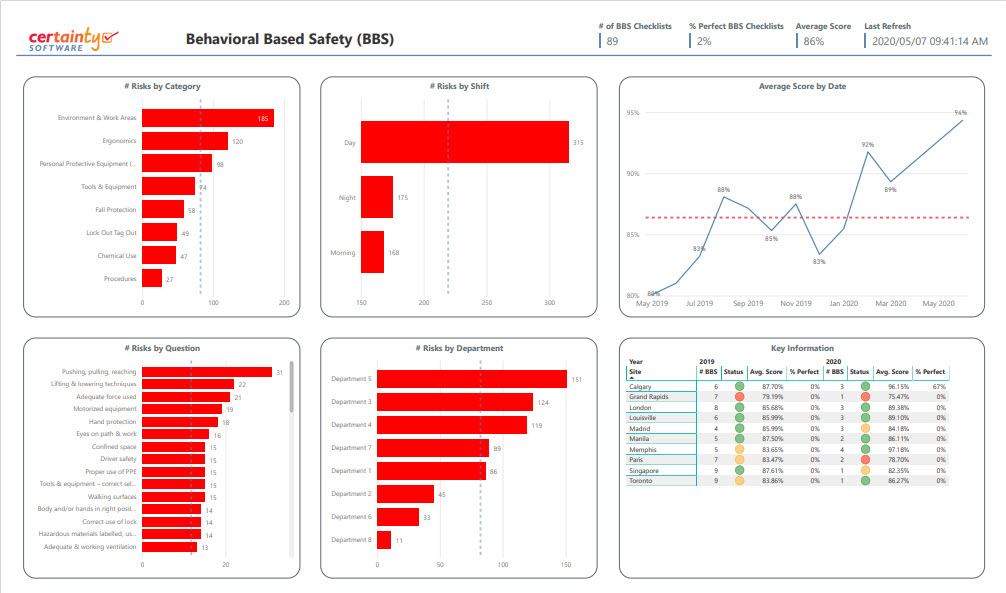
Purpose-built construction safety audit software ensures observation reports are complete, accurate, and immediately accessible. Supervisors and EHS managers can then act on findings without delay. Digital reporting tools eliminate the delays and data gaps inherent in paper-based systems. They automatically route observations to the appropriate responsible parties and track corrective action closure in real time.
Consequently, these tools generate the management dashboards and regulatory audit trails that Safety Directors and VP of Safety leaders rely on. They use this information to manage multi-site safety programs effectively.
Construction safety observation reports are a proven driver of improved productivity, reduced total risk, and stronger regulatory compliance. Ready to streamline your safety observations and build a more resilient safety program across your construction operations?
You may also be interested in:
Case Study: How Vaughn Industries streamlined their safety observations with Certainty
The Top 7 Safety Issues Facing The Construction Industry
Solutions for managing construction safety observations
Frequently Asked Questions (FAQs)
What is the difference between a safety observation and a safety inspection?
A safety observation is a structured, real-time assessment of worker behaviors and site conditions. Designated observers typically conduct these as part of daily or weekly safety management activities. In contrast, a safety inspection is a more formal, scheduled evaluation of the worksite against defined regulatory or organizational standards. Inspections often use a comprehensive checklist.
Both are essential components of a complete construction safety management system. Specifically, observations provide high-frequency, leading indicator data. Inspections provide in-depth, periodic compliance assessments. Together, they create a comprehensive picture of site safety performance.
How often should construction safety observations be conducted?
The frequency of construction safety observations should match the hazard level of the work being performed. High-hazard activities — such as work at heights, confined space entry, hot work, and heavy equipment operation — warrant daily or even continuous observation. For general site conditions, weekly structured observations supplemented by daily informal walk-throughs represent a strong baseline.
Furthermore, OSHA’s construction standards require competent person inspections before each use for specific equipment and systems. These include scaffolding, fall protection, and excavations. This requirement sets a minimum regulatory floor that most effective safety programs significantly exceed.
What OSHA standards govern construction safety observations?
Multiple OSHA standards under 29 CFR 1926 (Safety and Health Regulations for Construction) establish observation and inspection requirements for specific hazard categories. Key standards include 29 CFR 1926.502 (Fall Protection Systems — competent person inspection), 29 CFR 1926.451 (Scaffolding — competent person inspection before each shift), and 29 CFR 1926.651 (Excavations — competent person daily inspection). Additionally, 29 CFR 1926.403 covers Electrical Safety requirements.
Beyond these specific requirements, OSHA’s General Duty Clause creates a broad obligation for employers. They must proactively identify and control recognized hazards. As such, systematic construction safety observations form a core element of any defensible OSHA compliance program.