Summary: A hazard is anything with the potential to cause harm, while risk is the likelihood that the harm will actually occur when workers are exposed to that hazard. For EHS teams, understanding the hazard-versus-risk distinction is essential to effective hazard identification, risk assessment, and control selection, because workplace safety improves when organizations evaluate both the source of danger and the probability of harm.
Table of contents

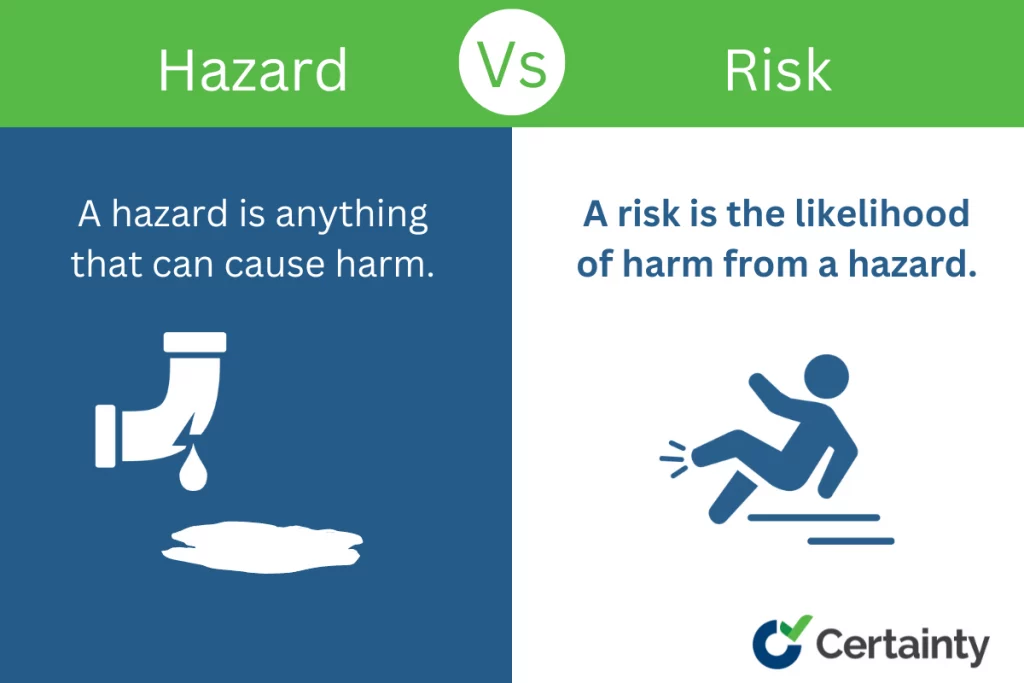
A hazard is anything that could cause harm. Specifically, it refers to a condition, substance, activity, or behavior that may lead to injury, illness, or damage. A risk, on the other hand, measures how likely harm will actually occur from exposure to that hazard. People often use these terms interchangeably. However, they represent distinct concepts in occupational health and safety. Understanding the difference between hazard and risk is therefore fundamental to effective hazard identification, risk assessment, and OSHA compliance.
Both hazards and risks can produce serious short- and long-term consequences when left unmanaged. Under OSHA’s General Duty Clause (Section 5(a)(1) of the OSH Act), employers must maintain a workplace free from recognized hazards. In particular, this covers hazards that cause or are likely to cause death or serious physical harm. Similarly, ISO 45001:2018 (Clause 6.1.2) requires organizations to systematically identify hazards, assess risks, and implement controls. Here is what you need to know about the difference between hazard and risk — and how to manage both effectively.
What is a Hazard?
A hazard is any source, situation, or act that could cause harm. This includes physical injury, occupational illness, property damage, or environmental impact. Workplace hazards typically fall into six categories. Physical hazards include noise, heat, and radiation. Chemical hazards cover toxic substances, flammable materials, and corrosives. Biological hazards involve pathogens, mold, and bloodborne diseases. Additionally, ergonomic hazards arise from repetitive motion, poor workstation design, and manual handling. Psychosocial hazards stem from work-related stress, fatigue, and workplace violence. Finally, safety hazards include slip/trip/fall risks, unguarded machinery, and electrical faults.
For example, a frayed electrical cable on a construction site represents a physical/electrical hazard. The exposed wiring could cause electric shock, burns, or fire. However, not all hazards are this obvious. A worker dealing with chronic fatigue from excessive overtime faces a psychosocial hazard. In particular, this reduces alertness and increases the chance of operational errors that lead to injury. As a result, safety teams must look beyond visible dangers to capture the full spectrum of harmful conditions.
What is a Risk?
A risk combines two factors: the probability that a hazard will cause actual harm and the severity of those consequences. Risk exists on a spectrum from negligible to critical. Moreover, several contextual factors influence where a risk falls on this spectrum. These include the nature of the hazard, how often workers face exposure, the effectiveness of existing controls, and how vulnerable the workers are.
Consider the frayed electrical cable again. If it is largely intact and sits in a rarely accessed storage area where workers wear appropriate PPE, the risk of injury stays low. In contrast, imagine the same cable badly damaged in a high-traffic production area. Workers lack proper personal protective equipment (PPE) in this scenario. Consequently, the risk escalates from a moderate concern to a high-priority issue that demands immediate corrective action.
Risk assessment evaluates the likelihood and severity of harm from identified hazards. It serves as a core requirement of both OSHA standards and ISO 45001. Furthermore, risk scores guide decisions about control priorities, resource allocation, and corrective action urgency across the safety program.

30+ Audit and inspection checklists free for download.
Examples of Hazards and Risks
Several common workplace scenarios show how hazards and risks interact. Moreover, they reveal how management decisions directly affect risk levels.
Liquid spill on a shop floor: A spilled liquid — water, oil, or chemical — creates a slip, trip, and fall hazard. The associated risk depends entirely on how teams manage the situation. If workers immediately identify the spill, cordon off the area, and place warning signs per OSHA 29 CFR 1910.22, the risk of injury stays low. However, if the spill goes unreported and workers move through the area unaware, the risk of a serious fall jumps significantly. In other words, the hazard stays identical in both scenarios. Consequently, the risk changes based on the speed and quality of response.
Production line machinery: All powered machinery represents a safety hazard. Workers face potential injury from entanglement, crush points, electrical faults, or ejected materials. However, the level of risk depends on multiple control factors. Has the equipment met OSHA’s machine guarding standard (29 CFR 1910.212)? Have workers completed training on safe operating procedures? Do teams follow LOTO (Lockout/Tagout) procedures under 29 CFR 1910.147 during maintenance? Does the machine receive regular inspections? Each factor directly raises or lowers the risk of a recordable injury.
Safety documentation gaps: Missing or inadequate safety documentation also qualifies as a hazard. For example, absent SDS sheets, outdated LOTO procedures, or inaccessible confined space entry protocols make it more likely that workers will skip safe procedures. The risk level depends on how safety-critical the missing information is. In addition, it varies based on task frequency and whether workers can access guidance through other means.
How Hazards and Risks are Connected
All hazards carry some level of associated risk. Where no hazard exists, there is no risk of harm from that source. In fact, the relationship is direct: more hazards and weaker controls mean higher overall risk exposure for the workforce.
Effective EHS management requires a systematic approach to both hazard elimination and risk reduction. ISO 45001 Clause 8.1.2 establishes the hierarchy of controls as the organizing framework. Organizations should first eliminate the hazard entirely wherever possible. If elimination is not feasible, they should substitute a less hazardous alternative. After that, they apply engineering controls, administrative controls, and PPE in descending order of effectiveness. Most importantly, this hierarchy directs control efforts toward the most impactful interventions first.
Hazard identification is the essential first step. For instance, frameworks such as our Confined Space Identification & Hazard Evaluation Checklist give EHS teams a structured method for finding hazards in high-risk environments. These tools capture less obvious hazards alongside the more apparent ones. Once teams identify and document hazards, organizations can then prioritize control measures based on risk level. As such, they allocate resources to the highest-priority risks first.
Some hazards cannot be fully eliminated. The ever-present risk of fire on manufacturing or construction sites is one clear example. For this reason, tools such as our Fire Risk Assessment Checklist enable organizations to evaluate the risk level, identify existing control gaps, and strengthen controls. These controls align with NFPA fire prevention standards and OSHA’s fire protection requirements under 29 CFR 1910 Subpart L. Regular re-assessment then ensures that risk profiles stay current as operations, staffing, and site conditions change.
Ultimately, hazard and risk are distinct but inseparable concepts in workplace safety management. Improving safety performance and meeting OSHA, ISO 45001, and industry standard requirements demands two things. Organizations must systematically identify, eliminate, or control hazards. Similarly, they must continuously monitor and reduce the risks that remain.
Frequently Asked Questions (FAQs)
What is the hierarchy of controls for managing hazards and risks?
The hierarchy of controls, recognized by OSHA and ISO 45001, ranks hazard control methods from most to least effective: (1) Elimination — remove the hazard entirely; (2) Substitution — replace it with a less hazardous alternative; (3) Engineering controls — physically isolate workers from the hazard; (4) Administrative controls — change work procedures to reduce exposure; (5) PPE — provide personal protective equipment as a last line of defense. Effective risk management applies controls as high up the hierarchy as feasible.
How does ISO 45001 address hazard identification and risk assessment?
ISO 45001:2018 Clause 6.1.2 requires organizations to establish, implement, and maintain processes for ongoing hazard identification and risk assessment. These processes must consider routine and non-routine activities, human factors, and changes in operations. Risk assessment results must inform the planning of the OH&S management system, including the determination of controls and the setting of safety objectives.
What is a Job Hazard Analysis (JHA) and when should it be used?
A Job Hazard Analysis (JHA) — also called a Job Safety Analysis (JSA) — is a structured technique for identifying the hazards associated with each step of a specific work task, assessing the risk each hazard presents, and determining the most effective controls. JHAs are recommended by OSHA before high-risk tasks, when new processes or equipment are introduced, following an incident, or whenever the risk profile of a job changes. They are a foundational tool for proactive hazard management and worker safety training.
What is the difference between a hazard and a near miss?
A hazard is a condition or situation with the potential to cause harm. A near miss is an unplanned event where a hazard resulted in a close call — harm almost occurred but did not. Near misses serve as critical leading indicators. They signal that a hazard is active and that existing controls may fall short. Consequently, OSHA strongly encourages near-miss reporting to prevent the accidents that hazards would otherwise eventually cause.
You may also be interested in:
The Top 5 Safety Metrics You Should be Tracking
The Difference Between Leading and Lagging Safety Indicators