Summary: ESG risks are the environmental, social, and governance factors that can damage financial performance, disrupt supply chains, and expose a company to legal or reputational harm. For procurement and compliance teams, ESG risk management now requires more than broad policy statements because CSRD, CSDDD, and similar rules demand evidence of industry-specific due diligence across operations and suppliers. The practical takeaway is that ESG risks must be identified, prioritized, and mitigated with the same discipline as other enterprise risks.
Table of contents

ESG risks are the environmental, social, and governance factors that can materially harm a company’s financial performance, reputation, and regulatory standing. In 2025–2026, managing ESG risks is no longer optional: the EU’s Corporate Sustainability Reporting Directive (CSRD) now requires over 50,000 companies to disclose ESG impacts across their value chains, while the Corporate Sustainability Due Diligence Directive (CSDDD) mandates active human rights and environmental due diligence throughout global supply chains. Companies that fail to identify and address industry-specific ESG risks face financial penalties, supply chain disruptions, and lasting reputational damage.
ESG risks are the potential harms that a company’s operations could cause to society, the environment, and its own governance structures. These risks affect reputation, financial performance, and stakeholder relationships, and can expose a company to operational, legal, and regulatory liability under frameworks including the German Supply Chain Act (LkSG), CSRD, and CSDDD.
Understanding ESG Risks
ESG risks are composed of three interrelated dimensions: environmental, social, and governance. Understanding all three is essential for any organization subject to mandatory due diligence or sustainability reporting requirements in 2025 and beyond.
Environmental risks cover the effects of a company’s operations on the natural world — including greenhouse gas emissions, resource depletion, water usage, waste generation, pollution, biodiversity loss, and contribution to climate change. Under CSRD and CSDDD, companies must now measure and disclose Scope 1, 2, and 3 emissions, including those generated across their supply chains.
Social risks refer to a company’s impact on people — employees, customers, suppliers, communities, and society at large. This encompasses worker safety, labor rights and fair wages, forced labor and child labor in supply chains, human rights due diligence, diversity and inclusion, and public health. The LkSG (German Supply Chain Act), UFLPA, and multiple Modern Slavery Acts require companies to actively identify and remediate social risks in their supply chains.
Governance risks relate to how a company is managed and controlled — including transparency, accountability, ethics, anti-corruption, executive compensation, board diversity, regulatory compliance, and shareholder rights. Poor governance amplifies both environmental and social risk by undermining the controls needed to detect and correct problems.
These three dimensions are deeply interconnected. Poor environmental practices generate civil unrest and regulatory consequences. Weak labor standards create supplier non-compliance and reputational exposure. Inadequate governance allows fraud, corruption, and ESG data misreporting to go unchecked — a growing concern as third-party assurance requirements under CSRD take effect.
Firms must therefore adopt a comprehensive, systematic strategy for ESG risk management — one that covers their own operations as well as their extended supply chains, aligning with global sustainability standards and emerging regulatory requirements. ESG due diligence is one of four risk categories within a structured supplier risk management program — see ESG due diligence in supplier risk management for how environmental and social risks integrate with operational, financial, and cybersecurity oversight.
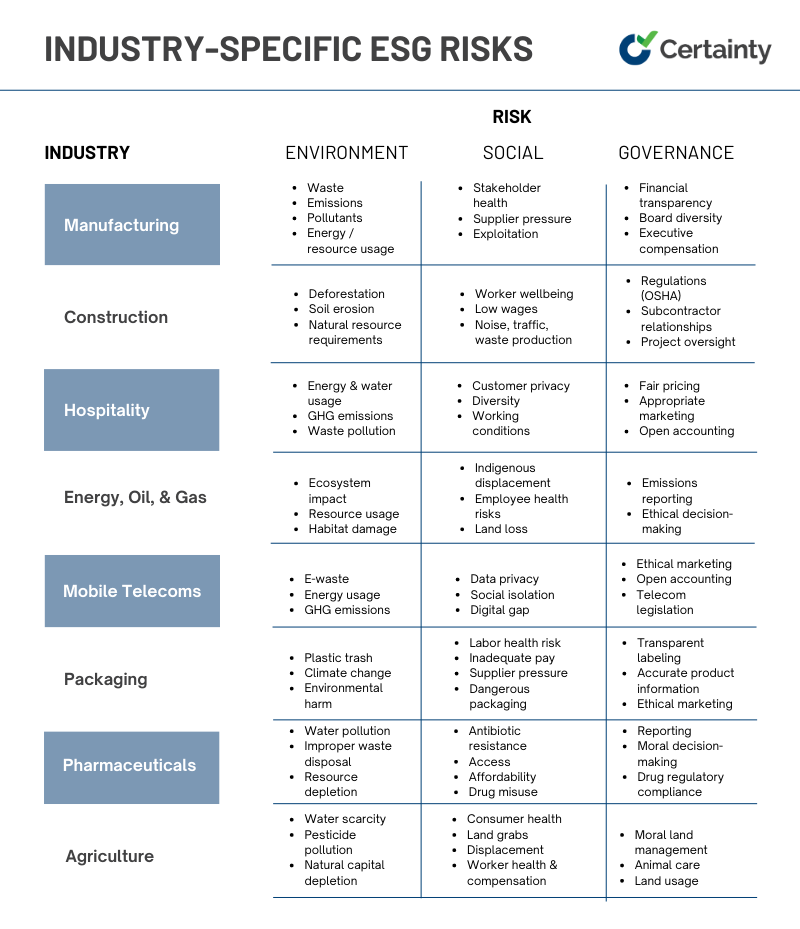
Manufacturing: Navigating the Triple Bottom Line
Manufacturing is one of the industries with the greatest ESG footprint. With global supply chains spanning dozens of countries and tier suppliers, manufacturers face compounded environmental, social, and governance risks — and heightened scrutiny under CSDDD, LkSG, and CSRD reporting obligations.
Environmental Risks:
Manufacturing operations generate significant quantities of waste, greenhouse gas emissions, and pollutants that contribute to climate change and environmental degradation. The sector is also a major consumer of energy, water, and raw materials. Under CSRD, large manufacturers must now disclose Scope 3 emissions — meaning supply chain environmental impacts can no longer be ignored. Companies face growing regulatory risk from carbon taxes, emissions caps, and extended producer responsibility laws across EU member states.
To counteract these risks, manufacturers must implement sustainable manufacturing practices: reducing waste generation, improving energy efficiency, adopting renewable energy sources, applying circular economy principles, and sourcing materials responsibly through verified supplier audits.
Social Risks:
Manufacturing supply chains are frequent sites of labor exploitation, unsafe working conditions, and inadequate wages. Workers across tier 1, 2, and 3 supplier facilities face health and safety hazards, while suppliers may compromise ethical standards under cost and timeline pressure. Under LkSG (effective since January 2023) and CSDDD (formally adopted in 2024), manufacturers with global supply chains are legally required to conduct human rights due diligence, identify at-risk suppliers, and implement corrective actions.
To reduce these risks, manufacturers must adopt social manufacturing practices that uphold human rights and advance social justice — maintaining safe working conditions, paying living wages, applying ethical labor standards, managing supply chains with structured self-assessment programs, ensuring product quality and safety, and engaging with local communities.
Governance Risks:
Governance challenges in manufacturing include ensuring financial transparency, appropriate executive compensation structures, board diversity, and robust compliance programs. Manufacturers must navigate a complex web of regulations governing environmental performance, labor rights, product safety, and anti-corruption — including industry-specific standards such as ISO 14001 and IATF 16949. Failure to maintain governance controls exposes organizations to regulatory penalties and investor scrutiny as ESG disclosure becomes mandatory.
Manufacturers must implement governance practices that enhance accountability and integrity: disclosing both financial and non-financial information in line with CSRD requirements, aligning executive incentives with sustainability targets, increasing board diversity and independence, upholding ethical standards, and maintaining full compliance with applicable laws.
Construction: Balancing Growth and Sustainability
Construction is one of the world’s most resource-intensive industries — responsible for approximately 38% of global energy-related CO₂ emissions according to the International Energy Agency. It faces significant ESG risks that could jeopardize its growth prospects, access to sustainable finance, and compliance with emerging EU and national due diligence regulations.
Environmental Risks:
Construction operations damage biodiversity and ecosystem services through habitat destruction, deforestation, and soil erosion. The industry also consumes vast quantities of water, energy, and materials that strain natural resources and drive up project costs. Green building regulations are tightening across the EU, with the Energy Performance of Buildings Directive requiring near-zero-energy buildings as standard by 2025.
Construction firms must employ environmentally responsible building practices that maximize resource efficiency: limiting land clearance, adopting low-water irrigation methods, following green building standards (such as LEED or BREEAM), and using certified sustainable materials throughout their supply chains.
Social Risks:
Construction activities directly affect the wellbeing of workers, customers, and communities. Workers face hazardous conditions, labor exploitation, and wage theft — the construction sector consistently reports high rates of workplace fatalities globally. Customers encounter dissatisfaction from quality defects, delays, and cost overruns. Construction operations generate noise, traffic, and waste in surrounding communities. As CSDDD due diligence obligations extend to construction supply chains, firms must demonstrate active monitoring of their contractor and subcontractor labor practices.
To prevent these risks, construction businesses must adopt social construction approaches that uphold human rights and foster social harmony — providing safe workplaces, paying fair wages, applying ethical labor standards, cooperating openly with clients and suppliers, and engaging with local communities throughout project lifecycles.
Governance Risks:
Construction operations present governance challenges including regulatory compliance with standards such as OSHA, ethical subcontractor relationships, and project oversight across complex multi-tier supply chains. The sector is also particularly exposed to bribery, corruption, and bid-rigging — reputational and legal risks that are amplified when operating across multiple jurisdictions. As CSRD value chain reporting requirements come into force, construction companies must document and disclose ESG performance across their entire project delivery chains.
Construction companies must implement governance practices that improve transparency and accountability: applying ethical procurement and contracting procedures, monitoring project progress and outcomes with digital audit tools, and resolving disputes fairly and promptly.
Hospitality: Rethinking Guest Experiences Responsibly
The hospitality industry depends on delivering outstanding guest experiences to generate loyalty and revenue. It faces growing ESG risks — from environmental impact to labor practices to governance failures — that can undermine its service quality, customer confidence, and compliance with sustainability reporting expectations under CSRD.
Environmental Risks:
Hotels, restaurants, and hospitality venues consume significant quantities of energy, water, and single-use materials, contributing to greenhouse gas emissions, water scarcity, and plastic waste. Tourism-driven carbon footprints are under increasing scrutiny: the UN World Tourism Organization estimates that tourism accounts for approximately 5–8% of global greenhouse gas emissions. Hospitality companies reporting under CSRD must disclose their environmental impacts and set measurable reduction targets.
To address these concerns, hospitality businesses must implement sustainable hospitality practices that reduce environmental impact while improving operational efficiency — deploying energy-efficient technologies, water conservation measures, waste management programs, and sustainable food procurement aligned with local and organic sourcing.
Social Risks:
The wellbeing of guests, employees, and communities is directly influenced by hospitality operations. Guests face data privacy concerns, security risks, and service quality challenges that affect their trust and satisfaction. Employees — many of whom are migrant workers — face low wages, precarious contracts, and poor working conditions that compromise their dignity and performance. Tourism activities can contribute to cultural erosion, gentrification, and social inequality in local communities. Supply chains for food, linens, and consumables may harbor forced labor risks subject to CSDDD and LkSG scrutiny.
Hospitality businesses must embrace social practices that uphold human rights and promote social inclusion: providing safe, private, and enjoyable guest experiences; paying living wages and improving working conditions; fostering workforce diversity; supporting local culture; and meaningfully engaging with the communities in which they operate.
Governance Risks:
Hospitality companies face governance challenges around fair pricing, responsible marketing, financial transparency, and compliance with local and international regulations. As global hotel chains and restaurant groups expand their supplier networks, they are increasingly subject to value chain disclosure requirements under CSRD and supply chain due diligence obligations under CSDDD. Ethical decision-making at the executive level — particularly regarding sustainability commitments and data accuracy — is subject to growing investor and regulatory scrutiny.
Organizations in the hospitality industry must implement governance mechanisms that strengthen accountability and integrity — upholding ethical standards, complying with applicable laws and regulations, ensuring fair pricing, and producing transparent, externally assured sustainability reports.
Energy, Oil, and Gas: Transitioning to a Greener Future
The energy, oil, and gas sector is at the center of the global sustainability transition. Facing stricter climate legislation, mandatory emissions reporting under CSRD, and growing pressure from institutional investors aligning with net-zero commitments, companies in this sector must fundamentally transform their ESG risk management approach.
Environmental Risks:
Oil and gas operations are among the largest contributors to global greenhouse gas emissions, accounting for nearly 15% of total energy sector emissions from extraction and processing alone, according to the International Energy Agency. Habitat damage, methane leaks, spills, and ecosystem disruption from drilling and pipeline operations pose severe environmental risks. The EU’s Fit for 55 package and Carbon Border Adjustment Mechanism are reshaping the regulatory and financial landscape for energy companies operating globally.
Energy, oil, and gas firms must embrace sustainable energy practices that reduce their environmental footprint and accelerate the transition to cleaner alternatives — cutting carbon emissions, scaling renewable energy, implementing carbon capture and storage, and establishing responsible waste disposal systems.
Social Risks:
The wellbeing of workers, communities, and indigenous peoples is materially affected by energy, oil, and gas operations. Workers face occupational health hazards and are exposed to physical risks that require rigorous safety management. Communities near extraction sites suffer noise, traffic, air and water pollution, and health risks. Indigenous peoples face displacement, land loss, and cultural erosion from major fossil fuel projects on or near their territories — a growing source of legal and reputational risk under international human rights standards. CSDDD requires companies to conduct meaningful stakeholder consultation and implement grievance mechanisms for affected communities.
Energy, oil, and gas businesses must adopt social energy practices that respect human rights and promote social responsibility: assuring worker health, safety, and fair compensation; engaging stakeholders through transparent and accountable communication; honoring indigenous rights and free, prior, and informed consent; and supporting community development initiatives.
Governance Risks:
Governance risks in the energy sector include maintaining environmental compliance, accurate emissions reporting, and ethical decision-making. Investors, customers, and regulators are intensifying pressure on companies to align with Paris Agreement targets, disclose transition plans, and avoid greenwashing. Under CSRD, energy companies must report on their transition strategies, climate-related risks and opportunities (following TCFD methodology), and supply chain ESG performance — with external assurance now required.
To reduce these risks, energy, oil, and gas businesses must implement governance practices that improve openness and accountability: complying with environmental legislation, providing independently verified emissions data, linking executive compensation to sustainability indicators, adhering to ethical codes of conduct, and engaging proactively with all relevant stakeholders.
Mobile Telecoms: Connecting Responsibly
Mobile telecommunications companies deliver critical communication infrastructure to billions of people globally. The sector faces growing ESG risks related to electronic waste, energy consumption, data privacy, and supply chain labor practices — with increasing regulatory attention from CSRD and CSDDD as telecom supply chains rely heavily on mineral extraction and electronics manufacturing in high-risk regions.
Environmental Risks:
Mobile telecommunications operations generate significant volumes of electronic waste, consume large amounts of energy to power networks and data centers, and rely on the extraction of conflict minerals (such as cobalt, tantalum, and tin) from environmentally sensitive regions. The global ICT sector accounts for approximately 2–4% of global greenhouse gas emissions. As 5G network rollouts accelerate, the energy and material demands of the sector are increasing, requiring proactive environmental management and CSRD-aligned Scope 3 disclosures.
To address these threats, mobile telecom businesses must implement sustainable practices that reduce environmental impact while improving efficiency: establishing e-waste recycling programs, transitioning to renewable energy sources for network infrastructure, deploying energy-efficient equipment, and engaging suppliers on responsible mineral sourcing.
Social Risks:
Mobile telecom activities affect users, employees, and communities. Users face growing concerns around data privacy, cybersecurity, and service accessibility — risks that are regulated by frameworks including GDPR. Employees face working condition challenges and limited diversity, particularly in technical and leadership roles. Communities experience digital divides, social isolation, and cultural disruption from the pervasive influence of mobile connectivity. Supply chain labor risks — including child labor in mineral mining — are subject to CSDDD due diligence requirements for large telecom companies operating in or sourcing from high-risk jurisdictions.
Mobile telecom businesses must embrace social practices that respect human rights and promote social inclusion: ensuring fair pricing and transparent billing, improving working conditions and fostering diversity, closing the digital divide, building digital literacy in underserved communities, and honoring local cultural values.
Governance Risks:
Governance risks for mobile telecom companies include compliance with sector-specific regulations, ethical marketing practices, accurate financial reporting, and transparent disclosures of ESG performance. As CSRD reporting obligations expand to mid-size telecoms and their subsidiaries, governance infrastructure must scale to meet data collection, verification, and assurance requirements. Companies also face growing scrutiny over lobbying activities and their influence on digital policy — an emerging area of ESG governance risk.
Mobile telecom firms must implement governance practices that strengthen integrity and accountability: complying with applicable laws, applying ethical marketing standards, disclosing both financial and non-financial performance data in line with CSRD requirements, upholding ethical codes of conduct, and engaging meaningfully with relevant stakeholders.
Packaging: Redefining Packaging Practices
The packaging sector serves industries across the entire economy — and sits at the intersection of the global plastics crisis, circular economy regulation, and supply chain labor risk. EU packaging regulations are being significantly tightened through the revised Packaging and Packaging Waste Regulation (PPWR), with mandatory recycled content, reusability targets, and extended producer responsibility obligations coming into force through 2030.
Environmental Risks:
Packaging operations generate enormous volumes of plastic and composite waste — an estimated 139 million tonnes of plastic packaging waste is produced globally each year. This harms ecosystems, contaminates waterways, and accelerates climate change through the embedded emissions of single-use materials. Regulatory pressure is intensifying: the EU’s PPWR mandates that all packaging be recyclable by 2030 and sets minimum recycled content targets across packaging categories. Companies that fail to adapt face compliance penalties and loss of market access in the EU.
Packaging businesses must implement sustainable packaging strategies that reduce environmental impact and improve efficiency: cutting plastic consumption, adopting certified eco-friendly materials, applying circular economy design principles, partnering with verified recycling networks, and conducting CSRD-aligned lifecycle assessments.
Social Risks:
Packaging operations affect workers, suppliers, customers, and local communities. Workers in packaging facilities face health and safety risks, labor exploitation, and inadequate wages that jeopardize their dignity. Suppliers — especially in lower-cost manufacturing regions — face pressure to meet delivery timelines and quality standards that may compromise their social and environmental practices. Customers are exposed to health risks from unsafe or mislabeled packaging. Packaging waste degrades the environment and aesthetics of communities worldwide. Under CSDDD and LkSG, packaging companies with EU-linked supply chains must actively audit their suppliers for labor rights compliance.
Packaging businesses must implement social practices that uphold human rights and advance social justice: creating safe workplaces, paying fair salaries, adhering to ethical labor standards, managing supply chains with structured audit programs, guaranteeing product quality and safety, and engaging with affected communities.
Governance Risks:
Governance risks in packaging include transparent product labeling, accurate sustainability claims, and ethical marketing — areas increasingly regulated by greenwashing legislation across EU member states. Packaging companies must also adhere to a rapidly evolving set of regulations governing their environmental, social, and governance performance, including CSRD value chain reporting and sector-specific EPR (Extended Producer Responsibility) compliance frameworks.
Packaging businesses must implement governance practices that increase accountability and transparency: adhering to ethical conduct standards, providing accurate and verifiable product information, applying responsible marketing practices, and maintaining full compliance with applicable packaging, environmental, and supply chain regulations.
Pharmaceuticals: Healing the World Responsibly
The pharmaceutical sector delivers life-critical health services globally — and faces complex ESG risks that span environmental contamination from pharmaceutical waste, social risks around drug access and labor rights across API (active pharmaceutical ingredient) supply chains in high-risk regions, and governance challenges around clinical trial transparency and regulatory compliance.
Environmental Risks:
Pharmaceutical manufacturing contributes to water pollution through inadequate disposal of active compounds and chemical byproducts — a significant concern for aquatic ecosystems and antibiotic resistance. The sector is also energy-intensive, with a growing regulatory focus on reducing its Scope 1, 2, and 3 emissions footprint. As CSRD reporting obligations extend to large pharmaceutical companies from 2025, disclosures must cover environmental performance across the full value chain, including API suppliers and contract manufacturers in regions with weaker environmental oversight.
Pharmaceutical businesses must implement sustainable practices that reduce environmental impact: deploying green chemistry techniques, reducing water consumption and contamination, managing pharmaceutical waste responsibly, and sourcing materials ethically from audited suppliers.
Social Risks:
Pharmaceutical operations affect the health of patients, employees, and communities. Patients face risks related to drug safety, access barriers, and affordability — particularly in low- and middle-income countries where essential medicines remain out of reach. Employees face occupational health hazards and, across global supply chains, labor exploitation and wage theft. Pharmaceutical supply chains — particularly API manufacturing in India, China, and other emerging markets — carry significant forced labor and occupational safety risks that are subject to CSDDD human rights due diligence requirements. Communities face broader public health risks from pharmaceutical pollution, antibiotic resistance, and drug misuse.
Pharmaceutical firms must implement social practices that uphold human rights and advance public health: ensuring drug safety, efficacy, and quality; addressing access and affordability challenges; improving working conditions across the supply chain; adhering to ethical standards in clinical trial procedures; and supporting community health initiatives.
Governance Risks:
Governance risks in pharmaceuticals include drug regulatory compliance, transparent clinical trial reporting, ethical decision-making, and anti-corruption controls across global operations. Regulatory authorities — including the EMA in Europe and FDA in the US — are intensifying oversight of data integrity, supply chain traceability, and ESG disclosures. Under CSRD, pharmaceutical companies must report on their sustainability governance structures, including their due diligence processes for supply chain human rights and environmental impacts, and obtain external assurance on their reports.
Pharmaceutical businesses must implement governance practices that improve accountability and transparency: adhering to applicable regulations, disclosing clinical trial data openly, upholding anti-corruption and ethical standards of conduct, and engaging proactively with regulators, investors, and patient communities.
Agriculture: Cultivating Sustainability
Agriculture is the world’s primary food production sector — and one of the largest contributors to deforestation, biodiversity loss, water scarcity, and greenhouse gas emissions. As the EU Deforestation Regulation (EUDR) takes full effect in 2025, agricultural companies and those sourcing agricultural commodities must demonstrate supply chain due diligence to avoid market exclusion from the EU.
Environmental Risks:
Agricultural activities drive deforestation, soil degradation, water depletion, and pesticide pollution — contributing approximately 10–12% of global greenhouse gas emissions according to the IPCC. The EUDR requires that commodities including soy, beef, palm oil, cocoa, coffee, and timber sold in the EU must be deforestation-free and legally produced, with geolocation evidence required for each production plot. Companies that cannot demonstrate supply chain compliance face import bans and penalties.
Agriculture businesses must embrace sustainable farming methods that protect the environment and optimize resource use: avoiding or reducing land clearance, deploying water-efficient irrigation systems, implementing regenerative and organic farming practices, and using agrochemicals responsibly with full traceability through the supply chain.
Social Risks:
Agricultural supply chains are among the highest-risk sectors for labor exploitation and human rights violations. Farm workers — especially seasonal and migrant laborers in lower-income countries — face occupational safety hazards, poverty wages, and systematic labor abuse. Food products that are contaminated or unsafe pose health risks to consumers. Agricultural activities can displace communities, drive land conflicts, and cause social disruption. Under LkSG, CSDDD, and related supply chain due diligence laws, companies sourcing agricultural commodities must conduct and document meaningful human rights risk assessments for their tier 1 and beyond suppliers.
Agricultural businesses must implement social practices that uphold human rights and advance social justice: creating safe workplaces, paying fair and living wages, adhering to ethical labor standards and ILO conventions, assuring food safety and quality, and engaging with affected communities in a meaningful, ongoing dialogue.
Governance Risks:
Agriculture businesses face governance challenges including compliance with land use regulations, ethical land management practices, animal welfare standards, and anti-corruption requirements in sourcing markets. As CSRD value chain reporting and EUDR due diligence become mandatory, agricultural companies must build robust governance systems for supply chain traceability, environmental data collection, and externally verified ESG reporting. Failure to meet these governance requirements exposes companies to regulatory sanctions, investor divestment, and exclusion from EU supply chains.
Agricultural businesses must implement governance practices that improve accountability and transparency: complying with land use and environmental regulations, applying ethical land management and animal welfare standards, providing full supply chain traceability, upholding anti-corruption and ethical standards, and engaging proactively with regulators and stakeholders.
How to Mitigate Your ESG Risks
ESG risks are complex, industry-specific, and increasingly regulated — as CSRD, CSDDD, LkSG, and dozens of national supply chain laws demonstrate. Identifying, assessing, and managing ESG risks requires a systematic, technology-enabled approach. Yet many organizations still rely on manual, paper-based, or fragmented systems for ESG data collection and reporting. These approaches are error-prone, inefficient, and unable to provide the real-time visibility and audit trail required by modern regulatory frameworks. Organizations that fail to upgrade their ESG risk management capabilities face not only regulatory penalties but also competitive disadvantage as institutional investors and procurement teams increasingly require demonstrated ESG performance from their partners and suppliers.
Certainty Software helps organizations at every stage of ESG risk mitigation — from data collection to supplier audits to board-level reporting. Using Certainty Software, firms can:
- Create customized forms for collecting ESG data across all relevant disciplines, including safety, quality, supply chain, ESG assessments, and human rights due diligence aligned with CSDDD and LkSG requirements.
- Use mobile devices or web browsers to collect data wherever they are — online, offline, in the field, or on the shop floor — enabling real-time supplier self-assessments across global supply chains.
- Deliver accurate, consistent, and comparable ESG metrics through real-time dashboards, charts, graphs, and tables — providing the data quality required for CSRD-compliant external assurance.
- Create and delegate corrective actions, track remediation progress, and verify completion to manage ESG issues, supply chain risks, and nonconformances at scale.
- Integrate with other enterprise systems and platforms to improve data flow, quality, and traceability across the entire compliance management lifecycle.
By adopting Certainty Software, businesses can reduce their ESG risks and strengthen their sustainability programs — improving stakeholder relationships, protecting financial performance, and demonstrating the transparent, accountable ESG governance that regulators and investors now demand.
You can schedule a demo or visit our website to learn more about how Certainty Software can assist in your overall ESG strategy success. Also, if you’d like to start optimizing your compliance operations now, try downloading our free ESG risk assessment checklist.

Frequently Asked Questions (FAQs)
What are ESG risks?
ESG risks are the environmental, social, and governance factors that can negatively affect a company’s operations, financial performance, reputation, and regulatory compliance. Environmental risks include climate change, pollution, and resource depletion. Social risks cover labor rights, human rights in supply chains, and community impact. Governance risks involve transparency, accountability, ethics, and regulatory compliance. Managing these risks is now a legal obligation for many companies under CSRD, CSDDD, and LkSG.
Which industries face the highest ESG risks?
Manufacturing, energy/oil and gas, agriculture, and construction face the highest material ESG risks due to their direct environmental impact, complex global supply chains, and labor-intensive operations. However, all industries are increasingly subject to ESG risk management obligations — particularly under CSRD (which applies to over 50,000 EU companies) and CSDDD (which applies to large EU and non-EU companies with significant EU operations).
What regulations require ESG risk management?
Key regulations requiring ESG risk management include: the EU Corporate Sustainability Reporting Directive (CSRD), which mandates detailed ESG disclosures aligned with European Sustainability Reporting Standards (ESRS); the EU Corporate Sustainability Due Diligence Directive (CSDDD), which requires large companies to conduct human rights and environmental due diligence across their value chains; Germany’s Supply Chain Act (LkSG), in force since January 2023; the US Uyghur Forced Labor Prevention Act (UFLPA); and national Modern Slavery Acts in the UK, Australia, and Canada (Bill S-211).
How can technology help with ESG risk mitigation?
ESG risk management platforms like Certainty Software automate data collection, supplier self-assessments, corrective action management, and real-time reporting — replacing manual, error-prone processes with structured, auditable workflows. This enables organizations to demonstrate compliance with CSRD, CSDDD, and LkSG requirements, improve supplier ESG performance, and generate the consistent, comparable data needed for external assurance.
You might also be interested in: