Summary: The due diligence process has become a critical quality management challenge as regulations including Germany's Supply Chain Act, the EU CSDDD, and the EU CSRD now require companies to document active due diligence across their entire value chains. For QA Managers and Quality Engineers, this Certainty and DNV webinar addresses the intersection of supplier quality assurance, compliance management, and established frameworks like ISO 9001, IATF 16949, and VDA 6.3 — providing actionable strategies for reducing audit fatigue, improving cross-site comparability, and lowering non-conformance rates in supplier networks.
Supplier due diligence — the systematic process of identifying, assessing, and managing human rights and environmental risks across your supply chain — has become one of the most pressing challenges facing global brands and procurement teams in 2025–2026. Regulations including Germany’s Supply Chain Act (LkSG), the EU Corporate Sustainability Due Diligence Directive (CSDDD), and the EU Corporate Sustainability Reporting Directive (CSRD) now require companies to document and demonstrate active due diligence not just for their direct suppliers, but across their entire value chains. To help organisations navigate this challenge, Certainty Software partnered with DNV — one of the world’s leading quality assurance and risk management companies — for a deep-dive webinar on supplier due diligence, quality assurance, and compliance management.
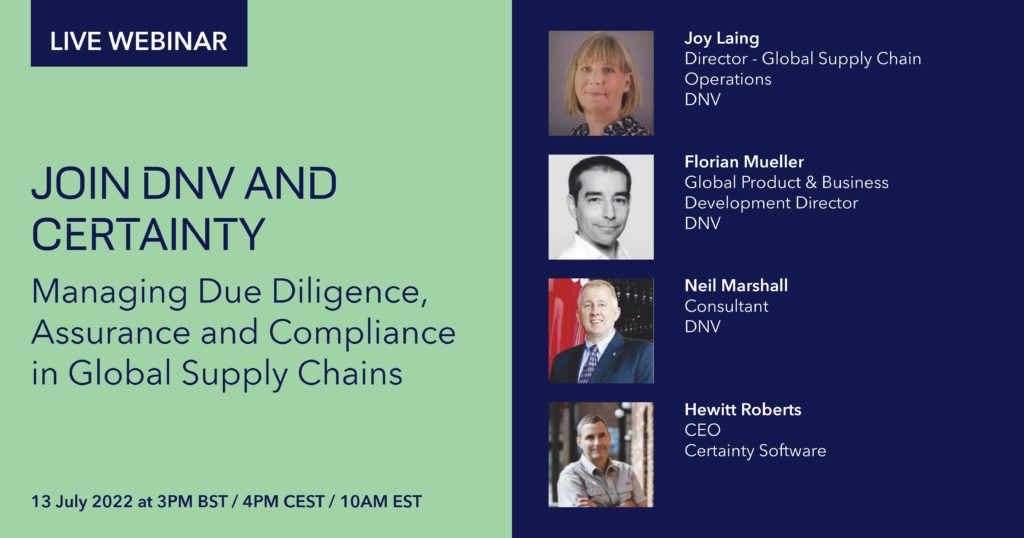
Expert panelists Florian Mueller, Global Product & Business Development Director at DNV, Joy Laing, Global Director of Supply Chain Management Services at DNV, and Neil Marshall, Senior Advisor at DNV joined Certainty Software to address the most critical questions facing supply chain compliance professionals today.
In this webinar, we answered these pressing questions affecting global supply chain success:
- What are the biggest supplier quality assurance and compliance issues facing global brands today?
- How important are supplier due diligence, assurance, and compliance management?
- What are the key regulatory trends in supplier due diligence, including the EU Directive on corporate sustainability due diligence and the German Supply Chain Due Diligence Act?
- Are there digital tools and techniques for managing many of these emerging issues?
Here’s a recording of a webinar – enjoy!
Why Supplier Due Diligence Matters More Than Ever in 2025
The regulatory environment for supply chain due diligence has evolved substantially since this webinar was first published. The key developments that make the topics covered even more relevant today include:
- LkSG (German Supply Chain Act) — Fully in force: Effective from January 2023 for companies with 3,000+ employees and expanded to 1,000+ employees from January 2024, Germany’s LkSG is now actively enforced by BAFA. Companies face fines of up to 2% of annual turnover for non-compliance, plus exclusion from public procurement.
- EU CSDDD — Adopted in 2024: The EU Corporate Sustainability Due Diligence Directive extends LkSG-style obligations to all large EU companies and their global value chains, with civil liability exposure. Progressive application begins from 2027, giving companies a narrow window to build compliant supplier management systems.
- CSRD — ESG reporting at scale: The EU Corporate Sustainability Reporting Directive requires large companies to disclose detailed sustainability information — including Scope 3 supply chain emissions, human rights due diligence outcomes, and supplier social performance data — from 2025 onwards.
- UFLPA — Forced labour at the border: The US Uyghur Forced Labor Prevention Act (UFLPA) creates a rebuttable presumption that goods made in Xinjiang, China are produced with forced labour, placing the burden of proof on importers to demonstrate clean supply chains through documented due diligence.
Key Insights: Supplier Due Diligence, Quality Assurance, and Compliance Management
The Certainty–DNV webinar explored several themes that remain at the forefront of supply chain compliance in 2025–2026:
The Gap Between Policy and Practice
Many global brands have supplier codes of conduct and sustainability policies in place, but lack the operational systems to verify compliance at scale. The due diligence process requires more than a questionnaire — it demands scheduled assessments, documented corrective actions, evidence of improvement, and real-time visibility into supplier performance across all tiers. The LkSG and CSDDD make this systematic approach a legal requirement, not just good practice.
Quality Assurance as a Foundation for Compliance
Quality assurance and social compliance are increasingly interlinked. Suppliers that fail to maintain consistent quality management systems — poor documentation, inadequate worker training, absence of corrective action processes — are also more likely to exhibit social and environmental compliance weaknesses. DNV’s experts emphasised that a robust quality management framework is the operational foundation upon which effective due diligence is built.
Digital Tools for Supplier Compliance at Scale
Managing supplier reviews across hundreds or thousands of suppliers — in multiple languages, across multiple tiers, and against multiple regulatory standards — is impossible with spreadsheets and email. Digital compliance platforms like Certainty Software enable organisations to schedule and distribute supplier assessments, track corrective action completion, generate compliance dashboards, and produce the documented evidence trails required for LkSG annual reporting and CSDDD due diligence documentation.
Frequently Asked Questions (FAQs)
Q: What is supplier due diligence and why is it required?
A: Supplier due diligence is the process by which companies identify, assess, prevent, and remediate human rights and environmental risks in their supply chains. It is now a legal requirement for companies subject to Germany’s LkSG (since 2023) and will be required for all large EU companies under the CSDDD from 2027. It is also a key input for CSRD sustainability reporting and supply chain transparency requirements under the UFLPA and various Modern Slavery Acts.
Q: What is the difference between supplier due diligence and a supplier audit?
A: Supplier due diligence is the broader process of managing supply chain risk — it includes risk assessment, supplier audits, corrective action management, grievance mechanisms, and ongoing monitoring. A supplier audit is one tool within the due diligence process: a structured assessment of a specific supplier’s performance against defined criteria. Regulatory frameworks like the LkSG and CSDDD require both systematic due diligence processes and documented audit evidence.
Q: How does Certainty Software support supplier due diligence requirements?
A: Certainty Software provides an enterprise-grade audit, inspection, and compliance management platform that enables organisations to design and deploy supplier assessment programmes, schedule and track audits across all supplier tiers, manage corrective actions with documented evidence, and generate compliance reports aligned with LkSG, CSDDD, and CSRD requirements. The platform supports multilingual deployment for global supplier networks and provides real-time analytics for supply chain risk prioritisation.
Q: How can companies prepare for CSDDD compliance?
A: Companies should begin by mapping their full supply chain to identify Tier 1, 2, and 3 suppliers; conducting a risk-based assessment of human rights and environmental risks by supplier and geography; establishing supplier assessment and audit programmes; implementing grievance mechanisms; and building systems for ongoing monitoring and annual due diligence reporting. Starting this process now — ahead of CSDDD’s progressive application from 2027 — significantly reduces compliance risk and cost.
You may also be interested in:
The Supplier Compliance Audit: What it is (and Why You Need One)