Summary: Bill S-211 requires qualifying companies to report annually on how they prevent and reduce forced labor and child labor risks in their supply chains. For procurement and compliance teams, the law raises the cost of weak due diligence by creating exposure to fines, reputational damage, and investor scrutiny. Companies that build traceable supply chain risk processes now will be better prepared for Canadian reporting obligations and broader global compliance trends.
Table of contents
Why You Should Care About Bill S-211
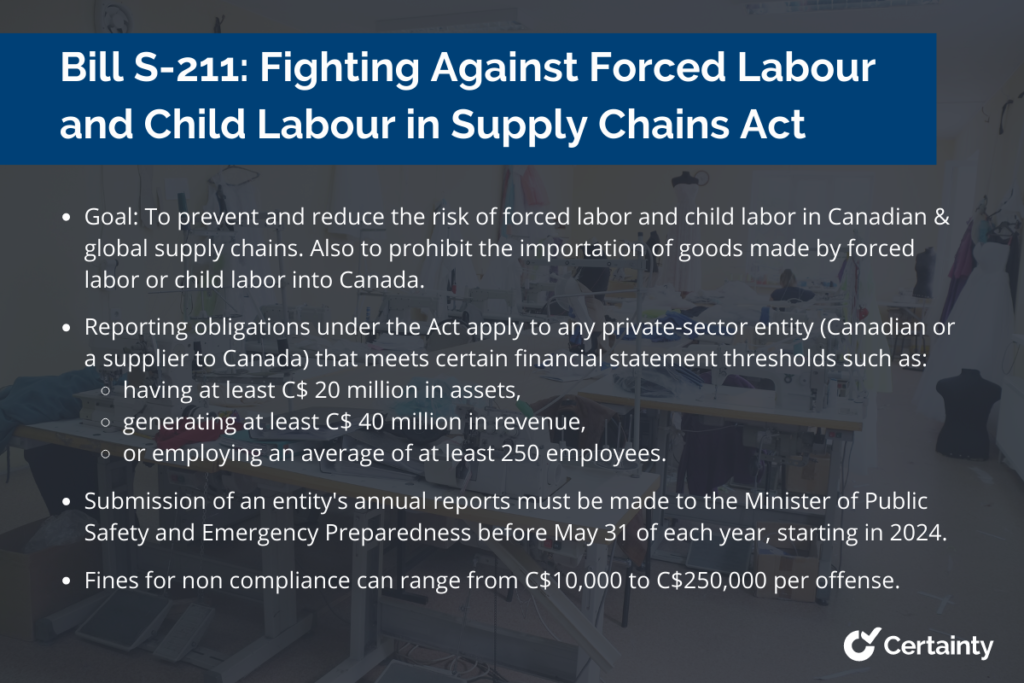
Canada’s Bill S-211 — the Fighting Against Forced Labour and Child Labour in Supply Chains Act — requires companies that meet specific thresholds to publish annual reports on their efforts to prevent forced labor and child labor risks in their supply chains. The first reports were due May 31, 2024. As a result, annual reporting cycles are now underway. Companies that have not yet established compliant due diligence programs face immediate legal exposure. Specifically, fines can reach up to C$250,000 per offense. Moreover, these companies face growing reputational risk as investors and customers scrutinize supply chain transparency disclosures.
Forced labor and child labor are serious human rights violations. In fact, according to the International Labour Organization, an estimated 160 million children and 27 million adults are affected globally. Furthermore, these violations pose significant legal, ethical, and reputational risks for businesses that operate or source goods from global supply chains. This is particularly true as the international regulatory framework for supply chain due diligence intensifies. Similarly, Bill S-211 complements the EU’s Corporate Sustainability Due Diligence Directive (CSDDD), Germany’s LkSG Supply Chain Act, and the US Uyghur Forced Labor Prevention Act (UFLPA). Together, these laws represent a growing global convergence on mandatory supply chain human rights obligations.
Canada passed Bill S-211 to enact the Fighting Against Forced Labour and Child Labour in Supply Chains Act and to amend the Customs Tariff. Bill S-211 aims to increase transparency and accountability in supply chains. It does so by requiring government institutions and certain private entities to publish annual reports on their efforts to prevent forced labor and child labor throughout their supply chains. In addition, it prohibits the importation into Canada of goods produced by forced or child labor.
This post explains how Bill S-211 affects your business and supply chain management. Additionally, it covers how to build a compliant, efficient reporting program. You will also learn best practices from aligned frameworks such as CSDDD and LkSG.
What You Need to Know About the Reporting Obligations
The reporting obligations under the Act apply to any private-sector entity that meets certain financial and employment thresholds. In particular, these thresholds are based on consolidated financial statements. They include:
- having at least C$20 million in assets,
- generating at least C$40 million in revenue,
- or employing an average of at least 250 employees.
These obligations also apply to all federal government institutions, ministries, and departments. In addition, Crown corporations and wholly owned subsidiaries must comply.
Companies must submit annual reports to the Minister of Public Safety and Emergency Preparedness before May 31 of each year. The first reports were due May 31, 2024, covering activities in the 2023 fiscal year. As a result, this reporting cycle is now firmly established. Consequently, companies that have not yet submitted their first report are already in violation of the Act. The reports must disclose information such as:
- Policies, procedures, due diligence measures, training programs, and remediation actions that the entity has implemented or plans to implement to prevent and reduce the risk of forced labor and child labor in its supply chain — demonstrating an approach aligned with the UN Guiding Principles on Business and Human Rights and OECD Due Diligence Guidelines, consistent with CSDDD and LkSG standards.
- The structure of its supply chain and the countries where its goods are produced or sourced. For global enterprises, accurately identifying tier 1, 2, and 3 suppliers is a significant undertaking requiring systematic supply chain mapping and visibility. Read our guide on supply chain visibility to learn how to get started.
- Any instances of forced labor or child labor identified or reported within the supply chain — including corrective actions taken and outcomes achieved.
- Any challenges or difficulties encountered or anticipated in complying with Bill S-211 — demonstrating good-faith engagement with the due diligence process even where gaps exist.
The entity must make the report publicly available in a prominent location. For example, this includes displaying it on the entity’s website or on a website the Minister designates. Furthermore, the entity’s governing body (board of directors or equivalent) must approve the report before submission. Ultimately, this requirement creates executive-level accountability for the report’s content and accuracy.
What You Need to Know About the Fines
Bill S-211 establishes a system of fines for private entities that make false or misleading statements in their reports or fail to comply with reporting obligations. In fact, fines can range from C$10,000 to C$250,000 per offense, depending on the nature and severity of the violation. Moreover, directors and officers of non-compliant entities may face personal liability if they directed, authorized, or acquiesced to the violation.
The fines and liability provisions under the Act create several important compliance incentives:
- Imposing real financial costs, legal liabilities, and public scrutiny on businesses that fail to comply — or that submit incomplete or inaccurate reports.
- Motivating investment in supply chain compliance infrastructure — including supplier audit programs, self-assessment platforms, and corrective action management systems — to generate the documented evidence needed for credible annual reports.
- Encouraging proactive cooperation with the Minister and relevant authorities in resolving compliance issues or disputes — and establishing a compliance culture that aligns with the parallel obligations of CSDDD and LkSG.
What You Need to Know About the Customs Tariff
The Act amends the Customs Tariff to prohibit importing goods made in whole or in part by forced labor or child labor into Canada. This prohibition applies regardless of whether the goods serve domestic consumption, use, or re-export. Similarly, it applies regardless of whether the importer knew or should have known about the prohibited labor practices. Notably, the prohibition aligns with the US UFLPA. That law similarly bans imports of goods from the Xinjiang Uyghur Autonomous Region absent clear and convincing evidence of no forced labor involvement.
The customs tariff prohibition could affect your business in several important ways:
- Affecting the availability and cost of goods sourced from countries or sectors where forced labor or child labor is prevalent — requiring supply chain restructuring or enhanced supplier verification for goods in high-risk categories.
- Requiring you to track and verify the origin and production methods of goods you import into Canada — with documentary evidence of due diligence needed to demonstrate compliance in the event of a customs audit or seizure.
- Creating strong incentives to adopt ethical and sustainable sourcing practices, aligned with the broader CSDDD, LkSG, and UFLPA regulatory environment that now governs supply chain sourcing decisions for global companies.
What You Need to Know If You Supply Goods to Canada
If you are a foreign business that supplies goods to Canada, Bill S-211 could affect both your reporting obligations and your broader supply chain management. Specifically:
- You may be required to comply with the reporting obligations under the Act if you meet the criteria (Part 2 Section 9) of a private entity that produces or imports goods into Canada, or that controls an entity that does so. This means you must submit an annual report to the Minister and make it publicly available on your website or on a website designated by the Minister.
- You must ensure that the goods you supply to Canada are not made by forced labor or child labor, as they could be prohibited under the Customs Tariff and seized by the Canada Border Services Agency. This may affect the market availability of your goods in Canada and expose you to legal liability, reputational damage, and loss of key customer relationships.
- You must monitor and verify the compliance of your own suppliers with the Act and with international standards and guidelines on human rights and supply chain due diligence — including conducting audits and self-assessments, implementing policies and procedures, providing training, and managing corrective actions. These requirements align closely with the CSDDD and LkSG obligations applicable to your EU-based customers, enabling a unified approach to multi-jurisdictional supply chain compliance.
30+ Audit and inspection checklists free for download.
How to Manage Your Supply Chain Risks and Reporting Obligations Effectively
Bill S-211 is now an active compliance obligation. The first annual reporting deadline passed on May 31, 2024, and subsequent reports are due each May 31 thereafter. Therefore, companies operating in or supplying to Canada must treat Bill S-211 compliance as an ongoing program requirement — not a one-time filing. The following best practices support an effective, efficient compliance program. They also align with parallel requirements under CSDDD, LkSG, and UFLPA for multi-jurisdictional supply chain compliance:
- Conduct regular audits and assessments of your supply chain to identify and remediate risks related to forced labor and child labor — covering tier 1, 2, and 3 suppliers in high-risk sectors and geographies.
- Implement policies and procedures that align with international standards on human rights and supply chain due diligence, including the UN Guiding Principles on Business and Human Rights and the OECD Guidelines for Multinational Enterprises — which also align with the due diligence frameworks required under CSDDD and LkSG.
- Provide training and education to employees, suppliers, and partners on Bill S-211 requirements, international human rights standards, and how to prevent and reduce forced labor and child labor risks in supply chains.
- Implement remediation actions and corrective measures to address any instances of forced labor or child labor identified in your supply chain — documenting all actions taken as required evidence for your annual Bill S-211 report.
- Engage with suppliers and stakeholders on a regular basis to monitor compliance, build shared accountability for human rights performance, and foster trust — consistent with the collaborative due diligence approach required by CSDDD and LkSG.
- Use Certainty Software to streamline your supplier data collection, assessment management, corrective action tracking, and annual reporting processes — reducing the compliance burden while generating the documented evidence needed for credible, board-approved Bill S-211 reports.
If you want to learn more about how Certainty Software can help you comply with Bill S-211 and improve your supply chain management, please contact us today for a free demo or consultation.
Frequently Asked Questions (FAQs)
What is Bill S-211 in Canada?
Bill S-211 — the Fighting Against Forced Labour and Child Labour in Supply Chains Act — is a Canadian law requiring government institutions and private sector entities meeting specific thresholds (C$20M+ in assets, C$40M+ in revenue, or 250+ employees) to publish annual reports on their efforts to prevent and reduce forced labor and child labor in their supply chains. Annual reports are due to the Minister of Public Safety before May 31 each year, starting in 2024. The Act also amends Canada’s Customs Tariff to prohibit the importation of goods made by forced or child labor.
How does Bill S-211 relate to CSDDD and LkSG?
Bill S-211, the EU’s CSDDD, and Germany’s LkSG are all part of a global convergence toward mandatory supply chain human rights due diligence. All three require companies to identify, assess, and mitigate forced labor and human rights risks in their supply chains. While they differ in scope and specific requirements, their due diligence frameworks are broadly aligned — companies that build robust supply chain compliance programs for one regulation are typically well-positioned to satisfy the others. A unified, technology-enabled approach using a platform like Certainty Software supports multi-jurisdictional compliance efficiently.
What must the Bill S-211 annual report include?
The annual Bill S-211 report must describe: (1) the entity’s structure, activities, and supply chains; (2) policies and due diligence measures to prevent and reduce forced and child labor risks; (3) the parts of the business and supply chain that carry risk of forced or child labor use; (4) measures taken to remediate any identified instances; (5) training provided to staff; and (6) how the entity assesses the effectiveness of its actions. The report must be approved by the entity’s governing body and publicly available on the entity’s website.
What are the fines for non-compliance with Bill S-211?
Fines for non-compliance with Bill S-211 range from C$10,000 to C$250,000 per offense. Violations include failing to submit the annual report, providing false or misleading information, and failing to comply with any order or requirement under the Act. Directors and officers of non-compliant entities can be held personally liable if they directed, authorized, or acquiesced to the violation.
You may also be interested in: