Summary: The German Supply Chain Act affects not only large German companies but also the global suppliers that support them, making human rights and environmental performance a direct business requirement. For supply chain managers, LkSG means supplier risk now includes documented due diligence expectations that can cascade across tiers and borders. Companies selling into Germany or the EU need compliance-ready processes now, not after customer demands intensify.
The German Supply Chain Act (Lieferkettensorgfaltspflichtengesetz, or LkSG) is one of the most far-reaching supply chain due diligence laws in force today. It became fully effective as of January 2023. Specifically, it requires German companies — and all of their global suppliers — to identify, prevent, and remediate human rights and environmental risks throughout their supply chains.
For many North American, Asian, and European companies that supply to German businesses, the LkSG was the first major signal of a regulatory transformation. This transformation is now accelerating. In particular, the EU Corporate Sustainability Due Diligence Directive (CSDDD), adopted in 2024, extends comparable obligations to all large EU companies and their value chains globally. The CSDDD will progressively apply from 2027 onward.
If your company operates in or sells to companies that operate in Germany or the broader EU, your social and environmental performance is a critical compliance issue right now.
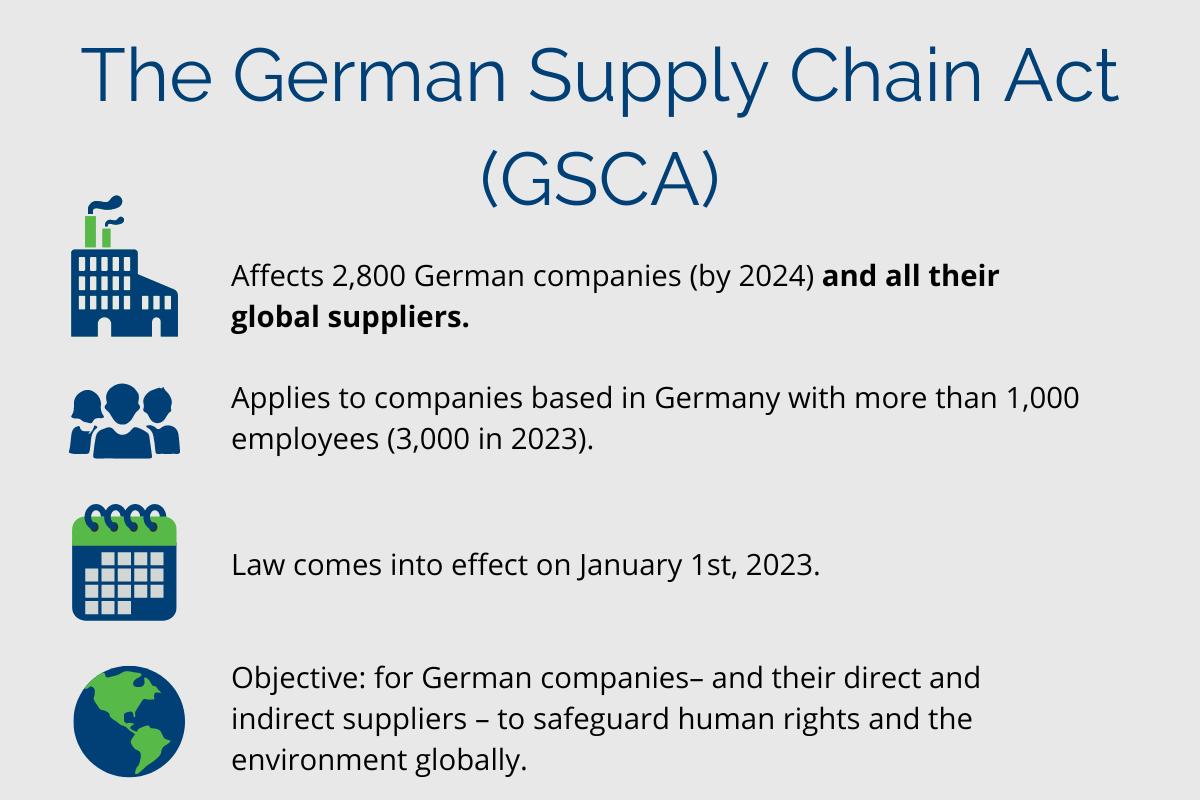
In July 2021, the German parliament passed the Act on Corporate Due Diligence in Supply Chains (Lieferkettensorgfaltspflichtengesetz). This law came into full effect on January 1st, 2023. It safeguards human rights and the environment globally. Specifically, it ensures that German companies and their direct and indirect suppliers meet the standards defined by the United Nations (UN) Guiding Principles on Business and Human Rights and the OECD Guidelines for Multinational Enterprises. Furthermore, the German Federal Office for Economic Affairs and Export Control (BAFA) now actively enforces the LkSG. BAFA has published guidance and initiated compliance assessments of in-scope companies since 2023.

The German Supply Chain Act applies to companies based in Germany with more than 1,000 employees. The threshold dropped from 3,000 to 1,000 in January 2024. As a result, these companies must take “appropriate measures” to ensure social and environmental safeguards in their operations and supply chains — globally. Unlike previous regulations aimed at performance within a single jurisdiction, the LkSG imposes due diligence obligations that follow the supply chain globally. In other words, it applies regardless of where a supplier operates.
The LkSG is now one component of an expanding regulatory landscape. The EU CSDDD, formally adopted in 2024, will apply to large EU companies from 2027 onward. It extends similar due diligence requirements across the entire EU single market. Together, the LkSG and CSDDD represent a fundamental shift. Social and environmental compliance in supply chains is no longer voluntary. Instead, it is a legal obligation enforced with significant penalties.
Who’s Affected?
The German Supply Chain Act (LkSG) directly applies to more than 2,800 German companies with 1,000+ employees. Notably, it covers all of their suppliers globally — including those in North America, Asia, and elsewhere. Consequently, any company exporting goods or services to a German company faces indirect LkSG due diligence requirements. Their German customer must assess and manage risks throughout the supply chain.
To put this in perspective, consider just the US and Canada. This Act directly impacts thousands of US and Canadian companies that export goods and services to German companies. Furthermore, the scope of indirect impact extends far beyond Germany. Any business in the global supply chain of a covered German company must be prepared. Specifically, they must provide documentation, participate in audits, and demonstrate social and environmental compliance.
What are the GSCA Requirements?
Companies directly bound by the German Supply Chain Act must put comprehensive due diligence practices in place. These practices safeguard human rights and the environment throughout their supply chains. Moreover, these requirements align with the broader framework established by the EU CSDDD. Specifically, LkSG compliance must include:
- A systematic approach to regularly assessing, reporting, and managing social and environmental risks — including a formal risk analysis conducted at least annually;
- Defined responsibility for corporate compliance, with a designated human rights officer or equivalent function;
- Social and environmental policies and documented due diligence procedures in place, including a supplier code of conduct;
- Corrective and preventive measures implemented in their own operations and those of their direct suppliers (and indirect suppliers where there is substantiated knowledge of human rights violations or environmental destruction);
- An operational grievance mechanism through which workers and affected communities can raise concerns; and
- Publication on their website of an annual performance report including due diligence policies and procedures, risks identified, and corrective and preventative measures taken — with BAFA review rights.

30+ Audit and inspection checklists free for download.
What risks are covered by the German Supply Chain Act?
The German Supply Chain Act aims to prevent environmental violations of internationally recognized conventions. In particular, the following conventions are covered:
- The Minamata Convention on Mercury
- The Stockholm Convention on Persistent Organic Pollutants (POPs Convention)
- The Basel Convention of the Control of Transboundary Movements of Hazardous Wastes and their Disposal
Additionally, the Act requires the prevention of human rights violations. These are outlined in the United Nations (UN) Guiding Principles on Business and Human Rights and the OECD Guidelines for Multinational Enterprises. Specifically, these guidelines cover:
- Child labor
- Forced labor
- Slavery
- Occupational health & safety
- Freedom of Association
- Unequal treatment/discrimination
- Adequate Living Wage
- Environmental Damage & Excessive Water Consumption
- Unlawful Eviction and Taking of Land, Forest, Water
- Inappropriate Use of Security Forces
What are the penalties for non-compliance?
BAFA enforces the German Supply Chain Act with significant financial penalties. Non-compliant companies face fines of up to 2% of their average annual turnover. For companies with annual turnover below 400 million euros, the maximum fine is 8 million euros. However, for larger companies, the 2% cap can result in substantially higher penalties.
Furthermore, companies violating the LkSG face exclusion from public tenders for up to 3 years. This is a significant commercial consequence for companies with government procurement revenue. Additionally, German trade unions and non-governmental organizations (NGOs) can bring civil liability proceedings on behalf of affected individuals. As a result, the risks of non-compliance extend well beyond financial fines.
Steps to ensure compliance throughout your supply chain:
The German Supply Chain Act, combined with the forthcoming CSDDD, will have an enormous impact on thousands of companies across global supply chains. However, your company can take concrete steps to ensure and maintain compliance. Moreover, companies that invest in systematic supply chain compliance management now will gain an advantage. Specifically, they will be better positioned when CSDDD obligations begin to apply from 2027.
For companies bound by the LkSG or preparing for CSDDD, the steps to ensure compliance are:
- Define corporate responsibility for social and environmental policies, including assigning a designated compliance officer or human rights function;
- Define your social and environmental supplier assessment checklist aligned with LkSG risk categories and CSDDD due diligence requirements;
- Map your direct and indirect suppliers and supply chain — know who supplies to you at every tier;
- Schedule first, second- or third-party social and environmental assessments for your suppliers, prioritised by risk level;
- Review and verify completion and accuracy of supplier assessments, maintaining documented records for BAFA review;
- Review and create supplier corrective actions for violations and non-compliance, with clear timelines and accountability;
- Report social and environmental performance across your supply chain in your annual LkSG due diligence report; and,
- Prioritise supplier performance improvements with trends, analytics, and scorecard dashboard reports to demonstrate continuous improvement to regulators.
For companies who supply to German companies, OEMs, and brands, the steps to ensure compliance are:
- Define your social and environmental assessment checklist aligned with the LkSG risk categories your German customers must manage;
- Self-assess your social and environmental performance against LkSG, ETI Base Code, and applicable SMETA criteria;
- Be ready to report to and actively support your customers’ social and environmental due diligence efforts — including providing audit access and documentation;
- Put policies, procedures, and improvement initiatives in place to continually improve social and environmental performance and demonstrate a positive compliance trajectory.
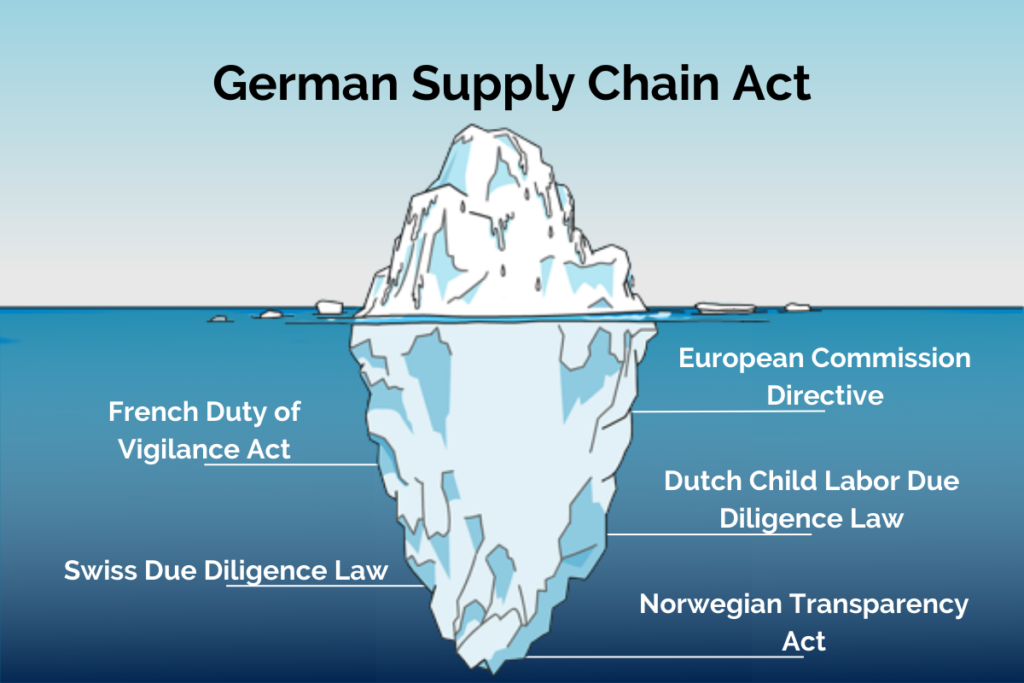
Spoiler Alert – This is just the tip of the social and ethical regulatory iceberg!
The German Supply Chain Act was an early mover in supply chain due diligence legislation. However, it is now part of a global regulatory wave. The EU CSDDD, formally adopted in 2024, extends similar due diligence obligations to all large EU companies and their global value chains. It will be progressively implemented from 2027 onward.
Meanwhile, the EU Corporate Sustainability Reporting Directive (CSRD) requires comprehensive ESG disclosure from 2025 onward. This includes detailed Scope 3 supply chain emissions and social impact data. Furthermore, the UK Modern Slavery Act continues to require transparency statements from large companies. Jurisdictions including France (Loi de Vigilance), Norway, and Australia have enacted or are expanding their own laws as well. Together, these regulations represent a fundamental, permanent change to global supply chain compliance expectations. Consequently, they affect companies far beyond Germany’s borders.
Frequently Asked Questions (FAQs)
Q: Is the German Supply Chain Act (LkSG) actively enforced in 2025?
A: Yes. The LkSG has been fully in force since January 2023. BAFA is the responsible enforcement authority. It has issued detailed guidance and conducted compliance assessments. Moreover, BAFA has the authority to impose fines of up to 2% of annual turnover on non-compliant companies.
Q: How does the LkSG relate to the EU CSDDD?
A: The LkSG was the first major national supply chain due diligence law in the EU. It served as an influential model for the EU CSDDD. The CSDDD, adopted in 2024, broadens these obligations to all large EU companies, not just German ones. Additionally, it extends civil liability exposure. It also aligns more closely with the EU Green Deal and Paris Agreement climate targets. As a result, companies already complying with the LkSG will have a significant advantage when CSDDD obligations begin in 2027.
Q: What is the LkSG employee threshold in 2025?
A: Since January 2024, the LkSG applies to all German companies with 1,000 or more employees. Previously, from January 2023, the threshold was 3,000 employees. Consequently, this expansion significantly increased the number of German companies in scope. It also increased the number of global suppliers subject to indirect due diligence requirements.
Q: What documentation must companies maintain for LkSG compliance?
A: Companies must maintain documented risk analyses, supplier assessment records, corrective action plans, grievance mechanism logs, and annual due diligence reports. Furthermore, these records must be available for BAFA review for a minimum of seven years. Using a digital compliance management platform such as Certainty Software enables companies to centralize and audit-trail all documentation efficiently. As a result, reporting becomes streamlined and audit-ready.