Summary: Supplier performance management is the ongoing process of measuring and improving how suppliers perform against quality, delivery, cost, responsiveness, compliance, and ESG expectations. Effective supplier performance management helps procurement teams catch issues early, reduce defects and delays, and build stronger supplier accountability over time. In a tighter regulatory environment, it also provides the evidence needed to support due diligence and supplier risk decisions.
Table of contents

What Is Supplier Performance Management?
Supplier Performance Management (SPM) is the systematic process of evaluating, monitoring, and continuously improving supplier performance against defined metrics — covering quality, delivery, cost, responsiveness, and, increasingly, regulatory compliance and ESG criteria. In 2025–2026, effective SPM extends beyond operational KPIs: under the EU Corporate Sustainability Due Diligence Directive (CSDDD), Germany’s LkSG, and the Corporate Sustainability Reporting Directive (CSRD), organizations are legally required to assess supplier performance against human rights, environmental, and governance standards as part of mandatory supply chain due diligence. SPM is no longer just a procurement best practice — it is a compliance imperative.
Why Does SPM Matter?
- Quality Assurance: SPM ensures that suppliers consistently meet quality standards. Whether it’s raw materials, components, or finished products, maintaining high-quality levels is non-negotiable — and defect-related supply chain failures cost global industry an estimated $1 trillion annually.
- Timely Delivery: On-time delivery is the lifeblood of supply chains. Supplier Performance Management helps track lead times, reduce delays, and mitigate disruptions — critical resilience capabilities in a world where geopolitical volatility, climate events, and regulatory changes regularly impact supplier reliability.
- Cost Optimization: Effective SPM identifies cost-saving opportunities, streamlines procurement processes, and encourages competitive pricing — while also reducing the hidden costs of non-compliance, audit failures, and supply chain disruptions.
- Risk Management: By assessing supplier risk across operational, financial, and ESG dimensions, organizations can proactively address vulnerabilities and build resilient supply chains. Under CSDDD and LkSG, risk assessment is a mandatory annual activity — not just a reactive response to incidents.
- Supplier Relationships: SPM cultivates collaborative partnerships that extend beyond simple transactions. It revolves around building trust, fostering transparency, and striving toward shared goals — including shared ESG performance targets that are increasingly required by CSRD value chain reporting obligations.
How Supplier Performance Management Differs From Supplier Relationship Management
Supplier Relationship Management (SRM)
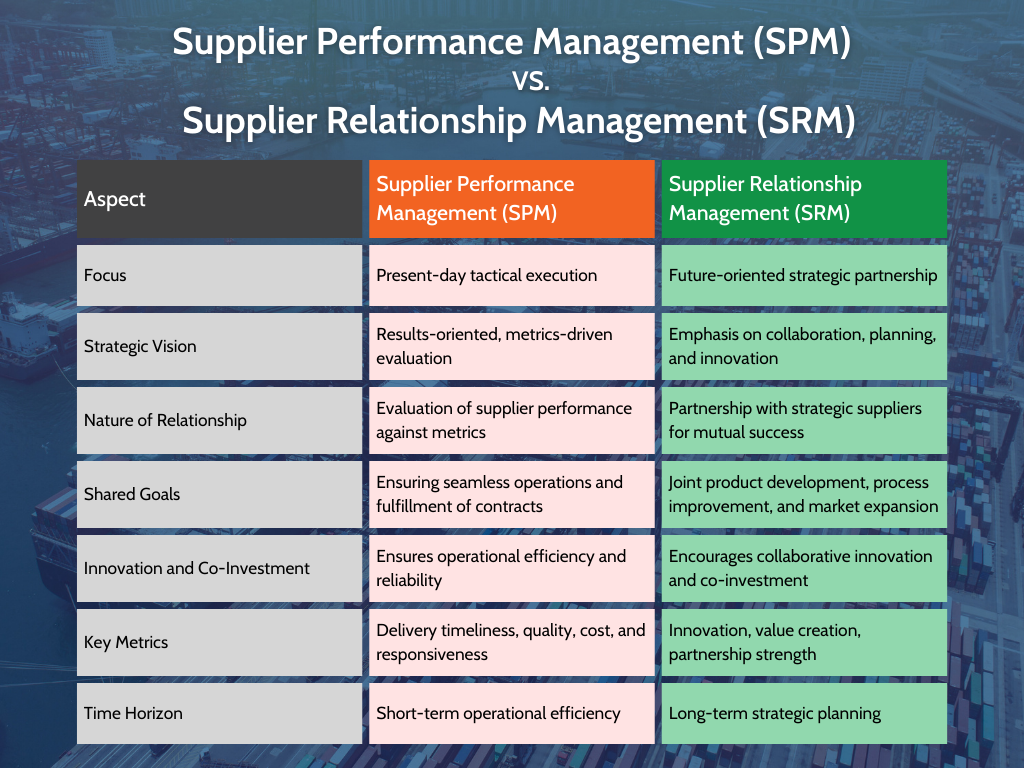
At the heart of SRM lies a strategic partnership — a harmonious collaboration between organizations and their key suppliers that goes beyond transactional exchanges. Here’s what sets it apart:
Strategic Vision: Supplier Relationship Management (SRM) looks toward the future. It requires collaboration in planning, fostering innovation, and creating value together. Organizations invest in building strong partnerships with strategic suppliers to drive shared success — including alignment on ESG goals and sustainability roadmaps that are increasingly requested under CSRD supply chain reporting requirements.
Shared Goals: SRM isn’t just about products; it’s about shaping the future together. Suppliers become partners in product development, process improvement, and market expansion — as well as partners in achieving the environmental and social targets required by regulations such as CSDDD and LkSG.
Innovation and Co-Investment: Strategic Relationship Management (SRM) fosters a culture of collaborative innovation and emphasizes forming partnerships to drive groundbreaking advancements. When a supplier shares your R&D objectives — and your ESG commitments — that’s when the essence of true SRM shines through.
Supplier Performance Management (SPM)
SPM, in contrast, is more tactical and results-oriented. While SRM looks at the big picture, SPM zooms in on execution and measurable outcomes:
Metrics-Driven Evaluation: SPM assesses supplier performance based on measures like delivery timeliness, quality, cost, and responsiveness — and in 2025–2026, increasingly includes ESG metrics such as carbon intensity, labor compliance audit scores, and CSDDD/LkSG risk ratings. The goal is to ensure that suppliers fulfill their contractual and regulatory duties effectively.
Operational Efficiency: Supplier Performance Management is the key to ensuring seamless operations. When a supplier is reliable, produces high-quality products, and works efficiently — including meeting ESG compliance obligations — it benefits the entire supply chain ecosystem.
Tactical Focus: SPM is all about efficient execution in the present day. It involves ensuring production schedules, managing inventory effectively, reducing disruptions, and maintaining documented evidence of supplier compliance — documentation that is increasingly required for CSRD sustainability statements and CSDDD due diligence reports.
Benefits of Effective SPM
- Cost Savings: Streamlined processes lead to cost reductions, better negotiation outcomes, and reduced spend on reactive compliance remediation — organizations with mature SPM programs report up to 20% reduction in supplier-related quality costs.
- Supply Chain Resilience: SPM mitigates risks across operational, financial, and ESG dimensions — ensuring continuity even during disruptions caused by geopolitical shifts, climate events, or regulatory changes such as new CSDDD enforcement actions.
- Service Quality: High-performing suppliers enhance service levels, directly impacting customer satisfaction and competitive differentiation — increasingly important as ESG performance becomes a procurement criterion for buyers subject to CSDDD and CSRD obligations.
- Operational Efficiency: Efficient supply chains translate to smoother operations, improved bottom lines, and the ability to scale compliance activities without proportional cost increases.
- Financial Stability: Assessing supplier financial health alongside ESG and compliance performance contributes to overall supply chain stability — reducing the risk of sudden supplier failures that would disrupt operations and trigger CSDDD incident reporting obligations.
Three Phases of Supplier Performance Management
Let’s explore the three critical phases that organizations navigate to ensure a steady, reliable supply of materials while maintaining strong supplier relationships and meeting increasingly complex regulatory compliance requirements:
1. Establishing Key Performance Indicators (KPIs)
In this foundational phase, organizations establish goals and measure supplier performance using specific metrics or KPIs. Key steps include:
- Defining Performance Targets: Organizations align KPIs with strategic goals — covering delivery, quality, cost savings, regulatory compliance, and ESG criteria. In 2025–2026, leading organizations are incorporating CSDDD-aligned human rights and environmental KPIs alongside traditional operational metrics to create a holistic supplier performance framework.
- Agreeing with Suppliers: Transparent communication is crucial. Organizations collaborate with suppliers to agree upon performance targets — including ESG and compliance targets required under LkSG contractual obligations — that become the measurable yardstick for ongoing evaluation and due diligence documentation.
2. Monitoring and Assessing Performance
During this active phase, organizations regularly check suppliers’ performance against set goals and metrics. Key activities include:
- Regular Performance Reviews: Organizations use scorecards, dashboards, and audit results to track supplier performance across quality, delivery, cost, and ESG dimensions. Digital platforms enable real-time performance tracking that supports both operational decision-making and CSDDD/LkSG due diligence documentation.
- Root Cause Analysis: When performance falls short — whether a late shipment, a quality failure, or an ESG audit finding — organizations investigate root causes systematically. Identifying underlying causes enables targeted corrective actions and prevents recurrence, fulfilling the “appropriate measures” standard required under CSDDD.
- Feedback Loops: Engage in candid, documented conversations with suppliers. Seek their feedback on processes, communication, and collaboration — and provide clear, constructive feedback on compliance gaps, supported by audit evidence.
3. Continuous Improvement and Adaptation
This phase is about agility and sustained evolution. Organizations strive for ongoing improvement and adapt to changing market dynamics, regulatory requirements, and supplier capabilities. Key aspects include:
- Kaizen Philosophy: SPM isn’t static. Continuous improvement is the mantra. Look for opportunities to enhance supplier performance across all dimensions — including progressive improvement on ESG metrics required for CSRD value chain disclosures.
- Benchmarking: Compare supplier performance against industry benchmarks and regulatory compliance standards — including LkSG risk assessment outcomes and CSDDD due diligence best practices. Identify areas where you can leapfrog industry norms and create competitive advantage.
- Flexible Governance: As markets shift, regulations evolve, and new requirements such as CSDDD come into force, governance processes must adapt. Collaborate across functions — procurement, quality, logistics, ESG, legal — to ensure SPM frameworks remain current and compliant.
Implementing Effective SPM: Best Practices
1. Define Clear Metrics (Going Beyond the Basics)
- Holistic Metrics: While on-time delivery and quality are fundamental, leading organizations in 2025–2026 are incorporating ESG performance metrics — including carbon intensity, labor compliance scores, and due diligence audit results — as core elements of their supplier scorecards.
- Responsiveness: How quickly does the supplier address compliance inquiries, corrective action requests, or due diligence data requests under LkSG or CSDDD obligations?
- Risk Mitigation: Assess the supplier’s ability to handle disruptions — operational, geopolitical, climatic, and regulatory — including their preparedness for CSDDD-mandated due diligence obligations.
- Financial Stability: Evaluate supplier financial health to ensure long-term viability and to identify early warning indicators of potential supply chain disruption.
- Customize Metrics: Tailor metrics to your industry, product type, regulatory exposure (e.g., LkSG scope, CSRD reporting obligations), and business model. A high-tech electronics supplier operating in conflict-mineral-affected regions requires different due diligence metrics than a domestic packaging supplier.
2. Regular Performance Reviews and Feedback (Beyond the Scorecard)
- 360-Degree Feedback: Engage in candid conversations with suppliers. Seek their feedback on your processes, communication, and collaboration — and provide transparent feedback on compliance performance, including ESG audit findings and CSDDD/LkSG risk assessments.
- Root Cause Analysis: Why did that shipment arrive late? What caused the quality issue? What underlies an ESG audit non-conformance? Address root causes systematically with documented corrective action plans — the evidentiary standard required by CSDDD’s “appropriate measures” obligation.
3. Monitor Supplier Performance Data (Beyond Automation)
- Predictive Analytics: Leverage data not just for historical tracking but for predictive insights. Can you anticipate supply chain disruptions — or emerging ESG compliance risks — based on early warning signals from supplier audit data, industry news, or regulatory updates?
- Benchmarking: Compare supplier performance against industry benchmarks and peer organizations’ due diligence standards. Identify areas where improved supplier ESG performance could differentiate your supply chain in procurement tenders or customer sustainability assessments.

30+ Audit and inspection checklists free for download.
4. Continuous Improvement and Recognition (Beyond Compliance)
- Kaizen Philosophy: SPM is about continuous improvement. Encourage suppliers to adopt the same mindset — including progressive improvement on CSDDD-relevant human rights and environmental standards, and CSRD-relevant Scope 3 emission reduction targets.
- Supplier Recognition Programs: Acknowledge high-performing suppliers publicly — including those that demonstrate exceptional ESG compliance and proactive engagement with your due diligence processes. It motivates them and sets a positive example for the broader supplier base.
5. Flexible, Streamlined Governance (Beyond Policies)
- Agile Governance: Governance isn’t about rigid policies; it’s about agility. As markets shift, regulations change — LkSG enforcement has been active since 2023, CSDDD transposition is underway across EU member states, and CSRD reporting is phasing in through 2026 — your supplier governance processes must evolve in step with these obligations.
- Collaborative Governance: Involve cross-functional teams — procurement, quality, logistics, ESG, legal, and finance — in supplier performance management. Their collective insights enhance decision-making quality, ensure regulatory alignment, and enable a more integrated response to due diligence obligations.
Best Supplier Performance Management KPIs and Metrics
Supplier Performance Management success relies on clear, measurable KPIs that span operational, financial, and ESG dimensions. In 2025–2026, leading organizations are expanding their SPM scorecards to include regulatory compliance metrics aligned with LkSG, CSDDD, and CSRD requirements. Here are the crucial KPIs and metrics that pave the way for a robust, future-proof SPM strategy:
- Lead Time
- Defect Rates
- Regulatory Compliance (including CSDDD/LkSG due diligence audit scores, REACH chemical compliance, and labor rights assessments)
- Contract Compliance
- Customer Service
- Risk Factor (including ESG risk scores, geographic risk ratings, and supply chain due diligence findings)
- On-Time Delivery
- Order Accuracy
- Return on Investment (ROI)
A Solution to Better Supplier Management
Certainty specializes in enterprise-level inspection and audit software solutions designed to improve performance, sustainability, and regulatory compliance across global supply chains. As due diligence obligations under CSDDD, LkSG, and CSRD Scope 3 requirements intensify, Certainty’s platform empowers organizations to assess and manage supplier performance — operational and ESG — at scale. Here’s how Certainty contributes to supplier performance management:
- Comprehensive Data Collection: Certainty enables easy collection and reporting of inspection data across your entire supplier network. Whether online, offline, in the field, or on the shop floor, users can complete audits and inspections wherever needed — capturing the documented evidence of supplier compliance that CSDDD and LkSG require.
- Real-Time Reports: With Certainty, organizations gain access to real-time performance reports spanning safety inspections, quality audits, and supply chain compliance assessments — including ESG metrics relevant to CSRD Scope 3 disclosures. These reports provide the timely, actionable information needed to identify and respond to supplier compliance gaps before they escalate into regulatory violations.
- Issue Resolution on the Go: When issues are identified — whether a quality defect or a CSDDD-relevant human rights or environmental concern — Certainty streamlines the resolution process. Users can create and delegate corrective actions directly within the platform, generating the documented audit trail required by due diligence regulations.
- Supplier Scorecards: Certainty’s reporting tools allow for consistent, comparable, and accurate supplier metrics across operational and ESG dimensions. Organizations can track supplier performance over time, highlight best practices, and identify areas that need improvement — with scorecard data that supports both internal governance and external CSRD reporting obligations.
- Business Insights: By collecting, tracking, and reporting accurate data across the entire supplier lifecycle, Certainty provides detailed business insights that empower procurement, ESG, and compliance teams to make informed decisions, optimize supplier relationships, and demonstrate systematic due diligence to regulators and stakeholders.
Organizations worldwide trust Certainty Software to complete millions of accurate audits and inspections annually. We help enterprises improve in safety, quality, ESG, and supply chain performance management — while building the documented due diligence capability required by CSDDD, LkSG, and CSRD. Book a demo with our team today to learn how Certainty can address your enterprise-level supply chain compliance challenges.
Frequently Asked Questions (FAQs)
What is Supplier Performance Management (SPM)?
Supplier Performance Management (SPM) is the systematic process of setting performance expectations for suppliers, measuring their performance against defined KPIs, and working collaboratively to drive continuous improvement. In 2025–2026, leading SPM programs incorporate ESG metrics and regulatory compliance assessments — including LkSG, CSDDD, and CSRD Scope 3 criteria — alongside traditional operational measures such as delivery performance, quality, and cost.
How does CSDDD affect Supplier Performance Management?
The EU Corporate Sustainability Due Diligence Directive (CSDDD) requires large companies to identify, prevent, mitigate, and account for adverse human rights and environmental impacts across their supply chains. This transforms SPM from an optional governance tool into a legal compliance mechanism: organizations must conduct regular, documented supplier risk assessments, deploy audit and corrective action processes, and maintain evidence of due diligence activities that can be reported annually and reviewed by supervisory authorities.
What ESG metrics should be included in supplier scorecards?
Leading supplier scorecards in 2025–2026 include a blend of environmental metrics (GHG emissions, energy intensity, waste management, chemical compliance including REACH), social metrics (labor rights audit scores, living wage assessment, health and safety performance, forced labor risk), and governance metrics (anti-corruption policy, transparency, whistleblower mechanisms). The specific metrics should be calibrated to your industry’s highest-risk areas, your LkSG and CSDDD due diligence obligations, and your CSRD Scope 3 reporting requirements.
What is the difference between SPM and supplier due diligence?
Supplier Performance Management (SPM) focuses on measuring and improving supplier performance across operational, financial, and ESG dimensions. Supplier due diligence — as required by LkSG and CSDDD — focuses specifically on identifying and mitigating adverse human rights and environmental impacts in the supply chain. In practice, the two overlap significantly: a mature SPM program that includes ESG audits, risk assessments, and corrective action management provides much of the documented evidence required to satisfy LkSG and CSDDD due diligence obligations.