Summary: Key risk indicators are measurable signals that show whether risk exposure is rising, stable, or improving, which makes them different from KPIs that track performance outcomes. In safety and risk management, KRIs help leaders act earlier by highlighting deteriorating conditions before incidents, compliance failures, or operational losses occur. Used well, KRIs connect frontline warning signs to enterprise decision-making and make prevention more targeted and timely.
Table of contents
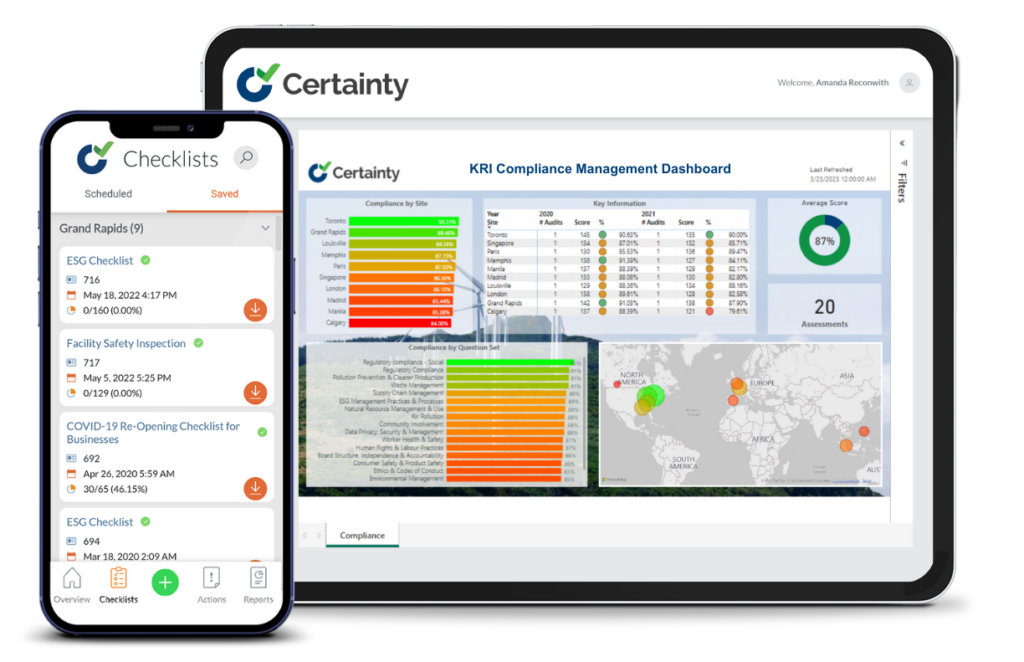
Key Risk Indicators (KRIs) are quantitative metrics that function as early-warning signals for emerging or escalating risks — enabling organizations to detect deteriorating risk conditions and take corrective action before those conditions produce incidents, compliance violations, or operational failures. For EHS Managers, Safety Directors, and Directors of Risk Management, KRIs are the difference between proactive risk management and reactive incident response. Traditional risk management approaches — where each business unit manages its own risks independently — consistently produce dangerous blind spots:
- Risks that fall between organizational silos and go undetected until they produce incidents, citations, or financial losses
- Misalignment between risk management activities and the strategic objectives and compliance obligations they are meant to protect
- Resistance to adopting consistent risk management tools and practices across departments, sites, and business units
These limitations prevent organizations from gaining the holistic, integrated view of risk exposure that effective enterprise risk management demands.
That is why leading organizations increasingly embrace enterprise risk management (ERM) frameworks — systematic processes that provide cross-organizational risk visibility, align risk management with strategic priorities, and enable proactive action rather than reactive response. Within an ERM framework, Key Risk Indicators are the operational mechanism that makes risk monitoring continuous, quantitative, and actionable.
This article provides a comprehensive guide to KRIs: what they are, how they differ from KPIs, their role in workplace safety and compliance management, how to establish and monitor them effectively, and how to use them to drive continuous risk improvement across your organization.
What are Key Risk Indicators (KRIs) and how do they differ from Key Performance Indicators (KPIs)?
Key Risk Indicators (KRIs) are metrics that monitor and quantify the level of risk an organization is currently exposed to in a given area — providing early warning of conditions that could threaten the achievement of objectives if left unaddressed. For safety professionals, KRIs include metrics such as inspection completion rate against schedule, near-miss report frequency, corrective action closure rate, percentage of overdue safety actions, and PPE compliance observation scores. For compliance leaders, KRIs might include permit violation trend rates, audit finding recurrence rates, or regulatory change response timelines.
Key Performance Indicators (KPIs) measure the results and outcomes of activities already completed — showing how well the organization has achieved its goals. A safety KPI might be Total Recordable Incident Rate (TRIR), Lost Time Injury Rate (LTIR), or DART rate. A compliance KPI might be the number of regulatory citations received or the cost of non-compliance penalties in a period. Like the Net Promoter Score (NPS) in customer experience management, KPIs tell you what has already happened.
The distinction is both conceptual and practically important. KRIs are predictive — they measure conditions and behaviors that precede outcomes. KPIs are descriptive — they measure outcomes after the fact. Both are essential, but organizations that rely solely on lagging KPIs (like TRIR) to manage safety are always measuring yesterday’s failures rather than preventing tomorrow’s. KRIs shift the focus forward.
To illustrate: KPIs are like the speedometer and odometer in a vehicle — they tell you how fast you are going and how far you have traveled. KRIs are like the fuel gauge, engine temperature warning, and oil pressure light — they tell you about conditions that will determine whether you reach your destination safely. A vehicle with a perfect speedometer reading but an ignored fuel gauge will eventually break down. An organization that tracks TRIR without monitoring leading KRIs faces an analogous risk.
What’s its Importance for Risk Management?
Key Risk Indicators play a vital, multi-dimensional role in modern risk management programs — particularly for organizations managing safety and compliance obligations under frameworks such as ISO 45001:2018, OSHA standards, and industry-specific regulatory regimes. KRIs enable organizations to:
Identify and assess risks before they become problems
KRIs function as the early-warning system of your risk management program. By monitoring defined metrics against threshold values on a regular cadence, safety and compliance teams can detect deteriorating conditions — declining inspection completion rates, rising overdue corrective action counts, decreasing near-miss report frequency — before they manifest as recordable incidents, regulatory citations, or enforcement actions. ISO 45001:2018 Clause 9.1 explicitly requires organizations to monitor, measure, analyze, and evaluate occupational health and safety performance — KRIs are the structured mechanism for fulfilling this requirement proactively.

30+ Audit and inspection checklists free for download.
Track and communicate risks across the organization
KRIs create a standardized, comparable language for risk communication across sites, departments, functions, and organizational levels. When all facilities use the same KRI definitions, threshold levels, and reporting formats, senior leadership can meaningfully compare risk profiles across the enterprise — identifying which locations, operations, or risk categories require priority attention and resource allocation. KRI dashboards and reports also make risk information accessible and actionable for non-specialists, enabling operational managers, site safety officers, and board-level risk committees to engage meaningfully in risk oversight without requiring deep technical expertise.
Mitigate and prevent risks from escalating or materializing
KRIs are most powerful when linked directly to escalation triggers and response protocols. When a KRI breaches a defined threshold — for example, when inspection completion rate falls below 80% for a second consecutive month, or when open corrective actions older than 30 days exceed a defined count — the KRI system automatically escalates the issue to the appropriate owner, triggers a structured response process, and creates an audit trail of the management action taken. This closes the gap between risk identification and risk response that is the most common failure point in reactive safety programs.
Align risk management with organizational strategy and objectives
KRIs ensure that day-to-day risk monitoring activity is directly connected to the strategic outcomes the organization is trying to achieve — whether that is achieving ISO 45001 certification, reducing TRIR by 25% over three years, maintaining zero OSHA citations, or improving regulatory audit readiness scores. By linking KRI thresholds to strategic targets, organizations can measure the effectiveness of their risk management investments in terms that resonate with senior leadership and board-level stakeholders — transforming EHS from a compliance function into a strategic performance contributor.
Used consistently, KRIs provide the quantitative foundation for evidence-based safety leadership — enabling organizations to direct resources, prioritize interventions, and demonstrate continuous improvement in ways that anecdotal reporting and lagging indicators alone cannot support.
What are the Different Types of Key Risk Indicators?
KRIs can be developed for any risk domain relevant to the organization. The most commonly used KRI categories in enterprise risk management programs include:
Financial KRIs
Financial KRIs monitor emerging threats to financial performance, stability, and liquidity — including revenue concentration risk, cost overrun trends, debt covenant proximity, and cash flow variability. For safety-focused organizations, financially relevant KRIs also include workers’ compensation claim frequency trends, safety-related legal reserve levels, and the cost trajectory of corrective actions related to regulatory compliance gaps. Early warning of financial risk deterioration allows organizations to restructure exposures, secure contingency financing, or accelerate cost control measures before thresholds are breached.
For example, a financial KRI could be the return on equity (ROE) trend over rolling quarters, or the ratio of safety-related costs to total operating expenditure.
Operational KRIs
Operational KRIs monitor the health of day-to-day operations — including safety program execution quality, equipment reliability, process stability, quality performance, and workforce engagement. For EHS professionals, the most directly actionable operational KRIs are safety leading indicators: inspection completion rate, near-miss report rate per worker, corrective action closure rate, toolbox talk completion rate, PPE compliance observation score, and safety training completion rate. These metrics directly reflect the quality and consistency of safety program execution — and are proven predictors of future TRIR performance.
For example, an operational KRI for a construction site might be the percentage of weekly safety inspections completed on schedule across all active project sites — with a threshold triggering escalation if completion falls below 85% in any rolling four-week period.
Compliance KRIs
Compliance KRIs track the organization’s proximity to regulatory violations and the health of its compliance management program — including permit condition adherence, regulatory change response timelines, audit finding closure rates, license renewal status, and contractor compliance performance. For organizations subject to OSHA, EPA, DOT, or industry-specific regulatory oversight, compliance KRIs provide the earliest warning of developing compliance gaps before they become citations, enforcement actions, or permit violations. They are also a key input to ISO 45001 management reviews and external certification audits.
For example, a compliance KRI could be the percentage of OSHA-required safety inspections completed within the required frequency across all covered facilities — with threshold alerts triggered when any site falls below the required inspection cadence for two or more consecutive periods.
Reputational KRIs
Reputational KRIs monitor emerging threats to organizational brand, stakeholder trust, and public perception — including media sentiment trends, social media monitoring signals, customer satisfaction trajectory, employee engagement scores, and community complaint frequency. For high-hazard industries, significant safety incidents are among the most damaging reputational events an organization can experience — making safety program KRIs indirectly reputational risk indicators as well. A deteriorating safety KRI profile is often an early warning of future reputational exposure.
For example, a reputational KRI could be the Net Promoter Score (NPS) trend across quarterly measurement periods — or, for publicly traded companies, the volume and sentiment of ESG-related analyst questions following quarterly earnings calls.
How to Establish Effective KRIs
Developing a meaningful, actionable KRI program requires more than selecting a list of metrics. Effective KRIs must be carefully designed, validated, and embedded in governance processes to deliver the early-warning value they promise. Follow this systematic process:
- Identify the risks most relevant to your organizational objectives. Map your risk universe against your strategic priorities, regulatory obligations, and operational exposures. For safety and compliance-focused organizations, this means identifying the specific hazard categories, regulatory requirements (OSHA standards, ISO 45001 clauses, permit conditions), and operational risk factors that most directly threaten your safety performance targets and compliance standing. Involve operational managers, safety professionals, compliance officers, and risk owners in this mapping exercise — cross-functional input surfaces risks that any single function would miss. Consider interdependencies among risks: a high near-miss rate in electrical work may correlate with training deficiencies that also affect LOTO compliance and PPE usage.
- Define metrics and thresholds for each KRI. For each identified risk, select the indicator that most reliably and sensitively signals changes in risk level — prioritizing metrics that are measurable, timely, comparable across periods, and causally connected to the risk they monitor. Define threshold levels — green (acceptable), amber (watch), and red (escalate) — based on historical performance data, regulatory requirements, and your organization’s stated risk appetite. Thresholds should be realistic enough to avoid alert fatigue but sensitive enough to provide meaningful lead time for corrective action. For example: inspection completion rate KRI thresholds might be green (≥95%), amber (85–94%), red (<85%).
- Communicate, assign, and report your KRIs. Establish clear ownership for each KRI — defining who is responsible for data collection, who reviews performance against thresholds, and who must respond when thresholds are breached. Integrate KRI reporting into existing governance rhythms (monthly safety meetings, quarterly management reviews, annual ISO 45001 performance evaluations) rather than creating parallel reporting processes. Use dashboards and automated alerts to make KRI status visible in real time to all relevant stakeholders — from site safety officers to senior leadership. A KRI that is defined but not regularly reviewed and acted upon provides no early-warning value.
How to Measure and Monitor Key Risk Indicators
Effective KRI measurement requires both the right data infrastructure and the right governance processes to ensure that risk signals are captured accurately, reviewed regularly, and acted upon promptly.
Start by selecting reliable data sources and fit-for-purpose measurement tools. For safety KRIs, primary data sources include your safety inspection management system (recording inspection completion, findings, and corrective action status), incident reporting database (recording near misses, first-aid cases, and recordable incidents), training management system (recording completion rates and competency assessments), and safety observation programs (recording behavioral safety compliance data). Choose tools that capture data at the point of activity — mobile inspection apps, digital near-miss reporting forms, and automated scheduling systems — rather than relying on manual aggregation processes that introduce lag and inconsistency.
For KRI visualization and analysis, business intelligence tools integrated with your risk data sources — such as Power BI (natively integrated in Certainty Software), Tableau, or QlikView — enable real-time KRI dashboards that surface threshold breaches immediately and display trend lines that reveal deteriorating conditions before they breach alert thresholds.
Establish regular, structured review processes for each KRI. Monthly operational KRI reviews (focused on site-level safety program execution metrics), quarterly strategic KRI reviews (assessing enterprise-wide risk exposure trends), and annual KRI framework reviews (evaluating whether the current KRI set remains relevant, well-calibrated, and aligned to current strategic priorities) together create a governance rhythm that keeps KRI monitoring active rather than episodic. Each review session should produce documented decisions — actions assigned, thresholds adjusted, escalations triggered — not just observations.
The Challenges in Implementing Key Risk Indicators
Data quality and availability: KRIs are only as reliable as the data they are built on. Incomplete inspection records, inconsistent incident classification, manual data aggregation errors, and gaps in hours-worked reporting all degrade KRI accuracy and credibility. Establishing data governance standards — defining data collection requirements, validation rules, and quality review processes — is a prerequisite for a KRI program that leadership will trust and act on. Digital inspection and reporting platforms that capture data at the point of activity and enforce mandatory fields eliminate most common data quality failures at source.
Ensuring alignment with organizational objectives: KRIs that are defined without direct connection to strategic objectives quickly become reporting exercises rather than decision-making tools. Safety KRIs that are not linked to TRIR reduction targets, ISO 45001 performance requirements, or regulatory compliance obligations lose their strategic relevance and fail to engage senior leadership attention. Alignment requires involving top management and key stakeholders in KRI design — not just ratification — and explicitly mapping each KRI to the objective it supports.
Overcoming resistance to change: Introducing KRIs can trigger organizational resistance — particularly when they make previously invisible risk conditions visible and create new accountability for risk owners. Frontline supervisors may resist safety KRIs that expose inspection execution gaps. Middle managers may resist compliance KRIs that surface regulatory proximity issues. Effective change management — building awareness of why KRIs benefit the organization, providing training on how to use them, demonstrating early wins, and recognizing proactive risk management behaviors — is as important as technical implementation in achieving sustained KRI adoption.
How to use Key Risk Indicators
KRIs deliver their greatest value when they are embedded in decision-making processes at every organizational level — from daily operational choices to board-level strategic planning. The two most impactful uses of KRIs in practice are:
Risk prioritization and resource allocation. KRI dashboards that display current risk exposure across multiple dimensions — safety program execution, compliance status, operational stability, financial risk — enable leadership to direct attention and resources to the areas of greatest current need. A site with a red-rated corrective action closure KRI and an amber-rated inspection completion KRI has a clearly higher risk priority than one with all-green KRI status — regardless of whether either site has had a recent recordable incident. This KRI-driven prioritization produces more efficient and effective safety investment decisions than reactive approaches that respond only to lagging incident data.
Strategic planning and performance evaluation integration. When KRIs are linked to annual safety improvement plans, ISO 45001 objectives and targets, and regulatory compliance roadmaps, they provide the quantitative evidence base for evaluating whether strategic safety initiatives are working. Organizations that set KRI improvement targets as part of their annual EHS planning cycle — and report KRI performance alongside TRIR and other outcome metrics in management reviews — consistently demonstrate more systematic and defensible safety improvement than those relying on lagging indicators alone.
For example, you can use a KRI report to show how safety program execution quality (measured by leading KRIs) correlates with TRIR trends — making the causal connection between proactive safety investment and injury rate reduction visible to leadership in a way that strengthens organizational commitment to safety resource allocation.
Examples of Key Risk Indicator Implementation
To illustrate how KRIs deliver practical value across different organizational contexts, here are examples of how organizations use KRIs to manage risk proactively:
A global construction contractor operating across 50+ active project sites uses safety KRIs to monitor program execution consistency at scale. KRI dashboards display weekly inspection completion rate, near-miss report rate per worker-hour, and corrective action closure rate for each project. Sites with amber or red KRI ratings trigger automatic notifications to regional safety managers and project directors, who are required to document response actions within 48 hours. Over a two-year period following KRI implementation, the contractor reduced enterprise TRIR by 31% and improved corrective action closure rates from 64% to 89% — attributing both improvements directly to the early-warning visibility that KRIs provided.
A multinational manufacturer subject to ISO 45001:2018 certification uses compliance KRIs to maintain audit readiness across 12 production facilities. KRIs track the percentage of required safety inspections completed on schedule, the age and closure rate of audit nonconformities, and the timeliness of regulatory change implementation. KRI reports are reviewed monthly by the global EHS Director and quarterly by the Executive Leadership Team — providing documented evidence of systematic compliance monitoring that significantly strengthens the organization’s position in third-party certification audits.
A healthcare network managing patient safety and regulatory compliance uses KRIs to monitor incident report frequency by department, staff safety training completion rates, and near-miss report trends. By identifying a declining near-miss report rate in one clinical area — a KRI that the risk team recognized as a potential indicator of reporting culture deterioration rather than genuine safety improvement — the organization conducted a targeted intervention that restored reporting rates and subsequently identified and corrected a systemic medication handling procedure gap before it resulted in a patient harm event.
How to Continuously Improve Your Key Risk Indicators
KRIs are not a static set-and-forget system — they require ongoing review, calibration, and evolution to remain relevant and effective as the organization’s risk landscape, regulatory environment, and strategic priorities change.
Conduct formal KRI reviews at least annually — and more frequently following significant operational changes, new regulatory requirements, major incidents, or strategic shifts. Review the continuing relevance of each KRI: Is it still measuring the right risk? Is the threshold level still appropriately calibrated? Is the data source reliable and consistently available? Are there new risks that require new KRIs? Retire KRIs that no longer serve a decision-making purpose — a cluttered KRI set produces alert fatigue and reduces the credibility of the whole program.
Systematically incorporate stakeholder feedback into KRI improvement cycles. Frontline safety officers who use KRI data daily often have the most accurate insight into whether thresholds are well-calibrated and whether the right metrics are being tracked. Safety committee members, risk owners, operational managers, and external auditors all bring perspectives that improve KRI design and utility. Structured feedback collection — through quarterly KRI review meetings, post-audit debriefs, and targeted surveys — creates the organizational learning loop that continuously improves KRI quality over time.
For example, after an OSHA inspection that identified a compliance gap not reflected in existing KRIs, conduct a root-cause analysis of why the KRI system failed to provide early warning — then redesign the relevant KRI or add a new one to close that monitoring gap.
How Certainty Enhances Risk Mitigation
In complex, multi-site enterprise environments, the value of Key Risk Indicators depends entirely on the quality and timeliness of the underlying data — and on having the analytical infrastructure to surface threshold breaches, trend deterioration, and cross-site risk patterns in real time. Certainty is built specifically to provide that infrastructure. Here is how Certainty supports KRI-driven risk mitigation for safety and compliance programs:
- Streamlined KRI Data Collection and Reporting: Certainty captures inspection completion data, corrective action status, near-miss report counts, and safety observation scores at the point of activity — providing the clean, consistent, real-time data feed that KRI programs require. Automated reporting eliminates the manual aggregation delays that cause KRI systems to lag operational reality.
- Real-time KRI Monitoring and Alerts: Configurable threshold alerts notify risk owners and safety managers immediately when KRI values breach defined levels — ensuring that deteriorating conditions trigger management action within hours rather than being discovered weeks later in a monthly report.
- Centralized KRI Database: All inspection, corrective action, near-miss, and safety observation data is stored in a single integrated platform — eliminating the fragmented, multi-system data environments that produce inconsistent KRI calculations and prevent cross-site risk comparison.
- Data Analytics and Insights: Certainty’s built-in Power BI integration enables sophisticated KRI trend analysis, cross-site benchmarking, and correlation analysis — connecting leading KRI performance to lagging TRIR outcomes and demonstrating the causal impact of safety program execution on injury rates.
- Collaboration and Accountability: Corrective actions triggered by KRI threshold breaches are assigned to named owners with due dates, escalation rules, and progress tracking — creating the closed-loop accountability that transforms KRI alerts from information into organizational improvement.
- Scalability and Flexibility: Certainty scales from single-site operations to global enterprises managing hundreds of facilities — with configurable organizational hierarchies, multilingual support, and flexible KRI framework design that adapts to your specific regulatory environment and risk profile.
If you would like to learn how Certainty can provide the data infrastructure and analytical capabilities your KRI program needs, get in touch with us.
You might also be interested in:
Frequently Asked Questions (FAQs)
What is a Key Risk Indicator (KRI)?
A Key Risk Indicator (KRI) is a quantitative metric that provides early warning of emerging or escalating risk conditions — signaling that a risk is increasing before it produces an adverse outcome. Unlike Key Performance Indicators (KPIs), which measure outcomes that have already occurred, KRIs are predictive and forward-looking. In workplace safety, KRIs include metrics such as inspection completion rate, near-miss report frequency, and corrective action closure rate.
What is the difference between a KRI and a KPI?
KPIs measure outcomes — what has already happened (e.g., TRIR, number of regulatory citations). KRIs measure risk conditions — what is currently happening that may produce adverse outcomes if not addressed (e.g., declining inspection completion rate, rising overdue corrective action count). Both are essential for safety performance management: KPIs benchmark historical outcomes, while KRIs enable proactive intervention before incidents occur.
What are examples of safety Key Risk Indicators?
Effective safety KRIs include: inspection completion rate against scheduled frequency, near-miss report rate per 100 workers per month, corrective action closure rate and average age of open actions, PPE compliance observation score from safety walkthroughs, toolbox talk and safety training completion rate, percentage of overdue safety actions by site, and contractor safety prequalification compliance rate. These metrics directly reflect the quality of safety program execution and are proven leading predictors of future injury rates.
How do KRIs support ISO 45001 compliance?
ISO 45001:2018 Clause 9.1 requires organizations to monitor, measure, analyze, and evaluate occupational health and safety performance using defined criteria and methods. A structured KRI program directly fulfills this requirement by providing a documented, systematic framework for ongoing safety performance monitoring — producing the quantitative evidence of proactive hazard management and continual improvement that ISO 45001 auditors assess during certification and surveillance audits.
How often should KRIs be reviewed?
Operational safety KRIs should be reviewed at least monthly by site safety managers and regional EHS leaders. Strategic KRIs should be reviewed quarterly by senior leadership and annually as part of formal management reviews. The KRI framework itself — including metric relevance, threshold calibration, and data source quality — should be formally evaluated at least annually, and following any significant operational change, new regulatory requirement, or major incident that reveals gaps in current KRI coverage.