Summary: The 2023 Safeopedia Safety Connect Virtual Conference highlighted four key takeaways for EHS professionals: the growing role of technology in safety management, the importance of leadership commitment to safety culture, the value of data-driven decision making for hazard prevention, and the need for continuous adaptation to evolving regulatory requirements. These insights reinforce that modern safety programs must combine digital tools with strong organizational culture to achieve sustainable improvements in workplace safety outcomes.
Certainty Software had the privilege of sponsoring and exhibiting at the 2023 Safety Connect Virtual Conference & Expo hosted by Safeopedia. This marked another year of our participation in this remarkable annual event for workplace safety professionals — and as always, it delivered practical takeaways on technology, leadership, and safety culture that we’re excited to share with the EHS community.
What is the Safety Connect Virtual Conference and Expo?
The Safety Connect Virtual Conference and Expo is an annual gathering of corporate safety leaders — EHS managers, safety directors, compliance officers, and operations professionals — who come together to share novel methodologies, cutting-edge tools, new products, and strategic approaches to improving workplace safety. The event is produced by Safeopedia, one of the leading online resources for EHS professionals. This year’s conference spotlighted three crucial safety themes: People and Community, Mental Health, and Leadership — themes that reflect the increasingly holistic understanding of what effective workplace safety management requires.
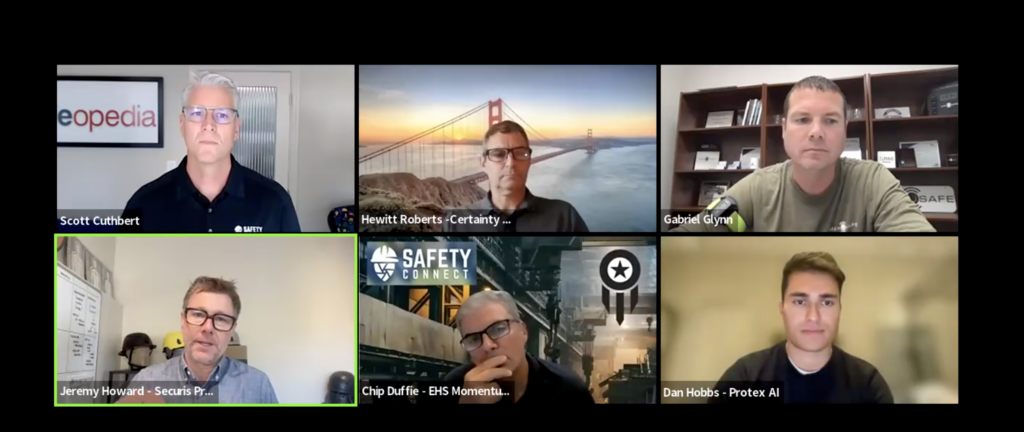
Pictured above is Certainty’s own Hewitt Roberts participating in the panel discussion “How to Leverage Technology to Super Charge Our Safety Initiatives.” The discussion helped attendees understand how digital inspection platforms, real-time data dashboards, and AI-assisted safety tools are transforming the way organizations manage workplace hazards, inspection completion rates, and corrective action workflows.
Our 4 Takeaways
It is hard to fully summarize the value of an event this rich in content and community. Here are the four most impactful takeaways from our time at the 2023 Safety Connect Virtual Conference:
1. The Safety Community is a fantastic group to be a part of
The sense of community among safety professionals was one of the conference’s most striking highlights. Across 29 sessions we attended and participated in, there was consistent energy and engagement — from thought-provoking Q&A sessions to active chat feeds filled with positivity, practical advice, and genuine curiosity. EHS managers, safety directors, site safety managers, and compliance officers from vastly different industries, company sizes, and experience levels all gathered around one shared priority: making workplaces safer.
What struck us most was how freely attendees shared personal experiences, hard-won best practices, and candid challenges. The conference reinforced that safety is not simply a regulatory obligation — it is a shared mission that draws people together to build safer, more secure work environments. Whether the challenge was reducing TRIR, improving inspection completion rates, or accelerating corrective action closure, the spirit of collaboration was unmistakable.
The Safety Connect Virtual Conference was not just a professional development event — it was a reaffirmation of the purpose that unites safety practitioners. It was a reminder that the challenges and triumphs of building safer workplaces are shared broadly across industries, and that no organization has to navigate them alone.
2. Safety improvement never stops
One of the most consistent themes across the conference was that safety improvement is not a destination — it is an ongoing commitment. The attendee mix was remarkably diverse: multinational corporations, regional manufacturers, small family-owned businesses, and public sector organizations all showed up with the same mindset. Everyone was there to learn, exchange ideas, and find new ways to improve safety performance in their specific context.
This continuous improvement ethos mirrors the requirements of ISO 45001 Clause 10.3, which mandates that organizations continually improve their occupational health and safety management systems. The conference underscored that organizations serious about safety do not treat compliance as a finish line — they treat it as a floor. The leaders we spoke with recognized that a safer workplace not only protects workers but directly contributes to reduced incident costs, lower workers’ compensation premiums, improved productivity, and stronger organizational resilience.
3. Costs are still a major challenge in improving workplace safety
A recurring tension throughout the conference was the financial reality of safety investment. While attendees universally agreed on the importance of workplace safety, many organizations face genuine budget constraints that complicate implementation. Funding comprehensive safety programs, upgrading inspection tools, providing ongoing training, and maintaining compliance with evolving OSHA standards all require financial resources that are not always readily available — particularly for mid-market and smaller organizations.

Conference discussions highlighted strategies safety leaders are using to optimize their investments — including deploying technology platforms that consolidate inspection management, corrective action tracking, and compliance reporting into a single system to reduce per-incident cost and administrative overhead. The consensus was that cloud-based safety management solutions with strong ROI profiles are increasingly accessible to organizations of all sizes, making the cost-versus-risk calculation more favorable than ever.
The underlying message was clear: organizations that invest in safety proactively avoid the far greater costs of incidents — OSHA citations, workers’ compensation claims, litigation, productivity losses, and reputational damage. Safety investment is not a cost center — it is a strategic risk management imperative that pays measurable dividends over time.
4. AI is here and the safety community is ready
Perhaps the most forward-looking theme at this year’s conference was the emergence of artificial intelligence as an active force in workplace safety management. From panel discussions to Q&A sessions, AI surfaced as an undercurrent across nearly every major topic. Predictive analytics, automated incident reporting, computer vision for hazard detection, and AI-assisted audit analysis were all discussed as near-term realities rather than distant possibilities.
The adoption of AI is already transforming how safety teams approach risk management, inspection scheduling, leading indicator analysis, and corrective action prioritization. Safety professionals are increasingly turning to AI-powered solutions to strengthen their safety programs — improving the speed and accuracy of hazard identification and enabling data-driven decisions that were not previously possible with manual processes.
Overall, the 2023 Safety Connect Conference was a vivid demonstration of where workplace safety is heading: toward more connected communities, continuous improvement mindsets, smarter technology adoption, and a clearer-eyed understanding of safety as a strategic business investment. We left with renewed commitment to serving the safety community and greater clarity on the challenges EHS professionals face every day.
See you at the next Conference,
The Certainty Team.
Frequently Asked Questions (FAQs)
What is the Safeopedia Safety Connect Virtual Conference?
The Safeopedia Safety Connect Virtual Conference and Expo is an annual online event for workplace safety professionals including EHS managers, safety directors, compliance officers, and operations leaders. It features expert panel discussions, product demonstrations, and networking sessions focused on the latest tools, strategies, and regulatory developments in occupational health and safety management.
How is AI being used in workplace safety management?
AI applications in workplace safety include predictive analytics that identify high-risk conditions before incidents occur, computer vision systems that detect unsafe behaviors or conditions in real time, natural language processing tools that analyze incident reports for root cause patterns, and AI-assisted audit scheduling that prioritizes inspections based on risk scoring. Safety management platforms like Certainty are incorporating AI capabilities to help EHS teams make faster, more informed decisions and reduce Total Recordable Incident Rates.