Summary: A SMETA audit is a practical way to evaluate supplier labor practices, health and safety, environmental controls, and business ethics within one widely accepted framework. For supply chain and procurement teams, SMETA audits create documented due diligence, improve supplier transparency, and support compliance with growing ESG and global supply chain regulations such as CSDDD, CSRD, and Germany's LkSG.
A SMETA audit (Sedex Members Ethical Trade Audit) is a globally recognised social auditing standard that enables businesses to assess supplier working conditions across labour, health and safety, environment, and business ethics — all within a single, shareable framework. In 2025–2026, SMETA audits have become an essential compliance tool for companies navigating the EU Corporate Sustainability Due Diligence Directive (CSDDD), the German Supply Chain Act (LkSG), and the Corporate Sustainability Reporting Directive (CSRD), which collectively require documented supplier due diligence across entire value chains.
A SMETA audit can help your organisation meet these obligations — here’s everything you need to know.
What is a SMETA Audit?
SMETA stands for the Sedex Members Ethical Trade Audit. According to Sedex (Supplier ethical data exchange), SMETA is a “social auditing standard that businesses can use to assess a supplier’s working conditions across the areas of labor, health and safety, environment and business ethics.” As of 2025, SMETA is one of the most widely used ethical audit methodologies globally, with hundreds of thousands of audit reports shared through the Sedex platform each year.
These ethical audits leverage an authorised, third-party provider to carry out inspections of a company’s site, current processes, documentation procedures, and technical systems. The findings are then compared to the Ethical Trading Initiative (ETI) Base Code along with any applicable local laws — including those mandated under the LkSG (Lieferkettensorgfaltspflichtengesetz) and the EU CSDDD, which require companies to identify and address human rights and environmental risks across their supply chains.
Understanding the 2-Pillar and 4-Pillar SMETA Audit
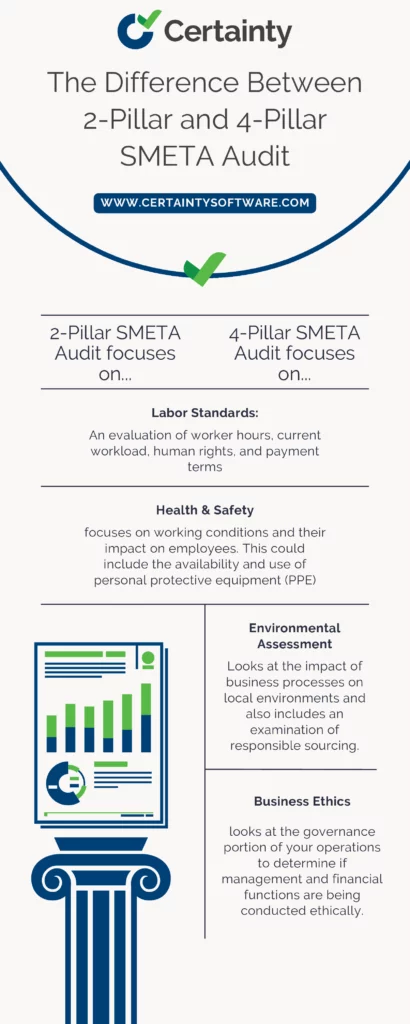
SMETA audits are divided into two broad categories: 2-pillar and 4-pillar. Choosing the right format depends on your regulatory obligations — companies subject to CSDDD or CSRD environmental disclosure requirements will typically need the more comprehensive 4-pillar assessment. Here’s a look at each.
SMETA 2-Pillar Audit
The SMETA 2-pillar audit focuses on two key areas: Labour standards and health and safety.
Labour standards include an evaluation of worker hours, current workload, human rights, and payment terms. Health and safety, meanwhile, focuses on working conditions and their impact on employees. This could include the availability and use of personal protective equipment (PPE), the presence of hazardous working environments, and any problems identified but not resolved. These areas align directly with the human rights due diligence requirements of the LkSG and CSDDD.
The 2-pillar audit methodology also includes evaluating management systems, entitlement to work, subcontracting, and a shortened environmental assessment.
SMETA 4-Pillar Audit
The SMETA 4-pillar audit adds two additional elements: A comprehensive environmental assessment and business ethics.
The extended environmental assessment evaluates the impact of business processes on local environments and includes an examination of responsible sourcing — key criteria under the CSRD’s environmental disclosure requirements and Scope 3 emissions reporting obligations. Business ethics, meanwhile, evaluates the governance portion of your operations to determine whether management and financial functions are being conducted ethically, addressing anti-bribery, anti-corruption, and transparent business conduct standards that regulators increasingly require.

30+ Audit and inspection checklists free for download.
What are the Benefits of a SMETA Audit?
Some of the top benefits of a SMETA audit include:
- Delivers a better understanding of current working conditions
A SMETA audit helps you better understand current working conditions in your business and overall supply chain and how they impact ESG at scale. For example, if the audit reveals a consistent pattern of employee overwork and underpaying, companies can take targeted corrective action. This documented understanding is essential for CSRD sustainability reporting and satisfying the risk-assessment requirements of LkSG and CSDDD.
- Provides a framework for corrective action plans
SMETA audits help you pinpoint areas that need improvement and create corrective action plans that address root causes rather than symptoms. Under the LkSG and CSDDD, companies must not only identify risks but demonstrate active remediation — a documented corrective action plan from a SMETA audit provides precisely this evidence for regulators and auditors. Consider a piece of machinery on production lines that is constantly being repaired and has caused several injuries. While replacing it may come with a large up-front cost, companies can save money over time as fewer incidents occur.
- Allows companies to assess supplier performance
Suppliers are a critical piece of ESG initiatives. In 2025, regulators under the CSDDD and LkSG hold companies accountable not just for their own operations, but for the social and environmental performance of their entire supply chain. SMETA compliance audits provide insight into supplier operations and let businesses make data-driven decisions about whether to renew current contracts, escalate corrective actions, or seek alternative partners.
- Improves overall industry reputation and regulatory standing
Regular SMETA audits provide documented proof of current conditions and any actions taken to improve worker health, reduce environmental impact, improve sustainable sourcing, and ensure social compliance practices are followed. This documented track record is increasingly requested by institutional investors conducting ESG due diligence, procurement teams enforcing supplier codes of conduct, and regulators assessing CSRD and CSDDD compliance — boosting the company’s reputation among prospective customers and B2B partners.
Best Practices for SMETA Audits
If you are planning to undergo a SMETA audit, here are some tips to help you prepare and ensure a smooth and successful process:
- Review the SMETA audit requirements and the ETI Base Code before the audit and make sure you comply with them. You can find them on the Sedex website or download them here. Also review which regulatory frameworks — CSDDD, LkSG, or CSRD — apply to your company or your customers, as these may extend the scope of what must be assessed.
- Gather all the relevant documents and records that the auditor will need to verify your compliance, such as contracts, policies, procedures, payroll, attendance, training, risk assessments, and supplier due diligence documentation. Make sure they are accurate, complete, and up-to-date. Under LkSG and CSDDD, written risk assessments and remediation records carry particular weight.
- Communicate with your employees and stakeholders about the purpose and scope of the audit and encourage their participation and cooperation. Inform them of their rights and responsibilities during the audit and assure them of confidentiality and non-retaliation.
- Assign a responsible person or team to coordinate with the auditor and provide them with access to the site, documents, and workers. Be responsive and cooperative with the auditor’s requests and questions and provide honest and accurate information.
- Follow up with the auditor after the audit and review the audit report and findings. If there are any non-conformities or corrective actions required, develop an action plan to address them within the agreed timeframe. Provide evidence of your progress and completion to the auditor. Maintaining this documented evidence trail is a core requirement under both LkSG and CSDDD due diligence obligations.
How to Conduct SMETA Audits
As noted above, SMETA audits require the use of a certified third party to carry out inspections and report their findings.
Before scheduling an audit, however, it’s worth taking the time to internally assess current processes and pinpoint any obvious areas of concern that could be remediated before audits take place. Here, it’s worth starting with a self-assessment using the SMETA checklist that covers key audit components relating to responsible business practices. This self-assessment approach is also recommended as a first step in building the formal risk management processes required under the LkSG and CSDDD.
Once the checklists have been completed and evaluated, companies can make any necessary changes and then reach out to an affiliate audit company (aac) to schedule an assessment.
Frequently Asked Questions (FAQs)
Here are some frequently asked questions about SMETA audits and their answers:
Q: What is the difference between a 2-pillar and a 4-pillar SMETA audit?
A: A 2-pillar SMETA audit covers labour standards and health and safety, while a 4-pillar SMETA audit also covers environmental management and business ethics. Companies with CSRD or CSDDD obligations typically require the 4-pillar format to satisfy environmental due diligence and governance disclosure requirements.
Q: How long does a SMETA audit take?
A: The duration of a SMETA audit depends on various factors, such as the size and complexity of the site, the number of workers, the scope of the audit, and whether a 2-pillar or 4-pillar format is used. Typically, a SMETA audit takes from one to three days.
Q: How much does a SMETA audit cost?
A: The cost of a SMETA audit varies depending on the type of audit (2-pillar or 4-pillar), the location of the site, the number of auditors required, and any additional regulatory scope required under LkSG or CSDDD. You can contact an authorised audit company (aac) to get a quote for your specific case.
Q: How often do I need to do a SMETA audit?
A: The frequency of SMETA audits depends on your customers’ or buyers’ requirements, your own ESG goals, and any applicable regulatory mandates. Generally, SMETA audits are valid for one year, but some customers or buyers may require more frequent audits. Under the LkSG, companies must conduct risk assessments at least annually, and under CSDDD, ongoing monitoring of supplier performance is required.
Q: How can I share my SMETA audit report with my customers or buyers?
A: You can share your SMETA audit report with your customers or buyers through Sedex Advance, an online platform that allows you to store and share your ethical data. You can also download your report in PDF format and send it via email or other channels. Centralising audit data in a dedicated compliance platform like Certainty Software enables you to track corrective action status, generate reporting dashboards, and demonstrate continuous improvement to auditors and regulators alike.
Q: Is SMETA sufficient for CSDDD and LkSG compliance?
A: SMETA audits address many of the human rights and environmental risk areas required by both the EU CSDDD and Germany’s LkSG. However, these regulations also require formal risk management systems, documented grievance mechanisms, and published annual due diligence reports. SMETA audit results are a strong evidential input into these broader compliance frameworks, but should be combined with a systematic supplier management and reporting platform to fully satisfy regulatory requirements.
You may also be interested in:
The Supplier Compliance Audit: What it is (and Why You Need One)