Summary: Bowtie analysis strengthens risk identification by mapping the causes of a hazard, the potential consequences, and the preventive and recovery controls that sit between them. For safety leaders, it makes workplace safety risk easier to visualize, communicate, and manage before incidents occur. Used well, bowtie analysis supports stronger compliance planning, better control validation, and more proactive incident prevention.
Table of contents

Risk management is the structured process of identifying, assessing, and mitigating the uncertainties that can affect an organization’s ability to protect its people, meet its compliance obligations, and achieve its strategic objectives. In 2025, the complexity and velocity of organizational risk have reached unprecedented levels. EHS managers, safety directors, and compliance leaders contend daily with threats ranging from workplace safety incidents and OSHA citations to cyberattacks, supply chain failures, regulatory changes, and reputational crises. According to the Bureau of Labor Statistics, US private industry employers reported approximately 2.6 million non-fatal workplace injuries and illnesses in 2023 — a figure that underscores the persistent scale of occupational risk that safety professionals must address. Organizations that adopt a proactive, systematic approach to the full risk lifecycle — from identification through monitoring — consistently outperform reactive counterparts on Total Recordable Incident Rate (TRIR), regulatory audit outcomes, and operational resilience.
This article examines eight of the most effective risk management techniques in use by leading organizations today, with particular attention to their application in workplace safety and compliance contexts.
1. Risk Identification: Bowtie Analysis
Risk identification is the foundational step of any risk management program. It involves systematically uncovering the sources of potential harm — known as hazards — that could affect workers, operations, the environment, or regulatory standing. Common workplace hazards include chemical exposures, struck-by and caught-in/between equipment incidents, electrical hazards, slip-trip-fall conditions, ergonomic risks, and fire and explosion risks. Effective hazard identification is a core requirement of OSHA’s General Duty Clause (Section 5(a)(1)) and a mandatory element of ISO 45001:2018 Clause 6.1 (Actions to address risks and opportunities).
Bowtie Analysis is a powerful visual risk identification technique that maps the causal chain between a hazard and its potential consequences, while explicitly identifying the preventive and mitigating controls in place at each point. A bowtie diagram consists of four elements: a hazard (the source of potential harm), a top event (the moment of loss of control over the hazard), threat scenarios (the causes that could produce the top event), and consequence scenarios (the outcomes if the top event occurs). Preventive barriers on the left side of the diagram reduce the likelihood of the top event occurring; recovery barriers on the right reduce the severity of consequences if it does occur.
The bowtie structure directly mirrors the layered control philosophy embedded in ISO 45001 and the hierarchy of controls — making it particularly well suited to workplace safety risk assessments, process safety management (PSM) programs, and major hazard facility risk registers.
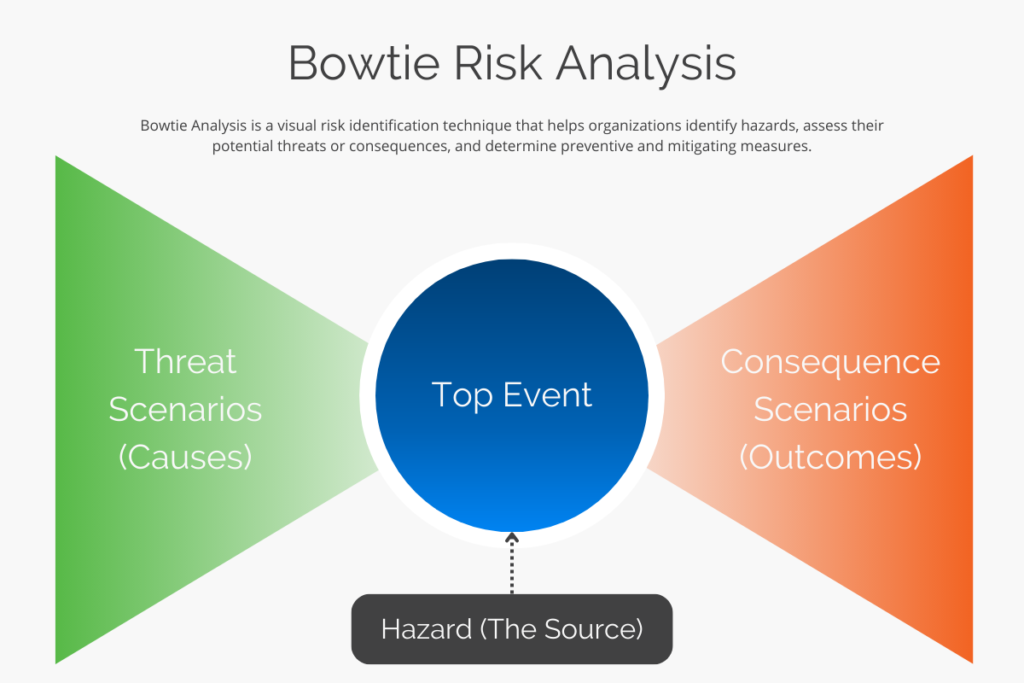
Bowtie Analysis helps EHS teams visualize complex causal relationships between hazards, control failures, and outcomes in an accessible format that can be shared with frontline workers, safety committees, and senior leadership. It also identifies gaps in existing controls — revealing where additional prevention or recovery measures are needed to reduce residual risk to acceptable levels. For organizations implementing behavior-based safety (BBS) programs or conducting Job Hazard Analyses (JHAs), the bowtie framework provides a complementary structure for organizing and communicating hazard control logic.
2. Risk Assessment and Prioritization: Risk Heat Maps
Risk assessment involves analyzing and evaluating identified risks based on two primary dimensions: the severity of potential harm (impact) and the probability of occurrence (likelihood). For workplace safety risks, impact severity is typically classified using OSHA injury and illness severity categories — from minor first-aid cases through serious injuries, permanent disability, and fatalities. Likelihood is assessed based on exposure frequency, existing control effectiveness, and historical incident data.
Risk Heat Maps are graphical prioritization tools that plot risks on a two-dimensional matrix — with severity on one axis and likelihood on the other — producing a visual risk profile that enables rapid identification of critical priorities. Each risk is color-coded by zone: low (green), medium (yellow), high (orange), or extreme (red). Heat maps translate complex risk assessment data into a format that is immediately understandable to operational managers, safety committees, and executive leadership — bridging the gap between technical risk analysis and strategic decision-making.
For EHS managers overseeing multiple sites or facilities, risk heat maps are particularly valuable for cross-site risk benchmarking — identifying which locations carry the highest aggregate risk exposure and directing inspection resources, corrective action investments, and safety training accordingly. Organizations managing ISO 45001 compliance programs use risk heat maps to document hazard risk ratings and demonstrate systematic risk prioritization in management reviews and third-party audits.
3. Risk Mitigation Strategies: Hierarchy of Controls
Risk mitigation — selecting and implementing controls to reduce or eliminate the likelihood or impact of identified risks — is where risk management translates into tangible protection for workers and assets. The quality and effectiveness of the controls selected determines whether risk assessments produce real safety improvements or remain theoretical exercises.
Developed by The National Institute for Occupational Safety and Health (NIOSH) and codified in OSHA standards including 29 CFR 1910.132 and referenced throughout ISO 45001:2018, the Hierarchy of Controls is the definitive framework for selecting and ranking workplace safety controls by effectiveness. The framework consists of five levels:
- Elimination: The most effective control — removing the hazard or source of risk entirely from the workplace. Examples include discontinuing a hazardous process, removing a dangerous chemical from operations, or automating a task previously performed by workers in proximity to moving machinery.
- Substitution: Replacing the hazardous element with a less hazardous alternative. Examples include replacing a carcinogenic solvent with a less toxic equivalent, or substituting heavy manual lifting tasks with mechanical assists.
- Engineering Controls: Physical modifications to the work environment or equipment that isolate workers from the hazard. Examples include machine guarding, ventilation systems, noise enclosures, interlocked safety devices, and fall protection systems (guardrails, safety nets). Engineering controls are preferred over administrative controls because they do not rely on consistent worker behavior to be effective.
- Administrative Controls: Changes to work practices, procedures, and policies that reduce worker exposure to hazards. Examples include job rotation to limit cumulative exposure, Lockout/Tagout (LOTO) procedures (29 CFR 1910.147), permit-to-work systems, safety observation programs, and toolbox talk schedules. Administrative controls depend on reliable human behavior and therefore require strong safety culture, supervisory oversight, and training to maintain effectiveness.
- Personal Protective Equipment (PPE): The last line of defense — protective clothing and equipment worn by workers to minimize exposure to residual hazards. While PPE is a required component of many OSHA standards (29 CFR 1910.132–138), it is considered the least effective control because it does not eliminate the hazard and its effectiveness depends entirely on correct selection, fit, and consistent use. PPE programs require documented hazard assessments, trained users, and regular inspection protocols.
The Hierarchy of Controls is one of the most widely applied risk management techniques in workplace safety because it provides a clear, evidence-based rationale for control selection that aligns with regulatory expectations. OSHA compliance officers and ISO 45001 auditors specifically assess whether organizations apply the hierarchy systematically — organizations that default to PPE without exploring higher-order controls face increased citation risk and slower safety performance improvement.
4. Risk Transfer and Insurance: Contractual Risk Allocation
Not all risks can be eliminated or fully mitigated through operational controls. Risk transfer — shifting some or all financial responsibility for a risk to another party — is a legitimate and widely used risk management strategy that complements operational risk controls. In construction, manufacturing, oil and gas, and other high-hazard industries, contractual risk allocation and insurance programs are essential components of a comprehensive risk management framework.
Contractual Risk Allocation is a legal risk management technique that assigns responsibility for specific risks and liabilities between contracting parties through formally negotiated contract clauses. In construction and subcontracting contexts — where multiple employers share a worksite and OSHA’s multi-employer citation policy applies — contractual risk allocation is particularly critical for defining safety responsibility boundaries. Commonly used contractual risk allocation mechanisms include:
- Indemnification Clauses: Require one party (typically the subcontractor or lower-tier contractor) to compensate the other for losses, damages, or claims arising from the indemnifying party’s negligence or breach of contract — including workers’ compensation claims, third-party injury claims, and property damage.
- Hold-Harmless Agreements: Require one party to waive legal claims against the other for specified losses or damages arising from the contractual relationship — commonly used in equipment lease agreements, vendor contracts, and facility access agreements.
- Limitation of Liability Provisions: Cap the financial exposure of one party for specified categories of loss — protecting against disproportionate liability in contracts involving significant asset values or operational risk.
Contractual risk allocation is most effective when supported by consistent safety performance monitoring, documented contractor prequalification programs, and insurance verification processes. Organizations managing contractor safety programs should integrate contractual risk allocation documentation with their overall safety inspection and compliance management systems.
Insurance is a complementary risk transfer mechanism that provides financial protection against losses that cannot be fully prevented or contracted away. General liability, workers’ compensation, professional liability, environmental liability, cyber liability, and business interruption insurance are among the most critical coverage types for organizations with significant risk exposure. Insurance underwriters increasingly assess an organization’s risk management maturity — including safety program quality, inspection frequencies, and incident rates — when setting premiums and coverage terms, creating direct financial incentives for strong safety performance.
5. Crisis Management and Response Planning: Business Impact Analysis (BIA)
Despite robust prevention programs, some risks will materialize into incidents or crises. Crisis management and response planning — preparing in advance for disruptive events that threaten operations, people, assets, or reputation — is an essential component of a comprehensive risk management framework. The COVID-19 pandemic, climate-related extreme weather events, and high-profile industrial disasters have reinforced the critical importance of tested, documented crisis response capabilities across all industries.
Business Impact Analysis (BIA) is the structured technique for building crisis preparedness by identifying which business functions and processes are most critical to the organization’s survival and determining the consequences of their unavailability across different time horizons. A BIA process involves three core activities: identifying critical business functions and the resources required to perform them; estimating the financial, operational, safety, and regulatory impacts of each function being unavailable for defined recovery time windows; and determining Recovery Time Objectives (RTOs) and Recovery Point Objectives (RPOs) that define acceptable limits for operational disruption.
For safety-critical operations — oil and gas facilities, chemical plants, construction sites, healthcare providers — BIA must specifically address scenarios involving loss of safety-critical systems, emergency response capability degradation, and regulatory notification obligations triggered by specific incident types. OSHA’s Emergency Action Plan standard (29 CFR 1910.38) and Process Safety Management standard (29 CFR 1910.119) set mandatory requirements for crisis preparedness that BIA processes should directly support.
6. Risk Monitoring and Early Warning Systems: Key Risk Indicators (KRIs)
Risk monitoring is the ongoing process of tracking and measuring the performance and effectiveness of risk management controls, detecting changes in risk conditions, and maintaining situational awareness across the enterprise risk profile. Without systematic risk monitoring, organizations are perpetually reactive — discovering risk failures only after they have produced incidents, regulatory violations, or operational disruptions.
Key Risk Indicators (KRIs) are quantitative metrics that function as early-warning signals for emerging or escalating risks. Derived from operational data sources — inspection completion rates, near-miss report frequencies, corrective action closure times, permit violation trends, equipment failure rates — KRIs are linked to predefined threshold levels that trigger escalation alerts and management actions when breached. Unlike lagging indicators (such as TRIR) that reflect past incidents, KRIs are predictive: they signal deteriorating risk conditions before incidents occur, enabling proactive intervention.
For EHS managers, the most operationally valuable safety KRIs include: inspection completion rate against schedule (a leading indicator of safety program execution quality), near-miss reporting rate (a proxy for safety culture strength), corrective action closure rate and average age of open actions (indicators of organizational responsiveness to identified hazards), PPE compliance observation rates, and toolbox talk completion rates. Organizations certified to ISO 45001:2018 are required to monitor, measure, and analyze occupational health and safety performance using defined indicators — KRI frameworks directly fulfill this requirement.

30+ Audit and inspection checklists free for download.
7. Risk Communication and Stakeholder Engagement: Risk Workshops
Risk communication and stakeholder engagement transform risk management from a technical exercise conducted by specialists into an organization-wide capability embedded in daily operations. Effective risk communication ensures that the right information about identified risks, control status, and performance trends reaches the right people — from frontline workers who need to understand hazard controls, to senior leadership who need to make informed strategic decisions, to regulators who need to verify compliance.
Risk Workshops are structured, facilitated sessions that bring together diverse stakeholders — operations managers, safety representatives, frontline workers, subject matter experts, and sometimes customers or regulators — to collaboratively identify, assess, and prioritize risks within a defined scope. Unlike formal audit processes, risk workshops create a psychologically safe environment for open dialogue about what is working, what is not, and what risks may be going unaddressed. They generate richer risk identification outputs than desk-based assessments alone — particularly for identifying systemic or cultural risks that are invisible in formal data.
Risk workshops are especially valuable when launching new operations or entering new facilities, following significant incidents or near misses, conducting periodic ISO 45001 management reviews, updating site-specific risk registers, or developing safety improvement action plans. Structured pre-work (distributing existing risk data, KRI trends, and recent inspection findings before the workshop) significantly increases the quality and efficiency of workshop outputs.
8. Risk Culture and Awareness: Training and Education Programs
The effectiveness of every other risk management technique on this list depends ultimately on the knowledge, skills, and behaviors of the people implementing them. A technically sophisticated risk assessment framework will fail if frontline workers do not understand or believe in it. A rigorous inspection program will degrade if supervisors do not actively support near-miss reporting. Risk culture — the collective attitudes, beliefs, and behaviors that shape how an organization identifies and responds to risk — is the foundational substrate on which all other risk management practices depend.
Training and Education Programs are the primary mechanism for building and sustaining a strong risk culture. Effective safety training programs include: OSHA-mandated training requirements (Hazard Communication 29 CFR 1910.1200, LOTO 29 CFR 1910.147, Emergency Action Plans 29 CFR 1910.38, and others applicable to the industry); ISO 45001-aligned competency development for personnel with EHS responsibilities; hazard-specific technical training for workers exposed to particular risks; incident investigation training for supervisors and safety representatives; and leadership development programs that equip managers to model risk-aware behaviors and support near-miss reporting cultures.
Training formats should be selected based on learning objectives, audience characteristics, and operational constraints — combining in-person instruction, digital e-learning modules, toolbox talks, simulation exercises, and scenario-based case studies to achieve and verify competency. Training completion rates, knowledge assessment scores, and observed behavior changes following training are all important leading indicators of safety culture strength. Documentation of training — including participant records, competency assessments, and trainer qualifications — is a mandatory OSHA and ISO 45001 recordkeeping requirement.
You might also be interested in:
Frequently Asked Questions (FAQs)
What are the most important risk management techniques for EHS professionals?
For EHS professionals, the most critical risk management techniques are hazard identification methods (including Job Hazard Analysis and Bowtie Analysis), the NIOSH Hierarchy of Controls for mitigation selection, Key Risk Indicators for leading indicator monitoring, and structured inspection and auditing programs. ISO 45001:2018 provides a comprehensive framework that integrates all of these techniques into a cohesive occupational health and safety management system.
How does the Hierarchy of Controls relate to OSHA compliance?
The Hierarchy of Controls is explicitly referenced across multiple OSHA standards and is a recognized framework for demonstrating feasible control implementation under OSHA’s General Duty Clause. OSHA compliance officers assess whether organizations have applied the hierarchy systematically — documenting why lower-order controls (such as PPE) were selected when higher-order options were available. Organizations that apply the hierarchy rigorously and document their control selection rationale are better positioned in enforcement actions and inspections.
What is the difference between leading and lagging risk indicators?
Lagging indicators (such as TRIR, Lost Time Injury Rate, and DART rate) measure outcomes of past safety performance — incidents and injuries that have already occurred. Leading indicators (such as inspection completion rate, near-miss report frequency, and corrective action closure rate) measure the quality and execution of safety program activities before incidents occur. Effective safety performance management uses both types: lagging indicators to benchmark outcomes and leading indicators to identify and address deteriorating conditions before they result in injuries.