Summary: DMAIC (Define, Measure, Analyze, Improve, Control) is a data-driven process improvement methodology rooted in Six Sigma that helps organizations systematically reduce defects, variability, and waste. Each phase builds on the previous one, using statistical tools and quality metrics like first pass yield and cost of poor quality to guide decision-making. Implementing DMAIC within your quality management system creates a repeatable framework for solving complex process problems and sustaining improvements over time.
Table of contents

In today’s competitive and dynamic business environment, Quality Managers, Process Improvement Leads, and Plant Managers need to constantly improve their processes and performance to stay ahead of the curve. Therefore, process improvement methodologies are essential frameworks that help organizations identify and eliminate inefficiencies, defects, and waste in their operations. Notably, one of the most widely used and effective methodologies is the DMAIC process.
The DMAIC process is a structured and data-driven approach for achieving continuous improvement and operational excellence. Specifically, it stands for Define, Measure, Analyze, Improve, and Control. These are the five phases that guide the problem-solving and improvement efforts of quality-driven organizations. By following the DMAIC process, Quality Engineers and QA Directors can align their company’s processes with organizational goals. Additionally, they can reduce non-conformance rates and drive efficiency across all functions.
In this comprehensive guide, we will explore the DMAIC process in detail. Furthermore, we will show you how to implement it in your organization. We will also compare it with another popular methodology, DMADV, and discuss the key differences between them. Finally, we will highlight the benefits of implementing DMAIC and share some tips and best practices for overcoming implementation challenges.
What is the DMAIC Process and Its Importance?
The DMAIC process is a systematic and data-driven methodology for improving existing processes and solving complex problems. Specifically, it is derived from the Six Sigma philosophy, which aims to reduce variation and defects in processes and achieve near-perfection.
For QA Managers and VP Quality Assurance professionals responsible for maintaining compliance with frameworks such as ISO 9001, IATF 16949, VDA 6.3, and FDA cGMP, DMAIC provides a proven structure. As a result, they can systematically improve quality outcomes. The acronym DMAIC stands for:
- Define
- Measure
- Analyze
- Improve
- Control
Understanding the DMAIC Phases
The DMAIC process consists of five phases that guide the improvement efforts of enterprise-level businesses. Each phase has its own objectives, activities, and deliverables that ensure a structured and rigorous approach. For Quality Supervisors and Lead Auditors managing cross-functional teams, understanding each phase is essential. Specifically, it drives measurable improvements in key quality KPIs such as first pass yield (FPY), cost of poor quality (COPQ), and time to resolution. Let’s take a closer look at each phase.
Define Phase
The first phase of the DMAIC process is to define the problem or opportunity that needs to be addressed. Specifically, this involves clarifying the customer requirements, the business process boundaries, and the project scope and goals.
For Quality Engineers and Process Improvement Leads, the Define phase is where audit findings, non-conformance trends, and compliance gaps from standards like ISO 9001 or IATF 16949 are translated into actionable project charters. Layered process audits are a particularly rich source of these findings on the shop floor — see how LPA findings feed continuous improvement projects for the program-design steps. In particular, the main activities in this phase include:
- Developing a problem statement that describes the gap between the current and desired state of the process
- Creating a project charter that outlines the project objectives, scope, timeline, budget, team roles and responsibilities, and expected benefits
- Mapping the high-level process flow and identifying the key inputs and outputs
- Conducting a stakeholder analysis and engaging relevant stakeholders throughout the project
Measure Phase
The second phase of DMAIC is to measure the current state of the process and establish baseline metrics. Specifically, this involves collecting relevant data on the process performance, quality, and variability.
For QA Managers and Quality Directors still relying on paper-based audits or disconnected spreadsheets, this phase often reveals the limitations of manual data collection. Additionally, it highlights the lack of cross-site comparability. Therefore, establishing baselines for quality KPIs like audit completion rates, non-conformance rates, and FPY is critical. The main activities in this phase include:
- Defining the critical-to-quality (CTQ) characteristics that reflect the customer needs and expectations
- Developing an operational definition for each CTQ characteristic that specifies how it will be measured
- Designing a data collection plan that specifies what data will be collected, how, when, where, and by whom
- Validating the measurement system to ensure its accuracy, precision, and reliability
- Collecting and summarizing the data using appropriate tools and techniques

30+ Audit and inspection checklists free for download.
Analyze Phase
The third phase of the DMAIC process is to analyze the data collected in the previous phase and identify the root causes of the problem. In particular, this involves exploring the relationships between the current process inputs and outputs, testing hypotheses, and verifying their impact on the process.
For Lead Auditors and Quality Supervisors, this phase is where patterns in non-conformance data, audit fatigue trends, and recurring corrective action failures become visible. Specifically, the main activities in this phase include:
- Performing a data analysis using appropriate tools and techniques such as histograms, Pareto charts, scatter plots, correlation analysis, regression analysis, etc.
- Identifying potential root causes using tools such as fishbone diagrams, brainstorming sessions, affinity diagrams, etc.
- Prioritizing root causes using tools such as Pareto analysis, failure mode and effects analysis (FMEA), etc.
- Testing root causes using tools such as hypothesis testing, design of experiments (DOE), etc.
- Validating root causes using tools such as cause-and-effect matrix, verification matrix, etc.
Improve Phase
The fourth phase of the DMAIC process is to improve the process by implementing solutions that address the root causes of the problem. Specifically, this involves generating and evaluating potential solutions, selecting the best one, and verifying its effectiveness.
For Plant Managers and Process Improvement Leads, this is where manual corrective action processes are replaced with streamlined, trackable workflows. As a result, this reduces time to resolution and improves COPQ. The main activities in this phase include:
- Generating potential solutions using tools such as brainstorming sessions, benchmarking studies, best practices research, etc.
- Evaluating potential solutions using tools such as solution selection matrix, cost-benefit analysis, risk assessment, etc.
- Selecting the best solution based on criteria such as feasibility, impact, cost, risk, etc.
- Developing an implementation plan that specifies how the solution will be executed, who will be involved, what resources will be needed, what risks will be mitigated, etc.
- Implementing the solution according to the plan and monitoring its progress and performance
- Monitoring the effectiveness of the solution using tools such as before-and-after analysis, statistical process control (SPC), etc.
Control Phase
The fifth and final phase of the DMAIC process is to control the improved process and ensure its sustainability. In particular, this involves monitoring and maintaining the process performance, implementing control mechanisms, and documenting the results and learnings.
For QA Directors and VP Quality Assurance professionals, the Control phase ensures that improvements are sustained across all sites. Furthermore, it ensures these improvements remain in compliance with ISO 9001, IATF 16949, VDA 6.3, or FDA cGMP requirements. Specifically, the main activities in this phase include:
- Developing a control plan that specifies how the process will be monitored, measured, and controlled to prevent deviation or deterioration
- Implementing control mechanisms such as control charts, standard operating procedures (SOPs), checklists, audits, etc.
- Training and educating process owners and operators on the new process and its controls
- Communicating and celebrating the project results and achievements with stakeholders
- Documenting the project learnings and best practices for future reference and replication
DMAIC vs. DMADV: Key Differences
The DMAIC process is not the only methodology that can be used for process improvement and problem-solving. Another popular methodology is the DMADV process, which stands for Define, Measure, Analyze, Design, and Verify. Notably, the DMADV process is similar to the DMAIC process in some aspects. However, it has some key differences that make it more suitable for certain situations and applications.
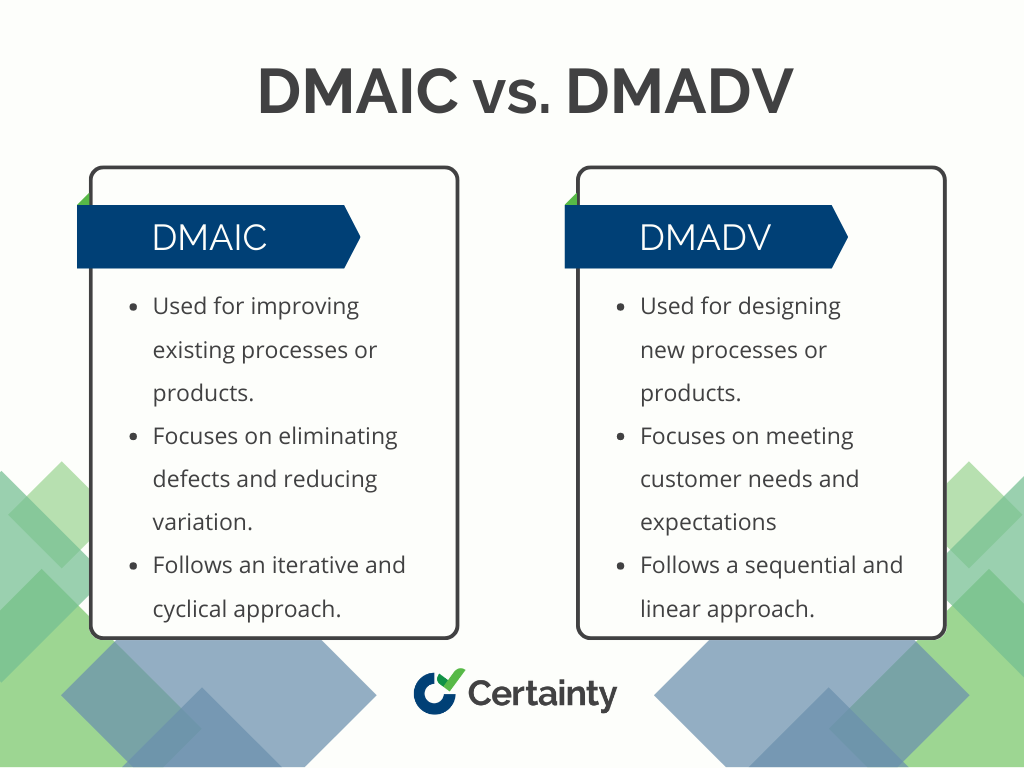
The main difference between DMAIC and DMADV is that DMAIC is used for improving existing processes. In contrast, DMADV is used for designing new processes or products. Specifically, DMAIC assumes that the process or product already exists and needs to be optimized or enhanced. On the other hand, DMADV assumes that the process or product does not exist or needs to be radically redesigned or replaced.
For Quality Engineers working within established quality management systems governed by ISO 9001 or IATF 16949, DMAIC is typically the more applicable approach. This is because the goal is to optimize existing processes rather than design entirely new ones.
Furthermore, DMAIC focuses on eliminating defects and reducing variation in processes or products. In contrast, DMADV focuses on meeting customer needs and expectations in processes or products. Specifically, DMAIC aims to achieve near-perfection in quality and performance by minimizing errors and waste. Meanwhile, DMADV aims to achieve customer satisfaction and loyalty by maximizing value and innovation.
Additionally, DMAIC follows an iterative and cyclical approach. In contrast, DMADV follows a sequential and linear approach. For example, DMAIC allows for repeated measurement cycles, analysis, improvement, and control until the desired results are achieved. However, DMADV follows a one-way flow of design, development, testing, and verification until the final product or process is delivered.
The table below summarizes the key differences between DMAIC and DMADV:
Both DMAIC and DMADV are powerful methodologies that can help businesses achieve their process improvement and problem-solving goals. However, each methodology has its own strengths and limitations. Therefore, it is important to choose the right one based on the situation and application.
Benefits of Implementing DMAIC
Implementing the DMAIC process can bring significant benefits and advantages that boost performance and competitiveness. For QA Managers, Plant Managers, and Quality Engineers, these benefits translate directly into measurable improvements in quality KPIs. Specifically, some of the key benefits of implementing DMAIC are:
Improved operational efficiency
By following the DMAIC process, companies can identify and eliminate the sources of inefficiency, waste, and variation in their processes. As a result, this leads to faster cycle times, higher throughput, lower rework, and better resource utilization. Furthermore, for organizations struggling with manual corrective action processes or paper-based audits, DMAIC provides the structure to digitize and streamline these workflows. Consequently, this directly improves time to resolution and audit completion rates.
Enhanced quality control
Through DMAIC, businesses can ensure that their processes and products meet or exceed customer requirements and expectations. Consequently, this results in lower defects, higher customer satisfaction, lower warranty costs, and higher reputation. Moreover, for organizations operating under ISO 9001, IATF 16949, VDA 6.3, or FDA cGMP, DMAIC helps reduce non-conformance rates and improve first pass yield (FPY). Therefore, it directly supports compliance objectives.
Reduced costs
Using DMAIC can optimize a company’s processes and products to minimize the costs associated with defects, waste, variation, and inefficiency. As a result, this leads to higher profitability, lower operating expenses, and higher return on investment. In particular, quality leaders who track cost of poor quality (COPQ) often find that DMAIC projects deliver measurable reductions in scrap, rework, and warranty claims.
Driven continuous improvement
By following the DMAIC process, businesses can foster a culture of continuous improvement and innovation in their organizations. Consequently, this results in higher adaptability, agility, and resilience to changing customer needs and market conditions. Furthermore, for VP Quality Assurance and QA Directors overseeing multi-site operations, DMAIC enables cross-site comparability and standardized improvement practices. As a result, it combats audit fatigue and ensures consistent quality performance.
Example of DMAIC implementation
To illustrate these benefits, let’s look at an example of a business that has successfully implemented the DMAIC process and achieved measurable results.
Amazon is one of the most successful and innovative online retailers in the world. Notably, it has applied the DMAIC process to improve its customer service and delivery processes. As a result, the company has reported that it reduced its customer contacts per order by 50%. Additionally, it increased its on-time delivery rate by 20% through Six Sigma and DMAIC initiatives since 2013.
Implementation Challenges
Implementing the DMAIC process can be challenging and complex. Specifically, there are many factors and variables that can affect the success and outcome of DMAIC projects. In particular, Quality Supervisors, Lead Auditors, and Process Improvement Leads often encounter the following common challenges during DMAIC implementation:
Project selection
Choosing the right project to apply the DMAIC process is crucial for achieving the desired results and benefits. However, selecting the right project can be difficult and time-consuming. Specifically, it requires a clear understanding of the business objectives, customer needs, process performance, and improvement potential. Consequently, a poorly selected project can result in wasted resources, low impact, and low return on investment.
Team collaboration
Working as a cross-functional team is essential for executing the DMAIC process effectively and efficiently. However, collaborating as a team can be challenging and problematic. For example, it involves dealing with different personalities, perspectives, opinions, and agendas. As a result, a dysfunctional team can lead to conflicts, misunderstandings, delays, and errors.
Data collection and analysis
Collecting and analyzing data is a key component of the DMAIC process. Specifically, it provides the basis for making data-driven decisions and improvements. However, collecting and analyzing data can be challenging and tedious. In particular, it requires a reliable measurement system, a robust data collection plan, and appropriate tools and techniques.
Furthermore, organizations still using paper-based audits or siloed spreadsheets face particular difficulty in this phase. This is because the lack of cross-site comparability and inconsistent data formats undermine the accuracy of analysis. Consequently, poor data quality, insufficient data quantity, or inappropriate data analysis can result in inaccurate or misleading conclusions and recommendations.
Change management
Implementing changes in processes or products is the ultimate goal of the DMAIC process. However, implementing changes can be challenging and risky. Specifically, it involves overcoming resistance, managing expectations, mitigating risks, and ensuring sustainability. Therefore, poor change management can result in failed implementation, low adoption, or backsliding.
How to Overcome the Challenges of Implementation
To ensure successful DMAIC implementation, businesses need to adopt some strategies and recommendations. For QA Managers, Plant Managers, and Quality Engineers, these best practices help translate DMAIC theory into practical, measurable results. Specifically, here are some of the key strategies and recommendations:
Project selection
To select the right project for DMAIC implementation, you will need a systematic and objective approach. Specifically, this approach should consider various criteria such as business impact, customer value, process performance, improvement potential, and resource availability. Furthermore, quality leaders should prioritize projects that target high-impact KPIs like non-conformance rates, COPQ, or audit completion rates.
In particular, assistive tools that can help with project selection include the project prioritization matrix, project screening matrix, and project scoping matrix.
Team collaboration
To collaborate effectively as a team for DMAIC implementation, establish clear roles and responsibilities first. Then, set common goals and expectations. Additionally, communicate openly and frequently. Furthermore, resolve conflicts constructively and leverage each other’s strengths and skills.
Specifically, tools that can help with team collaboration include the team charter, RACI matrix (Responsible-Accountable-Consulted-Informed), communication plan, and team building activities.
Data collection and analysis
To collect and analyze data accurately and efficiently for DMAIC implementation, first define the critical-to-quality characteristics. Then, develop operational definitions and design a data collection plan. Additionally, validate the measurement system and use appropriate tools and techniques. Finally, verify the results.
Moreover, replacing paper-based audits with digital data collection eliminates transcription errors. It also enables real-time cross-site comparability and reduces audit fatigue for field teams. In particular, tools that can help include operational definition worksheets, data collection plan templates, measurement system analysis (MSA), histograms, Pareto charts, scatter plots, correlation analysis, regression analysis, hypothesis testing, and design of experiments (DOE).
Change management
For implementing changes successfully and sustainably during DMAIC implementation, you should first assess the readiness and resistance for change. Then, engage and communicate with stakeholders. Additionally, manage risks and issues proactively. Furthermore, monitor and evaluate the results. Finally, document the learnings and best practices.
Specifically, tactics that can help with change management include readiness assessment surveys, stakeholder analysis, risk assessment matrix, issue log, control chart, statistical process control (SPC), and project documentation reports.
Certainty Software’s Support for DMAIC Implementation
Certainty Software is a leading provider of comprehensive solutions to support DMAIC implementation in enterprise-level businesses. Specifically, Certainty Software offers various tools, features, checklists, and services that can help Quality Managers, Plant Managers, and Process Improvement Leads streamline their audit and inspection processes.
Furthermore, these tools ensure compliance with ISO 9001, IATF 16949, VDA 6.3, FDA cGMP, and other regulatory standards. In particular, some of these offerings include:
- Measure and monitor audit and inspection performance, quality, and compliance with real-time dashboards tracking audit completion rates, non-conformance rates, and FPY
- Analyze and identify the root causes of performance risks with cross-site comparability and centralized data
- Improve and implement solutions that address root causes, replacing manual corrective action processes with automated, trackable workflows
- Control and sustain processes and ensure their alignment with regulations, and business objectives.
Frequently Asked Questions (FAQs)
How does the DMAIC process support ISO 9001 and IATF 16949 compliance?
The DMAIC process aligns directly with the continuous improvement requirements of ISO 9001 (Clause 10.3) and IATF 16949. Specifically, it provides a structured, data-driven framework for identifying non-conformances, analyzing root causes, and implementing verified corrective actions. As a result, DMAIC helps Quality Managers and Lead Auditors demonstrate ongoing compliance during internal and external audits. Furthermore, the Control phase ensures improvements are sustained and documented in accordance with quality management system requirements.
What quality KPIs should we track during a DMAIC project?
During a DMAIC project, QA Directors and Quality Engineers should track KPIs that directly measure process performance and improvement. In particular, key metrics include first pass yield (FPY), cost of poor quality (COPQ), non-conformance rates, audit completion rates, and time to resolution for corrective actions. Most importantly, establishing baselines for these KPIs during the Measure phase and monitoring them through the Control phase ensures that improvements are quantifiable and sustainable.
How can DMAIC help organizations move away from paper-based audits?
The Measure and Analyze phases of DMAIC often reveal that paper-based audits and manual data collection are significant root causes of data quality issues, audit fatigue, and delayed corrective actions. Therefore, by applying DMAIC to the audit process itself, organizations can define the requirements for a digital solution. They can then measure current inefficiencies. As a result, they can implement digital audit tools that enable real-time data capture, cross-site comparability, and automated corrective action workflows.
Can DMAIC be applied in FDA-regulated industries?
Yes. DMAIC is widely used in FDA-regulated industries including pharmaceutical, medical device, and food manufacturing. Notably, the methodology’s emphasis on data-driven decision-making, root cause analysis, and documented controls aligns well with FDA cGMP and VDA 6.3 requirements. Consequently, Quality Supervisors and VP Quality Assurance professionals in regulated environments use DMAIC to reduce non-conformance rates, improve COPQ, and maintain audit readiness while meeting strict regulatory documentation requirements.
How does DMAIC address audit fatigue across multi-site operations?
Audit fatigue is a common challenge for Plant Managers and QA Managers overseeing multiple locations. However, DMAIC addresses this by standardizing audit processes. Specifically, it identifies redundant or low-value inspection activities during the Analyze phase. Then, it implements streamlined, risk-based audit programs in the Improve phase. Furthermore, digital audit platforms used in the Control phase enable cross-site comparability, reduce repetitive manual tasks, and provide centralized dashboards. As a result, quality leaders gain visibility without overburdening frontline teams.
You might also be interested in:

Spend Time On Prevention
Not Paperwork
Watch our overview video to see how your organization can benefit from Certainty.
Watch Video